

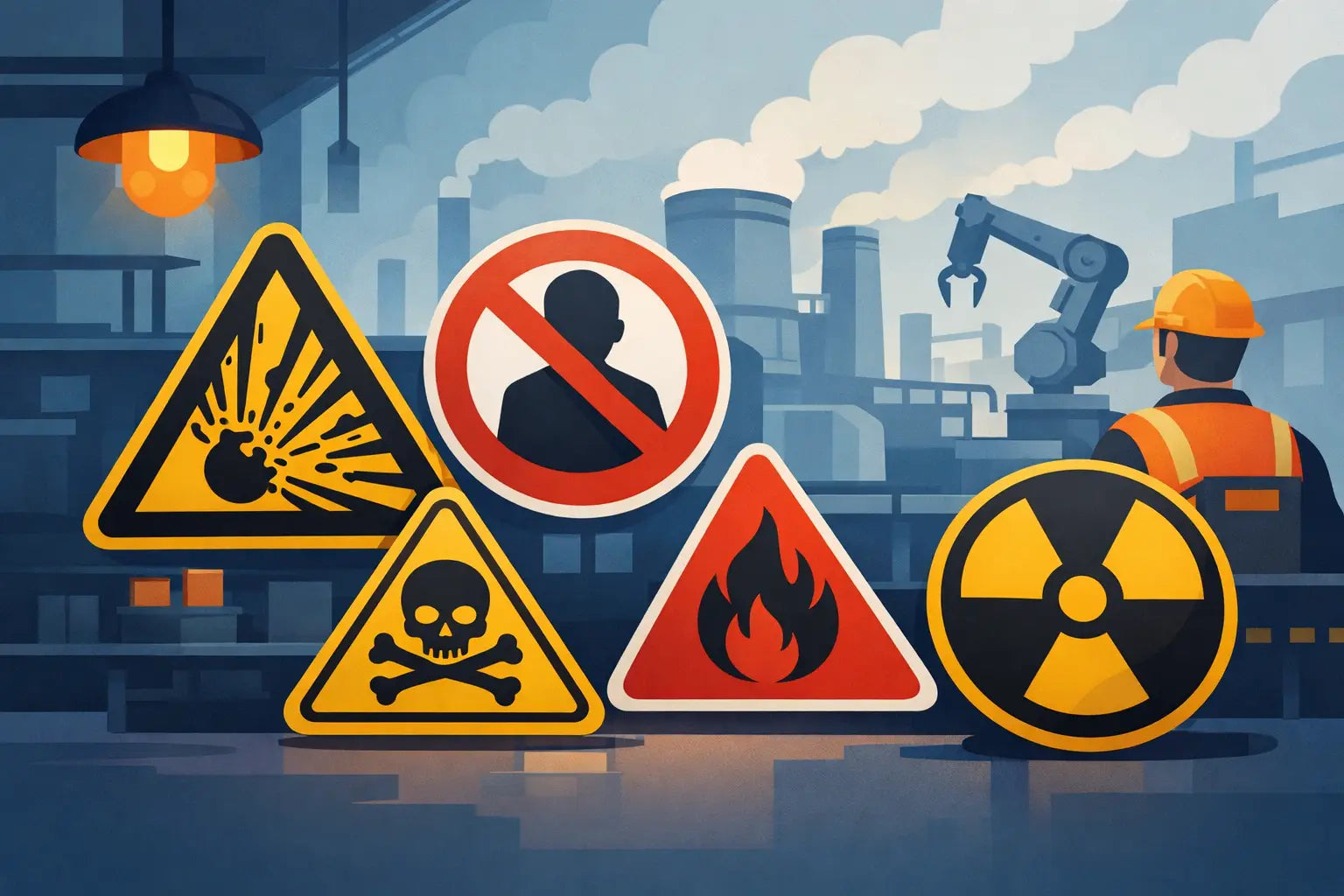
A missing sign beside a forklift route, unguarded machine or chemical store can turn a familiar work area into an avoidable risk. So, which danger signs are used in factories? In UK workplace signage, the signs most people call danger signs are usually warning signs: yellow triangles with a black border and black safety symbol. They alert people to a hazard that may cause injury if they do not take suitable care.
The right sign is not simply the one that looks most serious. It must identify a real risk, be positioned where people can see it before reaching the hazard, and support the controls already in place. Good signage helps staff, contractors and visitors make the right decision quickly. It does not replace guarding, training, safe systems of work or supervision.
Which danger signs are used in factories?
Factory danger signs are commonly selected around machinery, vehicle movements, electrical equipment, hazardous substances, hot processes and areas with restricted access. Under the Health and Safety (Safety Signs and Signals) Regulations 1996, safety signs should be used where a significant risk remains after other appropriate control measures have been considered or introduced.
A warning sign uses a yellow background covering at least half of the sign face, a black triangular border and a black pictogram. The familiar yellow-and-black format is designed to be recognised at a glance, even where workers speak different first languages or a visitor has not seen a site induction pack.
In most factories, the following warning signs are the ones used most often:
- Warning forklift lorries identifies routes, crossings, loading areas and warehouse entrances where lift lorries or other workplace transport may be moving.
- Warning industrial vehicles is useful where pallet lorries, tugs, reach lorries or site vehicles create a broader traffic risk.
- Warning overhead loads should be displayed near crane operations, lifting zones, gantries and areas where suspended loads may pass.
- Warning moving machinery alerts people to machinery with moving parts, particularly around production lines, conveyors, presses and automated equipment.
- Warning rollers is suitable where entanglement or trapping could occur at roller systems, laminators or similar plant.
- Warning sharp element helps identify cutting stations, exposed blades, guillotines and equipment with sharp edges.
- Warning electricity marks electrical panels, switchrooms, substations and equipment where there is a risk of electric shock or arc-related injury.
- Warning hot surface is used on ovens, furnaces, pipework, moulding equipment and machinery that remains hot after operation.
- Warning hazardous chemicals identifies areas where substances with hazardous properties are stored, transferred or used.
- Warning toxic material and warning corrosive material may be appropriate at specific chemical handling locations where the risk assessment calls for a clear hazard warning.
- Warning flammable material identifies stores, process areas or waste points where flammable liquids, gases or vapours may be present.
- Warning explosive atmosphere is used where an explosive atmosphere may occur, such as certain dust, gas or solvent-handling areas.
- Warning slippery surface helps protect people near wash-down zones, entrances, spill-prone areas and processes that leave floors wet.
- Warning low headroom and warning uneven surface are often needed in older factory buildings, mezzanine areas, plant rooms and loading locations.
Warning signs are only one part of factory safety signage
Using yellow warning triangles alone can create gaps in the information people need. A factory safety sign scheme normally combines several recognised sign types, each with a different job.
Prohibition signs are circular, with a red border and diagonal bar. They tell people what they must not do, such as no smoking, no unauthorised access or no pedestrian access. They are particularly useful where a behaviour could introduce a hazard, for example smoking near flammable materials.
Mandatory signs are blue circles with a white pictogram. They set out an action that must be taken, such as wear eye protection, wear hearing protection, wear safety footwear or wear a face mask. Place them at the entrance to the relevant area, not halfway through it, so workers can comply before exposure begins.
Safe condition signs are green and rectangular or square. They show escape routes, emergency exits, first-aid equipment, eyewash stations and assembly points. Fire equipment signs are generally red and rectangular or square, helping people locate extinguishers, fire alarm call points and fire blankets quickly.
This colour and shape system matters. A worker should be able to understand whether a sign is warning about a hazard, requiring an action or directing them to safety without stopping to read a lengthy message.
Do not confuse warning signs with chemical labels
Chemical containers, drums and intermediate bulk containers need hazard information under the Classification, Labelling and Packaging regime. These labels use red diamond-shaped pictograms, such as the flame, skull and crossbones, corrosion symbol or health hazard silhouette.
Those labels are not a substitute for area signage. A yellow triangular warning sign at the entrance to a chemical store warns anyone approaching that there is a hazardous area ahead. The label on the container identifies the specific substance hazards and handling information. In practice, factories often need both.
Where factory danger signs should be placed
A correctly chosen sign can still fail if it is poorly positioned. Display warning signs at the point where someone can see, understand and act on the warning before entering the danger area. For example, a forklift warning sign belongs at the entrance to a vehicle route and at pedestrian crossing points, rather than only on a warehouse noticeboard.
Mount signs at a sensible viewing height and avoid placing them behind open doors, racking, stacked materials or equipment. Lighting, glare, dust and the normal direction of travel all affect visibility. In noisy production areas, visual warnings may be particularly valuable, but they should be sufficiently large and clear to be seen at the required distance.
Signs should also be durable enough for their environment. Indoor offices and dry storerooms may suit self-adhesive labels or standard rigid signs. Wash-down areas, external yards, cold stores and dusty workshops often need tougher materials and secure fixings. Consider the surface too: rough blockwork, corrugated cladding, glazed panels and machine guards may each require a different fitting approach.
Avoid sign overload. Covering every wall with multiple notices can make the genuinely urgent information harder to spot. Review each area through the eyes of a new starter or visiting contractor: what hazard do they meet first, what action is expected, and where do they go in an emergency?
Choosing signs from a risk assessment
The sensible starting point is the factory risk assessment, not a generic shopping list. Walk the site by task and route, including entrances, delivery areas, loading bays, production lines, maintenance rooms, welfare areas and emergency exits. Check routine work, cleaning, breakdown maintenance and infrequent contractor activities, as these can create different hazards.
For every residual risk, decide whether a sign would add useful information. A warning sign may be justified for a live forklift route, but it is not an alternative to marked walkways, barriers, speed controls and trained drivers. Likewise, a moving machinery sign is useful, but machinery must still have suitable guarding and isolation procedures.
Use clear pictogram-based signs wherever possible and keep wording short when supplementary text is needed. A sign stating “Warning Forklift Trucks” may be more useful at a shared crossing than a vague notice saying “Take Care”. Where local instructions are essential, pair the symbol with a concise supplementary plate, such as “Pedestrians use marked crossing”.
Keep signs current, clean and consistent
Factory layouts change quickly. New racking, relocated machinery, altered pedestrian routes and temporary works can all make existing signage inaccurate. Include a signage check in routine safety inspections, after incidents and whenever the layout or process changes.
Replace faded, cracked, obscured or outdated signs promptly. Remove signs that no longer apply, as they dilute confidence in the ones that do. Consistency across multiple units also helps contractors and employees understand controls faster, particularly where the same hazards exist at more than one location.
For busy sites, ordering signs in planned batches can reduce delays and help keep standards consistent across departments. The Safety Sheep Store supplies British-made workplace safety signs for factory, warehouse and industrial settings, with trade pricing and bulk savings available where larger quantities are needed.
A well-signed factory feels easier to work in because people can identify hazards and required actions without guesswork. Start with the risks your teams face every shift, make the message visible before the hazard, and keep every sign in place for a reason. Think Safety - Think Sheep.
Share:
What Danger Signs Are Needed on Construction Sites?
Do CCTV Signs Deter Crime? A UK Site Guide