

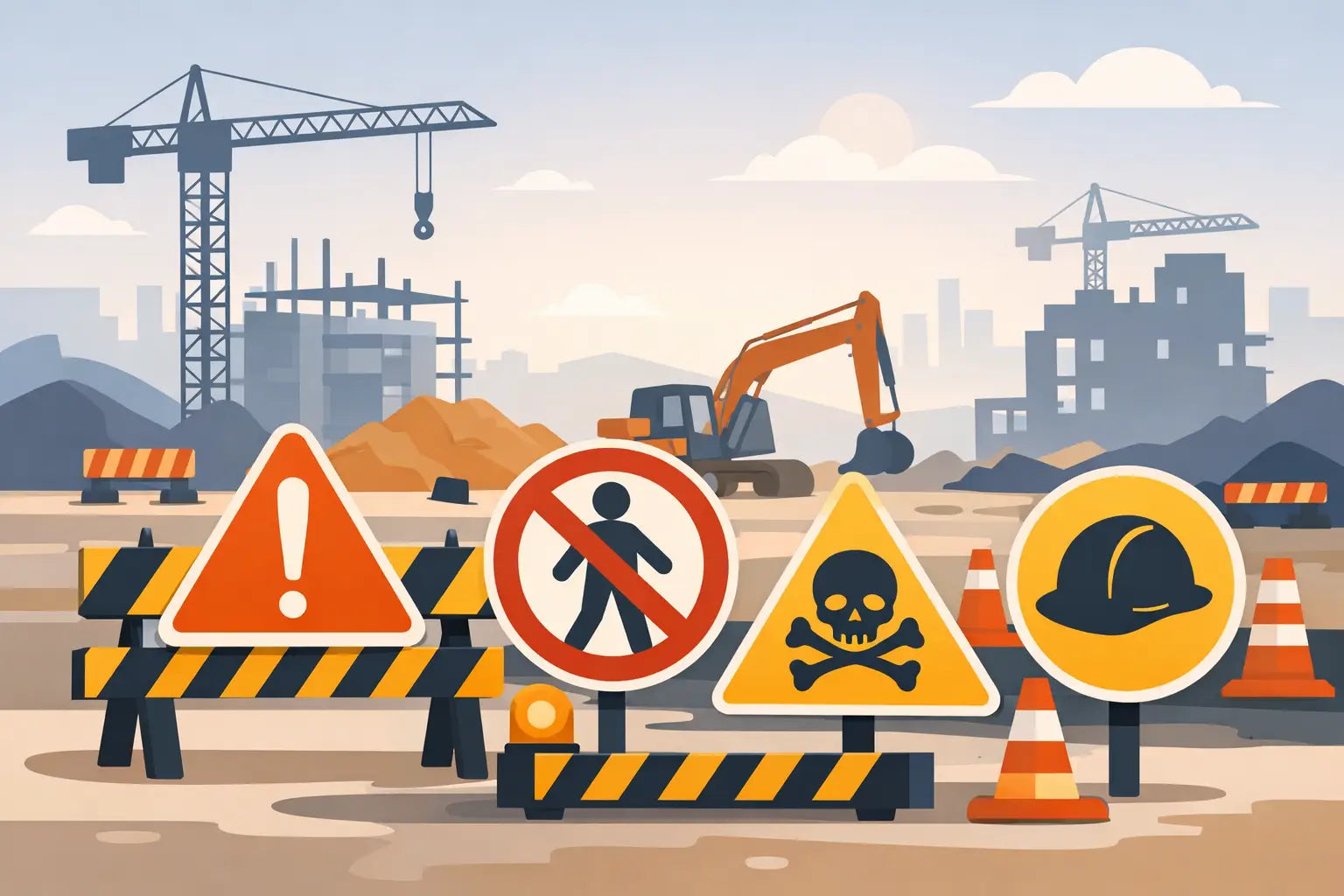
A missing sign at a live excavation, plant crossing or temporary electrical supply can turn an otherwise well-managed construction site into an avoidable risk. So, what danger signs are needed on construction sites? The answer depends on the hazards present, the people who may be exposed and the controls already in place. Signs should make remaining risks clear at the point where someone needs to act.
For UK site managers and contractors, the aim is not to cover every fence panel in warnings. It is to use clear, durable safety signs that support the risk assessment, protect workers and visitors, and help keep the public out of hazardous areas.
When are danger signs required on a construction site?
Under the Health and Safety (Safety Signs and Signals) Regulations 1996, safety signs are required where a significant risk cannot be avoided or adequately controlled by other means. In practical terms, a sign is used to warn people about a risk, prohibit unsafe behaviour, require PPE or direct people towards safe routes and emergency equipment.
A sign is not a replacement for proper control measures. An unprotected excavation does not become safe because it has a warning board beside it. Barriers, edge protection, trained supervision, segregation and safe systems of work come first. Signage then reinforces those controls and communicates the risk quickly to people who may not know the site layout.
This matters particularly on changing sites. A delivery driver, visiting surveyor or new subcontractor may encounter a hazard for the first time. Clear signs at entrances, access routes and work areas reduce reliance on verbal briefings alone.
The core construction site danger signs
The most appropriate signs will follow your project risk assessment and site rules. However, most active construction sites need a combination of warning, prohibition, mandatory and safe-condition signs.
Warning signs for immediate hazards
Warning signs are generally yellow triangles with a black border and symbol. They alert people to a hazard that remains present despite the controls in place. On a construction site, common examples include:
- Warning construction site signs at the perimeter and main entrance.
- Danger deep excavation, open trench or falling hazard signs around excavations and groundworks.
- Warning overhead load signs in lifting areas and beneath crane operations.
- Warning moving vehicles or forklift lorries signs at plant routes, loading bays and crossings.
- Warning high voltage, electrical hazard or overhead cable signs near temporary supplies, switchgear and overhead lines.
- Warning slippery surface, uneven ground and trip hazard signs where changing conditions create a foreseeable risk.
- Warning falling objects signs below scaffold work, roof work and areas where materials may be handled above ground level.
- Warning hazardous substances signs where relevant chemicals, fuels, gases or contaminated materials are stored or used.
Prohibition signs to control access and behaviour
Prohibition signs have a red circle and diagonal bar. They tell people what they must not do. These are especially useful at site boundaries and where the public, visitors or unauthorised workers could enter a controlled area.
Typical examples include No unauthorised entry, No entry, No pedestrians, No smoking and No naked flames. A No entry sign is appropriate for restricted work zones, while No pedestrians can support a segregated plant route. For fuel stores, gas cylinders and flammable materials, No smoking and No naked flames signs should be prominently displayed.
At the site entrance, a clear Construction Site - Keep Out or Danger Construction Site sign helps establish that access is controlled. Where members of the public could reasonably approach, perimeter signage needs to be visible, legible and positioned at intervals rather than limited to one gate.
Mandatory signs for PPE and site rules
Mandatory signs are blue circles and specify an action that must be taken. On construction sites, they often form part of the site induction and PPE policy. Hard hats, safety footwear, high-visibility clothing and eye protection may be mandatory across the whole site or only in designated areas.
Use the sign that reflects the actual requirement. A blanket PPE sign can be helpful at the entrance, but local mandatory signs are still needed where additional protection is required. Hearing protection may be necessary close to cutting, breaking or high-noise plant. Respiratory protection may be required for dusty work or particular substances, subject to the suitable controls identified in the risk assessment.
Avoid relying on a generic “PPE must be worn” notice if individual PPE requirements are more specific. A worker needs to know whether the requirement is a hard hat, goggles, gloves, hearing protection or a combination of these.
Safe-condition and emergency signs
Construction site safety signs must also help people find a safe way out and respond to an emergency. Green safe-condition signs identify emergency exits, escape routes, first aid points, emergency showers and assembly points.
The route shown must match the current site arrangement. This is a frequent issue on phased projects, where a route that was safe last month is blocked by stored materials, hoarding or ongoing works. Check exit and assembly point signs whenever the layout changes, and ensure temporary routes are clearly marked during alterations.
Fire action notices, fire point signs and extinguisher identification signs are also needed where fire equipment is provided. These should be easy to find without people having to search through cabins, compounds or work areas under pressure.
What danger signs are needed at the site entrance?
The entrance is where a site establishes expectations before anyone starts work. A well-signed gate or reception point normally combines site-specific warnings with clear instructions for visitors and deliveries.
A suitable entrance sign package may include a Construction Site warning, No unauthorised entry, mandatory PPE requirements, a requirement to report to the site office, and any key prohibition such as No smoking. Where vehicle movements are frequent, signs directing drivers to the delivery point and separating pedestrian access can prevent confusion at the busiest part of the site.
The detail should be proportionate. A small refurbishment project and a major civils project do not carry the same risk profile. But both need to make it clear that entry is controlled and that visitors must receive instructions before proceeding.
Signs for plant, vehicles and deliveries
Vehicle movements remain one of the most serious construction site risks, particularly where pedestrians and reversing plant share space. A sign alone will not create segregation, but it can make a planned traffic management system understandable.
Use warning signs for moving vehicles and forklift lorries where routes intersect. Add directional signs, designated pedestrian route signs and no-pedestrian signs to make separation obvious. Reversing areas, loading zones and lorry waiting points should be marked clearly, especially if drivers are unfamiliar with the project.
Consider sight lines, not just sign selection. A sign hidden behind stacked materials or positioned above a driver’s eye line will not perform its job. At busy entrances, larger-format signs and repeated messaging may be justified.
Temporary hazards need temporary signage
Construction conditions change quickly. Wet concrete, a newly opened trench, a scaffold alteration, overhead lifting or a temporary diversion can introduce a risk that was not present at the morning briefing. Temporary signs should be available for supervisors to deploy promptly.
Use signs only while the hazard exists, then remove or cover them. Out-of-date warnings create sign fatigue. If every area is labelled “Danger”, people stop looking closely at the message. Accurate signage carries more authority and is more likely to be followed.
Temporary signage must also be weather-resistant and fixed securely. A loose board that blows into a route or becomes unreadable after rain is not a control measure. For outdoor use, choose durable materials and check them during regular site inspections.
Choosing signs that people can actually use
The best construction signs are simple, recognisable and positioned where a decision is made. Standard safety symbols help people understand a message quickly, including workers with limited English or visitors who have not yet received a detailed briefing.
Size matters. A sign viewed from a vehicle approach, across a compound or from the far end of a pedestrian route needs to be larger than a sign mounted at a door. Lighting also matters for early starts, winter work and enclosed areas. If the sign cannot be seen, it cannot communicate the risk.
Review signs as part of routine site inspections and after incidents, near misses or changes to the programme. Ask a straightforward question: could a person arriving today understand where they may go, what they must wear and which hazards they need to avoid?
For fast-moving projects, keeping a stock of clear UK-compliant construction safety signs avoids delays when conditions change or replacements are needed. Think Safety - Think Sheep: select the message that matches the real hazard, position it before the point of risk and keep it in place only for as long as it is needed.
Share:
What Danger Signs Are Required by HSE at Work?
Which Danger Signs Are Used in Factories?