

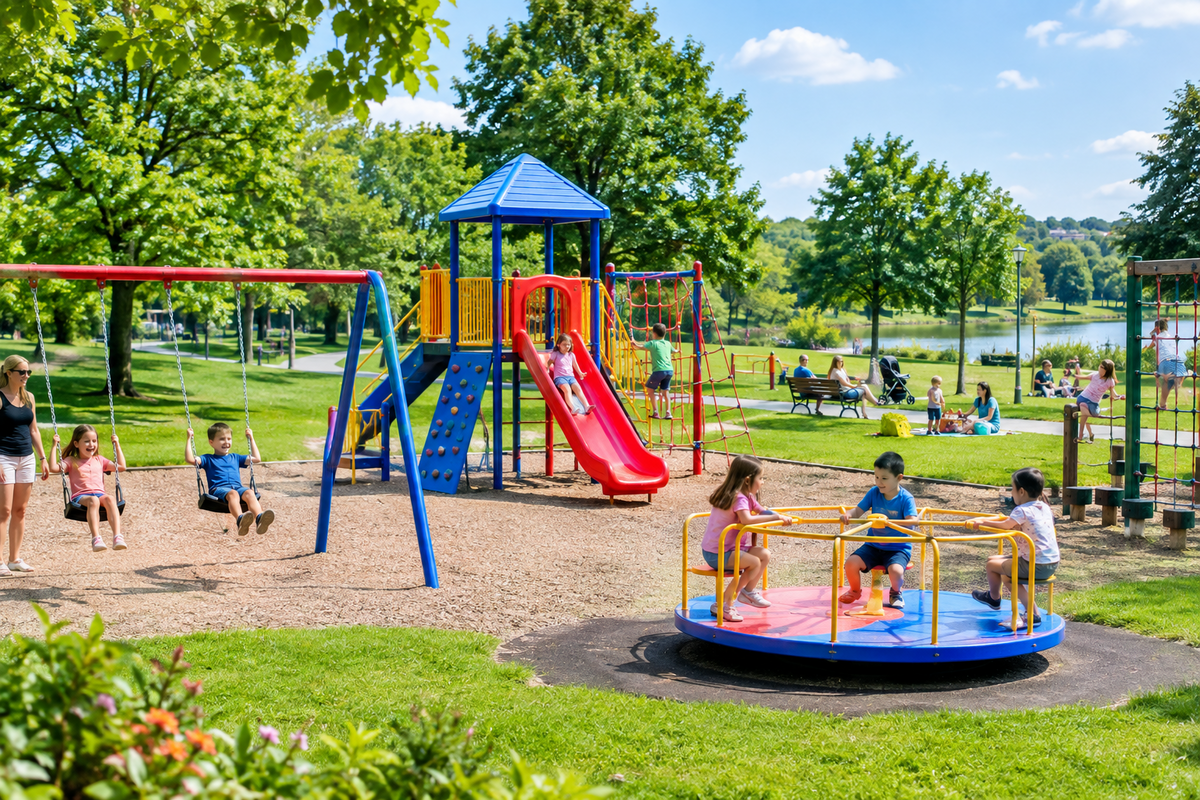
Buying the right play area safety signs is only half the job.
A well-designed playground sign won't achieve much if it's hidden behind a hedge, positioned where visitors have already passed it, mounted too high to read or placed so far from the relevant area that nobody knows what it refers to.
For playground operators, schools, nurseries, councils, holiday parks, pubs and leisure facilities, good sign positioning is about putting the right information where people need it.
So where should play area and playground safety signs be positioned?
This guide looks at the most useful locations and the practical factors to consider.
Start at the Play Area Entrance
The entrance is usually the most important location for general play area signs.
Visitors should ideally see important rules and information before they or their children begin using the play area.
An entrance sign could include information such as:
-
Play area rules
-
Intended age range
-
Supervision information
-
No Dogs
-
No Smoking
-
No Cycling
-
No Glass
-
No Alcohol
-
Opening information
-
Operator contact details
-
How to report damaged equipment
If you have a multi-message playground rules board, positioning it at the main entrance is usually much more useful than placing it at the back of the playground.
The principle is simple:
Give visitors important information before they need to act on it.
What If the Playground Has Several Entrances?
One entrance sign may not be enough if visitors can enter the play area from several directions.
Walk around the perimeter and identify every normal access point.
These could include:
-
Main gates
-
Secondary gates
-
Open pedestrian entrances
-
Paths from car parks
-
Access from playing fields
-
Entrances from housing developments
-
Access from pub or restaurant gardens
-
School playground entrances
Ask yourself:
Could somebody enter and use the play area without passing the main rules sign?
If the answer is yes, additional signage may be useful.
That doesn't necessarily mean duplicating a huge rules board at every entrance. A smaller sign communicating the most important restrictions may be sufficient at secondary access points.
Where Should Playground Rules Signs Go?
A Playground Rules Sign should normally be positioned somewhere visitors naturally encounter before using the equipment.
The main entrance or gate is an obvious choice.
Look for a position that is:
-
Clearly visible
-
Easy to approach
-
Easy to read
-
Unobstructed
-
Close enough to the entrance to be relevant
-
Away from locations where readers would block an access route
Avoid putting a long list of playground rules somewhere people have to stand in the middle of a busy gateway to read them.
Where possible, give parents and carers enough space to stop and read the information safely.
Where Should Age Guidance Signs Be Positioned?
If a play area or particular section is designed for a particular age group, place the age information where parents and carers can see it before the child uses the equipment.
For a playground intended entirely for one age group, the main entrance may be the most appropriate location.
If a larger playground has separate areas—for example, equipment intended for younger and older children—signage may be more useful at the entrance to each zone.
Typical messages could include:
-
Children's Play Area – Under 12s
-
Play Area for Younger Children
-
Equipment Intended for a Particular Age Group
Make sure the wording accurately reflects the play area's design and operator's arrangements.
Don't add arbitrary age restrictions simply because another playground has them.
Where Should Adult Supervision Signs Go?
Where adult supervision information forms part of your playground rules, position it where parents or carers are likely to see it before children start playing.
Useful positions can include:
-
Main entrance
-
Entrance gate
-
Playground rules board
-
Entrance to an age-specific play zone
There's little value in positioning a supervision notice somewhere parents only see when they're leaving.
Supervision signage can communicate expectations, but it doesn't replace appropriate playground design, inspection, maintenance or management.
Where Should No Dogs Signs Be Positioned?
If dogs aren't permitted in a children's play area, position the No Dogs Sign at the point where the restriction begins.
That could be:
-
Entrance gate
-
Perimeter opening
-
Access path
-
Boundary fence
This is especially important in public parks where dogs may be permitted in the surrounding area but prohibited within the enclosed children's playground.
The visitor needs to understand exactly where the rule changes.
A No Dogs sign positioned in the middle of the playground is too late.
What If Dogs Must Be Kept on Leads Rather Than Prohibited?
Make sure the sign reflects the actual rule.
No Dogs and Dogs Must Be Kept on Leads communicate very different requirements.
Don't use a prohibition sign if dogs are actually permitted subject to conditions.
The wording should match the policy applying to that particular area.
Where Should No Smoking Signs Go?
Where No Smoking signage is appropriate, entrances are usually a useful location because visitors can see the restriction before entering the play area.
Additional signs may be useful depending on:
-
Playground size
-
Number of entrances
-
Layout
-
Surrounding facilities
-
Applicable rules or policies
If vaping is also prohibited under the operator's policy, use wording that makes this clear rather than assuming a No Smoking sign automatically communicates a vaping restriction.
Smoking and vaping aren't legally identical issues.
Where Should No Cycling or No Scooter Signs Go?
Where cycles or scooters aren't permitted within a play area, display the restriction before riders enter.
Suitable locations include:
-
Entrance gates
-
Access paths
-
Perimeter openings
If cycle parking is provided outside the playground, positioning the restriction nearby can make the arrangement particularly clear.
Avoid putting the first No Cycling notice next to the play equipment after somebody has already ridden into the area.
Where Should No Glass Signs Go?
Where glass bottles or containers aren't permitted, entrances are usually the logical place to communicate the rule.
No Glass signage may be particularly useful at play areas within:
-
Public parks
-
Holiday parks
-
Pub gardens
-
Leisure facilities
-
Recreation grounds
-
Picnic areas
If the surrounding area permits glass but the playground itself doesn't, position the sign at the boundary where the restriction starts.
Where Should Emergency Information Be Displayed?
If your play area provides emergency or operator information, it should be somewhere visitors can find it quickly.
Potential information could include:
-
Name of the playground
-
Location
-
Operator
-
Contact telephone number
-
How to report damaged equipment
-
Emergency information
The main rules or information board can be a sensible location.
For larger sites, consider whether somebody unfamiliar with the area could accurately describe their location to emergency services.
Keep contact information current.
An emergency number that's faded, damaged or no longer in service isn't useful.
Where Should Signs About Damaged Equipment Go?
If equipment has been identified as unsafe or needs to be taken out of service, a warning or closure sign should be positioned directly at the affected equipment.
But this is important:
Don't rely on a sign alone to prevent children using unsafe equipment.
Where continued use presents an unacceptable risk, appropriate action may include:
-
Taking the equipment out of use
-
Physically preventing access
-
Installing suitable barriers
-
Arranging prompt repair
-
Removing the hazard
A handwritten “Do Not Use” notice tied to unsafe equipment isn't a substitute for effective risk control.
Where Should Temporary Playground Closure Signs Go?
If the entire playground is temporarily closed, visitors need to know before entering.
Position closure signs at:
-
Main entrance
-
Secondary entrances
-
Gates
-
Access paths where appropriate
Reasons for temporary closure might include:
-
Maintenance
-
Repairs
-
Flooding
-
Construction work
-
Damaged surfacing
-
Severe weather
-
Vandalism
Where physical access needs to be prevented, use appropriate barriers or other measures alongside the information sign.
Remove temporary notices once they're no longer relevant.
Position Signs at the Point of Decision
One of the most useful principles for playground signage is the point of decision.
Ask:
Where does somebody need this information in order to make the right decision?
For example:
| Sign | Useful Position |
|---|---|
| Playground Rules | Main entrance |
| Age Guidance | Entrance or relevant equipment zone |
| Children Must Be Supervised | Entrance/rules board |
| No Dogs | Point where dog restriction begins |
| No Smoking | Entrance/prominent access point |
| No Cycling | Entrance/access path |
| No Glass | Entrance |
| Keep Gate Closed | On or immediately beside the gate |
| Report Damaged Equipment | Main information board |
| Equipment Closed | Directly at affected equipment |
| First Aid | At or directing towards first aid facilities |
| Emergency Information | Clearly visible central/entrance information point |
This is generally more effective than putting every possible instruction on one distant noticeboard.
How High Should Play Area Signs Be Mounted?
There isn't one ideal mounting height for every playground sign.
Consider who needs to read it.
Most general rules and information signs are primarily aimed at:
-
Parents
-
Carers
-
Guardians
-
Other adult visitors
They should therefore be mounted at a comfortable reading height while remaining clearly visible.
Also consider children.
A sign shouldn't create:
-
A head-height obstruction
-
Sharp projections
-
Accessible sharp edges
-
An unintended climbing feature
-
Exposed fixings
The installation should be secure and appropriate for an environment used by children.
Don't Mount Signs Where Children Can Climb on Them
A poorly positioned sign can create its own problem.
Avoid installations that provide an obvious foothold or climbing opportunity next to:
-
Fencing
-
Walls
-
Gates
-
Other structures
Also consider whether a signpost itself could become an obstacle within an active play zone.
The sign should provide information without introducing an unnecessary hazard.
Keep Signs Away From Active Play Zones Where Possible
A playground sign doesn't usually need to be positioned immediately beside a swing, slide or climbing frame unless it relates specifically to that equipment.
For general information, entrances, boundaries and designated information points are usually more appropriate.
This reduces unnecessary structures within areas where children are running and playing.
Consider Viewing Distance
The size and position of a sign should work together.
A small sign can work perfectly well if visitors naturally pass within a metre or two of it.
The same sign may be almost useless if it's expected to be read from across a large playground.
Consider:
-
How far away the reader will be
-
How quickly they're moving
-
Amount of text
-
Letter size
-
Mounting height
-
Lighting
-
Background contrast
Multi-message playground rules signs usually need to be larger because they contain more information.
Think About Parents With Pushchairs & Wheelchair Users
Don't automatically position important information where it's only easily visible to a standing adult.
Think about the range of people using the site.
Where practical, signage should be readable and accessible to:
-
Parents with pushchairs
-
Wheelchair users
-
People of different heights
-
People approaching from different directions
Avoid positions where bins, benches, parked pushchairs or other features routinely obstruct the sign.
Check the Background Behind the Sign
Contrast matters.
A playground sign can become difficult to notice if it's mounted against a visually busy background.
Consider:
-
Fencing
-
Vegetation
-
Colourful play equipment
-
Advertising
-
Other signs
-
Noticeboards
The aim is for important information to stand out without creating unnecessary visual clutter.
Consider Trees, Hedges & Seasonal Growth
A surprisingly common signage problem is vegetation.
A sign may be perfectly visible when installed in February but almost completely hidden by leaves in July.
When choosing the position, consider:
-
Trees
-
Hedges
-
Shrubs
-
Climbing plants
-
Grass and weeds
Include vegetation around signs in routine site maintenance.
Consider Lighting & Visibility
Will the playground be used during low-light conditions?
If so, check whether important signs remain visible.
This can be relevant at:
-
Holiday parks
-
Pubs
-
Leisure facilities
-
Residential developments
-
Recreation areas with extended opening hours
Don't assume that a sign visible in bright daylight is equally readable on a winter afternoon.
Avoid Sign Clutter
Putting ten separate signs on an entrance gate can make it harder for visitors to identify the important messages.
Where several permanent rules apply, a well-designed multi-message playground rules sign can often be clearer.
You might then use individual signs only where a particular rule needs additional emphasis.
For example:
Entrance:
One main rules board.
Gate:
Keep Gate Closed.
Boundary:
No Dogs where required.
Specific equipment:
Temporary closure information when necessary.
This creates a more organised signage system.
Don't Hide Important Signs Among Advertising
Playgrounds within pubs, holiday parks, attractions and leisure facilities may have advertising and promotional notices nearby.
Keep important safety and rules information visually distinct.
Visitors shouldn't have to search through:
-
Menus
-
Event posters
-
Promotional banners
-
Sponsorship signs
-
Advertising
to find the playground rules.
Check Sign Positions During Playground Inspections
Signage shouldn't be treated as a “fit it and forget it” purchase.
Include signs when carrying out routine playground and site checks.
Look for:
-
Loose fixings
-
Sharp edges
-
Damage
-
Fading
-
Graffiti
-
Dirt
-
Obstructions
-
Vegetation
-
Outdated information
-
Changed access routes
Also ask whether the position still makes sense.
Playgrounds evolve.
A new fence, bench, bin, gate or item of equipment can change how visitors enter and move through the site.
Review Signs When the Playground Changes
Review signage whenever you make significant changes to:
-
Equipment
-
Layout
-
Entrances
-
Fencing
-
Age zones
-
Rules
-
Opening arrangements
-
Operator details
-
Contact information
Don't leave an old sign communicating rules that no longer apply.
Is There a Legal Height or Exact Position for Playground Signs?
There isn't a single universal mounting position that applies to every playground sign in every UK play area.
The appropriate position depends on factors including:
-
Purpose of the sign
-
Intended reader
-
Playground layout
-
Viewing distance
-
Access routes
-
Equipment
-
Site rules
-
Surroundings
Rather than looking for one magic measurement, focus on making the information clear, visible, relevant and safely installed.
Play Area Signs Don't Replace Playground Management
Sign positioning is important, but signage is only one part of playground management.
A well-positioned warning sign can't compensate for:
-
Damaged equipment
-
Inadequate maintenance
-
Unsafe surfacing
-
Poor inspection
-
Dangerous fixings
-
Uncontrolled hazards
Use signs to communicate useful information.
Use appropriate playground management, inspection and maintenance to control the actual risks.
Play Area Sign Positioning Checklist
Walk around your playground and check:
Entrances
☐ Main rules sign visible before entering
☐ Secondary entrances considered
☐ No Dogs restriction visible where applicable
☐ Smoking restrictions communicated where appropriate
☐ Cycling/scooter rules clear where relevant
Sign Visibility
☐ Signs easy to see
☐ Text easy to read
☐ Appropriate size for viewing distance
☐ Signs aren't hidden by vegetation
☐ Signs aren't obscured by bins or benches
☐ Background provides adequate contrast
☐ Lighting has been considered
Installation
☐ Signs securely fixed
☐ No exposed sharp fixings
☐ No sharp edges
☐ No unnecessary head-height obstruction
☐ Sign isn't creating a climbing opportunity
☐ Signpost isn't obstructing an active play area
Information
☐ Rules are current
☐ Age guidance is accurate
☐ Contact details are current
☐ Restrictions reflect actual site policy
☐ Temporary notices have been removed when no longer required
Maintenance
☐ Signs included in site inspections
☐ Faded signs replaced
☐ Damaged signs repaired or replaced
☐ Graffiti removed
☐ Vegetation kept clear
☐ Sign locations reviewed after site changes
Walk the Playground as a First-Time Visitor
One of the best ways to assess playground sign positioning is to forget that you know the site.
Approach it as a first-time visitor.
Start at the car park or access path.
Ask:
Can I find the playground?
As you approach:
Can I see the rules before entering?
At the gate:
Do I know whether dogs, cycles, smoking or other activities are restricted?
Inside:
Can I identify any age-specific areas?
Then ask:
If I spotted damaged equipment, would I know how to report it?
This simple walkthrough often identifies signage problems that aren't obvious to somebody familiar with the site.
The Best Sign Is in the Right Place
Effective playground signage isn't about displaying as many notices as possible.
It's about communicating the right message at the right location and at the right time.
Put general playground information at entrances.
Put restrictions where they begin.
Put age guidance where it applies.
Put temporary warnings directly at the affected area.
And regularly check that every sign remains visible, accurate and safely installed.
That creates a clearer and more useful playground signage system for parents, carers, children and other visitors.
Shop Play Area Signs
Safety Sheep supplies Play Area Signs for schools, nurseries, councils, parks, holiday parks, pubs, leisure facilities and other children's play spaces.
Choose from playground rules signs, children's play area signs, age guidance, No Dogs notices and other safety and information signs in a range of sizes and durable materials suitable for outdoor use.
Made in Britain, with options for businesses, schools, councils and other organisations managing play areas.
Think Safety. Think Sheep.
Share:
What Information Should Be on a Playground Rules Sign?
No Dogs Signs for Children's Play Areas: A UK Guide