

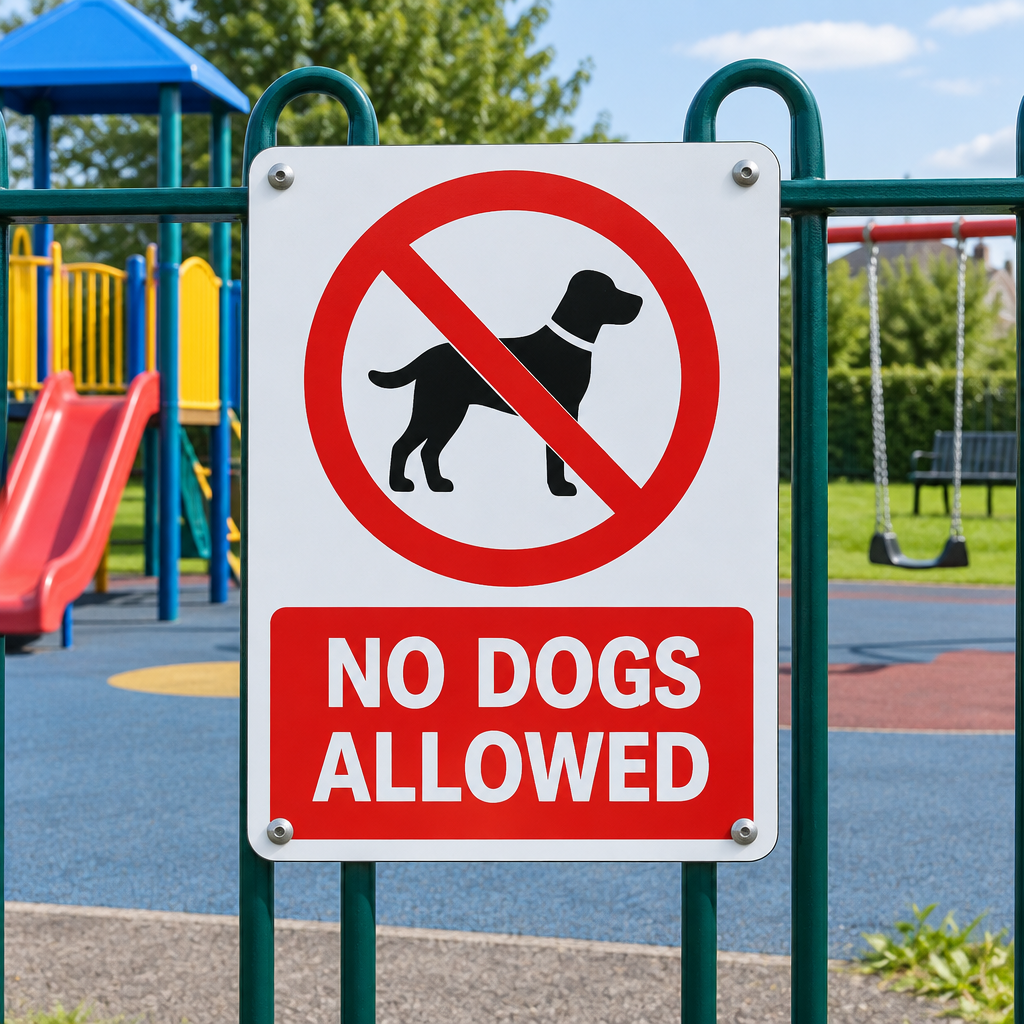
Children's playgrounds and dogs don't always make the best combination.
Dog fouling, uncontrolled dogs and animals running around play equipment can create hygiene and safety concerns, particularly in areas used by young children.
That's why No Dogs Signs are a common sight at playground entrances throughout the UK.
But are dogs automatically prohibited from children's play areas? Are No Dogs Signs legally required? What should the sign say, and where should it be positioned?
Here's what playground operators, schools, councils, pubs, holiday parks and other organisations responsible for children's play spaces should consider.
Why Are Dogs Often Excluded From Children's Play Areas?
There are several reasons why an operator may want dogs kept outside a designated children's play area.
Dog Fouling
Dog faeces are unpleasant and can present a health risk.
This is particularly important in playgrounds because children are more likely to have close contact with the ground, grass, sand, bark and other play surfaces.
Keeping dogs outside enclosed play spaces can help reduce the likelihood of dog fouling within areas where children play.
Unpredictable Behaviour
Even a normally friendly dog can react unpredictably when surrounded by excited children, noise and fast movement.
Some children may also be frightened of dogs regardless of the animal's behaviour.
Separating dogs from designated play areas can therefore make the environment more comfortable for children and parents.
Protecting Play Surfaces
Dogs can also enter sand, bark and other loose-fill play surfaces.
Keeping dogs outside the playground helps operators manage these areas specifically for their intended users.
Does Every UK Playground Have to Ban Dogs?
No.
There isn't a single UK-wide rule stating that dogs must be prohibited from every children's playground.
Rules can depend on:
-
Who owns or operates the land
-
Where in the UK the playground is located
-
Local authority restrictions
-
Public Spaces Protection Orders or other applicable controls
-
Whether the playground is enclosed
-
The operator's own site rules
-
Assistance-dog exemptions
This means you shouldn't put up an enforcement-style No Dogs sign based on the assumption that every children's play area automatically has the same legal restriction.
First establish what rule actually applies to your site.
What Are Public Spaces Protection Orders?
In England and Wales, you may encounter Public Spaces Protection Orders, commonly shortened to PSPOs.
A local authority can use a PSPO to place particular restrictions on activities within a public space.
Dog-related restrictions can include:
-
Excluding dogs from particular places
-
Requiring dogs to be kept on leads
-
Requiring owners to remove dog faeces
-
Limiting the number of dogs controlled by one person
An enclosed children's play area within a larger public park is a common example of somewhere a local authority may choose to exclude dogs.
Where a formal local restriction applies, signage is particularly important because visitors need to know where the restriction begins and what they're required to do.
Check Your Local Rules
If you operate or manage a public playground, don't assume the rules used by a neighbouring council apply to you.
Check the requirements for your own location.
The local authority may publish information covering:
-
Which playgrounds are included
-
Maps of dog exclusion areas
-
Whether the rule applies to enclosed play areas only
-
Assistance-dog exemptions
-
Fixed penalties
-
Other dog-control requirements
If you're responsible for displaying an official dog-exclusion notice, make sure the wording accurately reflects the applicable order.
Private Play Areas Are Different
Not every playground is council-owned.
Children's play areas can also be found at:
-
Pubs
-
Hotels
-
Holiday parks
-
Campsites
-
Housing developments
-
Schools
-
Nurseries
-
Leisure facilities
-
Visitor attractions
-
Private estates
A private operator may decide that dogs aren't permitted within a designated children's play area as part of its site rules.
In that situation, signage should clearly communicate the operator's actual policy.
Don't add references to legislation, fines or penalties unless they genuinely apply.
What Should a No Dogs Sign Say?
For a straightforward site rule, simplicity is usually best.
Examples include:
No Dogs
or:
No Dogs Allowed in the Children's Play Area
A familiar dog prohibition symbol makes the restriction quick to recognise.
For a playground within a larger dog-friendly park, more specific wording can be particularly helpful:
No Dogs Allowed in the Children's Play Area
This makes it clear that the restriction relates to the playground rather than necessarily applying to the whole park.
Should the Sign Say “No Dogs” or “Dogs Must Be Kept on Leads”?
These are different instructions.
No Dogs means dogs aren't permitted within the designated area, subject to any applicable exemptions.
Dogs Must Be Kept on Leads means dogs can enter, but must remain on a lead.
Make sure your sign communicates the actual rule.
Don't use a No Dogs sign where the site's policy merely requires dogs to be kept on leads.
What About Assistance Dogs?
This needs particular care.
Dog-control arrangements can include exemptions for assistance dogs, and operators should consider accessibility and applicable equality obligations when establishing and communicating restrictions.
If an exemption applies, the sign should avoid creating the impression that an assistance-dog user is prohibited when they aren't.
Depending on the circumstances and applicable rule, wording might include:
No Dogs Except Assistance Dogs
or an equivalent message.
For an official local-authority dog exclusion area, use wording consistent with the relevant order and the exemptions that actually apply.
Don't simply copy the wording from another council's sign.
Where Should No Dogs Signs Be Positioned?
The most important position is normally the entrance to the play area.
Visitors should see the restriction before entering with a dog.
Useful positions can include:
-
Entrance gates
-
Pedestrian entrances
-
Perimeter fencing beside entrances
-
Access paths immediately before the playground
-
Multiple entrances to larger play areas
If the playground has three entrances, putting one small No Dogs sign at only one of them may not communicate the restriction effectively.
Consider every normal route into the play area.
Put the Sign Where the Restriction Begins
This is particularly important where a children's playground sits within a larger public park.
Dogs might be permitted in the park but excluded from the fenced play area.
In that situation, the No Dogs sign should make the boundary clear.
For example:
PARK
Dogs permitted according to park rules.
↓
CHILDREN'S PLAY AREA
No Dogs.
The sign should help visitors understand that distinction.
Should You Put No Dogs Signs on the Playground Fence?
Yes, this can be useful, particularly if the playground has a clearly defined fenced boundary.
However, prioritise entrances.
A sign halfway along the back fence may technically be visible but doesn't help somebody approaching the gate with a dog.
Additional fence signs can be useful where:
-
The boundary is large
-
There are several access points
-
People regularly approach from different directions
-
The playground adjoins a popular dog-walking area
How Big Should a No Dogs Sign Be?
There isn't one ideal size for every playground.
Consider:
-
Viewing distance
-
Entrance width
-
Mounting height
-
Surrounding vegetation
-
Whether people approach on foot
-
Whether the sign contains additional wording
-
How visually busy the entrance is
A simple pictogram and short No Dogs message can usually be understood more quickly than a sign containing several paragraphs of small text.
If the sign includes detailed information about a local restriction, choose a size that allows the information to remain clearly legible.
Use a Recognisable Symbol
A clear pictogram helps visitors understand the restriction quickly.
A typical No Dogs sign uses a dog symbol combined with the familiar red prohibition circle and diagonal bar.
This is particularly useful in public places because a strong visual symbol can communicate the basic restriction without relying entirely on written English.
Text can then clarify exactly where or how the rule applies.
What Material Should You Use?
Children's playground signs are usually installed outdoors, so material choice matters.
The sign may be exposed to:
-
Rain
-
Sunlight
-
Wind
-
Frost
-
Temperature changes
-
Dirt
-
Regular cleaning
For long-term installation, choose a durable material suitable for external use.
The appropriate material will also depend on whether you're fixing the sign to:
-
Metal fencing
-
Timber fencing
-
A gate
-
A wall
-
A post
-
Playground railings
If the restriction is temporary, a lighter-weight material may be sufficient.
Fix Playground Signs Safely
A No Dogs sign shouldn't introduce a new playground hazard.
When installing signs, consider:
-
Sharp corners
-
Exposed fixings
-
Protruding screws
-
Mounting height
-
Climbing opportunities
-
Damage to fencing
-
Loose panels
Fix signs securely and inspect them as part of the wider play area's routine checks.
Include No Dogs Information on a Playground Rules Board
You don't necessarily need a separate sign for every rule.
A larger Playground Rules Sign at the main entrance can combine information such as:
-
Children's Play Area
-
Age guidance
-
Adult supervision
-
No Dogs
-
No Smoking
-
No Cycling
-
No Glass
-
No Alcohol
-
Contact information
This can create a cleaner entrance than installing numerous separate signs.
However, make sure the No Dogs message remains sufficiently prominent if it's an important site restriction.
Should You Use Both a Rules Board and Separate No Dogs Signs?
Sometimes.
A large playground may have a main rules board at its principal entrance plus smaller No Dogs signs at secondary entrances.
This can work particularly well where:
-
There are several gates
-
Dogs are common in the surrounding park
-
People regularly enter from different directions
-
The dog restriction is frequently overlooked
The objective isn't to display as many signs as possible.
It's to make the rule clear at the places where people need to know it.
Don't Rely on the Sign Alone
A No Dogs sign is a communication tool.
If keeping dogs outside a children's playground is important, other site-management measures may also be appropriate.
Depending on the location, these can include:
-
Fencing
-
Self-closing gates
-
Regular inspections
-
Appropriate cleaning
-
Dog-waste facilities outside the play area
-
Suitable dog exercise areas elsewhere
-
Public information
-
Enforcement where an applicable restriction exists
A faded No Dogs sticker attached to an open gateway shouldn't be the entire dog-control strategy.
Playground Inspections Should Include Signs
No Dogs Signs should be checked as part of routine playground inspections.
Look for:
-
Damage
-
Fading
-
Graffiti
-
Missing signs
-
Loose fixings
-
Sharp edges
-
Vegetation blocking the sign
-
Outdated information
-
Incorrect contact details
If a sign has been removed or vandalised, replace it where the restriction still applies.
Check Gates & Fencing Too
If the objective is to keep dogs outside the playground, inspect the physical boundary as well.
Look for:
-
Gates that don't close
-
Damaged fencing
-
Large gaps
-
Missing panels
-
Unofficial access points
A perfect No Dogs sign won't be particularly effective if the adjacent gate is permanently stuck open.
Dog Fouling Still Needs Managing
Even where dogs are prohibited, playground operators should continue checking for contamination.
Signs and fencing can't guarantee that every dog owner will follow the rules.
Routine inspections should therefore identify dog fouling and other contamination so it can be dealt with appropriately.
This is especially important where playground surfaces include:
-
Grass
-
Sand
-
Bark
-
Soil
-
Other loose-fill materials
Avoid Unnecessary Legal Claims on the Sign
If you're creating a general No Dogs sign for a private play area, be careful with statements such as:
“It is illegal to bring dogs into this playground.”
That may not be true.
Likewise, don't add:
“£1,000 fine”
unless the applicable legal restriction actually provides for that consequence and the wording is appropriate.
For an ordinary private playground, a simple:
No Dogs Allowed in the Children's Play Area
may communicate everything that's needed.
Official enforcement signage should reflect the actual legal order that applies.
No Dogs Signs & Playground Safety
A No Dogs sign doesn't make a playground safe by itself.
Playground safety involves wider arrangements including:
-
Suitable design
-
Appropriate equipment
-
Safe surfacing
-
Risk assessment
-
Inspection
-
Maintenance
-
Repairs
-
Site management
Dog-control signage is one small part of managing the overall environment.
No Dogs Signs & BS EN 1176
BS EN 1176 is an important series of standards concerning playground equipment and surfacing.
However, displaying a No Dogs sign doesn't make a playground “BS EN 1176 compliant”.
The sign communicates a site rule or restriction.
Playground standards cover much wider considerations involving the design, equipment, installation, inspection and maintenance of the play facility.
Avoid confusing the two.
No Dogs Signs & BS EN ISO 7010
You may also see references to ISO 7010 when purchasing safety signs.
BS EN ISO 7010 provides standardised graphical safety symbols for many types of prohibition, warning, mandatory, emergency and fire-safety signs.
Using clear, recognisable graphical symbols can make safety information easier to understand.
However, an ISO-style pictogram doesn't by itself create a legal dog exclusion.
The underlying rule or restriction must come from the site's actual arrangements or an applicable legal measure.
No Dogs Sign Checklist for Children's Play Areas
Use this quick checklist when reviewing your playground.
The Rule
☐ Have you established whether dogs are actually prohibited?
☐ Does a local authority restriction apply?
☐ Have you checked the exact area covered?
☐ Have applicable assistance-dog exemptions been considered?
☐ Does the sign accurately describe the restriction?
Position
☐ Main entrance covered
☐ Secondary entrances covered
☐ Restriction visible before entering
☐ Playground boundary is clear
☐ Sign isn't obscured by vegetation
☐ Sign can be read at the expected viewing distance
Sign
☐ Clear No Dogs symbol
☐ Wording easy to understand
☐ Suitable outdoor material
☐ Securely fixed
☐ No dangerous projections or fixings
☐ Legible and undamaged
Playground Management
☐ Gates working correctly
☐ Fencing intact
☐ Playground checked regularly
☐ Dog fouling removed appropriately
☐ Damaged or missing signs replaced
☐ Rules reviewed when circumstances change
No Dogs or Dogs on Leads: Which Sign Do You Need?
Before ordering, establish exactly what you want dog owners to do.
If dogs aren't allowed inside the children's play area:
Choose a No Dogs Sign.
If dogs are allowed but must remain on a lead:
Choose a Dogs Must Be Kept on Leads Sign.
If dogs are allowed in the surrounding park but not inside the playground:
Use a No Dogs Sign at the playground boundary or entrances.
If a formal local-authority restriction applies:
Use signage that accurately reflects the relevant order and its exemptions.
Choosing the right wording avoids confusing visitors and makes the rule easier to follow.
Shop No Dogs & Play Area Signs
Safety Sheep supplies Play Area Signs for schools, councils, nurseries, parks, holiday parks, pubs, leisure facilities and other children's play spaces.
Our range includes No Dogs signs, playground rules, age guidance, supervision notices and other play-area safety and information signs in a choice of sizes and durable materials.
Choose clear signage for gates, fencing, entrances and other outdoor locations.
Made in Britain, with bulk savings available for businesses and organisations.
Think Safety. Think Sheep.
Share:
Where Should Play Area Safety Signs Be Positioned?
Accessible Toilet Signs: A Guide for UK Businesses