

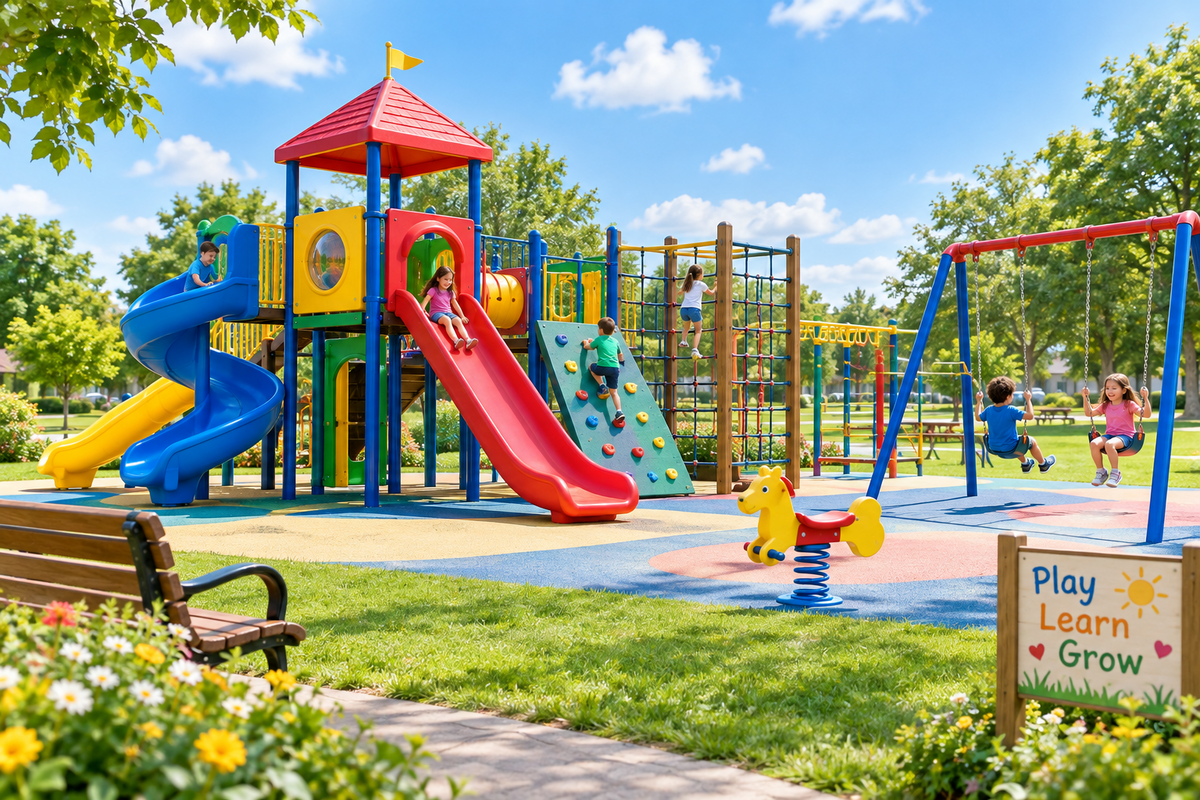
A good playground rules sign should tell parents, carers and children the important things they need to know before using a play area.
That might include the intended age range, supervision information, restrictions on dogs, smoking or cycling, emergency details and a way to report damaged equipment.
But there's an important balance.
Include too little information and visitors may not understand how the play area should be used. Include too much and the sign becomes a wall of text that few people will read.
So, what information should you put on a playground rules sign?
Here's a practical checklist for UK playgrounds, parks, schools and other children's play areas.
1. Name or Identify the Play Area
Start by making it clear what the sign relates to.
This could be as simple as:
Welcome to Our Play Area
or:
Children's Play Area
For public playgrounds, you might also include the official name of the park or play area.
Clearly identifying the location can be particularly useful if emergency or reporting information is also displayed on the sign.
2. Intended Age Range
If a play area or particular group of equipment is intended for a certain age range, consider making this clear.
For example:
-
Suitable for children under 5
-
Play area for children aged 2–6
-
Suitable for children under 12
-
Junior play area
-
Toddler play area
Don't simply choose an age limit because you've seen it on another playground sign.
The information should reflect the design and intended use of the actual equipment.
Where a playground contains separate areas for different age groups, signs can help parents and carers identify the appropriate equipment.
3. Adult Supervision Information
Many playground rules signs include wording relating to parental or adult supervision.
For example:
Children should be supervised by a responsible adult.
This can provide parents and carers with a useful reminder, particularly where the play area is intended for younger children.
However, a supervision statement shouldn't be treated as a substitute for properly managing the playground itself.
Playground operators still need appropriate arrangements for inspection, maintenance and dealing with defects.
4. No Dogs
If dogs aren't permitted within the children's play area, make this clear.
A simple:
No Dogs
message accompanied by an appropriate prohibition symbol can be understood quickly.
This is particularly useful where dogs are allowed in the surrounding park but aren't permitted inside the fenced play area.
In that situation, position the restriction where the playground boundary begins.
5. No Smoking
Where smoking is prohibited, this can also be communicated on the playground rules board.
Use a clear No Smoking message and recognised symbol where appropriate.
Smoking rules and statutory requirements aren't identical throughout all four UK nations, so operators should ensure that their arrangements reflect the requirements applicable to their premises and location.
6. No Vaping
If your organisation also prohibits vaping in the play area, state this separately or use a combined No Smoking & No Vaping message.
Don't assume that a No Smoking instruction automatically communicates your policy on vaping.
If both are prohibited, making both restrictions explicit avoids ambiguity.
7. No Alcohol
Some play area operators prohibit alcohol within the children's playground.
This may be particularly relevant to play areas located in:
-
Public parks
-
Holiday parks
-
Pubs
-
Leisure facilities
-
Recreation grounds
-
Housing developments
If alcohol is prohibited, communicate the rule clearly.
Don't add it simply because it appears on another playground's rules board if it isn't actually one of your site's rules.
8. No Glass
Broken glass can create an obvious hazard in an area where children run, climb and play.
Where glass containers aren't permitted, include a simple:
No Glass
or:
No Glass Bottles
message.
Again, the rule should reflect the site's actual management arrangements.
9. Cycling, Scooters & Wheeled Activities
Some play areas restrict bicycles, scooters, skateboards or similar activities.
Whether this is appropriate depends on the design and intended use of the space.
A small enclosed playground containing swings and climbing equipment may have very different rules from a larger recreation area specifically designed to accommodate several types of play.
If a restriction applies, make it clear.
Possible wording includes:
-
No Cycling
-
No Bicycles
-
No Scooters
-
No Skateboarding
Avoid unnecessarily restricting activities that the site has actually been designed to accommodate.
10. Use Equipment as Intended
A playground rules sign can include a simple instruction encouraging appropriate use of equipment.
For example:
Please use play equipment as intended.
Keep this type of instruction short.
Trying to list every possible way somebody could misuse every piece of playground equipment is unlikely to create an effective sign.
The objective is clear communication, not writing a complete playground operating manual.
11. Don't Use Damaged Equipment
You may want to tell visitors not to use equipment that appears damaged and to report the problem.
For example:
Do not use damaged equipment. Please report any faults to the playground operator.
But this shouldn't become a substitute for inspection and maintenance.
If an operator knows that equipment presents an unacceptable risk, appropriate action should be taken to prevent its use until the problem has been addressed.
A sentence on the rules board isn't a solution to known defective equipment.
12. Report Damaged Equipment
Providing a simple way for visitors to report problems can be particularly useful in public playgrounds.
Your sign might say:
Please report damaged equipment to:
followed by:
-
Telephone number
-
Email address
-
Website
-
QR code
This allows parents and other visitors to tell the operator about problems between scheduled inspections.
Make sure somebody actually monitors the contact method you provide.
13. Playground Operator Details
Consider identifying the organisation responsible for the playground.
For example:
This play area is managed by Example Town Council.
This is particularly useful at public facilities where visitors might otherwise have no idea who owns or manages the site.
Operator information can also make it easier to report:
-
Damaged equipment
-
Vandalism
-
Graffiti
-
Broken fencing
-
Litter
-
Anti-social behaviour
-
Other maintenance problems
Keep the information current when contracts, management arrangements or contact details change.
14. Emergency Information
Consider what somebody would need to know if there were a serious incident.
Depending on the location, useful information might include:
-
Call 999 in an emergency
-
Name of the playground
-
Full address
-
Postcode
-
Location reference
-
What3words or another location identifier where appropriate
This can be particularly useful at large parks or remote recreation areas where somebody calling the emergency services may find it difficult to explain their exact location.
The information needs to be accurate.
Check location details carefully before printing them permanently onto a sign.
15. First Aid Information
If first aid facilities are available nearby, consider whether visitors would benefit from knowing where they are.
For example:
First Aid available at the main reception.
This is more likely to be relevant at:
-
Holiday parks
-
Leisure centres
-
Visitor attractions
-
Schools
-
Sports facilities
-
Pubs
-
Hotels
Don't advertise first aid facilities that aren't reliably available whenever the playground is open.
16. Opening & Closing Times
Where the play area has specific opening hours, include them if this will help visitors understand when the facility can be used.
For example:
Play Area Open: 8am–8pm
or:
Play Area closes at dusk.
Only include opening times if they're actually managed and kept up to date.
Seasonal opening arrangements may be better communicated on a replaceable panel rather than incorporated permanently into an expensive main playground board.
17. Maximum Capacity – Only Where Relevant
Some managed or enclosed play facilities may have an established maximum capacity.
If there is a genuine operational reason for limiting numbers, this information can be displayed.
But don't invent an arbitrary capacity for an ordinary outdoor playground simply because you've seen one on another sign.
Any stated limit should have a sound basis.
18. Site-Specific Hazards
Does your particular playground have something visitors genuinely need to know about?
This might include a nearby:
-
Water feature
-
Steep bank
-
Shared vehicle route
-
Cycle route
-
Unfenced boundary
-
Other significant site-specific feature
Consider whether additional information or a separate warning sign is appropriate.
Don't use a generic playground rules board to try to solve every site hazard.
Some risks require physical measures, design changes, barriers or other controls rather than—or in addition to—signage.
19. Litter & Waste Information
A simple litter instruction can help reinforce good behaviour.
For example:
Please put litter in the bins provided.
This may be particularly useful where food and drink are permitted around the play area.
If there are no bins nearby, however, telling visitors to use the bins provided isn't particularly helpful.
Make the sign match the facility.
20. Behaviour Rules
Some playground operators include general behaviour rules.
Examples might include:
-
Be considerate of other users
-
Do not climb on fences
-
No abusive behaviour
-
Do not damage equipment
Keep these to a minimum.
Prioritise instructions that are genuinely useful and relevant to the individual facility rather than filling the sign with obvious statements.
Playground Rules Sign Checklist
Here's a useful starting point when designing a playground rules sign.
Play Area Information
☐ Name of playground or play area
☐ Intended age range, where applicable
☐ Adult supervision information, where appropriate
☐ Opening hours, if applicable
Site Rules
☐ No Dogs, if applicable
☐ No Smoking, if applicable
☐ No Vaping, if applicable
☐ No Alcohol, if applicable
☐ No Glass, if applicable
☐ Cycling/scooter restrictions, if applicable
☐ Litter information, if useful
☐ Any genuine site-specific rules
Safety Information
☐ Use equipment appropriately
☐ Don't use obviously damaged equipment
☐ Relevant site-specific safety information
☐ First aid information, where applicable
Contact & Emergency Information
☐ Playground operator
☐ Fault-reporting contact details
☐ Emergency information
☐ Playground address/location
☐ Location reference where useful
The important phrase throughout this checklist is:
“if applicable”.
A playground rules sign should reflect the actual playground.
It shouldn't be a generic collection of every possible restriction.
What Shouldn't Be on a Playground Rules Sign?
Knowing what to leave off can be just as important.
Unnecessary Legal Warnings
Avoid filling the sign with intimidating legal language unless there's a genuine reason for it.
A children's playground sign should primarily communicate useful information clearly.
Blanket Liability Disclaimers
Statements attempting to remove all responsibility from the playground operator should be treated with caution.
A notice saying children use the playground “entirely at their own risk” isn't a substitute for appropriate playground management, inspection and maintenance.
Focus the sign on information visitors can actually use.
Rules That Don't Apply
Don't copy a competitor's playground sign word for word.
If your site allows scooters, don't display No Scooters.
If there is no age restriction, don't invent one.
If dogs are allowed, don't display No Dogs.
Every unnecessary instruction makes the genuinely important information less prominent.
Too Much Text
A playground entrance isn't the place for an essay.
Parents may be:
-
Watching children
-
Carrying bags
-
Pushing a buggy
-
Talking to other people
-
Entering through a gate
-
Trying to supervise several children
They aren't likely to stand reading 500 words of terms and conditions.
Prioritise information.
Use short headings, clear symbols and concise instructions.
Should Playground Rules Signs Use Symbols?
Recognised symbols can help people understand important messages quickly.
For example, a red prohibition symbol can immediately draw attention to a No Dogs or No Smoking instruction.
Standardised safety symbols are particularly useful where an established safety sign exists.
Text can then provide additional clarification.
However, not every playground rule has an internationally standardised safety symbol.
General information such as:
Suitable for children under 12
may simply need clear, legible text.
Don't invent complicated pictograms if words communicate the message more effectively.
What Colours Should Playground Rules Signs Use?
Playground rules boards often combine general information with recognised safety signs.
Where recognised workplace-style safety signs are used, familiar conventions include:
Red – prohibition, such as No Smoking.
Yellow – warnings.
Blue – mandatory actions.
Green – safe-condition or emergency information.
General playground information doesn't necessarily need to use these colours.
The priority is to avoid altering recognised safety symbols in ways that could make them confusing.
How Big Should a Playground Rules Sign Be?
The right size depends on:
-
Viewing distance
-
Number of rules
-
Amount of text
-
Number of symbols
-
Mounting height
-
Entrance layout
A board containing ten rules, operator information and emergency details needs considerably more space than a simple Children's Play Area sign.
Don't solve an overcrowded design by making the text tiny.
If there's too much information, consider:
-
Removing unnecessary rules.
-
Shortening the wording.
-
Increasing the sign size.
-
Moving specialist information onto a separate sign.
Readability is more important than squeezing everything onto the smallest possible panel.
Where Should a Playground Rules Sign Be Positioned?
The main playground rules sign will usually be most useful at or immediately beside the principal entrance.
Visitors should be able to see important information before they start using the playground.
Where there are several entrances, consider whether one sign is enough.
Also consider:
-
Viewing height
-
Gates
-
Fencing
-
Vegetation
-
Lighting
-
Benches
-
Bins
-
Other signs
-
Seasonal foliage
Don't mount the board somewhere that creates a climbing opportunity, sharp projection or other unnecessary hazard.
Don't Hide the Important Rules
Suppose a playground sign contains 15 rules.
If No Dogs and Children Under 8 Should Be Supervised are particularly important, they shouldn't disappear into paragraph seven of tiny text.
Use:
-
Clear headings
-
Recognisable symbols
-
Short sentences
-
Logical grouping
-
Adequate spacing
Visitors should be able to understand the main rules with a quick glance.
One Large Rules Board or Several Small Signs?
Often, a combination works best.
A main playground entrance board can contain:
-
Welcome information
-
Age guidance
-
Main rules
-
Operator information
-
Emergency/contact details
Then specific restrictions can be reinforced at the relevant location.
For example:
No Dogs – entrance gate.
No Smoking – entrance or other prominent position.
Equipment Closed – affected equipment.
Deep Water – relevant water hazard.
This keeps the entrance board manageable while putting specific messages where people need them.
Are Playground Rules Signs Legally Required?
There isn't one prescribed playground rules board that every UK playground must display.
The appropriate information depends on the facility, its users, equipment, location and management arrangements.
Where safety signage is used in a workplace context, the general principle is that signs support other risk-control measures rather than replacing them.
For playground operators, effective safety management also involves matters such as:
-
Appropriate design
-
Suitable equipment
-
Installation
-
Inspection
-
Maintenance
-
Repairs
-
Site management
Putting up an impressive rules board doesn't make poorly maintained equipment safe.
Playground Signs & BS EN 1176
BS EN 1176 is an important series of standards relating to playground equipment and surfacing.
It covers matters extending far beyond signage, including aspects of playground equipment, installation, inspection and maintenance.
A playground rules sign doesn't make a playground “BS EN 1176 compliant”.
Be wary of products marketed as though buying a particular sign automatically achieves playground compliance.
The sign is a communication tool.
The safety of the playground depends on the wider facility and how it's managed.
Review Your Playground Sign Regularly
A playground rules sign shouldn't be installed and forgotten.
Include it in your regular site inspections.
Check:
☐ Is it still securely fixed?
☐ Is it easy to read?
☐ Has it faded?
☐ Is it damaged?
☐ Are there sharp edges?
☐ Is vegetation obscuring it?
☐ Are all the rules still correct?
☐ Are contact details current?
☐ Are opening times correct?
☐ Does the stated age range still reflect the equipment?
☐ Have new facilities or hazards changed the information needed?
Remove outdated information.
A beautifully designed sign with the wrong telephone number or obsolete playground rules isn't doing its job.
Example Structure for a Playground Rules Sign
A straightforward playground sign could be arranged like this:
WELCOME TO OUR PLAY AREA
Suitable for children aged [AGE RANGE]
Children should be supervised by a responsible adult.
Please:
-
Use the equipment appropriately
-
Keep the play area tidy
-
Report damaged equipment
Not permitted:
-
Dogs
-
Smoking or vaping
-
Glass
-
Alcohol
-
Cycling
In an emergency call 999
Play Area: [LOCATION NAME]
Address/Location: [LOCATION DETAILS]
To report damaged equipment:
[OPERATOR NAME]
[CONTACT DETAILS]
Only include rules that genuinely apply to the individual play area.
Keep It Clear, Relevant & Useful
The best playground rules sign isn't necessarily the one containing the most rules.
It's the one that gives parents, carers and visitors the right information at the right time.
Start with your actual play area.
Consider:
-
Who uses it?
-
What equipment is provided?
-
What ages is it intended for?
-
What rules genuinely apply?
-
What information would help parents and carers?
-
What should visitors do if something is damaged?
-
What information might be needed in an emergency?
Then build the sign around those answers.
The result will be clearer, easier to read and much more useful than simply copying a generic list of playground rules.
Shop Play Area Signs
Safety Sheep supplies Play Area Signs for parks, schools, nurseries, councils, holiday parks, pubs, leisure facilities and other children's play spaces.
Choose from playground rules signs, children's play area signs, age guidance, No Dogs signs and other safety and information signs in a range of sizes and durable materials suitable for outdoor use.
Made in Britain, with bulk savings available for businesses and organisations.
Think Safety. Think Sheep.
Share:
Playground Safety Signs: A Checklist for UK Play Areas
Where Should Play Area Safety Signs Be Positioned?