

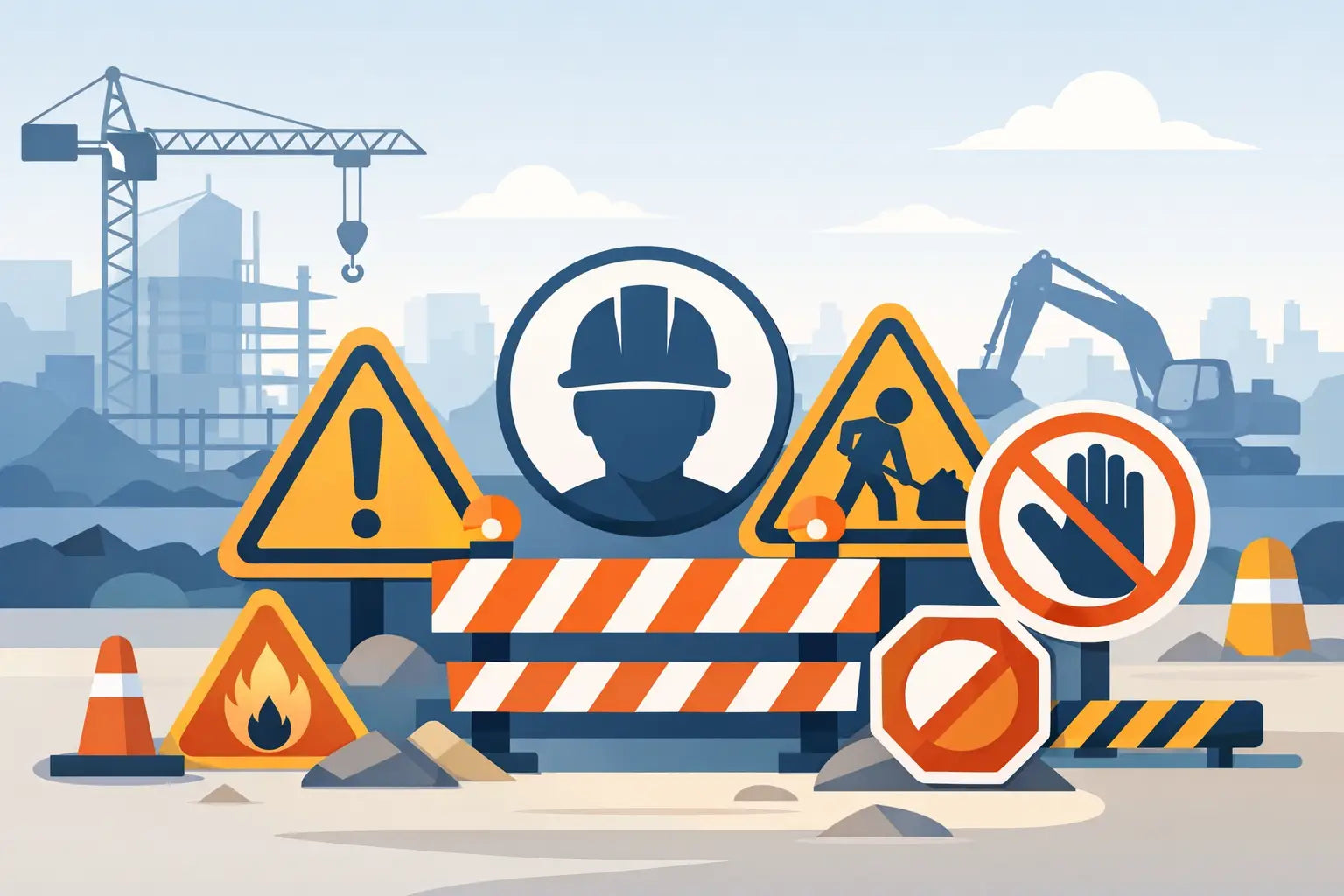
A missing sign at a site entrance, excavation edge or vehicle crossing can turn a known hazard into an avoidable incident. So, what warning signs should every construction site have? The short answer is signs that make the site’s real, current risks clear to workers, delivery drivers, visitors and the public before they reach danger.
There is no one identical sign pack for every project. A small refurbishment site and a multi-contractor development face very different risks. However, UK construction sites do share common hazards, and clear, correctly positioned safety signage is a practical part of controlling them. Signs should support proper planning, barriers, supervision, training and safe systems of work - never replace them.
Start with the site entrance
The entrance is where expectations need to be established quickly. Anyone entering the site should be able to see that it is a controlled work area, understand whether access is restricted and know the minimum rules before passing through the gate.
A prominent Construction Site - Keep Out or Danger Construction Site sign is usually the starting point. It warns members of the public that the area is hazardous and makes the boundary clear. Where the public could approach the site, this should be displayed at every practical access point, not just on the main gate.
Entrance signage should also state No Unauthorised Access. This is particularly useful where work is taking place near occupied premises, public footpaths, retail areas or shared industrial estates. A clear prohibition sign can help site staff challenge unauthorised entry before it becomes a problem.
PPE requirements belong at the entrance too. A mandatory sign should show the equipment required for that particular site, such as safety helmets, safety footwear, hi-vis clothing, eye protection or hearing protection. Avoid displaying a generic collection of symbols that does not reflect the rules being enforced. If face protection is only necessary in a designated cutting area, for example, sign that area rather than suggesting it applies everywhere.
Site rules boards can bring these messages together, covering visitor reporting, speed limits, mobile phone restrictions, welfare arrangements and emergency contacts. They are especially effective on larger sites with several contractors. Keep the information current and readable from a sensible distance.
Warning signs for the hazards on site
Under the Health and Safety (Safety Signs and Signals) Regulations 1996, warning signs use a yellow triangle with a black border and symbol. Their purpose is to draw attention to a remaining risk. The symbol needs to be familiar, visible and relevant to the location.
The following hazards commonly require warning signage on construction sites:
- Moving vehicles and plant: Use warning signs where excavators, dumpers, telehandlers, forklifts, lorries or cranes operate. Separate pedestrian and vehicle routes wherever possible, then reinforce crossings, blind corners, reversing areas and loading zones with clear signs.
- Excavations and uneven ground: Signs such as Danger Deep Excavation, Warning Uneven Surface or Danger Steep Drop are appropriate where people could approach trenches, pits, open basements or unstable edges. They must sit alongside secure edge protection, barriers and safe access arrangements.
- Overhead hazards: Display warnings for Overhead Loads, Overhead Crane, Low Headroom and overhead power lines where applicable. A sign will not control lifting operations, but it alerts people who may otherwise walk beneath a suspended load or bring tall plant into a restricted area.
- Electrical risks: Use Danger Electricity, High Voltage and Beware Live Cables signs at temporary electrical installations, switch rooms, cable routes and areas affected by underground or overhead services. The precise sign depends on the risk identified by the survey and work activity.
- Work at height and falling objects: Signs for Danger of Falling, Falling Objects and Fragile Roof are needed where access to roofs, scaffolds, elevated work zones or areas below overhead work must be controlled.
- Hazardous substances: Where fuels, solvents, cement, gases or other harmful materials are stored or used, provide the relevant hazard communication and access-control signs. Chemical labelling and safety data arrangements still apply - a general warning sign alone is not enough.
Match the sign to the instruction
Not every safety message is a warning sign. Using the right format makes instructions easier to understand at a glance.
A yellow triangular sign warns of danger, such as forklift traffic. A red circular prohibition sign tells people what they must not do, such as No Smoking near fuel or gas cylinders. A blue circular mandatory sign tells them what they must do, such as Wear Eye Protection. Green signs identify safe conditions, including first aid, emergency exits and assembly points. Red rectangular signs identify fire equipment and fire action information.
This distinction matters. A sign saying Beware of Forklift Lorries is useful, but it does not tell pedestrians where to walk. Combine it with marked pedestrian routes, crossing signs and, where necessary, a Keep Clear or No Pedestrian Access instruction. Good site signage works as a system, not as isolated notices fixed to a fence.
Do not overlook fire and emergency signs
Construction sites change quickly, and fire arrangements need to keep pace. Temporary cabins, hot works, fuel storage, battery charging and incomplete escape routes can all alter the risk profile from one phase to the next.
Fire point signs should identify extinguishers, hose reels, alarms and other equipment clearly. Fire action notices should be located where people can read them, particularly in welfare units, offices and accommodation areas. Where smoking creates a fire risk, display No Smoking signs around fuel stores, gas cylinders, flammable materials and designated restricted zones.
Every site also needs clear emergency wayfinding. Green First Aid signs should identify first aid kits, first aid rooms and eyewash facilities where provided. Mark the assembly point, emergency exits and escape routes, making sure the signs remain visible if the layout changes or temporary fencing is moved.
For a larger site, emergency information boards can show the site address, grid reference where helpful, emergency contact numbers and the location of the assembly point. This gives a visitor or new starter vital information without relying on memory during a stressful event.
Traffic management signs protect more than drivers
Vehicle movements remain a serious construction risk, particularly where delivery vehicles and mobile plant share space with people on foot. Signs should reinforce the traffic management plan, not stand in for one.
Use clear speed limit signs at entrances and along internal routes. Mark one-way systems, delivery bays, parking areas, pedestrian walkways and crossing points. Caution Vehicles Reversing signs are valuable near loading areas, but reversing should be minimised through route design and managed by trained banksmen where required.
Consider who will read each sign. A delivery driver arriving for the first time may not know the site layout, while a worker carrying materials may have limited sightlines. Position signs before the point of conflict, at a height that is not obscured by parked plant, stacked materials or site hoarding.
Keep signs visible, current and fit for the job
A compliant message is of little value if it is faded, hidden or left behind after the hazard has gone. Construction environments are hard on signage: rain, dust, UV exposure, mud and repeated site changes all take their toll. Choose durable materials suitable for outdoor use and use secure fixings appropriate to hoarding, fencing, gates, cabins or rigid barriers.
Inspect signs during routine site checks. Replace damaged or illegible notices promptly, and remove temporary signs when the activity ends. Too many outdated notices create sign fatigue, where people stop noticing messages because every surface is covered.
Placement also depends on viewing distance and lighting. A small sign may be adequate on a pedestrian gate, but a vehicle route or public-facing perimeter may need a larger format. Reflective or photoluminescent signage can be useful where lighting is poor, though it should be selected for the actual conditions rather than as a blanket upgrade.
A risk-led approach is the right answer
The question of what warning signs every construction site should have is best answered through the site risk assessment and construction phase plan. Start with access control, mandatory PPE, moving vehicles, excavations, electricity, work at height, fire and emergency information. Then add signs for the specific tasks, materials and conditions present that week.
For trade buyers managing multiple projects, standardising the core entrance, PPE, traffic and emergency signs can save time and create consistency. Keep a separate supply of task-specific signs ready for changing works, such as demolition, lifting operations, hot works or temporary electrical hazards. Bulk ordering can be sensible for repeat needs, but only when the messages will genuinely be used.
The Safety Sheep Store supplies British-made site safety signs across these common categories, helping contractors and facilities teams source clear, durable signage without slowing down the job. Think Safety - Think Sheep.
The best sign is the one a person sees early enough to make a safer decision. Review the site as it is now, not as it looked when the project began, and let the signage change with the work.
Share:
What PPE Signs Are Required on Building Sites?
What Danger Signs Are Required by HSE at Work?