

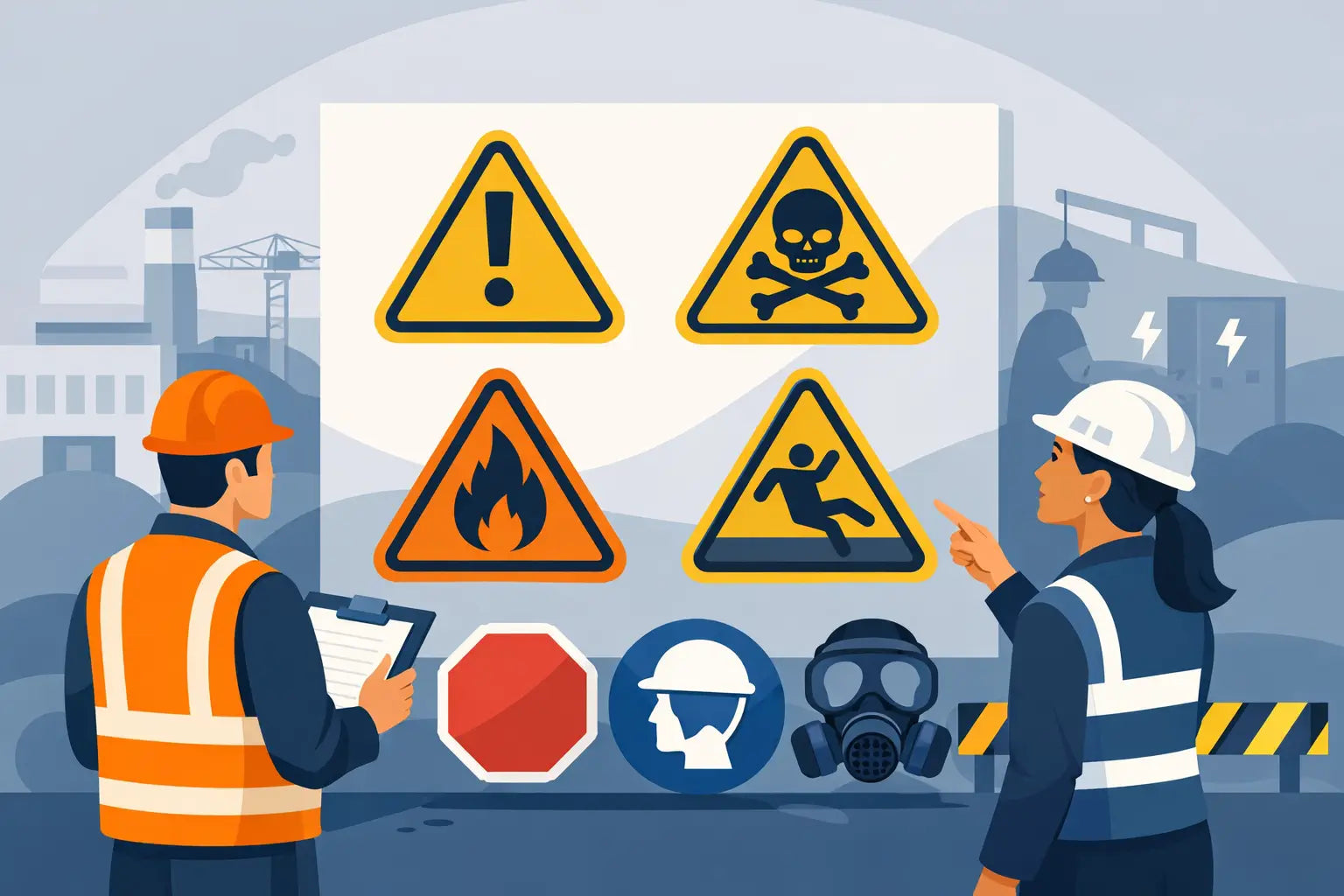
A missing warning sign can turn a known site hazard into an avoidable incident. When asking, what danger signs are required by HSE?, the practical answer is that HSE does not publish one fixed shopping list for every workplace. The signs you need depend on the hazards identified in your risk assessment, the people exposed to them and the controls already in place.
For UK employers, contractors, landlords and facilities teams, signage is part of a wider duty to provide clear health and safety information. The right sign helps workers, visitors and contractors recognise a risk before they reach it. The wrong sign - or too many poorly positioned signs - can be ignored just as easily as no sign at all.
What danger signs are required by HSE?
Strictly speaking, HSE does not require every business to display generic “Danger” signs. Under the Health and Safety (Safety Signs and Signals) Regulations 1996, safety signs are required where a significant risk remains after other suitable control measures have been put in place, and where a sign can help prevent or reduce that risk.
That distinction matters. A warning sign must never be used as a substitute for guarding machinery, repairing a damaged floor, securing a chemical store or training staff. Remove or control the hazard first wherever reasonably practicable. Use signs to communicate the remaining risk, reinforce a procedure or direct people towards the safe action.
For example, an exposed live electrical part should be isolated, enclosed or otherwise made safe. Where access is still restricted and an electrical hazard remains, a suitable warning sign is appropriate. A slippery entrance may need cleaning, drainage or a repaired surface; during a temporary wet-floor risk, a clearly placed warning sign is also needed.
The main sign types used on UK sites
The phrase “danger sign” is often used to describe any health and safety sign. In practice, UK workplaces use several standard sign categories, each with a particular colour, shape and meaning. Consistency is what makes them quick to understand.
Warning signs - hazards that remain
Warning signs tell people to take care because a hazard is present. They are generally a black pictogram on a yellow triangular background with a black border. Examples include warnings for electricity, forklift lorries, overhead loads, hot surfaces, deep water, uneven ground, asbestos, toxic material and flammable substances.
A warning sign is appropriate when someone may encounter a hazard and needs advance notice to avoid it. A yellow warning triangle at the entrance to a battery-charging area, for instance, can alert staff to corrosive substances or explosive atmospheres where relevant. The exact sign should match the actual risk, not a vague assumption.
Prohibition signs - actions that are not allowed
Prohibition signs have a black symbol inside a red circle with a diagonal bar. They are used where a particular behaviour could create or increase danger. Common examples are No Smoking, No Naked Flames, No Unauthorised Access, No Pedestrians and Do Not Use Mobile Phones.
These signs are especially useful around fuel, gas cylinders, flammable liquid stores, machinery and controlled work areas. A No Smoking sign may be necessary where smoking could create an ignition source, but it should be paired with proper storage, separation and site controls rather than treated as the only precaution.
Mandatory signs - actions people must take
Mandatory signs are blue circles with a white pictogram. They instruct people to carry out a required action, such as Wear Eye Protection, Wear Hearing Protection, Wear Safety Footwear, Wear a Hard Hat or Keep This Door Closed.
PPE signs should follow the PPE requirements identified by your assessment. If eye protection is mandatory in a workshop zone, display the sign at every practical access point, before a person enters the area. Do not rely on a single sign hidden behind racking or placed halfway across the workshop.
Safe-condition and fire safety signs
Safe-condition signs use a green background and white symbol. They show escape routes, emergency exits, first-aid points, eyewash stations, assembly points and emergency escape opening devices. Fire equipment signs use a red background with a white pictogram, identifying items such as fire extinguishers, fire hose reels, fire alarms and fire blankets.
These are not usually called danger signs, but they are central to safe site operation. In an emergency, staff and visitors need to find an exit, alarm point or first-aid facility immediately. Fire and emergency signage must be clear, suitably positioned and kept visible as layouts change.
When signage is likely to be necessary
A risk assessment should lead the decision. Signs are commonly needed where hazards cannot be entirely eliminated, where access must be controlled, or where people unfamiliar with the site could be exposed to risk. This is particularly relevant on construction sites, farms, warehouses, manufacturing premises, schools, retail back-of-house areas, car parks and shared commercial buildings.
Consider a warehouse with forklift routes. Physical segregation, speed limits, mirrors and marked walkways are stronger controls than a sign alone. Yet warning signs for forklift traffic, pedestrian restrictions and mandatory high-visibility clothing may still be required at entry points and crossings. The signs support the system people have to follow.
The same principle applies to temporary work. A contractor opening a ceiling void, carrying out hot works, cleaning a spill or unloading a lorry may create a short-term hazard. Temporary signs and barriers can be the right solution, provided they are removed when the risk is gone. Leaving outdated notices in place weakens the credibility of every sign on site.
Choosing the correct sign for the hazard
The safest choice is usually a standardised pictogram that people recognise at a glance. Text can provide useful detail, particularly for site-specific rules, but a familiar symbol should remain the main visual message where possible. Consider workers who may not read English confidently, visitors seeing the area for the first time, and people who only have seconds to react.
Sign size depends on viewing distance, lighting and the speed at which people are moving. A small label on a chemical cabinet may be suitable at arm’s length; it is not suitable for identifying a restricted plant room from a corridor. Larger rigid signs, banners or repeated signs may be needed in yards, loading areas and construction entrances.
Material matters too. Indoor office signs may only need a clean, durable self-adhesive finish. A farm gate, external compound or busy factory needs signage that can withstand moisture, dirt, sunlight and routine cleaning. For temporary hazards, use portable floor stands or temporary boards that are stable and visible without obstructing an escape route.
Signs for hazardous substances and specialist risks
Some risks have additional, specific labelling requirements. Hazardous chemicals, for example, require appropriate packaging labels under GB chemicals legislation, including relevant hazard pictograms. A warning sign on the door of a chemical store does not replace labels on individual containers, safety data sheets, suitable storage or staff training.
Asbestos is another area where precision is essential. If asbestos-containing materials are known or presumed to be present, the dutyholder must manage the risk. Signs may be used to mark controlled areas or identify specific hazards where appropriate, but careless labelling can cause unnecessary alarm or encourage tampering. Follow the asbestos register and management plan rather than applying signs indiscriminately.
For electrical rooms, confined spaces, laser areas, radiation work, biohazards and explosive atmospheres, specialist rules and competent advice may apply. In these cases, check that the sign communicates the particular hazard and access condition. A generic “Danger” notice can be less useful than a clear symbol and instruction such as “Danger - 415 Volts”, “Confined Space - Permit Required” or “Authorised Personnel Only”.
Positioning, maintenance and site checks
A compliant sign is only useful if people can see and understand it. Put signs at the point where a decision must be made: before entering a restricted area, before reaching a machine hazard, at a pedestrian crossing or alongside the required equipment. Avoid placing several conflicting messages on one small board.
Include signage in routine inspections. Check for faded colours, broken fixings, peeling stickers, obscured notices and signs left behind after work has finished. If a site layout changes, review the signs at the same time. A relocated fire extinguisher, altered pedestrian route or new loading bay often creates an immediate need to update signage.
For multi-site operators, a simple sign schedule can save time. Record the hazard, location, sign type, material, installation date and review date. This helps procurement teams standardise orders and gives managers a clear record of what is displayed at each location.
A practical approach to ordering safety signs
Start with the risk assessment, then walk the site as a visitor would. Identify hazards at entrances, routes, work zones, storage areas, welfare facilities and emergency points. Choose recognised safety sign formats, specify the right size and material, and order enough signs to cover every relevant approach - not just the most obvious one.
The Safety Sheep Store supplies British-made workplace signage across warning, prohibition, mandatory, fire safety and safe-condition categories, with options for individual replacements and larger site orders. Where several premises use the same controls, standardising your signs can support clearer rules, faster ordering and consistent presentation.
Good safety signage does not make a poor system safe. It makes a well-controlled workplace easier to understand, especially when pressure is high and time is short. Think Safety - Think Sheep.
Share:
What Warning Signs Should Every Construction Site Have?
What Danger Signs Are Needed on Construction Sites?