

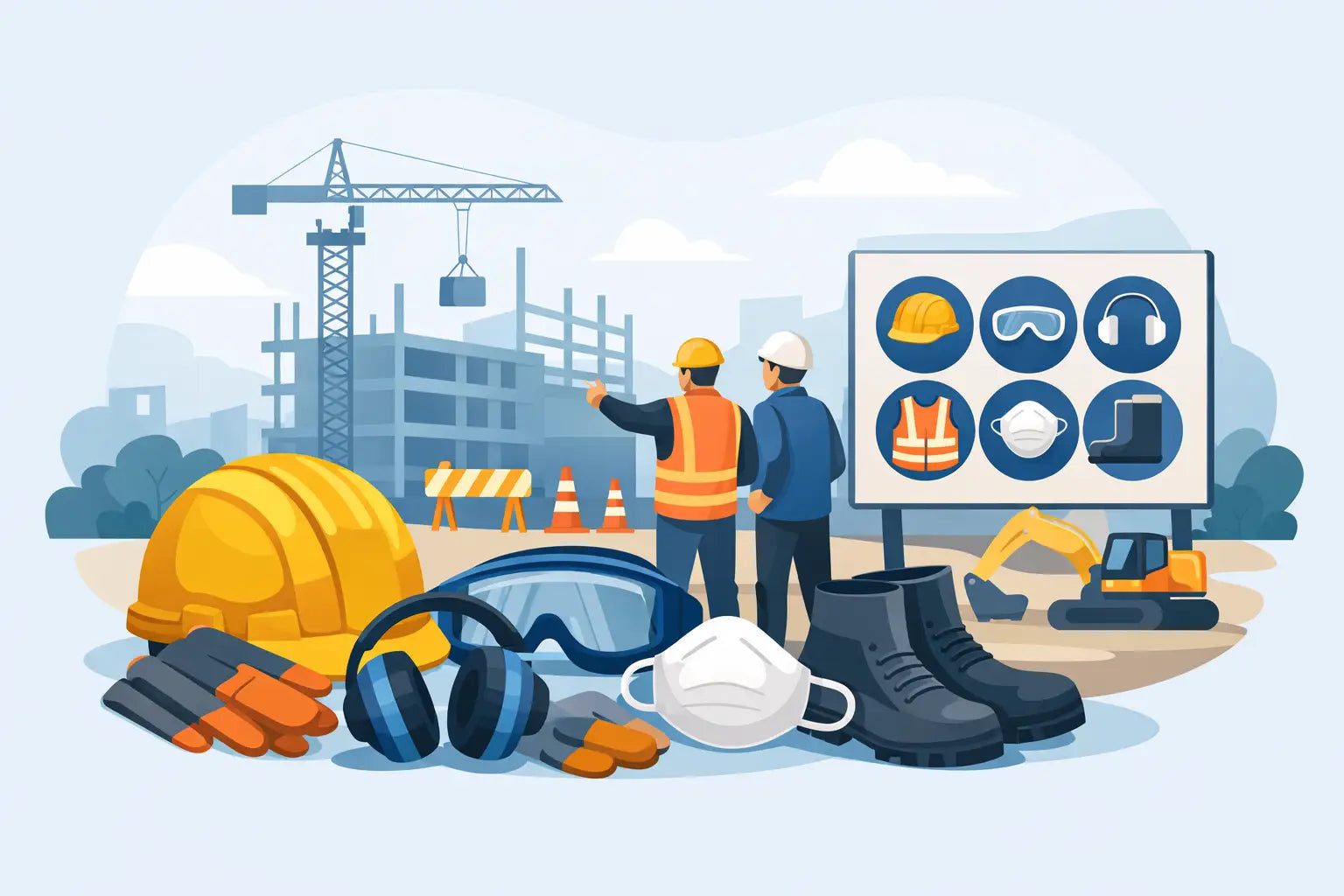
A missing sign at a site entrance can leave workers, delivery drivers and visitors unclear about the rules before they have even passed the gate. When asking what PPE signs are required on building sites?, the practical answer is that there is no single fixed set for every project. Your signs must reflect the PPE identified by your risk assessment, the activities taking place and the hazards present in each area.
For most UK construction sites, this means clear mandatory PPE signs at entry points, backed up by additional signs where a particular task or changing site condition demands more protection. The aim is simple: people should know what they must wear, where they must wear it and what they need to do before entering a hazardous area.
The legal basis for PPE signs on UK building sites
The Health and Safety at Work etc. Act 1974 requires employers and those in control of premises to protect employees and others affected by their work. On a building site, that duty extends beyond the workforce to subcontractors, visitors, suppliers and members of the public who may be exposed to site risks.
The Management of Health and Safety at Work Regulations 1999 require suitable and sufficient risk assessments. These assessments are what determine whether hard hats, safety footwear, eye protection, hearing protection or other PPE is necessary. PPE should not be the first control measure where a hazard can be eliminated or controlled another way, but it remains essential on many construction tasks.
The Health and Safety (Safety Signs and Signals) Regulations 1996 require safety signs where a significant risk cannot be avoided or adequately controlled by other means. In practice, mandatory signs are used to communicate the PPE rule clearly. They should use recognisable symbols, normally in line with BS EN ISO 7010, and be positioned where people will see them before entering the relevant risk area.
A blue circular sign with a white pictogram means an action is compulsory. That makes it the correct format for messages such as “Safety helmets must be worn” or “Eye protection must be worn”. A blue sign is not merely a reminder. It supports a site rule that has been set following risk assessment.
What PPE signs are required on building sites at the entrance?
The main entrance is the starting point for site-wide PPE instructions. It is usually the right place for a combined mandatory PPE sign that tells every person entering the site what the minimum requirement is.
On many active building sites, the standard entry requirement will be a safety helmet, safety footwear and high-visibility clothing. A combined sign is often the clearest option, particularly where space is limited and delivery drivers or visitors need to understand the rules quickly. However, do not copy this approach automatically. If the work and risk assessment do not justify a particular item, the sign should not make it a blanket requirement simply because it is common elsewhere.
For example, hard hats remain necessary where there is a foreseeable risk from falling objects, overhead work, lifting operations or striking against fixed objects. In a low-risk site office or a completed, controlled internal area, that same rule may not apply. The sign must reflect the actual boundary of the risk, not habit.
Entrance signs should be large enough to read from a sensible approach distance and fixed where they cannot be obscured by gates, parked vehicles, temporary fencing or notices. Where the public can approach the entrance, pair PPE instructions with appropriate prohibition, warning and site access signage so that the message is not misunderstood as an invitation to enter.
PPE signs needed for specific construction activities
A site entrance sign sets the baseline. It does not replace task-specific signage. Construction work changes quickly, and the PPE required around a temporary cutting station, demolition zone or roof access point can be very different from the rest of the site.
The following mandatory signs are commonly needed where the relevant hazards exist:
- Safety helmets must be worn where there is a risk from falling, moving or overhead objects.
- Safety footwear must be worn in areas with risks from sharp materials, crush injuries, uneven ground, nails or heavy loads.
- High-visibility clothing must be worn around moving plant, vehicle routes, loading areas and poor-light working zones.
- Eye protection must be worn for cutting, grinding, drilling, chemical handling and work that creates flying particles or splashes.
- Hearing protection must be worn where noise assessments identify hearing protection zones, such as near demolition equipment, compressors or saws.
- Respiratory protection must be worn where suitable respiratory protective equipment is required for dust, fumes, vapours or hazardous substances.
- Protective gloves must be worn where handling materials, chemicals or sharp-edged items creates a hand injury risk.
- Safety harness must be worn where a fall-arrest system is required for work at height.
Put signs where the decision to wear PPE is made
The best sign is one seen before exposure begins. This means placing PPE signs at entrances to designated zones, not halfway through them. A hearing protection sign belongs at the entrance to the hearing protection zone. An eye protection sign belongs before the cutting or grinding area. Respiratory protection instructions need to be visible before a person enters a dusty enclosure or begins work with a hazardous substance.
Consider the site journey. A worker arriving on foot, a subcontractor entering through a turnstile and a delivery driver reporting to a gatehouse may each approach from a different direction. Your signs need to work for all of them. If language, lighting, distance or temporary routes could affect understanding, use standard pictograms and reinforce the instruction during induction and toolbox talks.
Temporary works require particular attention. As site layouts move, scaffold access changes or a new workface opens, old signs can become irrelevant and new hazards can appear overnight. Include signage in routine inspections, especially after changes to traffic management, work sequencing, plant locations or hazardous processes.
Signs alone do not make PPE rules effective
A mandatory sign is part of the control system, not a substitute for it. Workers must be given suitable PPE free of charge, trained in its use and provided with equipment that fits properly and is maintained. A sign telling someone to wear respiratory protection is inadequate if the correct mask has not been selected, face-fit testing has not been carried out where required, or the work creates more dust than the control measures can manage.
The same principle applies to site visitors. Provide a clear visitor process, issue appropriate PPE where necessary and make sure the escort understands which areas are off limits. A generic “PPE must be worn” notice is not enough for a visitor who has no helmet, safety boots or understanding of the route they are expected to follow.
Supervisors should also check compliance consistently. If a mandatory sign is displayed but PPE rules are ignored, the site is sending mixed messages. Clear signs, inductions, available equipment and fair enforcement need to work together.
Choosing durable, clear PPE signage
Building sites are hard on signs. Rain, mud, dust, UV exposure and regular relocation can quickly make a cheap or unsuitable sign difficult to read. Choose a material and fixing method suited to the location. Rigid boards work well on hoarding, gates and welfare areas, while self-adhesive vinyl may suit clean internal surfaces. Temporary fencing may call for cable-tied signs that can be moved as the site develops.
Check signs regularly for fading, damage and obstruction. A sign covered in spray, dirt or a stack of materials may as well not be there. It is also worth keeping spare mandatory PPE signs on hand for changing work zones and urgent replacements, particularly on larger projects or multi-site contracts.
Safety Sheep supplies British-made mandatory PPE signage for construction sites, including individual, combined and site-entry formats, with trade pricing available for larger orders. Selecting the right signs is quicker when they are organised around the hazards your team actually manages.
A well-signed site does more than satisfy an inspection. It gives people a clear instruction at the moment they need it, reduces avoidable confusion and helps every contractor arrive ready to work safely. Think Safety - Think Sheep.
Share:
What Signs Are Legally Required on a Construction Site?
What Warning Signs Should Every Construction Site Have?