

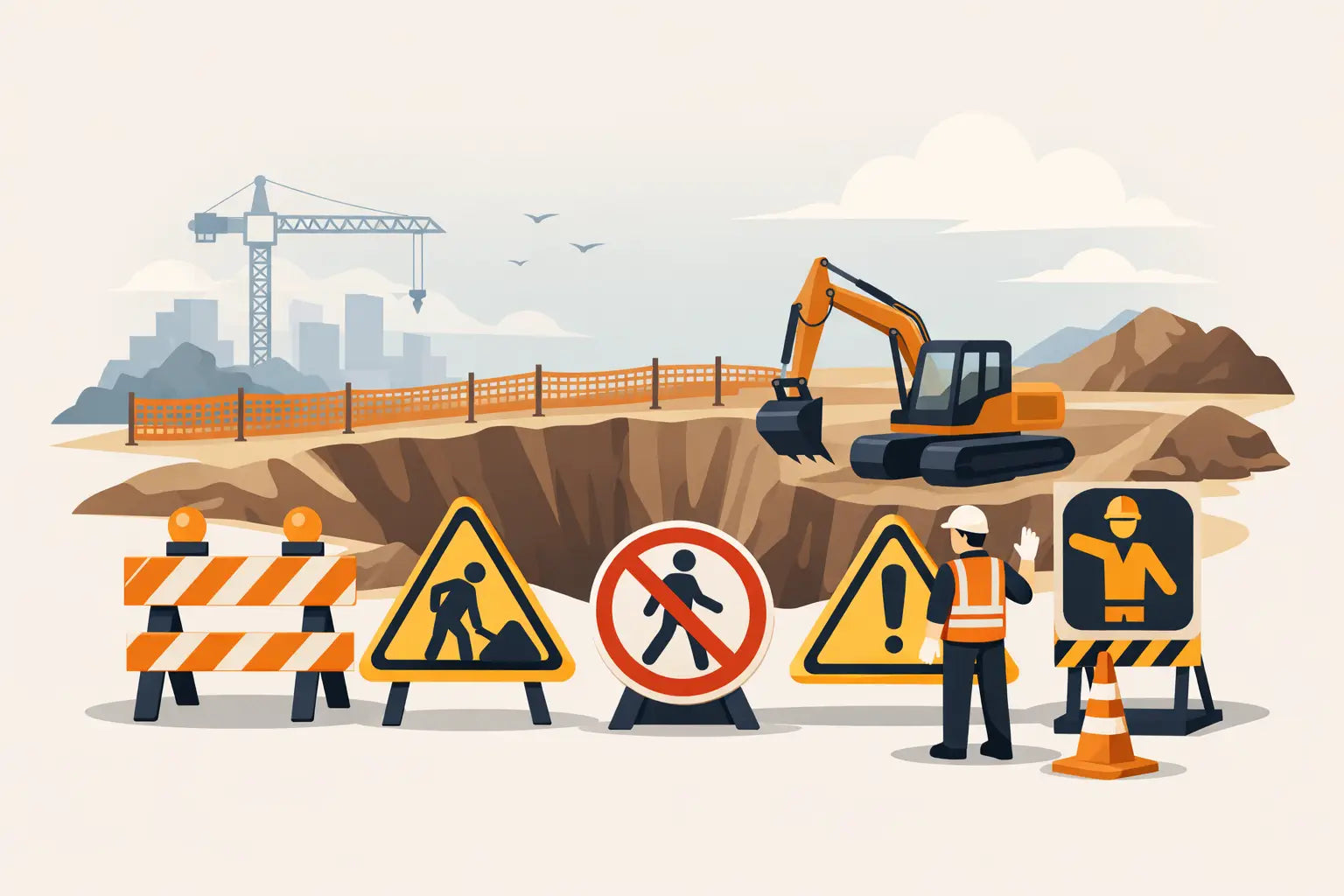
An excavation can become a serious hazard before anyone steps into it. A shallow trial hole beside a footpath, an open trench on a busy construction site or a deeper foundation excavation all create risks from falls, unstable ground, moving plant and unauthorised access. That is why the question, what signs are needed around excavations?, should be answered as part of the planning process, not when the work has already started.
Clear signs do not replace secure barriers, edge protection, safe access or competent supervision. They do, however, make the hazard obvious, reinforce site rules and give workers, visitors and the public clear instructions at the point they need them.
What signs are needed around excavations on UK sites?
There is no single sign that makes every excavation compliant. The right combination depends on the depth and position of the dig, the nature of the work, who could approach it, vehicle movements and the findings of the site risk assessment.
Under the Health and Safety (Safety Signs and Signals) Regulations 1996, safety signs should be used where a significant risk remains after other suitable controls have been put in place. For excavation work, this usually means using signs to warn of the open excavation, restrict entry, control vehicle routes and communicate any PPE or emergency requirements.
A sign stating Danger Deep Excavation or Danger Open Excavation is commonly appropriate where there is a fall risk. Where the public, delivery drivers or other unauthorised people could gain access, pair the warning with a clear Keep Out, No Unauthorised Entry or Construction Site Keep Out notice. The wording should reflect the actual risk rather than relying on a vague generic message.
For most active excavation areas, a practical signing package will include warning signs at the perimeter and access points, prohibition signs where entry must be restricted, and directional or mandatory signs where people need to follow a safe route or wear specified PPE.
Start with the physical controls, then sign the risk
An exposed edge needs more than a warning notice. Excavations must be suitably supported or battered back where necessary, protected by barriers or edge protection, and inspected by a competent person at the required intervals and after events that may affect stability. Signage supports these controls by making their purpose clear.
This matters because signs can create a false sense of security if they are used on their own. A "Danger Excavation" sign attached to lightweight tape is not adequate protection around a trench that someone could fall into. Use suitable fencing, barriers, gates or hoarding first, then fix signs where they are visible to anyone approaching the hazard.
The level of protection should increase where the excavation is close to a pedestrian route, public highway, entrance, shared workplace, school, retail unit or neighbouring property. A remote area of a controlled construction site may need fewer signs than a roadworks excavation beside a public pavement, but both still need a clear, risk-based approach.
Warning signs for open trenches and excavations
Warning signs alert people to a hazard they may not immediately see, particularly in poor light, wet weather or busy work areas. The familiar yellow triangular warning format is designed to attract attention quickly.
For an excavation, suitable warnings may include Warning Excavation, Danger Deep Excavation, Danger Open Trench or a fall hazard warning. Choose wording that is proportionate to the condition. A deep, unprotected excavation deserves direct language. For a shallow service trench with controlled access, a general excavation warning may be enough alongside barriers and a safe crossing point.
Where excavators, dumpers or lorries operate close to the dig, warning signs should also address the movement risk. Beware Moving Plant, Construction Traffic and Caution Site Vehicles signs help separate pedestrians from vehicle routes. They are especially useful at blind corners, haul roads, loading areas and crossing points.
Do not obscure the main hazard with too many messages on one board. A person arriving at the perimeter should be able to identify the excavation danger and the required action within seconds.
Prohibition signs to stop unauthorised access
An excavation often attracts people who should not be near it: visitors looking for a shortcut, delivery drivers, members of the public, children, or workers from another trade. A prohibition sign gives a direct instruction, normally shown as a red circular symbol with a diagonal bar.
No Unauthorised Entry, Keep Out, No Entry and No Pedestrians signs are suitable options depending on the route and restriction. Use them at gates, gaps in fencing, site boundaries and approaches from neighbouring work areas. If entry is permitted only for trained personnel, make that clear rather than using wording that could be misunderstood.
At a larger site, a Construction Site - Keep Out sign at the main boundary helps set the rule before someone reaches the excavation itself. At the immediate perimeter, a more specific warning such as Danger Deep Excavation - Keep Out is often more effective.
Mandatory signs and safe access information
People who are authorised to work near an excavation still need clear instructions. Blue mandatory signs can confirm requirements such as safety helmets, high-visibility clothing, safety footwear or eye protection. The correct PPE requirements should come from the task and risk assessment, not from a standard sign bundle.
If workers must use a designated walkway, stair tower, ramp or crossing point, sign it clearly. A Pedestrian Route, Keep to Footpath or Use Designated Access sign can reduce the temptation to walk beside an unsupported edge or cross a trench at an unsafe point.
Where a trench crossing is provided, it should be properly designed, maintained and guarded as necessary. A sign saying "Use Crossing Point" does not make an improvised scaffold board safe. The route must be safe first, then clearly marked.
Where should excavation signs be placed?
Put signs where they can be seen before a person reaches the danger. This usually means at every practical approach to the excavation perimeter, not only on one side facing the site office. Consider workers arriving on foot, plant operators, drivers, visitors and members of the public using adjacent routes.
Mount signs securely on fencing, barriers, gates or purpose-made posts. They should be at a readable height, face the direction of travel and remain visible when plant, materials or parked vehicles are nearby. If the site operates at dusk or overnight, consider lighting, reflective materials or illuminated traffic management where the risk assessment calls for it.
Inspect signs as part of routine site checks. Rain, mud, wind, vibration and site traffic can leave a sign damaged, dirty, turned away or missing altogether. Conditions also change quickly during excavation work. A new access route, a deeper dig, a relocated barrier or a change in public access may mean the signs need moving or adding.
Signs for excavations near the public highway
Excavations next to roads, pavements and public spaces need particularly careful planning. The public may not understand site layouts, may be distracted by traffic, and may include people with limited mobility, visual impairment or pushchairs.
Use strong physical segregation and clear pedestrian diversion signs where a normal footway is affected. Road and street works can require traffic signs, cones, barriers, lighting and permits that follow the relevant highway authority requirements and traffic management arrangements. A standard construction warning sign alone is unlikely to be sufficient.
Keep the message simple. Tell pedestrians whether the route is closed, where to go instead and whether they need to cross. Do not leave them to work it out beside an excavation or live traffic route.
A practical excavation signage check
Before work starts, check that the site has addressed these distinct points:
- A clear warning sign identifies the excavation or open-trench hazard.
- Barriers, fencing or edge protection are in place before relying on signs.
- Unauthorised access is restricted with suitable prohibition notices at likely entry points.
- Pedestrian and vehicle routes are separated and signed where needed.
- PPE, safe access and emergency information are displayed for authorised workers.
- Signs are visible, secure, clean and reviewed as site conditions change.
The best excavation signs are the ones people see early, understand instantly and can act on safely. Keep the message specific, keep the barrier secure, and review both whenever the ground, workforce or traffic route changes. Think Safety - Think Sheep.
Share:
What Fire Safety Signs Should Every Workplace Have?
What Signs Are Legally Required on a Construction Site?