

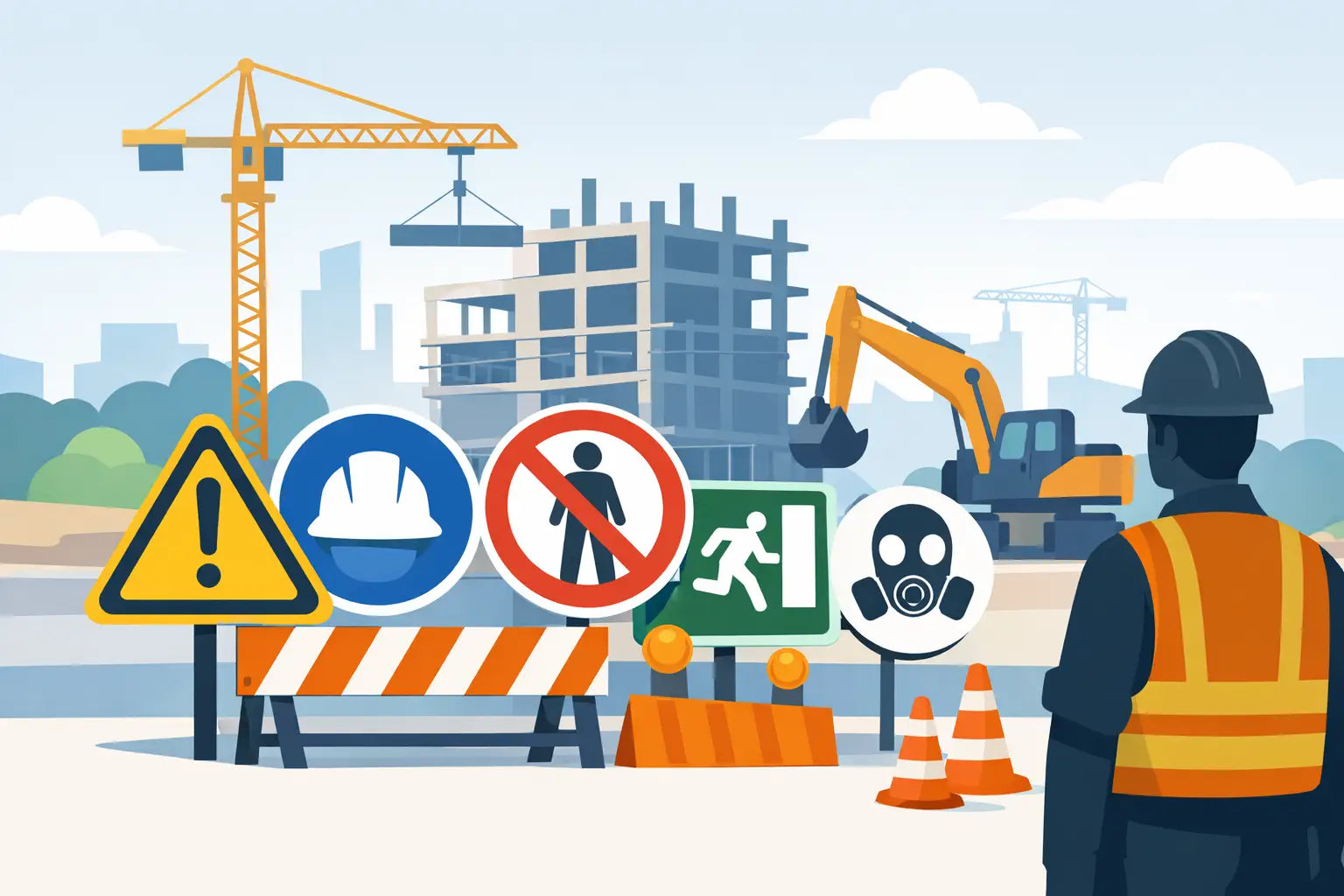
A poorly signed site entrance can create a problem before anyone reaches the work area. So, what signs are legally required on a construction site? The short answer is that UK law does not prescribe one fixed sign pack for every project. Required signage depends on the work being carried out, the risks identified, the people on site and whether the public could be affected.
For site managers, the practical task is to make sure essential information is visible, safety warnings are clear and people can act safely without relying on guesswork. Signs support your risk assessments, method statements, induction process and physical control measures. They do not replace them.
What signs are legally required on a construction site?
The main legal framework includes the Health and Safety at Work etc. Act 1974, the Construction (Design and Management) Regulations 2015, the Health and Safety (Safety Signs and Signals) Regulations 1996, and fire safety legislation. These laws require employers and dutyholders to manage risk, provide information and use safety signs where a risk cannot be adequately controlled by other means.
That distinction matters. A mandatory hard hat sign is not automatically required on every square metre of every site. But where a risk assessment identifies a head-injury risk and hard hats are required, a clear mandatory PPE sign is an appropriate and often expected control. The same principle applies to warning signs for excavation, moving vehicles, overhead work and restricted access.
A compliant site will usually need a combination of statutory notices, prohibition signs, warning signs, mandatory instruction signs and emergency information. The exact mix should change as the job changes.
The F10 notification notice on notifiable projects
Under CDM 2015, certain projects must be notified to the Health and Safety Executive using an F10 notification. A project is notifiable if construction work is scheduled to last longer than 30 working days and has more than 20 workers working simultaneously at any point, or if it exceeds 500 person-days.
Where notification is required, the principal contractor must display the F10 notice clearly where it can be read by workers. It must be kept up to date if the project details change. This is one of the clearest examples of a specifically required construction site notice.
The notice includes key details such as the project address, client, principal designer, principal contractor, planned start and finish dates, and the expected maximum number of people working on site. Do not treat an F10 as a generic site safety sign. It is a project notification and is only required when the project meets the notification threshold.
Health and safety law poster or leaflet
Employers must provide employees with health and safety law information. In practice, this means displaying the approved Health and Safety Law poster where employees can read it or providing each employee with the approved leaflet.
On a construction project, the site office, welfare unit or induction area is normally the most suitable position for the poster. A weatherproof version may be sensible where conditions are harsh, but it still needs to be legible. If the workforce changes regularly, include the information in the site induction process and make sure the poster remains visible for direct employees.
Signs that should follow your risk assessment
The Safety Signs and Signals Regulations apply where safety signs are needed to warn people of risks that cannot be avoided or controlled adequately by other measures. This means the principal contractor or employer should not simply cover the perimeter with signs. Too many irrelevant notices reduce the impact of the ones people genuinely need to see.
Use standard sign colours and symbols so the message is immediately recognisable: red for prohibition and fire equipment, yellow for warnings, blue for mandatory actions, and green for safe-condition and emergency escape information.
PPE signs and mandatory instructions
Construction work often requires personal protective equipment, but the requirement can vary between work zones. Mandatory blue signs should state the PPE needed for the particular hazard, such as hard hats, eye protection, hearing protection, respiratory protection, safety footwear or hi-vis clothing.
A blanket "PPE must be worn" notice at the gate can be useful, but it may not be enough on a complex site. Place additional signs at the point where the rule applies, especially at cutting areas, demolition zones, confined spaces and locations with high noise or dust exposure. The instruction should match the PPE policy actually being enforced.
Hazard warning and prohibition signs
Warning signs are typically needed around foreseeable site hazards. Common examples include deep excavations, unstable ground, overhead loads, electrical danger, moving plant, slippery surfaces, hazardous substances and asbestos work.
Prohibition signs control behaviour that could cause immediate harm. Depending on the site, these may cover unauthorised entry, smoking, naked flames, mobile phone use, pedestrian access, entry beneath suspended loads and parking restrictions. Smoking and naked-flame controls are particularly important where flammable gases, fuels or other dangerous substances are stored or used.
The sign must be positioned before a person reaches the risk, not after they have already entered the danger area. For an excavation, that usually means signs at access points and along the barrier line, supported by suitable edge protection. A sign alone will not make an unprotected excavation safe.
Fire safety and emergency escape signs
Every construction site needs suitable fire precautions, including an emergency plan proportionate to the risks. Fire escape routes, emergency exits and fire-fighting equipment should be clearly identified where signs are necessary to guide people to safety.
Green safe-condition signs should show escape routes, final exits, assembly points and first-aid locations where applicable. Red fire equipment signs should identify extinguishers, hose reels, fire alarm call points and fire blankets. Keep these signs visible as the layout changes. A fire point hidden behind stacked materials or a fire exit sign pointing towards a locked gate creates a serious failure, even if the sign itself is technically correct.
If temporary accommodation, enclosed work areas or multi-storey structures are involved, check escape routes frequently. Construction sites change quickly, and the signage must change with them.
First aid, welfare and site information
The Health and Safety (First-Aid) Regulations require adequate first-aid provision. Clear signs for first-aid boxes, first-aid rooms and trained first aiders help workers get assistance quickly, particularly where the site is large or divided into separate work areas.
Welfare facilities should also be easy to find. Signage for toilets, washing facilities, drying rooms, drinking water and canteens is not merely a convenience on a busy project. It helps workers access the facilities required under CDM welfare provisions without delay.
A site information board can bring together practical notices such as emergency contacts, induction requirements, delivery instructions, visitor reporting procedures and the site rules. Not every item on that board is a legal requirement, but it is a sensible way to communicate the arrangements that keep the site controlled.
Protecting visitors and the public
A construction site has duties towards anyone affected by its work, including visitors, delivery drivers, neighbouring occupiers and passers-by. Perimeter signs should make the boundary and access arrangements clear. Typical messages include "Construction site - keep out", "Danger - construction work in progress", "All visitors must report to site office" and instructions for drivers.
Where vehicle movements cross pedestrian routes, use clear directional signs, speed restrictions, designated walkways and warning notices. Reversing lorries and mobile plant remain a major source of construction risk, so signs should support a properly planned traffic management system with segregation, trained banksmen where needed and suitable barriers.
If work affects a pavement, road or public right of way, additional requirements may apply through the local authority or highway authority. Do not assume that standard site signs are sufficient for temporary traffic management or diversion routes.
Keep your construction site signs current and usable
Legal compliance is not achieved by putting signs up on day one and leaving them there. Check signage during site inspections, after changes to the programme, when new trades arrive and following any incident or near miss. Remove notices that no longer apply, replace damaged signs promptly and make sure temporary signs are fixed securely.
Choose durable, clearly printed signs suited to the location. Outdoor perimeter boards need to withstand weather; internal notices need to remain visible around changing storage and work areas. For multi-site contractors and procurement teams, ordering standardised British-made signage in quantity can also make replacements faster and keep messages consistent across projects.
The right sign at the right point gives workers, visitors and the public a clear instruction when it matters. Review the risks, sign the controls people need to see and keep the message current. Think Safety - Think Sheep.
Share:
What Signs Are Needed Around Excavations?
What PPE Signs Are Required on Building Sites?