

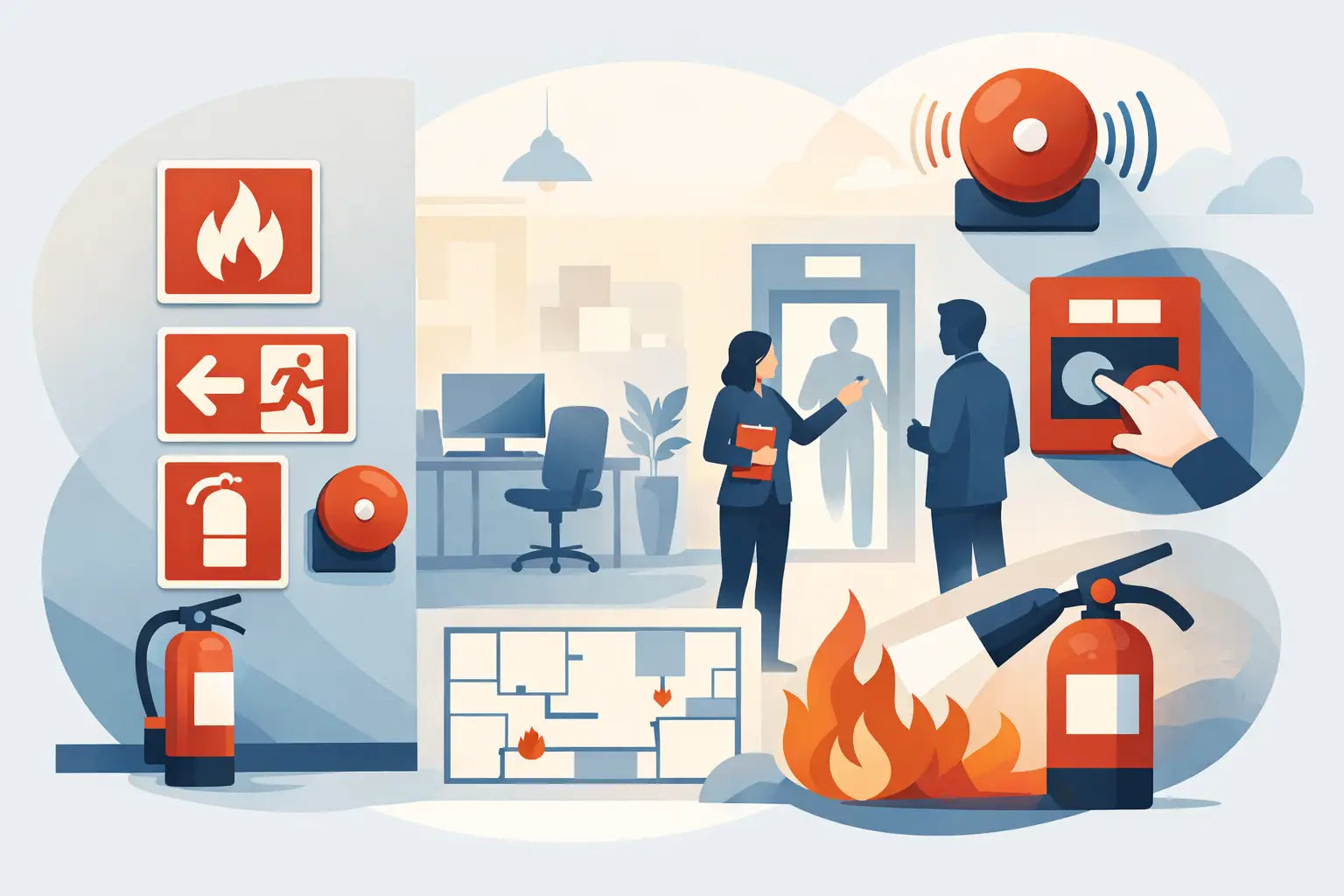
A fire risk assessment may identify the hazards, but clear signs help people act on that information when seconds matter. So, what fire safety signs should every workplace have? The answer depends on your premises, escape routes, people at risk and fire precautions, but every workplace needs clear, durable information that directs people to safety and supports an orderly evacuation.
For site managers, facilities teams and business owners, the aim is not to cover every wall with notices. It is to place the right signs where staff, visitors and contractors need them, keep them visible, and replace any that are damaged, faded or no longer accurate.
What fire safety signs should every workplace have?
Most UK workplaces require a combination of safe-condition signs, fire equipment signs, mandatory notices and fire action information. The precise selection should follow your fire risk assessment and reflect the building layout. A small office with one straightforward exit needs less signage than a multi-storey warehouse, farm facility, school or public-facing premises.
Signs should use familiar safety colours and symbols. Green signs identify escape routes and first-aid or safe-condition information. Red signs identify firefighting equipment and fire alarm points. Blue mandatory signs give an instruction, while yellow warning signs may be needed where a specific fire-related hazard is present.
Fire exit and escape route signs
Fire exit signs are the foundation of workplace evacuation signage. They should show people the route to a place of safety, particularly where the direction is not immediately obvious. In a larger building, that can mean signs above final exits, at corridor junctions, on stairways and wherever a change of direction is required.
Use the running-man symbol with the correct directional arrow for the route. Position signs so they can be seen from the approach to the exit, rather than only when somebody is standing directly beneath them. An exit that is clear to a person who knows the building may be unclear to a visitor, agency worker or contractor arriving for the first time.
Escape route signs must remain relevant if layouts change. A relocated partition, racking installation or change to a door’s use can make an existing sign misleading. Check routes and signs together during regular workplace inspections.
Where normal lighting could fail during an incident, consider whether photoluminescent signs or emergency lighting are appropriate. This is particularly relevant in warehouses, workshops, stairwells, corridors without natural light and premises that operate outside daylight hours.
Fire action notices
A fire action notice tells occupants what to do if they discover a fire or hear the alarm. It is one of the most useful signs in any workplace because it converts a general evacuation plan into clear instructions at the point of need.
A good fire action notice should state how to raise the alarm, what evacuation action to take, where to assemble and any site-specific arrangements. It should also include the emergency contact number and, where useful, the full site address. This detail can be vital for a visitor or a member of staff who is unfamiliar with the premises.
Place fire action notices near call points, entrances, staff noticeboards and other prominent locations. Do not rely on an induction alone. In an emergency, people need information that is visible, concise and specific to the building they are in.
Fire alarm call point signs
Manual fire alarm call points should be clearly identified with red fire alarm signs. The call point itself may be recognisable to trained staff, but a clear sign helps visitors and new starters locate it quickly.
Mount the sign directly above or adjacent to the call point without obstructing it. If a call point is positioned around a corner, behind a door or in a large open area, additional directional signage may be appropriate. The goal is simple: nobody should lose time searching for the means to raise the alarm.
Fire extinguisher identification signs
Every fire extinguisher should have an accompanying identification sign. This sign indicates the type of extinguisher, the classes of fire it is suitable for and any uses that should be avoided. The extinguisher’s own label is not always visible from a distance, especially when equipment is mounted in a recess or grouped with other items.
Use the correct extinguisher sign for the unit provided, whether it is water, foam, carbon dioxide, powder or wet chemical. A general extinguisher notice is less helpful than clear individual identification, particularly in kitchens, workshops, plant rooms and areas with electrical equipment or flammable liquids.
The sign should be positioned above the extinguisher so it remains visible when people are moving through the space. It also makes equipment easier to locate if the area becomes smoky or crowded. Where extinguishers sit together, ensure each unit can still be identified without ambiguity.
It is worth remembering that signs do not authorise untrained people to tackle a fire. Your fire action procedure should make clear that evacuation is the priority, and firefighting should only be attempted where it is safe to do so by a trained person with a clear escape route.
Fire blanket, hose reel and other equipment signs
The same principle applies to other firefighting equipment. Fire blankets need clear identification, especially in commercial kitchens, canteens and food preparation areas. Hose reels, dry risers, fire buckets and specialist suppression equipment should also be marked where they are provided.
Equipment signs are not decorative additions. They help staff identify resources quickly, support routine checks and reduce the risk of somebody using unsuitable equipment. In higher-risk areas, clear identification should form part of the wider control measures set out in the fire risk assessment.
Fire assembly point signs
A fire assembly point sign identifies where people should gather after leaving the building. It supports roll calls, helps fire marshals account for staff and visitors, and reduces the risk of people congregating near entrances, vehicle routes or emergency access points.
Choose an assembly point that is a safe distance from the building, clear of fire appliance access and unlikely to be affected by smoke or other hazards. A convenient spot is not automatically a safe one. For example, a point next to a busy delivery yard, fuel storage area or farm machinery route may create a second risk during evacuation.
Larger sites may need more than one assembly point. If so, fire action notices and staff training should explain which groups use which location. The sign must match the plan, and the plan must be workable during normal trading, shift changes and poor weather.
Fire door signs
Fire doors are only effective when they are closed, unobstructed and used correctly. Appropriate signs help protect that function. Depending on the door and how it is used, common messages include “Fire door keep shut”, “Automatic fire door keep clear” and “Fire exit keep clear”.
These notices are especially valuable in communal corridors, plant rooms, warehouses, flats within mixed-use buildings and any workplace where fire doors are routinely propped open for convenience. A wedge, pallet or delivery trolley can compromise a compartment line and allow smoke or fire to spread.
Make sure the sign reflects the door’s purpose. A final exit may need “Fire exit keep clear”, while a self-closing internal fire door needs a different instruction. Do not use a generic notice where it gives the wrong message.
Lift and evacuation signs
Where lifts must not be used during a fire, display a clear “Do not use lift in the event of fire” sign at relevant lift locations. This is particularly important in multi-storey office buildings, public buildings and residential or mixed-use premises.
However, do not assume every lift sign should say the same thing. Some buildings have evacuation lifts or specific arrangements for people who need assistance. Your signage must align with the evacuation strategy, including any personal emergency evacuation plans and refuge arrangements. Inaccessible or contradictory information can put vulnerable occupants at greater risk.
Signs for higher-risk workplace areas
Some fire safety signs are not universal, but become essential when a particular hazard is present. Workshops and industrial premises may need warnings for flammable materials, gas cylinders, hot work or explosive atmospheres. Agricultural sites may require signs around fuel stores, grain handling areas, machinery sheds and chemical storage. Commercial kitchens need visible fire blanket and wet chemical extinguisher identification, alongside clear instructions for staff.
For construction sites, conditions change frequently. Temporary escape route signs, fire point signs and assembly point signs should be checked as the site layout develops. A sign that was correct at the start of a project may point directly towards a restricted area or blocked route a few weeks later.
The same applies to public-facing premises. Visitors cannot be expected to know where the exits are, how the alarm is raised or where to assemble. Clear signage is a practical control that reduces reliance on verbal instructions during a stressful event.
Placement, condition and consistency matter
Buying compliant signs is only part of the job. They need to be positioned at the correct height, visible under normal operating conditions and suitable for the environment. A paper notice taped to a warehouse wall is unlikely to remain legible for long. Choose durable materials suited to indoor, outdoor, cold-store, washdown or high-traffic areas as required.
Keep signs free from obstruction by stock, open doors, display stands or machinery. Check them after refurbishments, tenancy changes, new equipment installations and alterations to escape routes. Include signage in fire safety inspections rather than treating it as a one-off purchase.
Consistency also helps. Use matching symbols, clear wording and a logical layout across the site. Staff should not need to interpret different styles of fire action notice or search for equipment signs hidden amongst unrelated notices.
Build your sign selection around the risk assessment
There is no single fixed shopping list that suits every workplace. Your fire risk assessment should identify who may be at risk, the available escape routes, fire precautions already in place and any areas requiring additional information. It should also account for lone workers, visitors, contractors, night shifts and anyone who may need assistance to evacuate.
Start with exits, alarm points, firefighting equipment, assembly arrangements and fire doors. Then add hazard-specific and site-specific signs where the assessment requires them. For multi-site operators, standardising sign formats and ordering in volume can make checks, replacements and procurement far easier.
Clear, correctly positioned fire signage is a straightforward investment in safer decisions under pressure. Keep it accurate, keep it visible, and when it is time to replace or expand your workplace signage, Think Safety - Think Sheep.
Share:
Battery Charging Area Signs for Safer Sites
What Signs Are Needed Around Excavations?