

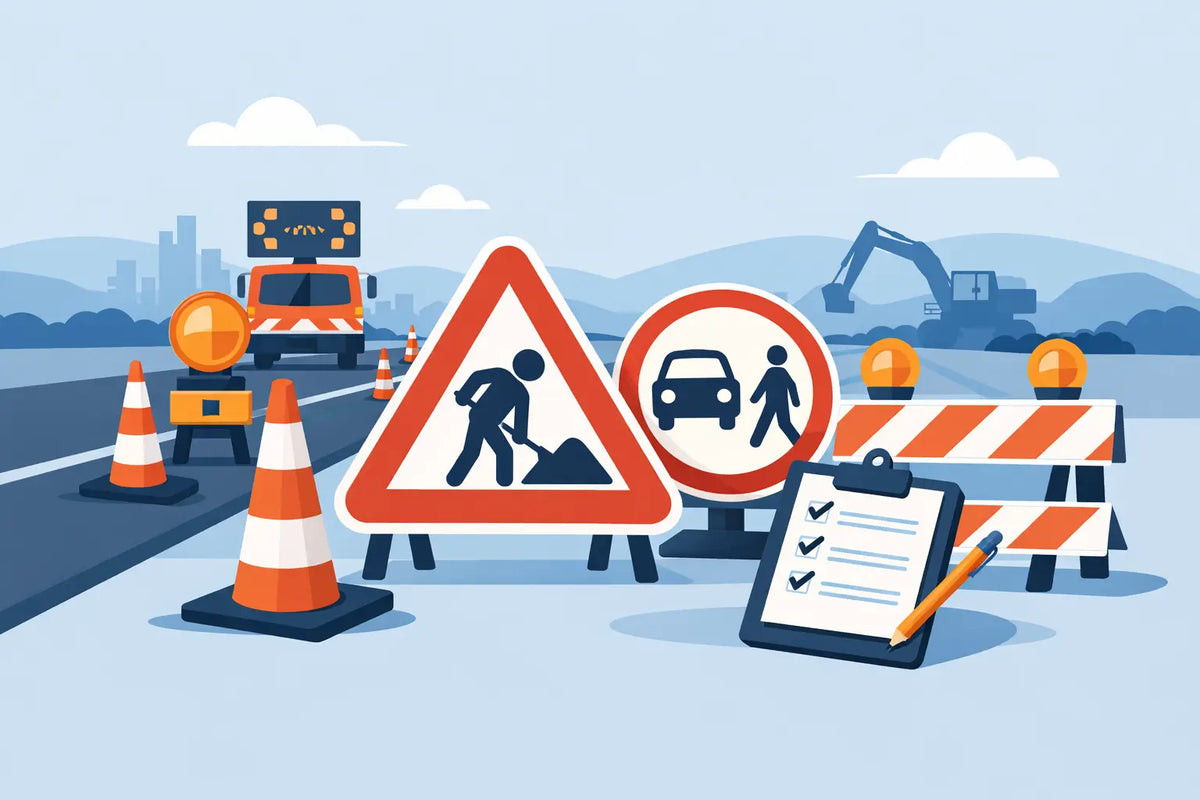
A temporary roadwork signage checklist is not a box-ticking exercise to complete once and forget. It is the working control that helps drivers, cyclists, pedestrians and your own workforce understand what has changed ahead of them. On a live road, a missing advance warning sign or a poorly positioned diversion sign can create confusion within minutes.
The right arrangement depends on the road, the speed limit, visibility, the type of work and who needs to pass through the area. A short pavement repair outside a shop needs different controls from an excavation on a rural A-road. Use the checklist below to plan the job, brief the team and inspect the setup at the start of every shift.
Start with the roadwork risk assessment
Before ordering or deploying signs, establish the conditions at the site. Consider the road classification, normal traffic speed and volume, junctions, bends, parked vehicles, bus stops, cycle routes, crossings and nearby schools or businesses. Check whether there is enough forward visibility for approaching road users to see and react to the first sign.
You also need to identify who has authority over the road. Works on the public highway may require permits, notifications and an approved traffic management arrangement through the relevant highway authority. Street works and road works must be planned and signed in line with applicable UK requirements, including the Traffic Signs Regulations and General Directions and current sector guidance. A competent traffic management provider or qualified person should be involved where the job is complex, high speed, involves a lane closure or creates significant risk.
Private roads, industrial estates and car parks are different, but the duty to manage risk remains. Clear, consistent signs, safe segregation and sensible traffic routes still protect people and reduce the likelihood of incidents.
Temporary roadwork signage checklist before setup
Work through these points before the crew arrives. The aim is to ensure the sign schedule matches the actual site, rather than relying on a generic kit.
- Advance warning: Confirm which warning signs are needed for approaching traffic, such as road works ahead, lane closure, loose chippings, temporary traffic signals, road narrows or diversion information. Position them far enough in advance for the road speed and available sight distance.
- Traffic control: Check whether the works need temporary signals, stop/go boards, priority working, a road closure, a diversion or a lane restriction. Do not improvise a traffic control method where a designed arrangement is required.
- Pedestrian management: Identify every walking route affected by the works. Provide a safe, obvious route around the work area, with appropriate directional signs, barriers and accessible widths where possible. Never direct pedestrians into an unprotected carriageway.
- Cycle and equestrian routes: Consider whether cyclists need a signed diversion, a lane arrangement or a dismount instruction, and whether horse riders may be present on rural routes. These users need early, readable information, not a last-minute obstacle.
- Work zone protection: Confirm the taper, cones, delineators, barriers, safety zones and end-of-works signing needed to make the site boundary clear. Signs must support the physical layout, not substitute for it.
- Night-time and poor weather: Check whether reflective faces, sign lamps or other lighting are necessary. Rain, fog, low sun and darkness can reduce visibility sharply, even on a familiar road.
- Sign condition and stability: Inspect faces, frames, ballast and fixings. Use clean, legible signs of suitable size and make sure they cannot blow over, swivel, obstruct a route or become a hazard themselves.
Put signs out in the correct sequence
The order of deployment matters. If the crew starts at the work area and moves backwards, workers can be exposed to live traffic before drivers have received any warning. In most situations, the advance warning arrangement should be established first, working towards the site under a safe method of work. Removal is generally carried out in reverse, so the work area remains protected until people and equipment are clear.
Keep signs facing the intended road user and position them where they can be read without being hidden by vegetation, parked vehicles, street furniture or other signs. A sign placed behind a bend, immediately after a junction or too close to the hazard may technically be present but operationally useless.
Avoid clutter. Too many messages in one place can be as unhelpful as too few. Give the driver time to take in each instruction, particularly where a diversion, speed change or lane arrangement follows. Where a road layout is unusual, a simple supplementary plate or clear directional sign may prevent uncertainty.
Check the pedestrian route as a pedestrian would
Pedestrian arrangements deserve the same attention as vehicle signing. Walk the route yourself from both directions before opening it. Look for uneven surfaces, trailing cables, sharp edges, pinch points, open excavations, poor lighting and barriers that can be moved aside easily.
For public-facing works, consider people using pushchairs, wheelchairs, mobility aids or visual guidance. A signed route that is physically inaccessible is not a safe route. If the footway cannot be maintained safely, a properly assessed diversion or alternative control may be required.
Signs should be at a readable height, clear of obstructions and placed so that they do not create a trip hazard. On busy pavements, temporary barriers often provide a clearer boundary than cones alone. They also make it harder for pedestrians to enter the work area accidentally.
Inspect at the start of every shift
Roadwork signing changes as conditions change. Overnight winds can move cones, delivery vehicles can obscure a sign, and a growing queue may reveal that the layout is not giving drivers enough warning. Assign responsibility for inspections and make sure the team knows who can authorise changes.
At the start of each shift, and after any significant change in weather, traffic conditions or work activity, check that warning signs are visible and clean, cones and barriers remain in position, pedestrian routes are open and safe, and no sign conflicts with the current traffic arrangement. Confirm that old signs from a previous phase have been covered, removed or updated. Leaving a redundant diversion or speed instruction in place damages driver confidence and can create unnecessary risk.
Record the inspection in your site documentation. A brief, consistent record supports good management and gives supervisors a clear handover between shifts. For higher-risk works, photographs of the installed arrangement can be useful, provided they are taken safely and do not replace physical inspections.
Match the signs to the phase of work
Many jobs develop in stages. An excavation may move along the road, a delivery may briefly block an access, or resurfacing may require a different traffic arrangement each day. Treat each change as a new check, not a minor adjustment.
When the work zone moves, move the advance signs, taper and pedestrian controls with it. Remove or amend signs as soon as they no longer describe the hazard ahead. This is particularly important for temporary traffic signals, road closures and diversions, where outdated information can send road users in the wrong direction.
For planned multi-phase schemes, label and store signs by phase where practical. It saves setup time, reduces mistakes and makes it easier for a relief crew to confirm that the correct signs are in use.
When standard signing is not enough
A straightforward low-speed job may be managed with a well-planned temporary arrangement. However, some situations need specialist input: high-speed roads, restricted visibility, complex junctions, major pedestrian flows, multiple lanes, emergency access requirements, large plant movements or work close to schools and events.
Do not assume a standard set of signs will cover these risks. The trade-off between keeping traffic moving and keeping workers protected should always favour a safe, properly assessed arrangement. A short closure or managed diversion can sometimes be safer and more efficient than trying to maintain traffic through a constrained work area.
Make replacement stock part of site readiness
Temporary signs work hard. They get dirty, damaged, lost and occasionally left at the wrong location. Keeping replacement stock available avoids the pressure to use faded, cracked or unsuitable signage when a job is already underway.
For contractors and organisations managing several sites, standardising core roadwork warning signs, pedestrian notices, barriers and accessories can make urgent replenishment faster and more cost-effective. British-made signage, clear product specification and trade ordering options are practical advantages when consistency matters across a fleet or estate.
The best temporary roadwork setup is one that road users understand before they reach the hazard and workers can rely on throughout the shift. Build inspections into the routine, respond quickly when conditions change and keep the site message clear. Think Safety - Think Sheep.
Share:
12 Best Warehouse Safety Notices for UK Sites
Hazardous Waste Signage Requirements Explained