

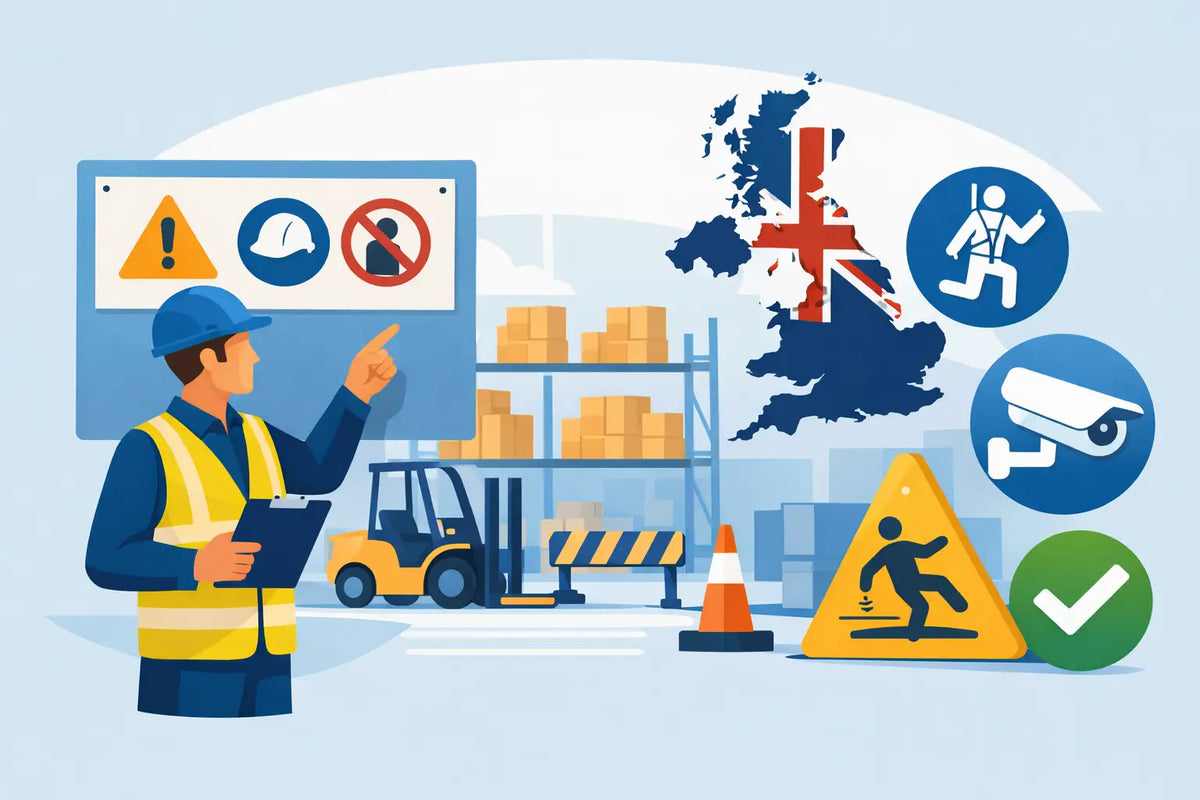
A pallet dropped in a loading bay, a visitor stepping into a forklift route or a fire exit hidden behind stock can turn a busy shift into a serious incident. The best warehouse safety notices make the expected action clear before somebody enters a risk area. They help staff, agency workers, drivers and visitors recognise hazards quickly, follow site rules and find essential safety equipment without delay.
Signs are not a substitute for physical safeguards, training or supervision. A marked pedestrian route still needs effective segregation from workplace transport, for example. But where a risk remains, clear and correctly positioned notices are a practical part of a well-managed warehouse.
Start with the risks, not the sign catalogue
There is no single set of notices that suits every warehouse. A small unit storing boxed consumer goods has different priorities from a distribution centre with articulated lorries, reach lorries, mezzanine floors and hazardous substances. Begin with your risk assessment, traffic management plan, fire risk assessment and any site rules already issued to employees and contractors.
Walk the site as a new starter or delivery driver would. Consider the route from the gate to reception, goods-in, storage aisles, packing areas, welfare facilities and emergency exits. Look for decision points: crossings, changes in floor level, restricted doors, battery-charging areas and places where people are expected to wear PPE. These are usually where notices earn their place.
For UK sites, safety signs should use recognisable symbols and suitable colours. BS EN ISO 7010 pictograms support consistency, while the Health and Safety (Safety Signs and Signals) Regulations 1996 set expectations for safety signage where a significant risk cannot be avoided or adequately controlled by other means. The sign must be visible, legible and relevant. A faded notice left on a wall because it has always been there does not improve compliance.
The 12 best warehouse safety notices to prioritise
The following notices cover the risks found in many warehouses. Treat them as a practical starting point, then add signs that reflect your building, operations and risk assessments.
1. Mandatory PPE notices
Use mandatory blue signs at entrances to areas where PPE is required, such as safety footwear, high-visibility clothing, eye protection or hearing protection. Place them before a person enters the area, not halfway down an aisle after the requirement should already have been followed. A combined notice can work well where several items are compulsory, provided the symbols remain easy to read from the approach distance.
2. Forklift lorries operating warning signs
Forklift activity is one of the most obvious warehouse risks, particularly near loading bays, end-of-aisle crossings and goods-in. Warning notices alert pedestrians and visitors to vehicle movements. They should support clear barriers, marked walkways, speed controls and a traffic plan - not replace them.
3. Pedestrian route and crossing notices
Signs identifying pedestrian walkways, crossings and designated doors make the safest route easier to follow. They are especially useful where visitors may be unfamiliar with the layout. In high-traffic locations, pair wall-mounted notices with durable floor markings so the route remains clear even when stock levels change.
4. Speed limit signs
A warehouse speed limit must be realistic for the vehicles, visibility, surface condition and pedestrian activity on site. Display the limit at entrances and where drivers join a new traffic area, including external yards. Avoid using a speed sign as a generic instruction: it should match the limit set in your site traffic rules and be enforced consistently.
5. Authorised personnel only notices
Restrict access to plant rooms, loading areas, racking aisles under maintenance, chemical stores and other controlled spaces with clear prohibition or access notices. These signs are useful only if the physical access control matches the message. A door marked “Authorised Personnel Only” should not routinely be left open and unattended.
6. High-visibility clothing notices
High-vis requirements commonly apply in yards, loading bays and vehicle operating zones. A notice at the vehicle gate, pedestrian entrance and reception point gives workers and visitors time to comply before entering the risk area. For sites that provide visitor PPE, position the instruction beside the collection point.
7. Fire exit and directional signs
Fire exit signs need to guide people along the actual escape route, including at changes of direction and where the final exit is not immediately visible. They must not be obscured by stored goods, temporary displays or open doors. Check the signs after layout changes, especially when racking or partitioning is added.
8. Fire door keep shut notices
A fire door only performs its role when it is closed, maintained and free from obstruction. “Fire Door Keep Shut” notices reinforce that simple requirement in warehouses where teams may be tempted to wedge doors open for convenience. If a doorway needs to remain open operationally, the right solution may be a suitable automatic release system rather than a propped-open door.
An assembly point must be far enough from the building and vehicle routes to keep people safe while allowing emergency services access. A clear sign helps wardens, visitors and new staff identify the location quickly. Review it when site boundaries, parking arrangements or evacuation plans change.
10. First aid notices
First aid signs identify the location of kits, rooms, eyewash equipment and trained first aiders. In a large warehouse, one sign by the main office is rarely enough. Use directional notices where the nearest provision is not visible, and keep the information current when staff responsibilities change.
11. Warning notices for flammable substances and battery charging
Battery-charging stations, fuel stores, aerosol storage and areas with flammable liquids need clear hazard communication. Depending on the risks, notices may address flammable materials, no smoking, naked flames and restricted access. Signage should sit alongside suitable ventilation, spill response arrangements, charging procedures and emergency equipment.
12. Racking safety and load notices
Racking systems need visible safe-working-load information where applicable, along with notices that discourage climbing, unauthorised alteration and unsafe loading. Damage-reporting notices are also useful near busy aisles, as impacts from handling equipment can compromise racking long before a failure becomes obvious. Ensure the displayed information matches the installed system and its current configuration.
Match warehouse notices to each zone
A useful approach is to organise notices by the way people move through the premises. At the entrance, display visitor instructions, PPE requirements, speed limits and reporting arrangements. In the yard and loading bay, prioritise vehicle warnings, pedestrian segregation, reversing controls and high-vis requirements.
Within storage areas, racking notices, forklift warnings, aisle restrictions and emergency-route signs usually matter most. Packing and dispatch areas may need manual-handling reminders, machinery safety notices and fire equipment identification. Welfare rooms and offices require fewer operational signs, but emergency information, first aid directions and any local access restrictions should still be clear.
Do not create a wall of competing messages. Where too many signs are placed together, people stop seeing them. Use the correct sign type for the instruction, remove outdated notices and place each message at the point where a person can act on it.
Choose materials that suit warehouse conditions
Paper notices taped to a door rarely last in an industrial setting. For permanent internal areas, rigid plastic signs offer a clean, durable option. Self-adhesive vinyl is useful on smooth doors, equipment and internal surfaces, while aluminium composite signs are a stronger choice for external yards, gates and exposed loading areas.
Size matters as much as material. A notice beside a pedestrian door can be smaller than one intended for a driver approaching a gate or junction. Consider viewing distance, lighting, mounting height and obstructions such as pallet stacks or roller shutters. Photoluminescent fire exit signs can provide additional visibility when normal lighting fails, but they should be selected and installed as part of the wider emergency lighting strategy.
Keep signage accurate after every change
Warehouses evolve quickly. A new mezzanine, revised one-way system, additional charging point or altered evacuation route can make existing signs misleading. Include signage in your planned inspections and after any operational change. Check that signs are clean, secure, readable and still directing people to the right place.
For multi-site businesses, using a consistent set of symbols, materials and wording makes training simpler and helps agency staff move between locations safely. Ordering standard notices in volume can also reduce cost and avoid the delays that come with sourcing individual replacements during an audit or urgent site change.
The right notice is the one that reflects a real risk, gives a clear instruction and remains visible when the warehouse is at its busiest. Think Safety - Think Sheep when you are reviewing the details that help people go home safely.
Share:
How to Order Bulk Safety Signs for Your Site
Temporary Roadwork Signage Checklist for UK Sites