

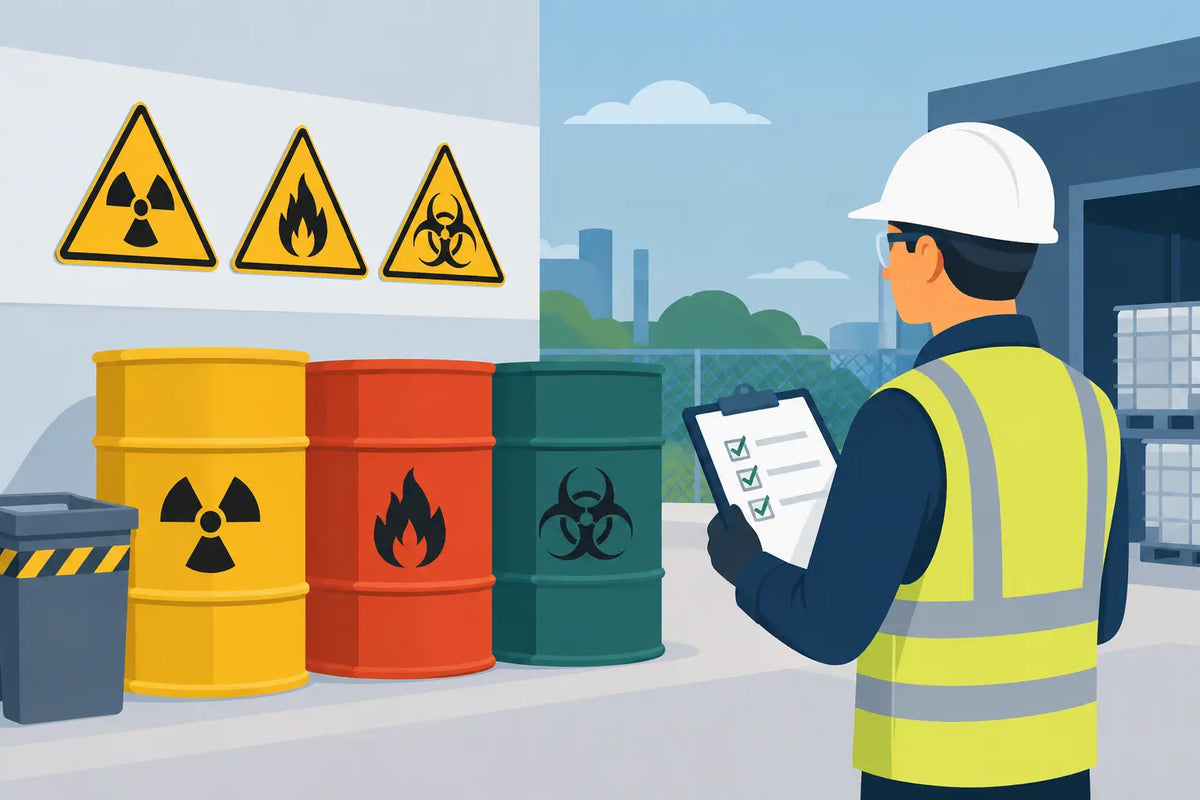
A drum with no label is not simply untidy. It can leave employees, contractors and emergency responders unable to tell whether it contains solvent, contaminated rags, batteries, chemicals or something incompatible stored nearby. Meeting hazardous waste signage requirements is therefore about more than putting a warning sign on a store door. It is about making hazards clear at the point decisions are made: when waste is handled, moved, collected or dealt with in an emergency.
For UK workplaces, the right approach depends on the waste, the storage arrangement and whether it is being transported. There is no single sign that makes every hazardous-waste area compliant. Clear identification, suitable warning signage and a documented waste-management process need to work together.
What hazardous waste signage requirements mean in practice
Hazardous waste is waste that can harm people or the environment because of its properties. Common examples include waste oils, solvents, paints, aerosols, chemicals, fluorescent tubes, lead-acid batteries, contaminated absorbents, pesticides and certain electrical items.
The legal framework is wider than signage alone. Employers and dutyholders need to consider their responsibilities under health and safety law, the Environmental Protection Act duty of care, waste legislation for their UK nation and, where applicable, the Control of Substances Hazardous to Health Regulations 2002 (COSHH). The Health and Safety (Safety Signs and Signals) Regulations 1996 also apply where a risk assessment shows that a safety sign is needed and the risk cannot be adequately controlled by other measures.
The practical point is straightforward: signs must communicate a real risk, not replace proper storage, containment, training or supervision. A yellow warning sign on a poorly segregated waste area will not make that area safe.
Start with a waste assessment
Before choosing signs, identify each waste stream and confirm whether it is hazardous. Your waste contractor, safety data sheets, product information and waste classification assessment can all help establish this. Record what the waste is, its likely hazards, where it is generated, how much is stored and who handles it.
This assessment determines what information people need to see. A maintenance cupboard holding a small, sealed container of waste adhesive needs a different level of signage from a fenced compound with multiple drums of flammable solvent waste. The latter may require prominent area warnings, access control notices, emergency information and clear labels on every container.
Signs for hazardous waste storage areas
A hazardous waste storage location should be readily recognisable to employees and authorised visitors. The most suitable sign will usually identify the area and warn of the relevant hazard, rather than rely on vague wording such as “Danger”.
For example, a sign reading “Hazardous Waste Storage Area - Authorised Personnel Only” is useful where access must be controlled. It can be paired with the correct pictogram-based warning sign, such as flammable material, corrosive substances, toxic material or environmental hazard, where those risks apply.
Safety signs should be visible before a person enters the area. Position them at gates, doors, compound entrances and other access points, at a height and location that is not hidden by parked vehicles, stacked materials or opening doors. Outdoor signs need to withstand weather, UV exposure and regular cleaning. In busy yards, a larger rigid sign may be more effective than a small self-adhesive label.
Where the risk assessment identifies mandatory PPE, use the appropriate blue mandatory signs. This might include eye protection, gloves or protective footwear. Do not display PPE signs by default if they are not relevant to the task or area. Too many generic signs can make the critical message easier to miss.
Use recognised symbols and clear wording
Pictograms allow hazards to be understood quickly, including by visitors and workers whose first language is not English. For workplace warning signs, the familiar yellow triangle with a black symbol is generally used to warn of danger. Chemical hazard labels use different diamond-shaped hazard pictograms under Great Britain CLP rules.
These are not interchangeable. An area warning sign tells people about a location and the precautions needed there. A container label identifies the contents and their hazards. In many cases, you need both.
Keep wording concise. “Hazardous Waste”, “Flammable Waste”, “Corrosive Waste” and “No Unauthorised Access” are clearer than lengthy instructions that cannot be read at a distance. If specific instructions are essential, place them on a separate notice where staff can safely stop and read them.
Labelling hazardous waste containers
Every container should be identifiable, even if it is kept inside a signed store. Workers should not have to guess what is in an unmarked drum, jerrycan, IBC or wheelie bin.
A good working label normally states the waste description, the main hazard or hazards, and the date or other reference needed for stock control. Your site may also include the European Waste Catalogue code, source department, container number or collection information. This makes inspections and collections more efficient, particularly across larger sites.
Where waste has been decanted from an original product container, ensure the new container is suitable for the material and is labelled correctly. Never use food or drink containers for chemical waste. Labels must remain legible for the full storage period, so choose material that resists moisture, oils, chemicals and abrasion.
If the waste is classified as dangerous goods for transport, additional packaging marks, labels and documentation may be required under ADR rules. These requirements can be highly specific to the substance, quantity and transport method. A waste carrier or dangerous-goods adviser can confirm the correct arrangements before collection or movement by road.
Segregation should be visible
Signs are particularly valuable where incompatible wastes could be mixed accidentally. Flammable liquids should be kept away from ignition sources, while acids, alkalis, oxidising agents and reactive materials may need separation based on their properties. Batteries, oils, aerosols and chemicals should not be treated as one general “hazardous waste” category if their safe-storage controls differ.
Use bay markers, shelf labels or container-location signs to show the intended place for each waste type. This is a simple control that helps temporary staff, cleaners, contractors and drivers follow the same system as permanent employees. It also reduces the chance that a container is put back in the wrong place after an inspection or collection.
Information for emergencies and collections
Emergency responders need to know what hazards may be present, but they also need a clear route in, access to the right information and a well-managed site. Signage can support that by identifying the hazardous waste area, keeping fire points and access routes clear, and displaying prohibition signs where smoking, naked flames or unauthorised entry create a risk.
An emergency notice can be appropriate where it gives useful site-specific instructions, such as who to contact, spill-kit locations or actions for a leak. Keep it current. A notice with an old telephone number or departed contact is worse than no notice because it encourages delay and confusion.
For collections, make sure containers, bays and access points are clearly marked so the carrier can collect the correct material without unnecessary handling. Your paperwork must also be right. Hazardous waste movements in England and Wales generally require a hazardous waste consignment note, while Scotland uses special waste consignment notes. Requirements can change and vary by nation, so check the current position with the relevant environmental regulator for your location.
Common signage mistakes to avoid
The most frequent failure is relying on one sign at the entrance while leaving containers unlabelled. Another is using an environmental hazard symbol to cover every type of risk, even where flammability, corrosivity or toxicity presents the more immediate danger to workers.
Poor placement is also common. Signs fixed behind a gate, above a roller shutter, or at eye level with a parked van do not provide a timely warning. Review visibility from the normal approach route, in poor light and when the site is busy.
Finally, avoid outdated, faded or contradictory signs. If a waste stream has been removed, take down the redundant sign. If a storage area changes use, update the signs, labels, risk assessment and emergency arrangements together. A clear system stays clear only when someone owns it.
A practical inspection routine
Include hazardous waste signage in regular site inspections rather than waiting for an audit or collection problem. Check that area signs are visible, containers are labelled, labels remain legible, incompatible wastes are separated, required PPE signs match the task and access restrictions are still appropriate.
For multi-site businesses, use the same sign wording, container-label format and inspection standard wherever practical. Consistency saves time for travelling managers and helps staff recognise the system immediately. It can also make bulk ordering simpler when replacements are needed at short notice.
The right sign is the one that gives the right person the right warning before they act. Review your hazardous waste area from the viewpoint of a new employee or visiting contractor: if they can identify the hazards, know where not to go and understand how to handle the waste safely, your signage is doing its job. Think Safety - Think Sheep.
Share:
Temporary Roadwork Signage Checklist for UK Sites
EV Parking & Charging Signs: A UK Guide