

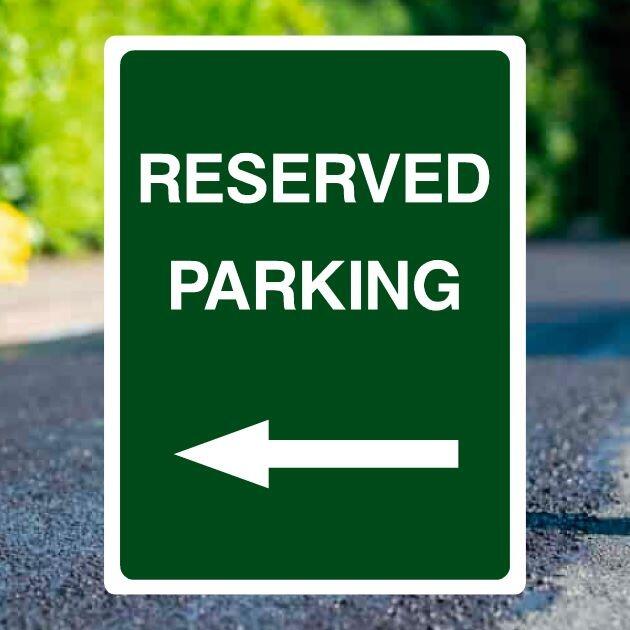
Who is allowed to park in that space?
It sounds like a simple question, but poorly identified parking bays can quickly create confusion for employees, residents, tenants, visitors and customers.
Reserved Parking Signs provide a straightforward way to identify spaces allocated to particular people, groups, vehicles or purposes.
From an individual employee parking bay to an entire residents-only parking area, choosing the right wording and positioning can make a car park much easier to understand.
In this guide, we look at the different types of reserved parking signs, where to position them and what UK businesses and property managers should consider when managing designated parking spaces.
What Are Reserved Parking Signs?
Reserved parking signs identify parking spaces that are not intended for general use.
A space might be reserved for:
- Employees
- Management
- Residents
- Tenants
- Permit holders
- Company vehicles
- Authorised vehicles
- Contractors
- Individual properties
- Particular departments
- Specific vehicle registrations
The most appropriate wording depends on exactly who is permitted to use the space.
A simple Reserved Parking sign may be enough in some locations, while a more specific Staff Parking Only or Residents Only sign can be clearer in others.
Reserved, Designated & Allocated Parking – What's the Difference?
These terms are often used interchangeably, but there can be subtle differences.
Reserved Parking
Reserved parking generally means a space is being kept for a particular user, group or purpose rather than being available for general parking.
Designated Parking
Designated parking describes a space identified for a particular use.
For example, a car park might contain designated areas for staff, visitors, customers or electric vehicles.
Allocated Parking
Allocated parking often describes a space assigned to a particular individual, property, department or organisation.
This is particularly common in residential developments and office car parks.
For example:
Allocated Parking – Flat 12
is more specific than:
Reserved Parking
There is considerable overlap between these terms, so the important thing is to choose wording that makes the actual parking arrangement clear to the driver.
Why Use Reserved Parking Signs?
Without clear signs, drivers may have no way of knowing that apparently identical parking spaces have different purposes.
Reserved parking signs can help:
- Identify allocated spaces
- Separate different groups of car park users
- Reduce accidental use of reserved bays
- Make parking arrangements easier to understand
- Direct drivers towards the correct parking areas
- Support wider parking-management arrangements
This can be particularly useful where parking spaces are limited or several different groups use the same car park.
Reserved Parking Signs for Businesses
Business car parks often need to accommodate several types of user.
A workplace might have spaces for:
Staff | Customers | Visitors | Management | Contractors | Company Vehicles | EV Charging
Without signs, arriving drivers may not know which spaces they should use.
Reserved and designated parking signs can help businesses divide a car park into clearly identifiable areas.
Employee & Staff Parking Signs
Employee Parking and Staff Parking signs identify spaces intended for people working at the premises.
They can be useful where employees share a car park with customers, visitors or residents.
For larger workplaces, signs can identify either:
- Individual staff bays
- A dedicated employee parking area
- Spaces reserved for particular departments
- Spaces for company vehicles
- Management parking
Where an entire section of a car park is reserved for employees, directional signs can also help staff find the correct area from the site entrance.
Management & Director Parking Signs
Some organisations allocate spaces to particular roles.
Where this is necessary, a specific sign such as Reserved for Management can communicate the allocation more clearly than a generic Reserved Parking sign.
However, avoid creating unnecessary categories if the parking arrangement can be kept simpler.
The objective should be to make the car park easier to understand rather than filling it with signs.
Reserved Parking for Company Vehicles
Businesses may need spaces kept available for vans, fleet vehicles or other company transport.
Signs can identify these spaces and discourage employees, customers or visitors from occupying them.
Depending on the circumstances, suitable wording might include:
Company Vehicles Only
Fleet Vehicles Only
or:
Reserved Parking – Company Vehicles
Choose the wording that most accurately describes how the space is used.
Resident Parking Signs
Residential developments often contain a mixture of:
- Resident parking
- Visitor parking
- Allocated spaces
- Disabled parking
- EV charging bays
- General parking areas
Clear signs can help residents and visitors understand these arrangements.
A Residents Parking Only sign may be suitable where a parking area is shared by residents.
Where each property has an individually allocated bay, more specific signs or numbered spaces may provide greater clarity.
Tenant Parking Signs
Commercial and residential properties may provide parking specifically for tenants.
Signs can identify spaces or areas intended for authorised tenants and distinguish them from visitor or general parking.
Where different tenants have separately allocated spaces, property-specific or numbered signs may help avoid confusion.
Allocated Parking for Apartments & Flats
Allocated parking is particularly common around apartment developments.
A property manager might assign one parking bay to each flat.
In this situation, a generic Reserved Parking sign may not tell drivers enough.
A sign such as:
Reserved Parking – Flat 8
or a clearly numbered parking bay can make the allocation easier to understand.
Where visitor spaces are also provided, these should be identified separately.
Permit Parking Signs
Permit Parking signs identify spaces or areas intended for vehicles authorised under a permit system.
Permit schemes can be used at:
- Workplaces
- Residential developments
- Managed estates
- Business parks
- Private car parks
- Educational premises
A simple Permit Holders Only sign identifies the intended users of the parking area.
If a formal parking-management or enforcement scheme operates, additional signage may be needed to explain the relevant parking terms.
Reserved Parking for Contractors
Some workplaces regularly receive contractors who need to park close to a particular entrance, loading point or working area.
Designated contractor parking can help keep these vehicles out of customer, visitor or operational spaces.
This can be especially useful on larger industrial, construction or commercial sites.
Should You Use “Reserved Parking” or a More Specific Sign?
Where possible, be specific.
Imagine a driver sees:
RESERVED PARKING
The obvious question is:
Reserved for whom?
Compare that with:
STAFF PARKING ONLY
or:
RESIDENTS ONLY
or:
PERMIT HOLDERS ONLY
The second group of messages immediately explains who may use the space.
Generic Reserved Parking signs are useful where the authorised user is already obvious or where a bay is individually assigned, but more descriptive wording is often better in shared car parks.
Where Should Reserved Parking Signs Be Positioned?
Signs should be positioned where drivers can see them before deciding to enter the parking space.
For individual bays, this commonly means installing the sign at the head of the space.
Depending on the site, signs can be mounted on:
- Walls
- Fences
- Posts
- Other suitable permanent structures
Consider how the sign will look when the car park is full.
A sign that is clearly visible in an empty car park might disappear completely behind a parked vehicle.
What Size Reserved Parking Sign Do You Need?
The appropriate size depends largely on viewing distance.
A sign immediately in front of an individual parking bay can usually be smaller than a sign identifying an entire reserved parking area from across a car park.
Consider:
- How far away drivers will be
- Whether vehicles will be moving
- Mounting height
- The amount of wording
- Lighting
- Other nearby signs
- Potential obstructions
Short, specific messages are generally easier for drivers to understand quickly.
Do You Need a Sign for Every Reserved Bay?
Not necessarily.
If several adjacent spaces form one clearly defined reserved parking area, a smaller number of appropriately positioned signs may be sufficient.
Individual signs can be more useful where different types of parking spaces are mixed together.
For example:
Staff | Resident | Visitor | Reserved | EV | Disabled
In a layout like this, identifying individual bays can make the allocation much clearer.
Reserved Parking Signs & Bay Markings
Upright signs can be used alongside surface markings.
A bay painted with a number or word such as RESERVED can provide a clear visual indication when the space is empty.
However, surface markings may become:
- Worn
- Dirty
- Covered by leaves
- Obscured by vehicles
- Less visible in poor weather
An upright sign provides another visible reference.
For allocated spaces, combining a bay number with a matching upright sign can be particularly effective.
Directional Reserved Parking Signs
On larger sites, drivers may need directions before they reach the reserved parking area.
For example:
Staff Parking →
Permit Parking ←
Residents Parking →
Directional signs are particularly useful at junctions and decision points where the designated parking area is not immediately visible.
Think about the driver's entire journey rather than only the final parking space.
Reserved Parking in Shared Car Parks
Shared car parks require particularly clear signage.
Consider a mixed-use development containing offices, shops and apartments.
The car park might include spaces for:
- Residents
- Office employees
- Retail customers
- Visitors
- Permit holders
- Disabled users
- EV charging
A collection of generic Reserved Parking signs would not explain these arrangements very well.
Specific signs for each group can make the layout considerably easier to understand.
Reserved Parking & Customer Parking
Customer parking spaces have a specific purpose: they are intended for people using the business.
If a bay is genuinely intended for customers, Customer Parking Only is usually clearer than simply saying Reserved Parking.
Businesses should use the most specific message appropriate to each parking space.
Reserved Parking & Visitor Parking
Visitors and customers are not necessarily the same group.
A visitor might be attending a meeting, interview or appointment without being a customer.
Where a business provides separate visitor spaces, identify them clearly rather than expecting visitors to use generic reserved bays.
Reserved Parking & Accessible Bays
Accessible parking spaces should be clearly distinguishable from general reserved spaces.
A generic Reserved Parking sign is not a substitute for appropriate accessible parking identification.
Where accessible bays are provided, use signage and markings that clearly identify their intended purpose.
Reserved Parking & EV Charging Bays
EV charging bays are another specialist type of designated parking.
If a space is intended specifically for electric vehicles using a charger, an EV Charging or EV Charging Only message is more informative than Reserved Parking.
Again, the principle is simple:
Use the most specific message that accurately describes the parking space.
Are Reserved Parking Signs Legally Enforceable?
A standard Reserved Parking sign communicates that a space is intended for a particular user or purpose.
It does not automatically create a right to issue parking charges or take enforcement action against a vehicle.
Private parking arrangements can involve contractual terms between a driver and the landholder or parking operator.
Where a formal parking scheme operates, appropriate notices may need to communicate conditions such as:
- Who may park
- Permit requirements
- Maximum stays
- Charges
- Consequences of breaching the parking terms
- Other applicable conditions
An ordinary bay-identification sign and a detailed parking-terms notice perform different functions.
Businesses and property managers should therefore avoid assuming that installing a Reserved Parking sign automatically creates an enforceable parking scheme.
Keep Reserved Bay Signs Simple
An individual bay sign should usually answer one basic question:
Who is this space for?
For example:
STAFF PARKING ONLY
is immediately understandable.
Trying to fit detailed terms, charges and enforcement conditions onto the same small sign can make the main message difficult to read.
Where formal parking conditions apply, use appropriate additional signage to communicate those conditions.
Can You Reserve a Parking Space on Private Property?
Property owners and managers can allocate parking spaces on land they control, subject to the rights, leases, tenancy arrangements and other agreements that may apply to the particular property.
Signs can help communicate those parking allocations.
However, putting a Reserved Parking sign beside a space does not by itself determine ownership, legal rights or contractual entitlements to that parking space.
Property managers should make sure signage accurately reflects the parking arrangements that actually apply.
Reserved Parking Signs for Property Managers
Property managers often face a more complicated task than simply identifying one reserved space.
They may need to manage:
- Resident parking
- Tenant parking
- Visitor spaces
- Contractor parking
- Permit schemes
- Accessible bays
- EV charging
- Loading areas
- No Parking zones
The first step should be to map the car park and decide exactly how each area is intended to operate.
Once the parking arrangement is clear, the appropriate signage becomes much easier to choose.
A Simple Parking-Sign Hierarchy
For larger managed car parks, think about signage in three levels.
1. Entrance Signs
Tell drivers they have reached the correct car park and communicate any important overall parking information.
2. Directional Signs
Guide drivers towards areas such as Staff Parking, Residents Parking or Visitor Parking.
3. Bay Signs
Identify individual allocated or reserved spaces.
This is usually clearer than trying to communicate every instruction at the car park entrance.
Common Reserved Parking Sign Mistakes
Using “Reserved” Without Saying Who It Is Reserved For
Where possible, use more specific wording.
Positioning Signs Too Low
Check whether the sign will still be visible when a vehicle is parked in the space.
Using Too Many Different Messages
A car park with unnecessary signs everywhere can be just as confusing as one with too few.
Keep the system consistent.
Forgetting Directional Signage
Drivers cannot use the correct parking area if they cannot find it.
Assuming a Sign Creates Enforcement Rights
A simple Reserved Parking sign is not automatically a contractual parking notice.
Failing to Update Allocated Spaces
Residents, tenants, departments and parking arrangements can change.
Make sure signs still reflect current allocations.
Mixing Specialist Bays with Generic Reserved Parking
Use specific Disabled Parking, EV Charging, Customer Parking and Visitor Parking signs where those descriptions better explain the purpose of the space.
Choosing Reserved Parking Signs for Outdoor Use
Most parking signs are installed outdoors, so material choice matters.
Consider:
- Weather exposure
- Sunlight
- Mounting surface
- Expected lifespan
- Viewing distance
- Potential physical damage
For long-term outdoor installations, a durable rigid material is generally a practical option for walls, fences and posts.
Signs should be checked periodically for fading, damage, dirt and loose fixings.
Reserved Parking Sign Checklist
Before ordering signs, ask:
- Who is each parking space actually reserved for?
- Would a specific sign be clearer than simply saying Reserved?
- Are spaces individually allocated?
- Do we need numbered or property-specific signs?
- Are there separate staff, visitor and customer areas?
- Do we operate a permit system?
- Can drivers identify the correct parking area from the entrance?
- Are directional signs needed?
- Will bay signs remain visible when vehicles are parked?
- Are accessible spaces clearly identified?
- Are EV charging bays clearly identified?
- Are formal parking terms communicated separately where appropriate?
- Are the signs suitable for outdoor use?
- Do the signs still reflect the current parking arrangements?
Answering these questions before ordering can prevent a lot of confusion later.
Creating a Clearer Reserved Parking Area
Good reserved parking signage starts with a clear parking plan.
Decide who each space is intended for.
Then use the most appropriate wording:
Reserved Parking for a general reserved space.
Staff Parking for employees.
Residents Only for residents.
Permit Holders Only for permit-controlled areas.
Visitor Parking for visitors.
Customer Parking for customers.
EV Charging for charging bays.
The more accurately the sign describes the space, the easier the parking arrangement is for drivers to understand.
Made in Britain Reserved Parking Signs
Safety Sheep offers a range of Reserved Parking Signs for businesses, workplaces, residential developments and private property.
Our reserved and designated parking signs are made in Britain and available in a choice of sizes and durable materials for individual parking bays, walls, fences, posts and larger parking areas.
Whether you need one sign for an allocated space or signage for an entire managed car park, clear reserved parking signs can help drivers understand which spaces they are authorised to use.
Share:
Fire Exit Signs: A Complete Guide for UK Businesses
Resident Parking Signs: A Guide for Landlords & Property Managers