

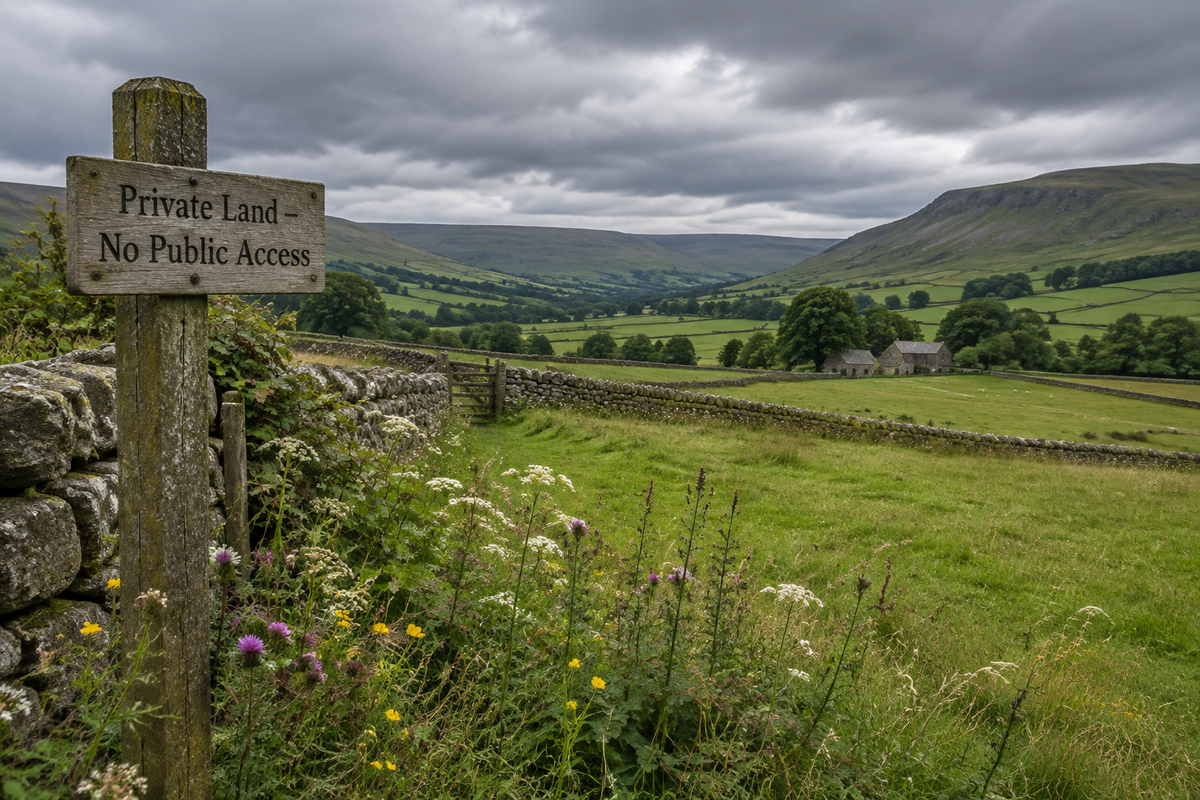
If you own a farm, woodland, private road, commercial property or residential estate, you may want to make it clear where your land begins and who is permitted to enter.
Private Land Signs provide a straightforward way to communicate ownership, access restrictions and important information to visitors.
But can you legally display a No Public Access sign? Does a Private Property notice prevent trespassing? And what happens if a public footpath crosses your land?
The answers aren't always as simple as putting up a Keep Out sign.
This guide explains the main considerations for UK landowners, including the differences between private ownership, public access rights, trespass and parking restrictions.
Can I Legally Put Private Land Signs on My Property?
Generally, landowners can display appropriate signs on their own property to identify ownership and communicate legitimate restrictions.
Common examples include:
-
Private Land
-
Private Property
-
Private Road
-
No Unauthorised Access
-
Keep Out
-
No Public Access
-
Private Woodland
-
Residents Only
However, the wording must accurately reflect the property's access arrangements.
Owning land doesn't automatically mean that every member of the public is prohibited from entering every part of it.
Public rights of way, statutory access rights, existing agreements and other legal arrangements may affect where access is permitted.
Before installing restrictive signs, establish which rights apply to the relevant land or route.
1. Private Property Signs
Private Property Signs are among the simplest ways to identify privately owned premises.
They can be suitable for:
-
Residential driveways
-
Commercial premises
-
Private yards
-
Farms
-
Estates
-
Woodland
-
Storage areas
-
Private entrances
A straightforward Private Property notice identifies ownership without necessarily explaining every access restriction.
If you need to communicate a more specific instruction, consider wording such as Private Property – No Unauthorised Access.
Choose the message according to what visitors genuinely need to understand.
2. No Public Access Signs
A No Public Access Sign communicates that an area isn't intended for general public entry.
These signs may be suitable for private grounds, restricted operational areas and other locations where public access is not permitted.
However, check whether any public access rights apply before displaying the notice.
For example, a public footpath may cross privately owned farmland.
Displaying a No Public Access sign in a way that discourages people from using that lawful route can create problems.
Where necessary, distinguish between the permitted route and the surrounding private land.
3. No Trespassing Signs
No Trespassing Signs communicate that entry without permission isn't welcome.
They can be useful around private yards, enclosed land, commercial premises and other restricted areas.
But a sign doesn't automatically make every instance of trespass a criminal offence.
In England and Wales, ordinary trespass to land is generally a civil matter, although particular conduct and circumstances can involve criminal offences.
Landowners should avoid using signage that threatens penalties or enforcement action without a proper legal basis.
A clear, factual notice is often preferable to unnecessarily aggressive wording.
4. Keep Out Signs
Keep Out Signs provide a direct instruction not to enter a particular area.
They're especially useful where an access restriction is associated with an operational area or identified hazard.
Examples include:
-
Private Property – Keep Out
-
Danger – Keep Out
-
Construction Area – Keep Out
-
Restricted Area – Keep Out
Where a hazard exists, a relevant warning sign may also be appropriate.
For example, an agricultural storage area could require a specific hazard warning rather than relying entirely on a generic Private Land notice.
5. Private Road Signs
Private roads can have different access arrangements.
Some are intended for residents only, while others permit deliveries, visitors, contractors or authorised vehicles.
Appropriate wording may include:
-
Private Road
-
Private Road – Residents Only
-
No Unauthorised Vehicles
-
Private Road – No Public Access
-
Authorised Access Only
Before installing restrictive signage, check whether other people have legal rights to use the road.
A Private Road sign doesn't automatically remove existing rights of access.
6. Can You Put No Public Right of Way Signs on Private Land?
A No Public Right of Way Sign communicates that a particular route isn't a public right of way.
It should only be used where that statement accurately reflects the route's legal status.
Landowners shouldn't assume that a path isn't public simply because it crosses private property.
If you're uncertain, investigate the position before installing a restrictive notice.
Depending on the location, relevant sources may include the local authority, definitive map records, historical evidence and applicable access legislation.
A misleading sign can cause unnecessary disputes and may interfere with lawful public access.
7. What If a Public Footpath Crosses My Land?
A public footpath can cross privately owned land.
Private ownership doesn't automatically remove the public's right to use that route.
In England and Wales, public rights of way may include footpaths, bridleways and other categories of route.
Landowners should avoid placing signs that incorrectly suggest a lawful public route is closed.
If you want to distinguish a public footpath from surrounding private land, consider clear and accurate wording.
For example:
Public Footpath – Please Keep to the Marked Route
This communicates the intended route without misleading visitors about their access rights.
Where you're unsure about the route's legal status, seek clarification from the relevant local authority.
8. Private Land Signs in Scotland
Scotland has a different approach to public access.
Under the Land Reform (Scotland) Act 2003, responsible public access rights apply to much of Scotland's land and inland water, including many privately owned areas.
These rights are explained through the Scottish Outdoor Access Code.
There are exceptions, including houses and gardens, certain buildings and land on which crops are growing.
This means landowners in Scotland should be particularly careful about displaying blanket No Public Access or Keep Out notices where responsible access rights apply.
Signage should accurately explain legitimate restrictions and can also help direct visitors around operational activities or areas where access rights don't apply.
Private ownership alone isn't a sufficient reason to assume all responsible public access can be prohibited.
9. Private Land Signs in Northern Ireland
Northern Ireland also has its own access arrangements.
Public rights of way can exist across privately owned land, and local councils have responsibilities relating to these routes.
Landowners must not display notices likely to deter people from exercising an existing public right of way.
Permissive access arrangements may also exist, allowing access on agreed terms.
If you're uncertain whether a route is public, private or permissive, contact the relevant council before installing restrictive signs.
10. Can I Display a Private Woodland Sign?
Yes, where the wording accurately reflects the woodland's access arrangements.
Private Woodland Signs can identify ownership and communicate relevant restrictions.
Examples include:
-
Private Woodland
-
Private Woods – Keep Out
-
Private Woodland – No Public Access
-
Private Woods – No Unauthorised Entry
However, woodland access can be affected by public rights of way and other statutory access rights.
In Scotland, responsible access rights may apply to privately owned woodland.
Check the legal position before selecting wording that prohibits public entry.
11. Can Farmers Display Private Land Signs?
Farmers can use appropriate signs to communicate ownership, operational restrictions and relevant hazards.
Typical locations include:
-
Farm entrances
-
Farmyards
-
Agricultural buildings
-
Machinery stores
-
Livestock areas
-
Private tracks
-
Storage compounds
-
Woodland boundaries
Where public rights of way cross farmland, signs must not misleadingly discourage lawful access.
A general Private Land notice may be useful, but a specific hazard warning can be more informative where a genuine risk exists.
For example, moving agricultural machinery, deep water or slurry storage may require more specific risk controls and warnings.
12. Do Private Land Signs Prevent Trespassing?
Signs can help communicate that land is privately owned and that particular access restrictions apply.
They may discourage unwanted entry and make the landowner's intentions clearer.
However, a sign doesn't physically prevent trespassing or guarantee that visitors will follow the instruction.
It also doesn't automatically provide additional enforcement powers.
Where unauthorised entry is a persistent problem, consider appropriate boundaries, gates, site management and professional advice where necessary.
13. Can I Put Up a Sign Threatening a Fine for Trespassing?
Be careful with wording that threatens automatic fines or penalties.
A landowner shouldn't assume that displaying a notice creates a legal entitlement to impose a financial penalty on anybody who enters the property.
The legal position depends on the circumstances and the applicable legal arrangements.
This is particularly important where a notice attempts to introduce contractual terms or parking charges.
For ordinary property identification, straightforward wording such as Private Property – No Unauthorised Access is generally clearer than an unsupported threat of a fixed penalty.
14. Private Land Signs vs No Parking Signs
These two types of signage serve different purposes.
A Private Land Sign primarily identifies ownership or access arrangements.
A No Parking Sign communicates a parking restriction.
For example, a business may permit customers to enter its premises but prohibit parking in a particular area.
In that situation, a No Parking notice is more relevant than a general Private Property sign.
Where formal private parking charges or enforcement arrangements apply, the terms, notices and legal requirements need separate consideration.
A simple No Parking sign doesn't automatically create an enforceable charging scheme.
15. Can I Display CCTV Signs on Private Land?
Where CCTV surveillance is genuinely operating, appropriate signage can help inform visitors that recording is taking place.
However, CCTV signs are different from general Private Land Signs.
A Private Property notice doesn't automatically tell somebody they're being recorded.
Businesses using CCTV should also consider their wider privacy and data-protection responsibilities.
Avoid displaying misleading CCTV notices or assuming that putting up a sign makes a surveillance system legally compliant.
16. Where Should Private Land Signs Be Positioned?
The best position is normally where somebody decides whether to enter the property.
Consider:
-
Main gates
-
Pedestrian entrances
-
Vehicle entrances
-
Fence lines
-
Private tracks
-
Woodland access points
-
Secondary entrances
For larger estates or commercial properties, one sign at the main entrance may not be sufficient to communicate the relevant restrictions at every access point.
Walk around the property as though you're visiting for the first time.
Can you clearly identify where access is permitted and where restrictions apply?
17. What Size Private Land Sign Should I Choose?
Choose the size according to viewing distance and location.
A notice attached to a pedestrian gate may only need to be read from a relatively short distance.
A sign intended for drivers approaching a private road may need larger lettering and a more prominent position.
Consider:
-
Viewing distance
-
Vehicle approach speed
-
Mounting height
-
Lighting
-
Background contrast
-
Vegetation
-
Amount of wording
Keep the message concise enough to be understood before somebody reaches the restricted area.
18. Choosing Outdoor Private Land Signs
Private Land Signs are frequently installed outdoors, where they may be exposed to rain, wind, sunlight and changing temperatures.
Choose a material appropriate for the location and intended lifespan.
Depending on the product, options may include rigid plastic, recycled plastic and aluminium composite.
Also consider how the sign will be fixed to the gate, fence, wall or other mounting surface.
For exposed countryside locations, secure fixing and regular inspection are particularly important.
Private Land Sign Checklist for UK Landowners
Before ordering your signs, use this practical checklist.
Ownership & Access
-
I have confirmed the relevant ownership or authority to display the sign.
-
I understand the access arrangements for the land.
-
I have checked whether public rights of way apply.
-
I have considered other relevant statutory access rights.
-
The wording accurately reflects the restriction.
-
The sign won't misleadingly discourage lawful public access.
Sign Wording
-
The message is clear and easy to understand.
-
The restriction is specific enough for the location.
-
The sign doesn't make unsupported legal claims.
-
Any hazard warning relates to a genuine risk.
-
Parking restrictions are communicated separately where necessary.
Positioning
-
Signs are positioned at relevant entrances.
-
Secondary access points have been considered.
-
Signs are visible before somebody enters.
-
Vegetation doesn't obscure the message.
-
The sign is suitable for its intended viewing distance.
Maintenance
-
The material is suitable for the environment.
-
Fixings are secure.
-
Signs remain legible.
-
Damaged notices are replaced.
-
Wording is reviewed when access arrangements change.
Which Private Land Sign Should I Choose?
The best sign depends on what you need to communicate.
| Situation | Sign to Consider |
|---|---|
| Identify privately owned land | Private Land |
| Identify private buildings or grounds | Private Property |
| Restrict general public entry where lawful | No Public Access |
| Restrict entry to authorised people | No Unauthorised Access |
| Identify a private vehicle route | Private Road |
| Communicate a direct entry restriction | Keep Out |
| Identify privately owned woodland | Private Woodland |
| Restrict parking rather than entry | No Parking |
| Inform visitors about operating cameras | CCTV in Operation |
Always make sure the selected wording accurately reflects the actual arrangements.
Clear Signage Starts With Accurate Information
Private Land Signs are useful for communicating ownership, identifying boundaries and explaining legitimate access restrictions.
However, the most effective approach isn't necessarily to choose the strongest possible warning.
It's to choose the clearest and most accurate message for the location.
Check the relevant access rights, use straightforward wording and position the sign where visitors need the information.
That approach can help reduce confusion and unnecessary disputes while making your property's access arrangements easier to understand.
Shop Private Land Signs at Safety Sheep
Safety Sheep supplies Private Land Signs for UK businesses, farms, estates, private roads, woodland, residential developments and commercial premises.
Choose from Private Property, No Public Access, No Trespassing, Keep Out, Private Road and countryside access signs in a range of sizes and durable materials.
Whether you're identifying a private entrance or installing matching notices across a larger estate, choose signage that clearly communicates your property's access arrangements.
Made in Britain, with bulk savings available for landowners, property managers and trade customers.
Think Safety. Think Sheep.
Share:
Accessible Toilet Signs: A Guide for UK Businesses
Water Safety Signs: A Checklist for UK Businesses & Landowners