

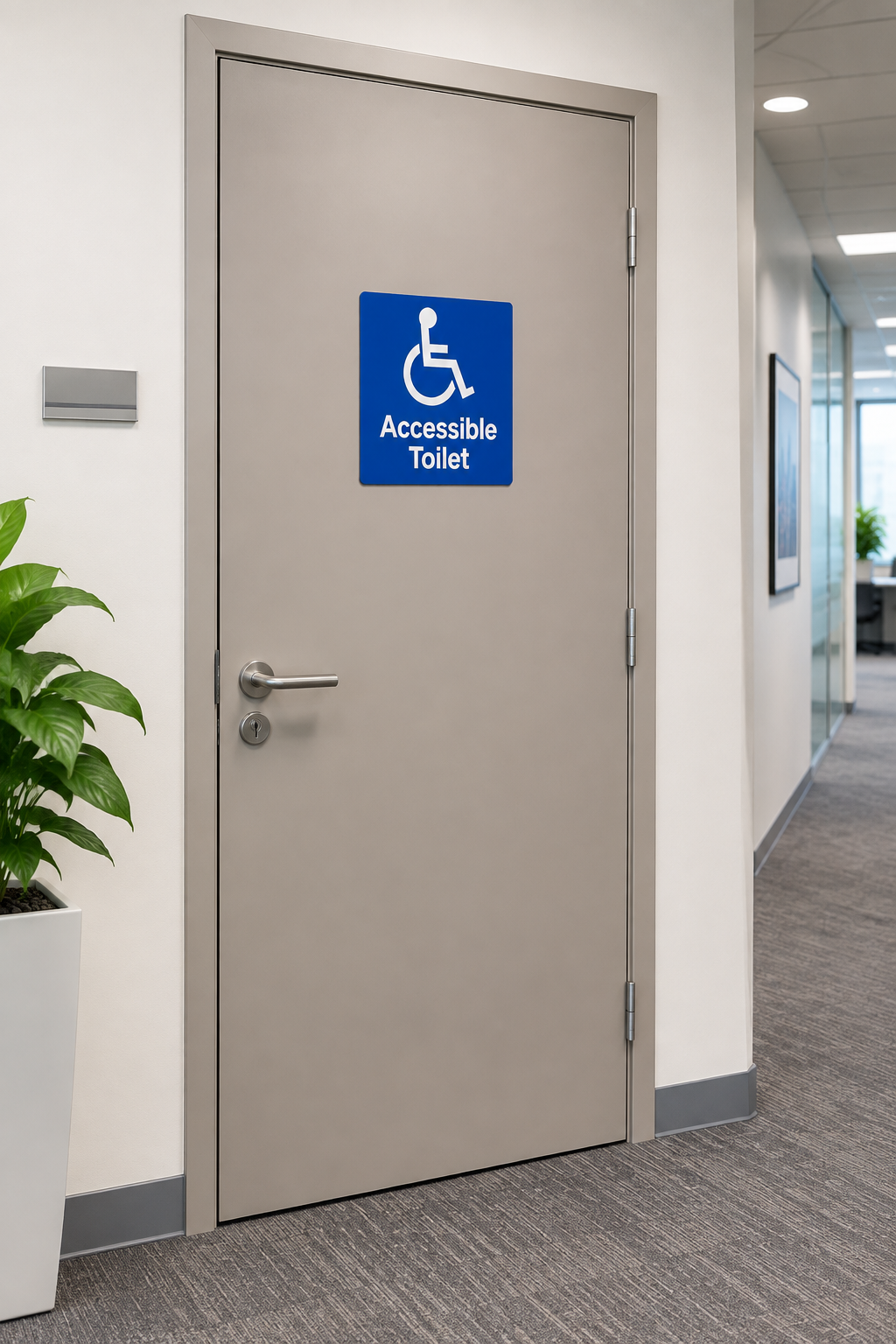
Accessible toilet facilities should be easy to find, clearly identified and straightforward to use.
Whether you manage an office, restaurant, shop, hotel, school, healthcare facility or other commercial premises, appropriate accessible toilet signs can help visitors and employees locate the facilities they need without unnecessary confusion.
But what should an accessible toilet sign look like? Should you use the wording Accessible Toilet or Disabled Toilet? Where should signs be positioned, and are there specific UK legal requirements?
This guide explains what businesses should consider when choosing and installing accessible toilet signage.
What Is an Accessible Toilet Sign?
An accessible toilet sign identifies a toilet facility designed or designated for use by people with accessibility requirements.
These signs commonly feature the internationally recognised wheelchair accessibility symbol, often accompanied by wording such as:
-
Accessible Toilet
-
Accessible WC
-
Disabled Toilet
-
Accessible Facilities
-
Wheelchair Accessible Toilet
The purpose is simple: to help people identify the correct facility quickly and confidently.
Accessible toilet signs are used throughout commercial and public-facing buildings, including workplaces, retail premises, hospitality venues, schools, healthcare facilities and leisure centres.
Accessible Toilet Signs vs Disabled Toilet Signs
Both accessible toilet signs and disabled toilet signs are familiar terms in the UK.
The phrase Disabled Toilet remains widely recognised and appears on many existing signs. However, Accessible Toilet is often a useful choice when updating signage because it focuses on the facility and its accessibility.
Whichever terminology you select, the sign should be clear, respectful and easy to understand.
For businesses installing new signage throughout a building, consistency is particularly important.
Avoid switching between Accessible Toilet, Disabled WC and other descriptions without a practical reason.
A consistent approach makes wayfinding easier for visitors.
The Wheelchair Accessibility Symbol
One of the most recognisable features of accessible toilet signage is the wheelchair accessibility symbol.
<AsyncImage query="accessible toilet sign wheelchair pictogram blue white" aspectRatio="16:9" width="100%"/>
The familiar pictogram provides a quick visual indication that a facility is intended to be accessible.
Combining a recognisable symbol with concise wording can help make the sign easier to understand, particularly in busy public buildings.
When choosing a sign, consider:
-
Whether the symbol is immediately recognisable.
-
Whether the wording is easy to read.
-
Whether there is sufficient contrast.
-
Whether the sign can be understood at the intended viewing distance.
-
Whether its design matches the wider building signage.
Avoid choosing an overly decorative pictogram if it makes the facility difficult to identify.
Are Accessible Toilet Signs a Legal Requirement in the UK?
There isn't one universal rule requiring every UK business to purchase a particular commercial accessible toilet sign.
However, businesses may have legal obligations concerning accessibility, sanitary facilities and the provision of information.
The Equality Act 2010, which applies in Great Britain, includes duties relating to reasonable adjustments for disabled people. Building regulations and associated guidance can also be relevant to the design and provision of accessible facilities.
Requirements depend on factors such as the building, its use, location and the nature of any building work.
For example, England has guidance covering access to and use of buildings under Approved Document M, alongside Approved Document T, which addresses toilet accommodation in relevant non-domestic buildings.
Scotland, Wales and Northern Ireland have their own applicable building regulatory frameworks.
Important: Displaying an accessible toilet sign doesn't, by itself, make a toilet accessible or demonstrate that a business meets all applicable legal requirements.
Signage should form part of wider accessibility and wayfinding arrangements.
Where Should Accessible Toilet Signs Be Positioned?
A well-designed sign is only useful if people can find it.
The most appropriate position depends on your building layout, but consider the entire journey from the main entrance to the accessible facility.
On or Beside the Toilet Door
The facility should be clearly identified as somebody approaches it.
An accessible toilet door sign can provide immediate confirmation that they've reached the correct location.
At Corridor Junctions
If accessible toilets are located away from the main public area, directional signs can help visitors choose the correct route.
Near Reception Areas
In larger premises, reception-area wayfinding can help visitors identify where accessible facilities are located.
Across Multiple Floors
If your building has accessible toilets on different floors, make sure the information is accurate and doesn't direct visitors towards a facility they cannot reach by an accessible route.
The overall objective is to make facilities easy to locate without requiring somebody to ask staff for assistance.
Choosing the Right Accessible Toilet Sign Size
Sign size should reflect where the sign will be positioned and how far away people need to recognise it.
A sign mounted directly beside a toilet door may only need to be read from a short distance.
A directional sign across a large reception area or along a corridor may need to be considerably larger.
Consider:
-
Viewing distance
-
Mounting position
-
Lighting
-
Text size
-
Symbol size
-
Background contrast
-
Surrounding visual clutter
Choose a design that's easy to identify rather than simply selecting the smallest available sign.
Colour Contrast & Readability
Good contrast can make signs easier to recognise and read, particularly for people with visual impairments.
Consider the contrast between the symbol, text and background, as well as between the sign itself and the surrounding wall or door.
Blue and white is a familiar combination for accessible facility identification, but the overall design should also be considered.
<AsyncImage query="accessible toilet door sign modern commercial interior" aspectRatio="16:9" width="100%"/>
For example, a polished metallic sign may look attractive but could be difficult to read if glare or reflections obscure the wording.
Readability should take priority over decorative appearance.
Accessible Toilet Signs for Different Businesses
Different premises have different signage requirements.
Offices & Workplaces
Office buildings should provide clear identification for staff, visitors and contractors.
Where several toilet facilities are available, use consistent wording and pictograms throughout the premises.
Restaurants, Cafés & Pubs
Customers should be able to locate accessible toilet facilities without having to ask staff.
If the facility isn't visible from the dining area, consider appropriate directional signage.
Hotels & Hospitality
Hotels may need accessible toilet signs in reception areas, restaurants, conference facilities and other shared spaces.
Consistency is especially useful in larger buildings.
Shops & Retail Premises
Retail businesses providing customer toilet facilities should consider the complete route from the shop floor to the facility.
Schools & Educational Premises
Clear identification can help pupils, staff and visitors locate the appropriate facilities.
Healthcare & Care Facilities
Signage may be particularly important where visitors are unfamiliar with the building or have additional accessibility needs.
In every setting, signs should accurately identify the facilities actually provided.
Accessible Toilets, Unisex Toilets & Inclusive Signage
Accessible, unisex and inclusive toilet signs aren't necessarily interchangeable.
An Accessible Toilet sign identifies a facility intended to accommodate relevant accessibility needs.
A Unisex Toilet sign identifies a facility intended for use regardless of sex.
Inclusive signage may be used to communicate the intended use of a particular facility, but its meaning should be clear.
Where a facility serves several purposes, choose wording and symbols that accurately communicate its designation.
Avoid assuming that displaying a wheelchair symbol automatically communicates every aspect of how a facility is intended to be used.
What About Changing Places Toilets?
Some buildings provide specialist Changing Places toilet facilities.
These are different from standard accessible toilets and incorporate additional space and equipment intended to support people with more complex needs.
Where a Changing Places facility is provided, use appropriate identification and wayfinding rather than assuming a standard accessible toilet sign communicates everything visitors need to know.
<AsyncImage query="Changing Places toilet official facility sign" aspectRatio="16:9" width="100%"/>
Choosing the Right Sign Material
Accessible toilet signs are available in different materials and finishes.
The best choice depends on the environment, mounting surface, expected use and appearance of the premises.
Self-Adhesive Signs
Self-adhesive signs can be useful on suitable smooth surfaces where a lightweight identification sign is required.
Rigid Plastic Signs
Rigid plastic can provide a practical option for workplaces, schools and other commercial environments.
Brushed Silver Toilet Signs
Brushed silver finishes can complement contemporary offices, hotels, restaurants and reception areas.
However, appearance shouldn't compromise readability.
Choose a finish that provides sufficient contrast and remains easy to recognise under the lighting conditions in your building.
Common Accessible Toilet Signage Mistakes
When reviewing your premises, look out for these common problems.
1. Signs that are too small
A symbol that looks clear when held in your hand may be difficult to recognise from across a corridor.
2. Poor contrast
Decorative colours or reflective materials can reduce readability.
3. Inconsistent terminology
Using several different descriptions for similar facilities can create unnecessary confusion.
4. Missing directional signage
A perfectly clear door sign isn't much help if visitors cannot find the door.
5. Obstructed signs
Doors, furniture, temporary displays and other objects can hide important information.
6. Outdated information
If facilities move or change designation, update the relevant signs and directions.
7. Assuming the sign makes the facility accessible
Accessibility involves the facilities, building layout and routes provided—not simply the identification on the door.
Accessible Toilet Sign Checklist for UK Businesses
Use this checklist when reviewing your existing facilities or ordering replacement signs.
Identification
-
Accessible toilet facilities are clearly identified.
-
Signs use recognisable symbols.
-
Wording accurately describes the facility.
-
Terminology is consistent throughout the building.
-
Specialist facilities are appropriately identified.
Positioning & Wayfinding
-
The sign is visible when approaching the toilet.
-
Directional signs are provided where useful.
-
Visitors can locate the facility from main public areas.
-
Signs aren't hidden by furniture or doors.
-
Directions follow an appropriate accessible route.
Visibility
-
Symbols are large enough to recognise.
-
Wording is legible.
-
Colour contrast is suitable.
-
Lighting doesn't obscure the sign.
-
Reflections or glare don't make the information difficult to read.
Maintenance
-
Signs are clean.
-
Signs are securely fixed.
-
Damaged signs have been replaced.
-
Information is accurate.
-
Signage is reviewed when facilities or building layouts change.
A Practical Way to Review Your Toilet Signage
One of the simplest ways to identify signage problems is to walk through your building as though you're visiting for the first time.
Start at the main entrance.
Can you identify where the toilets are located?
If you need an accessible toilet, can you follow the signage to the correct facility without asking somebody for directions?
When you reach the facility, is the door clearly identified?
Is the sign readable, appropriately positioned and consistent with the rest of the building?
This practical review can reveal wayfinding problems that are easy to overlook when you already know the premises.
Choosing Accessible Toilet Signs for Your Business
Good accessible toilet signage combines familiar symbols, clear wording, suitable contrast and thoughtful positioning.
Whether you're replacing one door sign or updating facilities throughout a commercial building, concentrate on making the information straightforward to recognise and understand.
Remember that signage supports accessibility; it doesn't replace the provision of suitable facilities or wider accessibility arrangements.
Shop Accessible Toilet & Washroom Signs
Safety Sheep supplies Toilet Signs & Washroom Signs for UK businesses, workplaces and public-facing premises.
Our range includes accessible toilet signs, disabled toilet signs, male and female toilet signs, unisex signs, baby changing signs and other facility identification signage.
Choose from a range of styles, sizes and materials, including premium brushed silver finishes.
Made in Britain, with bulk savings available for businesses and trade customers.
Think Safety. Think Sheep.
Share:
No Dogs Signs for Children's Play Areas: A UK Guide
Private Land Signs: What Can Landowners Legally Display in the UK?