

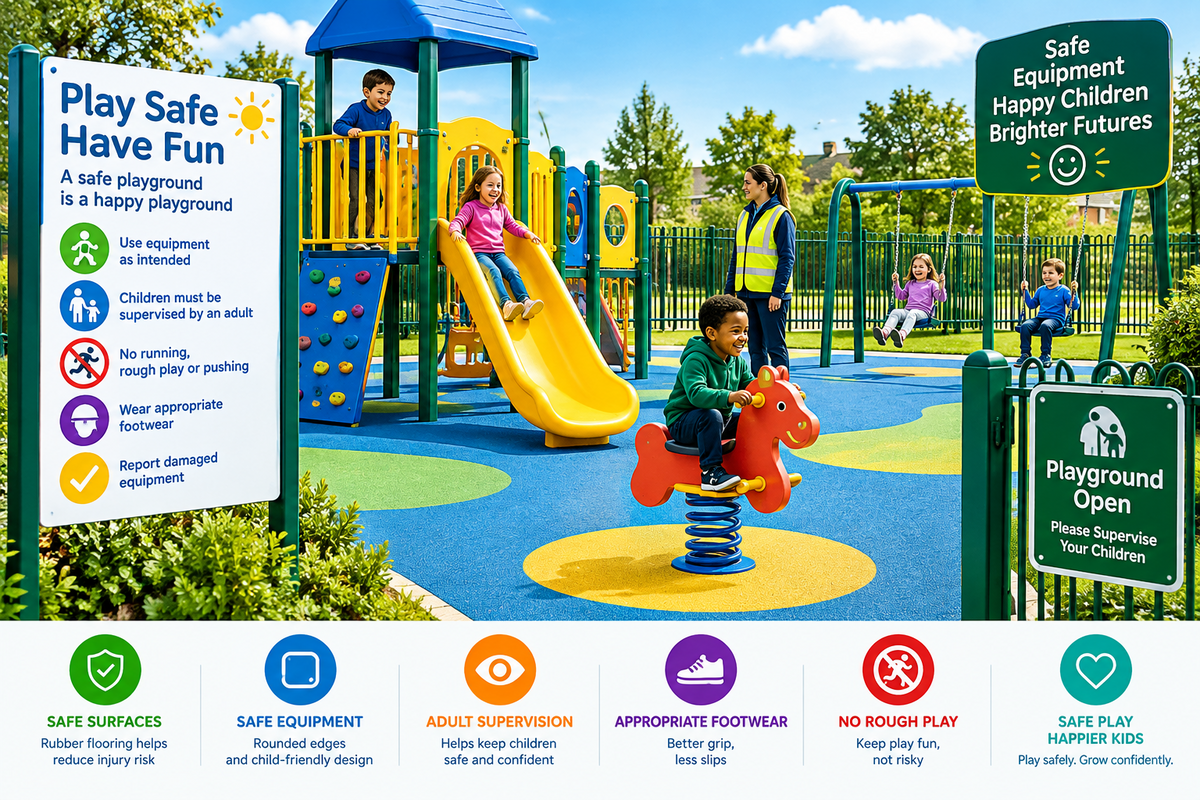
A good playground should be fun, welcoming and easy to use.
It also needs to be appropriately managed.
Whether you're responsible for a playground in a public park, school, nursery, pub, holiday park, housing development or leisure facility, clear playground safety signs can help children, parents and carers understand important rules and information before they start using the play area.
But which signs does a playground actually need?
There isn't one universal list of signs that every UK play area must display. The appropriate signage depends on the equipment, age groups, location, layout, rules and risks at the individual site.
Use this checklist to review the signs at your children's play area.
1. Playground Rules Sign
Check: Can visitors easily find the main rules for your play area?
A playground rules sign can provide important information in one easy-to-find location.
The entrance is often the most useful position because parents, carers and children can see the rules before entering.
Depending on your play area, the sign could cover:
-
Intended age range
-
Adult supervision
-
Dogs
-
Smoking or vaping
-
Cycling
-
Glass
-
Alcohol
-
Litter
-
Opening times
-
Appropriate use of equipment
-
Reporting damaged equipment
-
Operator contact details
Don't automatically include every possible rule.
A shorter sign containing information that's genuinely relevant to your playground is normally easier to understand than a board covered with unnecessary instructions.
2. Children's Play Area Sign
Check: Is it obvious that visitors are entering a designated children's play area?
A clear Children's Play Area or Welcome to Our Play Area sign can identify the facility and provide a natural location for additional rules or information.
This can be particularly useful where the playground forms part of a larger site such as:
-
Public park
-
Holiday park
-
Pub or restaurant
-
School
-
Housing development
-
Campsite
-
Leisure facility
-
Community recreation area
It helps distinguish the playground from surrounding areas that may have different rules.
3. Age Guidance Signs
Check: Is the play equipment intended for a particular age group?
Some playground equipment is designed with particular users or age groups in mind.
Where appropriate, signs can communicate guidance such as:
-
Under 5s
-
Under 8s
-
Under 12s
-
Suitable for younger children
-
Equipment intended for a particular age group
Make sure any age information reflects the actual playground design and equipment.
Don't choose an arbitrary age simply because you've seen the same restriction at another playground.
4. Adult Supervision Signs
Check: Does your play area have a supervision rule or guidance that visitors need to know?
Signs asking parents, guardians or carers to supervise children are common in play areas, particularly facilities intended for younger children.
Typical messages might include:
-
Children Must Be Supervised
-
Children Must Be Accompanied by an Adult
-
Parents & Guardians Are Responsible for Supervising Children
Keep the wording clear and proportionate.
A supervision sign can communicate the playground's rules, but it shouldn't be treated as a substitute for appropriate playground design, inspection, maintenance and management.
5. No Dogs Signs
Check: Are dogs prohibited inside the play area?
Dog restrictions are common around children's playgrounds.
Where dogs aren't permitted, a clearly positioned No Dogs Sign can tell owners about the restriction before they enter.
Good locations include:
-
Entrance gates
-
Access paths
-
Perimeter fencing
-
Open entrances
This is particularly important where dogs are permitted in the surrounding park but prohibited inside the children's play area.
Position the sign where the restriction begins.
6. No Smoking Signs
Check: Is smoking prohibited in or around the play area?
If smoking is prohibited, clear signage can communicate the rule to visitors.
Depending on the premises and policy, this might include:
-
No Smoking
-
No Smoking in Children's Play Area
-
No Smoking or Vaping
Remember that smoking and vaping aren't legally identical issues.
If vaping is prohibited by the playground operator, make sure the sign communicates the site's actual policy rather than implying that every smoking restriction automatically applies to vaping.
7. No Cycling Signs
Check: Are bicycles prohibited inside the playground?
Cycles moving through an area containing young children and fixed play equipment can create unnecessary conflict.
If cycling isn't permitted, a No Cycling Sign at the entrance can communicate the restriction before somebody enters.
Where the surrounding park has a cycle route, make sure it's clear exactly where the playground restriction begins.
8. Scooter & Wheeled Activity Rules
Check: Do your rules cover scooters, skateboards or other wheeled activities?
A No Cycling sign doesn't necessarily tell visitors whether scooters or skateboards are allowed.
If these activities are restricted, make the rule clear.
This may be particularly useful in playgrounds located next to:
-
Skate parks
-
Cycle paths
-
Schools
-
Housing developments
-
Large recreation areas
Avoid vague wording where a more specific instruction would be easier to understand.
9. No Glass Signs
Check: Are glass containers prohibited?
Broken glass presents an obvious problem in areas where children run, climb and play.
A No Glass sign can reinforce the rule at playgrounds where visitors may otherwise bring bottles or glass containers into the area.
This can be especially relevant to play areas within:
-
Parks
-
Pubs
-
Holiday parks
-
Campsites
-
Picnic areas
-
Leisure facilities
Signage should support appropriate cleaning and site-management arrangements rather than replace them.
10. No Alcohol Signs
Check: Is alcohol prohibited within the children's play area?
Some playground operators may choose or need to restrict alcohol within the play space.
Where this rule applies, signage can distinguish the children's play area from surrounding locations where different arrangements may apply.
Make sure any wording accurately reflects the site's policy and applicable local restrictions.
11. No Ball Games Signs
Check: Are ball games unsuitable inside the playground?
A playground containing swings, slides and climbing equipment may not be an appropriate location for football or other ball games.
If ball games are prohibited, communicate that restriction clearly.
Where possible, it can also help if visitors can easily identify an alternative open area where ball games are permitted.
12. Keep Gate Closed Signs
Check: Does your playground have a gate that needs to remain closed?
If a gate forms part of the play area's boundary arrangements, a Keep Gate Closed or Please Close the Gate sign can provide a useful reminder.
Position the sign where people naturally see it while entering or leaving.
But don't rely on a sign to compensate for a defective gate or closing mechanism.
If the gate is intended to close automatically or perform a particular safety function, make sure it is properly maintained.
13. Litter & Bin Signs
Check: Is litter a recurring issue?
Litter can make playgrounds unpleasant and potentially introduce hazards.
Useful messages might include:
-
Please Use Bins Provided
-
Put Litter in Bins
-
Keep This Area Tidy
-
Take Your Litter Home
Where bins are provided, make sure they're easy to locate and appropriately maintained.
A sign won't solve a litter problem if visitors can't find anywhere to dispose of rubbish.
14. Emergency Contact Information
Check: Can visitors report an urgent problem?
Depending on the playground, it can be useful to provide information explaining who operates the site and how problems can be reported.
This could include:
-
Playground operator
-
Site identification
-
Contact telephone number
-
Website
-
Fault-reporting information
-
Emergency location information
This can help visitors report:
-
Damaged equipment
-
Vandalism
-
Broken glass
-
Faulty gates
-
Flooding
-
Dangerous surfaces
-
Other site problems
Keep the information current.
An out-of-date telephone number can make an otherwise useful playground sign ineffective.
15. Equipment Out of Use Signs
Check: What happens when a piece of equipment is damaged?
Play equipment occasionally needs to be taken out of service for inspection, maintenance or repair.
A temporary sign can explain:
-
Equipment Out of Use
-
Do Not Use
-
Closed for Maintenance
-
Playground Temporarily Closed
However, if continued use could expose somebody to significant risk, don't rely on the sign alone.
The equipment may also need to be physically isolated, secured or otherwise prevented from being used until appropriate action has been taken.
16. Temporary Playground Closure Signs
Check: Can you clearly close the entire play area when necessary?
A playground may occasionally need to close because of:
-
Maintenance
-
Damaged equipment
-
Flooding
-
Severe weather
-
Construction work
-
Surfacing repairs
-
Vandalism
-
Site events
A clear closure sign should tell visitors that the play area isn't currently available.
Where necessary, use the sign alongside appropriate barriers, locked gates or other measures.
Remove temporary closure signs promptly once the playground reopens.
17. Water Hazard Signs
Check: Is the play area close to water?
Some playgrounds are located near:
-
Ponds
-
Lakes
-
Rivers
-
Canals
-
Beaches
-
Water features
-
Drainage ponds
Where water presents a relevant hazard, appropriate warning signage may be required as part of the wider management of the area.
Don't assume that a general playground rules sign is sufficient to communicate a significant water hazard.
Assess the actual location and the way children and visitors could encounter the water.
18. Traffic & Car Park Signs
Check: Do children need to cross or walk near vehicle routes to reach the playground?
The safety review shouldn't necessarily stop at the playground fence.
Think about how families reach the facility.
Potential issues include:
-
Car parks
-
Access roads
-
Delivery routes
-
Vehicle entrances
-
Shared pedestrian/vehicle areas
Appropriate traffic, parking or pedestrian signage may form part of the wider site arrangements.
Where possible, physical separation and good site design are generally more important than relying on signs alone.
19. First Aid Information
Check: Is first aid information relevant to your facility?
Larger staffed leisure facilities, schools and holiday parks may provide first aid equipment or facilities nearby.
Where appropriate, signs can identify or direct people towards:
-
First Aid
-
First Aid Kit
-
First Aid Room
-
Reception
-
Emergency telephone
The appropriate first aid arrangements depend on the premises and how the facility is operated.
20. Site-Specific Warning Signs
Check: Does your playground have an unusual hazard that visitors genuinely need to know about?
Not every playground requires warning signs.
But individual sites can have particular issues involving:
-
Steep slopes
-
Water
-
Uneven surfaces
-
Nearby traffic
-
Temporary works
-
Maintenance activities
-
Adjacent construction
-
Other environmental hazards
Where a significant risk can't be adequately controlled through other measures, appropriate warning information may be useful.
Avoid putting up generic warning signs simply because playgrounds contain an element of risk.
Signs should communicate something meaningful and specific.
Are Playground Safety Signs Required by Law?
There isn't one universal checklist of playground safety signs that every UK play area is legally required to display.
Different play areas have different:
-
Equipment
-
Users
-
Age groups
-
Layouts
-
Boundaries
-
Locations
-
Rules
-
Hazards
-
Management arrangements
The appropriate signage therefore needs to be considered for the individual facility.
For workplace safety signage more generally, the HSE principle is that safety signs are used where a significant risk remains after other relevant measures have been taken.
For playgrounds, signs should form part of wider arrangements for managing the facility rather than being treated as the main safety control.
Playground Signs & BS EN 1176
If you're responsible for playgrounds, you've probably encountered BS EN 1176.
The BS EN 1176 series relates to playground equipment and surfacing and includes requirements and guidance relevant to playground safety.
However:
Putting up a sign doesn't make a playground BS EN 1176 compliant.
Playground safety involves matters such as:
-
Equipment
-
Installation
-
Surfacing
-
Inspection
-
Maintenance
-
Site management
Signs can provide useful information to visitors, but they're only one small part of the overall system.
Be cautious of playground signs marketed as though the sign itself guarantees compliance with playground standards.
What About BS EN ISO 7010?
Some safety signs used around playgrounds may use standardised graphical symbols associated with BS EN ISO 7010.
These can include certain:
-
Prohibition signs
-
Warning signs
-
Mandatory signs
-
Emergency information signs
Standardised symbols can make safety messages easier to recognise.
However, many playground signs—such as age guidance, supervision instructions and playground rules boards—aren't simply standard ISO 7010 signs.
ISO 7010 is also a standard, not playground legislation itself.
Choose signs because they communicate information that's genuinely needed at your site, not simply because a standard symbol exists.
Where Should Playground Safety Signs Go?
A good rule is:
Put the information where visitors need to make the decision.
For example:
| Sign | Useful Location |
|---|---|
| Playground Rules | Main entrance |
| Age Guidance | Entrance or relevant equipment zone |
| Children Must Be Supervised | Main entrance |
| No Dogs | Entrance/boundary where restriction begins |
| No Smoking | Entrance or other prominent position |
| No Cycling | Entrance |
| Keep Gate Closed | Gate |
| Equipment Out of Use | Affected equipment |
| Emergency Contact Information | Main information board |
| Water Hazard Warning | Relevant approach to the hazard |
Avoid putting every sign on one distant noticeboard simply because it's convenient.
The visitor needs to see the information at the point where it matters.
How Many Playground Signs Do You Need?
There's no useful formula such as:
“One sign every 20 metres.”
The right number depends on the playground.
A small fenced play area with one entrance may need relatively few signs.
A large recreation facility with several entrances, different age zones and surrounding hazards may need more.
Think about:
-
Number of entrances
-
Perimeter layout
-
Different play zones
-
Viewing distances
-
Site-specific restrictions
-
How visitors approach the playground
Use enough signage to communicate clearly without creating unnecessary clutter.
What Size Should Playground Signs Be?
Choose sign size according to the amount of information and viewing distance.
A simple No Dogs sign contains very little information and can be recognised quickly.
A multi-message playground rules board containing ten instructions needs considerably more space.
Consider:
-
Viewing distance
-
Text size
-
Amount of information
-
Mounting height
-
Lighting
-
Visual clutter
-
Whether adults or children need to read it
Don't squeeze too much information onto a small sign.
If the rules can't be comfortably read, a larger board or shorter message is usually preferable.
What Material Is Best for Playground Signs?
Most playground signs are installed outdoors, so material choice matters.
Consider exposure to:
-
Rain
-
Wind
-
Sunlight
-
Temperature changes
-
Dirt
-
Regular cleaning
-
Accidental impact
The right material will depend on whether the sign is intended for short-term or permanent installation and how it will be mounted.
Long-term outdoor signs will generally benefit from a durable rigid material suited to external use.
Mount Playground Signs Safely
The sign itself shouldn't introduce a new hazard.
Think carefully about:
-
Sharp corners
-
Exposed fixings
-
Projections
-
Mounting height
-
Posts
-
Trip hazards
-
Climbing opportunities
-
Damage
Fix signs securely and inspect the mounting as part of routine playground checks.
This is particularly important in environments designed specifically for children.
Include Signs in Playground Inspections
Signs shouldn't be installed and forgotten.
Include them when inspecting the wider playground.
Check whether they're:
☐ Securely fixed
☐ Undamaged
☐ Clearly visible
☐ Legible
☐ Clean
☐ Free from sharp edges
☐ Unobstructed
☐ Still relevant
☐ Displaying current information
Outdoor signs can fade, become damaged or disappear behind vegetation.
Also check that changes to fencing, equipment or landscaping haven't affected their visibility.
Don't Use Signs Instead of Maintenance
This is one of the most important points on the checklist.
Imagine an item of play equipment develops a serious defect.
Putting up:
WARNING – EQUIPMENT DAMAGED
isn't necessarily an adequate response.
Where continued use presents an unacceptable risk, the priority is to control that risk appropriately—which may mean taking the equipment out of use until it's repaired.
Similarly:
A Slippery Surface sign isn't a long-term solution to defective surfacing.
A Keep Gate Closed sign doesn't fix a broken gate.
A Warning sign doesn't make damaged equipment safe.
Signage communicates risk and instructions. Maintenance and management deal with the underlying problem.
Avoid Playground Sign Overload
It's easy to end up with a playground entrance containing:
NO DOGS
NO SMOKING
NO CYCLING
NO GLASS
NO ALCOHOL
NO BALL GAMES
UNDER 12s ONLY
CHILDREN MUST BE SUPERVISED
KEEP GATE CLOSED
USE EQUIPMENT AT YOUR OWN RISK
By the time a parent has read everything, the children may already be halfway up the climbing frame.
Prioritise.
Ask:
-
Does this rule actually apply?
-
Is it important?
-
Does it need a separate sign?
-
Could it be included on the main playground rules board?
-
Where does the visitor need to see it?
-
Is the wording easy to understand?
A well-designed rules board and a handful of specific signs can often communicate more effectively than a forest of notices.
Playground Safety Sign Checklist
Use this checklist to review your play area.
Entrance Information
☐ Play area is clearly identified
☐ Main rules are easy to find
☐ Age guidance is displayed where appropriate
☐ Supervision guidance is displayed where appropriate
☐ Opening information is accurate where provided
☐ Operator/contact information is current
Restrictions
☐ No Dogs signs displayed where required
☐ Smoking restrictions clearly communicated
☐ Vaping policy communicated where applicable
☐ Cycling/scooter restrictions communicated where applicable
☐ Glass restrictions communicated where applicable
☐ Alcohol restrictions communicated where applicable
☐ Ball-game restrictions communicated where applicable
Safety Information
☐ Site-specific hazards have been considered
☐ Water hazards have been considered
☐ Nearby traffic routes have been considered
☐ First aid information provided where appropriate
☐ Emergency/reporting information is available where useful
Equipment & Maintenance
☐ Procedures exist for damaged equipment
☐ Temporary closure signs are available if needed
☐ Signs aren't being used instead of necessary repairs
☐ Gates and barriers work correctly
☐ Signs are included in routine inspections
Sign Condition
☐ Signs are legible
☐ Signs are clean
☐ Signs aren't faded
☐ Signs are securely fixed
☐ Fixings don't create a hazard
☐ Signs aren't obscured by vegetation
☐ Information is still accurate
☐ Unnecessary or outdated signs have been removed
Walk Through the Playground Like a First-Time Visitor
One of the simplest ways to check your playground signage is to approach the site as though you've never been there before.
Start outside the playground.
Before entering, can you tell:
-
What the area is?
-
Who it's intended for?
-
Whether an age range applies?
-
Whether children should be supervised?
-
Whether dogs are permitted?
-
Whether smoking is permitted?
-
Whether cycles or scooters are allowed?
-
What the main rules are?
Then walk through the play area.
Can you identify:
-
Different equipment zones?
-
Any unusual hazards?
-
Equipment that's unavailable?
-
How to report damage?
-
Who operates the playground?
-
What to do in an emergency?
Finally, walk back out.
Does the gate operate correctly?
Are the signs still visible from the directions visitors actually approach?
This simple exercise can reveal gaps that aren't obvious when the playground is viewed purely from an operator's perspective.
Review Signs When the Playground Changes
Playgrounds don't remain static.
You might:
-
Install new equipment
-
Remove old equipment
-
Change age zones
-
Replace fencing
-
Add another entrance
-
Change opening hours
-
Introduce new rules
-
Change operator
-
Alter contact information
Review the signs whenever significant changes are made.
An old rule can be just as confusing as a missing one.
Signs Are Only Part of Playground Safety
The most effective playgrounds don't depend on signs to keep children safe.
Good playground management involves a combination of appropriate:
-
Design
-
Equipment
-
Surfacing
-
Inspection
-
Maintenance
-
Risk management
-
Site management
-
Visitor information
Playground safety signs support these measures by communicating useful information to parents, carers and children.
Used well, they can make rules clearer, help visitors understand restrictions and provide important information exactly where it's needed.
Shop Play Area Signs
Safety Sheep supplies Play Area Signs for playgrounds, parks, schools, nurseries, holiday parks, pubs, leisure facilities and other children's play spaces.
Choose from playground rules signs, age guidance, children's play area signs, No Dogs signs, supervision notices and other safety and information signs in a range of sizes and durable materials.
Made in Britain, with outdoor options and bulk savings available for councils, schools, businesses and trade customers.
Think Safety. Think Sheep.
Share:
CCTV Signs: A Checklist for UK Businesses
What Information Should Be on a Playground Rules Sign?