

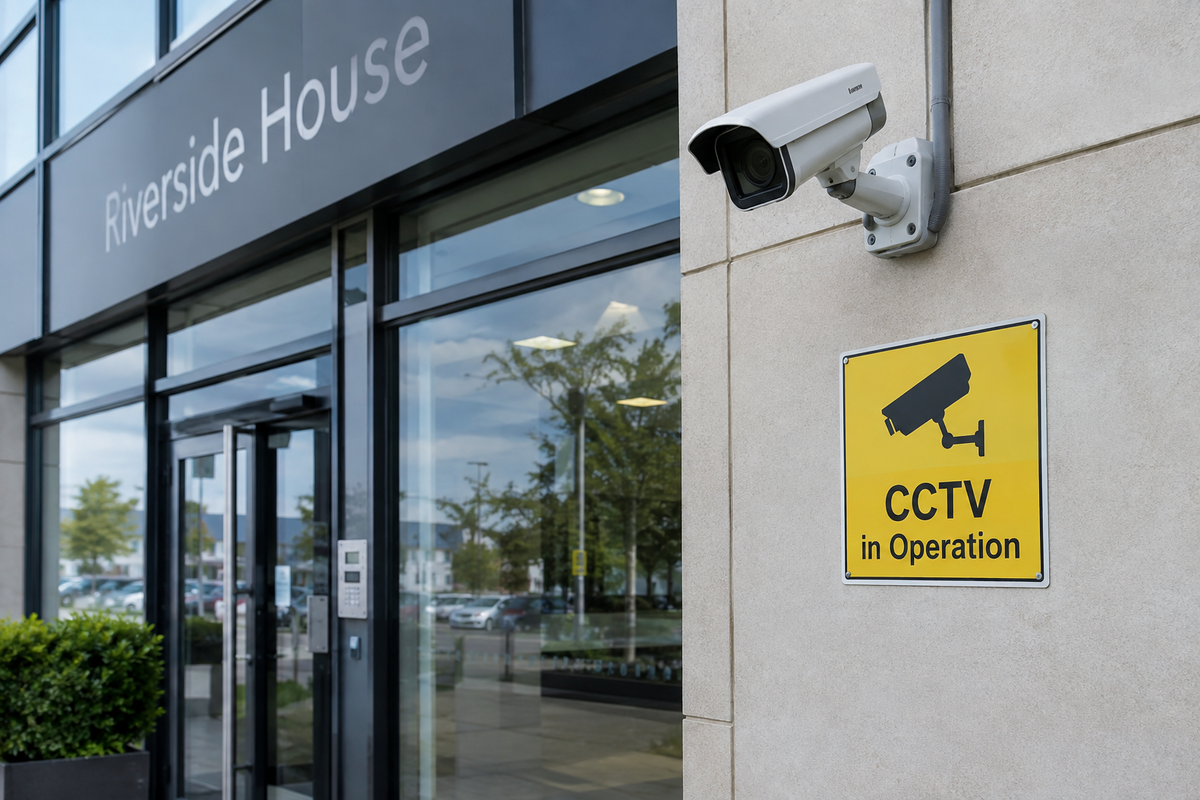
CCTV can help businesses protect property, deter crime, investigate incidents and improve security.
But installing cameras is only part of the job.
If your organisation uses CCTV, people should generally be made aware that they're being recorded and given appropriate information about the surveillance.
That's where CCTV signs come in.
From shops and offices to warehouses, factories, construction sites and private commercial premises, clear CCTV signage can help people understand that surveillance is taking place.
But what should a CCTV sign say? Where should it go? And is putting up a standard “CCTV in operation” sign enough?
Use this checklist to review the CCTV signage around your premises.
1. Tell People CCTV Is Being Used
Check: Would somebody entering the monitored area realise CCTV is operating?
People shouldn't normally have to discover that they're being recorded after the event.
CCTV signs provide an obvious way of telling employees, customers, visitors, contractors and members of the public that surveillance is taking place.
Typical wording includes:
-
CCTV in Operation
-
CCTV Cameras in Operation
-
CCTV Surveillance in Operation
-
These Premises Are Monitored by CCTV
-
24 Hour CCTV
-
CCTV Recording in Progress
The precise wording is less important than making the surveillance clear and understandable.
2. Position CCTV Signs Before People Enter the Monitored Area
Check: Can people see the CCTV notice before or as they enter the area being monitored?
Position is just as important as wording.
A CCTV sign hidden behind a counter or displayed deep inside a building doesn't provide the same notice as one clearly visible at the entrance.
Useful locations can include:
-
Main entrances
-
Reception entrances
-
Pedestrian gates
-
Vehicle entrances
-
Car parks
-
Site gates
-
Warehouse entrances
-
Building access points
-
Perimeter fencing
Think about every normal route into the monitored area, not just the front door.
3. Make CCTV Signs Clearly Visible
Check: Can people actually see and read your signs?
A CCTV notice isn't much use if it's:
-
Too small
-
Mounted too high
-
Hidden by vegetation
-
Behind an open door
-
Obscured by merchandise
-
Poorly lit
-
Faded
-
Damaged
-
Surrounded by dozens of competing notices
Consider where somebody will be standing when they need to see the sign.
The appropriate size will depend on the viewing distance and environment.
A sign beside an office entrance may be viewed from a few metres away, while a CCTV sign at a vehicle entrance or perimeter may need to be seen from considerably further away.
4. Identify Who Is Responsible for the CCTV
Check: Does your CCTV information make it clear who operates the system?
A basic camera symbol and the words “CCTV in operation” communicate that surveillance is taking place.
Depending on the circumstances, however, additional information may be required to explain who is responsible for the system and why personal data is being collected.
For business CCTV systems, think beyond the warning itself.
Your overall CCTV information should enable people to understand who is responsible for the surveillance and how they can obtain further information.
5. Explain Why CCTV Is Being Used
Check: Is the purpose of the surveillance clear?
Businesses use CCTV for different reasons.
These can include:
-
Crime prevention
-
Security
-
Protecting staff
-
Protecting customers
-
Protecting property
-
Monitoring access
-
Investigating incidents
The purpose should reflect why your organisation actually uses the cameras.
Avoid vague or misleading explanations.
If your surveillance has several purposes, your wider privacy information may need to explain those purposes more fully than can practically fit on the sign itself.
6. Provide Appropriate Contact Information
Check: Can somebody find out more about the CCTV system?
A CCTV sign has limited space.
Depending on your arrangements, it can therefore be useful or necessary to provide a way for people to obtain further information about the surveillance.
That might involve identifying:
-
The organisation operating the system
-
Appropriate contact details
-
A website or privacy notice
-
Another route to obtain information about the CCTV
The information required will depend on the surveillance and how your organisation handles personal data.
7. Use CCTV Signs at Vehicle Entrances
Check: Are drivers told about CCTV when entering your premises?
Businesses often focus on pedestrian entrances and overlook vehicles.
If your car park, yard, loading area or private road is monitored, consider whether drivers entering the area receive appropriate notice.
Potential locations include:
-
Car park entrances
-
Security gates
-
Barrier entrances
-
Delivery entrances
-
Loading yards
-
Private roads
Choose a sign size that can be recognised at an appropriate viewing distance.
8. Check CCTV Signs in Car Parks
Check: Is surveillance clearly communicated throughout your car park arrangements?
CCTV is commonly used in business car parks.
Signs may be appropriate at the main vehicle entrance and pedestrian access points.
Large or complex car parks may need additional notices depending on their layout and how people move through them.
Don't assume that one small notice beside the building entrance adequately communicates surveillance across a large external area.
9. Check Warehouse & Industrial CCTV Signage
Check: Do employees, contractors and visitors understand where surveillance operates?
Warehouses, factories and industrial premises can contain several monitored zones.
These might include:
-
External yards
-
Loading bays
-
Goods-in areas
-
Entrances
-
Storage areas
-
Reception areas
-
Vehicle routes
-
Perimeter boundaries
Review the site from the perspective of somebody visiting for the first time.
Could they enter a monitored area without reasonably seeing any CCTV information?
If so, reconsider your signage.
10. Check CCTV Signs on Construction Sites
Check: Are site visitors and contractors made aware of CCTV surveillance?
Construction sites increasingly use CCTV for security, monitoring and protecting equipment.
Potential sign positions include:
-
Main site gates
-
Pedestrian entrances
-
Perimeter fencing
-
Hoardings
-
Vehicle entrances
-
Site offices
Construction layouts change frequently.
As gates, fencing and access routes move, CCTV signs may also need to be repositioned.
A sign that was perfectly visible at the start of a project could be hidden or irrelevant a few months later.
11. Don't Confuse CCTV Signs With Security Signs
Check: Does the sign accurately describe the security measure being used?
CCTV signage should tell people that surveillance is taking place.
Other security signs can communicate different messages, such as:
-
Private Property
-
No Unauthorised Access
-
Security Notice
-
Guard Dogs
-
Keep Gate Locked
-
No Trespassing
These signs can complement CCTV signage but don't replace it.
A Private Property sign, for example, doesn't tell somebody that they're being recorded.
12. Don't Assume a Camera Symbol Is Enough
Check: Does your sign provide meaningful information rather than simply displaying a camera icon?
The familiar CCTV camera symbol helps people recognise surveillance quickly.
But a pictogram alone may not communicate enough information about your organisation's use of CCTV.
Combine clear visual identification with appropriate wording and any other information needed for your particular system.
13. Don't Call a Sign “GDPR Compliant” Too Easily
You may see products advertised as:
“GDPR compliant CCTV signs.”
That description can be misleading.
A sign by itself can't make an organisation GDPR compliant.
Data protection compliance involves the organisation's overall handling of personal data, including matters such as:
-
Why CCTV is being used
-
Lawful processing
-
Transparency
-
Data security
-
Access to recordings
-
Retention
-
Sharing footage
-
Individual rights
-
Accountability
The CCTV sign is one part of that wider picture.
A better way to think about it is:
CCTV signage can help your organisation provide appropriate transparency about surveillance.
14. Review the Wording on Older CCTV Signs
Check: Do your signs still accurately describe your CCTV system?
Businesses often install CCTV signs and leave them untouched for years.
But systems change.
You may:
-
Add cameras
-
Remove cameras
-
Change the areas monitored
-
Change the purpose of surveillance
-
Change CCTV provider
-
Change contact information
-
Change business ownership
-
Move entrances
If the information on the sign is no longer accurate, update it.
15. Don't Display CCTV Signs Where There Is No CCTV
Check: Does every CCTV notice correspond to genuine surveillance?
Some businesses are tempted to display CCTV warning signs simply as a deterrent even where cameras aren't operating.
That can create misleading information.
If a sign states that CCTV surveillance is taking place, it should accurately reflect the situation.
Use security signage that truthfully describes the measures at your premises.
16. Consider Employees as Well as Customers
Check: Have staff been appropriately informed about workplace CCTV?
CCTV isn't only about members of the public.
Employees can also be recorded at work.
Businesses using workplace surveillance should consider the privacy and data-protection implications carefully and provide appropriate information to employees.
A sign on the front door shouldn't be treated as the entire employee CCTV policy.
17. Check Whether Audio Is Being Recorded
Check: Does your CCTV system record sound as well as images?
Audio recording can raise additional privacy issues because it is generally more intrusive than recording images alone.
Businesses should understand exactly what their surveillance equipment records.
Don't assume that because a camera has a microphone, recording conversations should automatically be enabled.
Your signage and wider privacy information should accurately reflect the surveillance being undertaken.
18. Consider CCTV Around Sensitive Areas
Check: Are cameras positioned only where surveillance is appropriate?
Some locations create greater privacy concerns than ordinary entrances, shop floors or external yards.
Businesses should carefully consider the necessity and proportionality of surveillance and avoid monitoring locations where people have a particularly high expectation of privacy unless there is a justified and lawful reason.
CCTV signage doesn't make inappropriate surveillance acceptable.
19. Link CCTV Signs to Your Privacy Information
Check: Can people easily find more detailed information?
A sign can't practically contain every detail about how CCTV footage is handled.
Your organisation may therefore use layered information.
The sign provides the immediate warning and key information.
A fuller privacy notice can then explain matters such as:
-
Who operates the CCTV
-
Why it is used
-
How information is handled
-
How long recordings are retained
-
Who footage may be shared with
-
How people can exercise relevant rights
-
How to contact the organisation
This allows the physical sign to remain readable while more detailed information is available elsewhere.
20. Inspect CCTV Signs Regularly
Check: Are all your signs still visible and accurate?
Include CCTV signs in routine premises checks.
Look for:
-
Fading
-
Damage
-
Dirt
-
Graffiti
-
Loose fixings
-
Vegetation
-
Obstructions
-
Changed entrances
-
Outdated information
-
Missing signs
Outdoor CCTV signs are particularly likely to deteriorate or become obscured over time.
CCTV Sign Checklist for UK Businesses
Use this checklist when reviewing your premises.
Visibility
☐ CCTV surveillance is clearly communicated
☐ Signs can be seen before or when entering monitored areas
☐ Main pedestrian entrances have been considered
☐ Vehicle entrances have been considered
☐ Car parks have been considered
☐ Signs are large enough for the intended viewing distance
☐ Signs aren't obscured
☐ Signs remain legible in the expected lighting conditions
Information
☐ Signs clearly indicate CCTV is operating
☐ The organisation responsible for the CCTV is appropriately identified
☐ The purpose of surveillance is appropriately communicated
☐ People can obtain further privacy information
☐ Contact information is accurate where provided
☐ The wording reflects how CCTV is actually being used
Data Protection
☐ Your organisation has identified why CCTV is necessary
☐ CCTV use is covered by appropriate privacy information
☐ Staff have been appropriately informed
☐ Access to recordings is controlled
☐ Retention arrangements have been considered
☐ Procedures exist for handling requests relating to CCTV data
☐ Audio recording has been considered separately if used
☐ Surveillance remains necessary and proportionate
Physical Signs
☐ Signs are clean
☐ Signs are legible
☐ Signs are securely fixed
☐ Signs aren't faded or damaged
☐ Outdoor signs remain weather-resistant
☐ Old or inaccurate signs have been removed
☐ Sign positions are reviewed when entrances or cameras change
Walk Through Your Premises as a Visitor
One of the easiest ways to review CCTV signage is to approach your premises as though you've never visited before.
Start outside.
Ask:
Can I tell CCTV is operating before entering?
Then try each normal route:
-
Main entrance
-
Customer entrance
-
Staff entrance
-
Car park
-
Delivery entrance
-
Vehicle gate
-
Reception
-
Warehouse entrance
At each point, ask:
Would a reasonable visitor understand that they're entering a CCTV-monitored area?
Then look at the sign itself.
Can they understand:
-
That CCTV is operating?
-
Who is responsible?
-
Why surveillance is taking place?
-
Where they can obtain more information?
This practical walkthrough can reveal gaps that aren't obvious when reviewing a CCTV system from behind a desk.
How Many CCTV Signs Do You Need?
There isn't a useful universal answer such as “one sign per camera”.
The number of signs should be based on the layout of the monitored area and how people enter and move through it.
One appropriately positioned sign might provide clear notice at a small entrance.
A large industrial site with several gates, a car park, pedestrian entrances and multiple buildings could require substantially more.
Think about people and access routes, rather than simply counting cameras.
What Size CCTV Sign Should You Choose?
Choose a size based primarily on viewing distance and location.
A CCTV sign beside an office door can be read from relatively close range.
A sign at a car park or industrial entrance may need to be recognised by somebody approaching in a vehicle.
Consider:
-
Viewing distance
-
Mounting height
-
Vehicle speed
-
Lighting
-
Background
-
Visual clutter
-
Amount of information on the sign
The more information you add, the more important adequate sign size becomes.
What Material Is Best for CCTV Signs?
The best material depends on where the sign will be installed.
Indoor CCTV notices may only require a lightweight material suitable for walls or doors.
Outdoor locations may need a more durable material capable of handling:
-
Rain
-
Wind
-
UV exposure
-
Temperature changes
-
Regular cleaning
Also consider the mounting surface and whether the sign is intended to be permanent or temporary.
CCTV Signs for Businesses vs Homes
Domestic CCTV can raise data-protection considerations where cameras capture areas beyond the boundaries of a person's property.
Business CCTV, however, normally forms part of an organisation's wider data-protection responsibilities.
For businesses, signage should therefore be considered alongside the organisation's privacy information, CCTV procedures and overall handling of surveillance footage.
Don't simply copy a domestic “Smile, You're on CCTV” sign and assume that it provides everything a business needs.
Are “Smile, You're on CCTV” Signs Suitable?
They can provide a highly visible security message, but consider whether they provide the information needed for your actual surveillance arrangements.
A humorous or deterrent-style sign can complement more informative CCTV signage.
It shouldn't necessarily be treated as a substitute for the privacy information people need about business surveillance.
CCTV Signs Should Be Part of the System, Not an Afterthought
The best time to think about CCTV signage is when the surveillance system is being planned—not after all the cameras have been installed.
Consider:
-
Why is CCTV needed?
-
What areas will be monitored?
-
Who will be recorded?
-
Where will people enter those areas?
-
What information do they need?
-
Where should signs be positioned?
-
Where will fuller privacy information be available?
-
Who will maintain the signs?
-
When will the CCTV arrangements be reviewed?
This makes signage part of the surveillance system rather than simply a warning sticker added afterwards.
Shop CCTV Signs
Safety Sheep supplies CCTV Signs for UK businesses, workplaces, construction sites, warehouses and private commercial premises.
Choose from CCTV in Operation, 24 Hour CCTV, CCTV Surveillance, security and warning signs in a range of sizes and materials for indoor and outdoor locations.
Whether you're identifying CCTV at a shop entrance, warehouse, car park, site gate or commercial property, choose signage that's clearly visible and appropriate for your surveillance arrangements.
Made in Britain, with bulk savings available for businesses and trade customers.
Think Safety. Think Sheep.
Share:
Kitchen Safety Signs: A Checklist for UK Catering Businesses
Playground Safety Signs: A Checklist for UK Play Areas