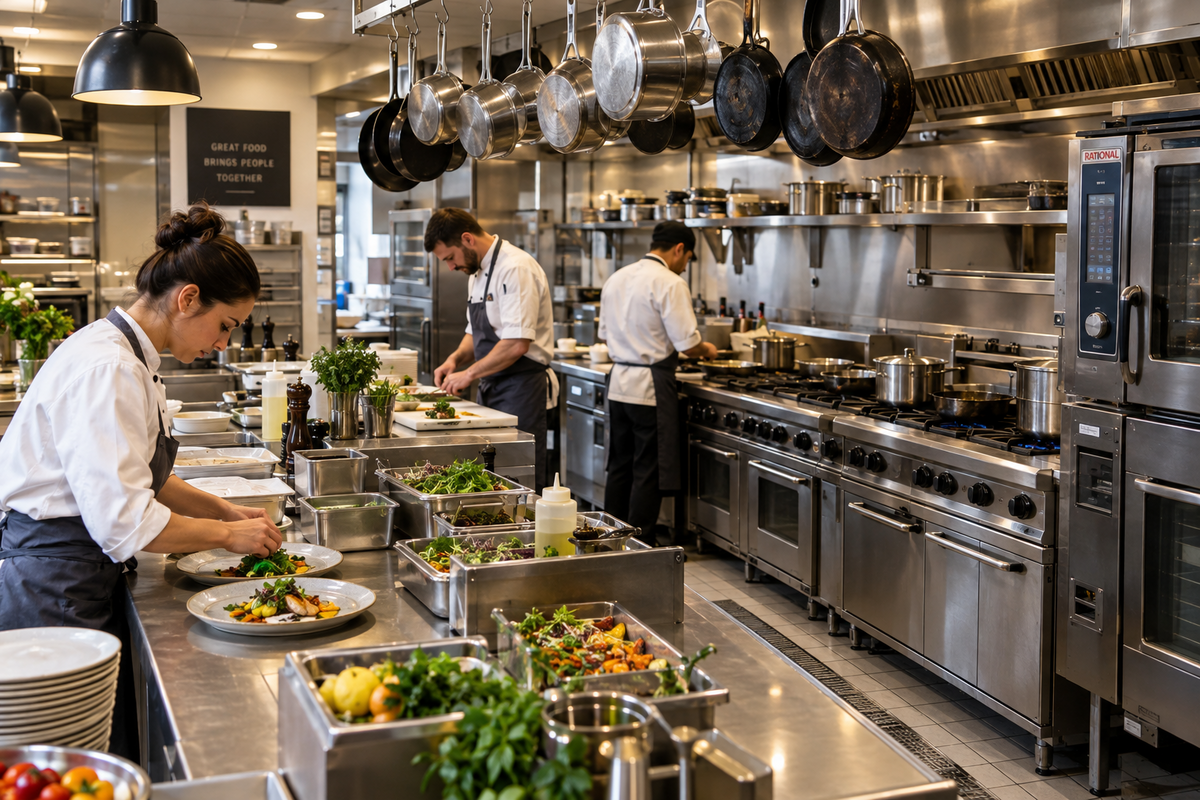
A busy commercial kitchen can be a challenging environment to manage safely.
Hot surfaces, sharp equipment, wet floors, cleaning chemicals, raw ingredients, allergens and multiple food preparation processes can all exist within a relatively small space.
Clear kitchen safety signs can help staff understand important instructions, identify hazards and follow established food hygiene procedures.
But which signs does a restaurant, café, takeaway or commercial kitchen actually need?
There isn't one universal checklist of signs that every UK catering business must display. The appropriate signage depends on your kitchen, equipment, food preparation processes, staff procedures and the risks you've identified.
This checklist will help you review the main areas where signage may be useful.
1. Hand Washing Signs
Check: Are your hand wash facilities clearly identified?
Hand hygiene is fundamental to good food hygiene.
In a commercial kitchen, staff should be able to identify designated hand washing facilities quickly and understand the procedures expected of them.
Useful signs can include:
-
Wash Hands
-
Now Wash Your Hands
-
Hand Wash Only
-
Wash Hands Before Returning to Work
-
Hand Washing Procedure
Position hand washing signs at or immediately beside the relevant facilities.
This is particularly important where several sinks are located close together and each has a different purpose.
Don't rely on the sign alone
A Wash Hands sign isn't a substitute for suitable facilities, appropriate procedures or staff training.
Use signage as a visible reminder of the food hygiene practices established for your business.
2. Sink Identification Signs
Check: Could somebody accidentally use the wrong sink?
Commercial kitchens may have separate facilities for:
-
Hand washing
-
Food washing
-
Equipment washing
-
Pot washing
-
Utensil washing
If the purpose of each sink isn't immediately obvious, clear identification can help prevent mistakes.
Typical signs include:
-
Hand Wash Only
-
Food Wash Only
-
Pot Wash Only
-
Utensil Wash Only
-
Equipment Wash Only
Position the sign directly beside or above the relevant sink.
This is a simple example of putting safety and hygiene information at the point of use rather than covering a general noticeboard with instructions.
3. Raw & Cooked Food Signs
Check: Are raw and ready-to-eat food preparation areas clearly distinguished?
Cross-contamination can occur when harmful bacteria are transferred between food, surfaces, equipment or hands.
Depending on your kitchen procedures, signs can help identify areas or equipment intended for different types of food.
Examples include:
-
Raw Food Only
-
Cooked Food Only
-
Raw Meat Preparation
-
Cooked Meat Only
-
Food Preparation Area
-
Wash Hands After Handling Raw Meat
-
Do Not Store Raw & Cooked Food Together
These signs should reflect the food safety procedures actually used in your kitchen.
If your business uses separate preparation zones, equipment or storage areas, clear identification can make those arrangements easier for staff to follow consistently.
4. Cross-Contamination Signs
Check: Are important cross-contamination controls being reinforced where mistakes could occur?
Food safety depends on much more than signage, but strategically positioned reminders can reinforce established procedures.
A Prevent Cross Contamination sign can be useful near preparation areas where staff need to remember procedures involving:
-
Raw and ready-to-eat foods
-
Hands
-
Utensils
-
Chopping boards
-
Work surfaces
-
Storage
-
Cleaning
Avoid treating a sign as the control itself.
The underlying procedures, facilities, equipment, cleaning and staff training are what manage the risk.
5. Food Allergen Signs
Check: Can customers obtain accurate allergen information and do staff understand your allergen procedures?
Allergen management deserves particular attention.
Food businesses must provide required information about regulated allergens and need effective procedures for managing allergen risks.
Depending on the business, useful notices may include:
-
Food Allergy Notice
-
Please Ask About Allergens
-
Allergy Information Available
-
Allergen Awareness reminders for staff
Customer-facing signs can encourage people with allergies or intolerances to speak to staff before ordering.
Back-of-house notices can reinforce your established allergen-management procedures.
An allergen sign isn't enough
Simply putting up a Food Allergy sign doesn't fulfil all of a food business's allergen responsibilities.
Accurate information, suitable procedures, staff knowledge and effective communication remain essential.
6. Food Storage Signs
Check: Are food storage areas clearly organised?
Food storage signage can help employees identify designated areas and reinforce your established storage procedures.
Depending on the kitchen, this could include:
-
Raw Food
-
Cooked Food
-
Chilled Food
-
Frozen Food
-
Dairy Products
-
Meat
-
Fish
-
Vegetables
-
Food Only
Clear identification can be particularly useful in larger kitchens, walk-in refrigerators, freezers and food production environments used by several members of staff.
7. Fridge & Freezer Temperature Signs
Check: Do staff have a clear reminder of your temperature-monitoring procedures?
Temperature control can be an important part of food safety management.
Signs positioned near refrigeration or freezer equipment can remind staff to carry out the checks established by your business.
However, a temperature sign isn't a substitute for:
-
Suitable equipment
-
Temperature monitoring
-
Appropriate records
-
Corrective action
-
Staff training
Use signage to reinforce the procedure rather than treating the sign as evidence that the procedure has been followed.
8. Cleaning Signs
Check: Are cleaning procedures clearly communicated?
Commercial kitchens require regular and effective cleaning.
Useful reminders can include:
-
Clean As You Go
-
Clean Equipment After Use
-
Keep This Area Clean
-
Clean Up Spillages
-
Keep Work Surfaces Clean
-
Keep Refuse Bins Closed
The best location is normally close to where the action needs to happen.
For example, a Clean Equipment After Use sign is more useful near the relevant equipment than on a noticeboard in a staff room.
9. Protective Clothing & PPE Signs
Check: Does your risk assessment or workplace procedure require particular protective equipment?
Depending on the work being undertaken, catering employees may need particular protective clothing or PPE.
Examples can include:
-
Protective Clothing Must Be Worn
-
Gloves Must Be Worn
-
Hair Protection Must Be Worn
-
Protective Footwear Must Be Worn
-
Hand Protection Must Be Worn
Where PPE is required, mandatory signage can help reinforce that instruction.
But a sign doesn't replace the need to select suitable PPE, provide it where required, train employees and manage its correct use.
10. Hot Surface Signs
Check: Could somebody encounter a hot surface without recognising the hazard?
Commercial kitchens contain plenty of hot equipment, including:
-
Ovens
-
Hobs
-
Grills
-
Fryers
-
Hot cupboards
-
Dishwashers
-
Heated preparation equipment
Where a hot surface presents a significant risk that isn't obvious or adequately controlled by other measures, an appropriate warning may help alert people before contact occurs.
Avoid covering every oven with unnecessary warning signs.
Signage is most useful where it communicates something the person genuinely needs to know.
11. Hot Water & Steam Signs
Check: Are there areas where hot water or steam presents a significant hazard?
Dishwashers, boilers, steam equipment and other catering machinery can create burn or scalding risks.
Depending on the equipment and risk assessment, warning signage may be appropriate.
Again, the sign isn't the primary safety measure.
Equipment design, guarding, maintenance, safe procedures and staff training remain important.
12. Kitchen Machinery Signs
Check: Does your kitchen use potentially hazardous machinery?
Commercial catering equipment can include:
-
Meat slicers
-
Mixers
-
Mincers
-
Food processors
-
Waste disposal equipment
-
Cutting machinery
Appropriate signs can reinforce specific instructions or warn people about hazards.
But don't try to make unsafe machinery safe by putting a warning sticker next to it.
Machine safety should primarily come from suitable equipment, guarding, maintenance, training and safe systems of work.
13. Wet Floor & Cleaning-in-Progress Signs
Check: How do you deal with temporary slip hazards?
Spillages and floor cleaning are common in catering environments.
Temporary warning signs can help alert employees and others while a short-term hazard is being dealt with.
But the priority should normally be to remove the hazard as quickly as practical.
A Wet Floor sign shouldn't become a permanent substitute for fixing a leaking appliance, damaged flooring or ineffective cleaning procedure.
14. Chemical & Cleaning Product Signs
Check: Are cleaning chemicals stored and used appropriately?
Commercial kitchens may use detergents, sanitisers, degreasers and other cleaning products.
Where appropriate, signs can help identify:
-
Chemical storage areas
-
Restricted cupboards
-
PPE requirements
-
Specific hazards
-
Cleaning stations
However, chemical safety involves much more than signage.
Follow the product information and your workplace procedures for storage, handling and use.
15. Knife & Sharp Equipment Safety
Check: Are there particular areas where sharp equipment creates a significant risk?
Knives are an everyday part of many kitchens, so generic warning signs everywhere are unlikely to add much value.
Signage may be more appropriate around specialist cutting machinery or locations where a particular hazard isn't obvious.
This illustrates an important principle:
Don't put up a sign simply because a hazard exists.
Use signage where it provides meaningful information that isn't adequately communicated through other controls.
16. First Aid Signs
Check: Can staff quickly find first aid facilities?
If somebody is injured, employees should be able to locate first aid equipment or facilities quickly.
Depending on your premises, appropriate signage could identify:
-
First Aid
-
First Aid Kit
-
First Aid Room
-
Eye Wash
-
Emergency Shower
The appropriate first aid arrangements depend on your workplace and first aid needs assessment.
17. Fire Safety Signs
Check: Can staff identify escape routes and relevant fire-safety information?
Commercial kitchens also need to consider general workplace fire safety.
Depending on the premises and fire risk assessment, signage may include:
-
Fire Exit
-
Emergency Exit
-
Fire Action
-
Fire Extinguisher identification
-
Fire Blanket
-
Fire Door
-
Assembly Point
Kitchen fire precautions should be based on the actual premises, equipment and fire risk assessment rather than a generic list of signs.
18. No Smoking Signs
Check: Is your smoke-free signage appropriate for your premises?
No Smoking signage may also form part of your wider premises signage.
Smoke-free signage requirements differ across the UK's four nations, so businesses should follow the requirements applicable where their premises are located.
If your business also prohibits vaping, a combined No Smoking & No Vaping sign can communicate your site policy clearly.
Remember that smoking and vaping aren't legally identical issues.
19. Staff Only & Restricted Access Signs
Check: Should customers or visitors be prevented from entering the kitchen?
Restaurants, pubs, hotels and cafés frequently have areas that aren't intended for customers.
Appropriate wording might include:
-
Staff Only
-
No Unauthorised Access
-
Authorised Personnel Only
-
No Entry
Choose the message that accurately describes the restriction.
If contractors or other authorised non-employees need to enter, No Unauthorised Access may be more accurate than Staff Only.
20. Waste & Refuse Signs
Check: Are food waste and refuse areas clearly managed?
Commercial kitchens generate substantial waste.
Signs can help identify:
-
Food Waste
-
General Waste
-
Recycling
-
Refuse Areas
-
Bins
-
Waste Storage
Where different waste streams are used, clear identification can make the system easier for staff to follow consistently.
Do UK Commercial Kitchens Have to Display Safety Signs?
There isn't one universal list of kitchen safety signs that every UK catering business must display.
For workplace safety signage generally, signs are required where a significant risk remains after other relevant measures have been put in place.
That means your signage should follow your actual risks and procedures, rather than a generic list copied from another restaurant.
Food businesses also have food safety responsibilities that extend far beyond displaying signs.
Your food safety management arrangements should address matters such as:
-
Personal hygiene
-
Cross-contamination
-
Cleaning
-
Cooking
-
Chilling
-
Allergens
-
Storage
-
Staff procedures
Signs can reinforce those arrangements at the point where staff need the information.
Kitchen Safety Signs & HACCP
You may see catering signs marketed as “HACCP compliant signs”.
That description can be misleading.
HACCP is a systematic approach to identifying and controlling food safety hazards. A particular sign doesn't make a kitchen HACCP compliant.
Instead, think of signs as tools that can support food safety procedures based on HACCP principles.
For example, your procedures may require raw and ready-to-eat food to be prepared separately.
Signs identifying those preparation areas can help staff follow that procedure consistently.
The procedure is the control; the sign helps communicate it.
What About ISO 7010?
BS EN ISO 7010 provides recognised graphical symbols for many types of safety sign, including warnings, prohibitions, mandatory actions, emergency information and fire safety.
Where a recognised safety symbol is appropriate, standardised symbols can make instructions easier to understand.
However, ISO 7010 isn't food hygiene legislation and displaying an ISO-style sign doesn't automatically make a commercial kitchen legally compliant.
Food hygiene notices such as Raw Food Only, Clean As You Go or Hand Wash Only also don't necessarily correspond to individual ISO 7010 safety symbols.
The important thing is to use appropriate signage for the actual instruction or risk.
Where Should Kitchen Safety Signs Go?
One of the most common signage mistakes is putting all the signs together.
Imagine a staff noticeboard containing:
-
Wash Your Hands
-
Prevent Cross Contamination
-
Clean As You Go
-
Wear Protective Clothing
-
Check Fridge Temperature
It looks comprehensive.
But it's often more effective to put each instruction where the action happens.
For example:
| Sign | Useful Location |
|---|---|
| Wash Hands | Hand wash basin |
| Hand Wash Only | Directly above the designated sink |
| Raw Food Only | Raw-food preparation area |
| Clean Equipment After Use | Relevant equipment |
| Fridge Temperature | Refrigeration area |
| Protective Clothing Must Be Worn | Entrance to the area where required |
| Hot Surface | At the relevant hazard where appropriate |
| Food Allergy Notice | Customer-facing ordering/service area |
| Staff Only | Kitchen/staff-area entrance |
| First Aid | At or directing towards first aid facilities |
The principle is simple:
Put the message where somebody needs to make the decision.
Avoid Sign Overload
More signs don't necessarily mean a safer kitchen.
HSE guidance specifically warns against using too many safety signs where this could cause confusion.
Walk around your kitchen and ask:
-
What hazard or procedure exists here?
-
What controls are already in place?
-
Does somebody need additional information?
-
Would a sign make the instruction clearer?
-
What should the sign actually say?
-
Where will people see it at the right moment?
This produces a much more useful signage system than buying a generic bundle of notices and putting them wherever there is spare wall space.
Commercial Kitchen Safety Sign Checklist
Use this checklist when reviewing your premises.
Food Hygiene
☐ Hand washing facilities identified
☐ Hand washing procedures reinforced where useful
☐ Sinks clearly identified
☐ Raw and cooked food areas identified where applicable
☐ Cross-contamination procedures reinforced
☐ Food storage areas identified where useful
☐ Cleaning procedures communicated
☐ Temperature-control reminders positioned where required
Allergens
☐ Customers can access accurate allergen information
☐ Staff know how to handle allergen enquiries
☐ Allergen-management procedures are understood
☐ Appropriate customer-facing allergen notices displayed where useful
☐ Kitchen procedures address allergen cross-contact
Workplace Safety
☐ PPE requirements clearly communicated where applicable
☐ Significant hot-surface hazards identified where necessary
☐ Machinery warnings/instructions provided where appropriate
☐ Temporary slip hazards can be identified
☐ Cleaning chemical areas appropriately managed
☐ Restricted areas clearly identified
Emergency Information
☐ First aid facilities easy to locate
☐ Fire exits and escape routes appropriately signed
☐ Relevant firefighting equipment identifiable where necessary
☐ Fire Action information provided where appropriate
☐ Assembly point identified where required by emergency arrangements
Sign Condition
☐ Signs are clean
☐ Signs are legible
☐ Signs are securely fixed
☐ Signs aren't obscured
☐ Instructions are still accurate
☐ Signs are positioned at the point of use
☐ Outdated signs have been removed
Review Your Kitchen From the Staff's Point of View
A useful final check is to walk through the kitchen as though it were your first shift.
Start at the staff entrance and follow the normal working process.
Can you identify:
-
Where to wash your hands?
-
Which sink to use?
-
Where raw food is prepared?
-
Where ready-to-eat food is handled?
-
Which cleaning procedures apply?
-
Where allergens are managed?
-
Which PPE is required?
-
Which areas are restricted?
-
Where first aid equipment is located?
-
How to leave safely in an emergency?
If an important instruction isn't obvious at the point where somebody needs it, that may be a good location for a sign.
Signs Support Good Kitchen Management
The most effective commercial kitchens don't rely on signs to create safe behaviour.
They combine appropriate facilities, good procedures, suitable equipment, effective cleaning, food safety management, training and supervision.
Kitchen safety signs support those measures by putting clear information where people need it.
Used well, they can help staff follow food hygiene procedures consistently, identify hazards and understand important workplace instructions without creating unnecessary visual clutter.
Shop Food Hygiene & Kitchen Signs
Safety Sheep supplies Food Hygiene & Kitchen Signs for restaurants, cafés, takeaways, pubs, hotels, schools, care homes, canteens and other UK catering businesses.
The range includes hand washing signs, food preparation signs, cross-contamination notices, allergen signs, cleaning signs, sink identification, food storage signs, PPE notices and other kitchen safety signage.
Choose from a range of sizes and durable materials, with Made in Britain signs and bulk savings available for businesses and trade customers.
Think Safety. Think Sheep.
Share:
How to Prevent Cross-Contamination in a Commercial Kitchen
CCTV Signs: A Checklist for UK Businesses