

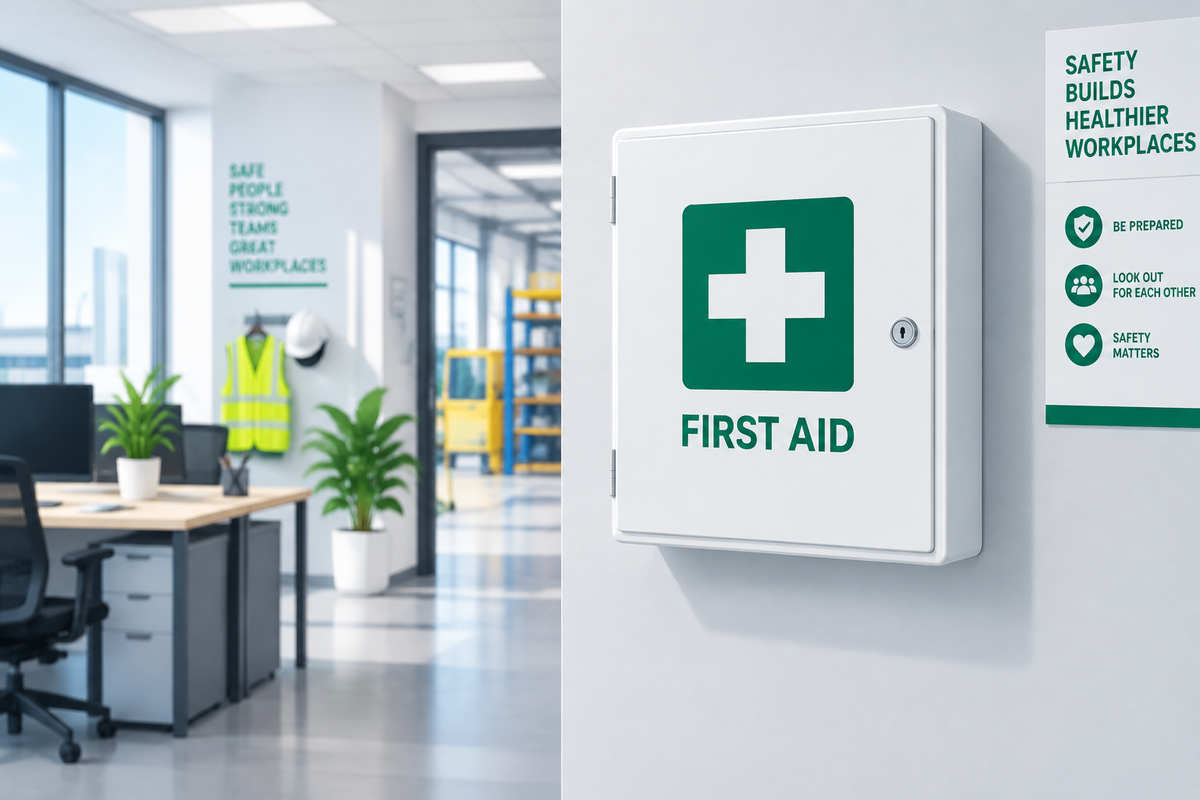
If somebody becomes ill or suffers an injury at work, knowing where to find first aid equipment and assistance can make an important difference.
A first aid kit may be fully stocked, but if nobody knows where it is kept, valuable time can be lost searching for it. The same applies to designated first aid rooms, trained first aiders, defibrillators and specialist emergency equipment.
First Aid Signs help employees, contractors and visitors quickly identify the equipment, facilities and assistance available within a workplace.
But which signs should your business display? Do you need a First Aid Kit Sign, a First Aider notice or additional directional signage?
This practical UK guide explains the main types of workplace first aid signs, where to position them and what to check when reviewing your existing arrangements.
Why Are First Aid Signs Important?
Clear first aid signage helps people locate assistance when it is needed.
It is particularly useful in larger workplaces, where equipment may be stored in different departments, behind cupboard doors or in designated first aid rooms.
Appropriate signage can help:
-
Identify first aid kits and boxes.
-
Locate designated first aid rooms.
-
Communicate first aider information.
-
Identify AED defibrillator locations.
-
Highlight emergency eyewash and shower facilities.
-
Direct people towards first aid equipment.
-
Help new employees and contractors understand workplace arrangements.
However, displaying a sign doesn't replace the requirement to provide adequate and appropriate first aid arrangements.
Your signage should reflect the actual equipment, facilities and personnel available.
Are First Aid Signs a Legal Requirement in the UK?
The Health and Safety (First-Aid) Regulations 1981 require employers to provide adequate and appropriate equipment, facilities and personnel so employees can receive immediate attention if they are injured or become ill at work.
Employers must also inform employees about their first aid arrangements.
The correct provision depends on a first aid needs assessment, which should consider factors such as workplace hazards, workforce size, working patterns and the nature of the activities undertaken.
First aid notices are a practical way to communicate the location of equipment and the identity of relevant personnel.
However, there isn't one identical shopping list of signs suitable for every UK workplace.
The correct selection depends on what your business provides and where it is located.
Workplace First Aid Sign Checklist
Use the following checklist to review your premises and identify which signs may be relevant.
1. First Aid Kit Signs
Check: Can employees easily identify where your workplace first aid kit is kept?
A First Aid Kit Sign identifies the location of essential first aid supplies.
These notices commonly feature a white cross on a green background, making them easy to recognise.
Typical locations include:
-
Office first aid cupboards.
-
Staff rooms.
-
Factory welfare areas.
-
Warehouse first aid stations.
-
Construction site offices.
-
Reception areas.
-
Workshop facilities.
Position the sign above, beside or directly on the relevant storage location.
Where a kit is stored inside a cupboard, make sure the sign clearly identifies the correct cupboard.
2. First Aid Box Signs
Check: Are your first aid boxes clearly marked?
First Aid Box Signs perform a similar function to First Aid Kit Signs.
They identify the location of the supplies provided for workplace first aid.
Where several kits are distributed around a large building, ensure each designated location is clearly identified.
HSE guidance states that first aid boxes should display a white cross on a green background.
3. First Aid Room Signs
Check: Does your workplace have a designated first aid room?
Where a dedicated first aid room forms part of your arrangements, it should be easy to identify.
A First Aid Room Sign can help employees and other relevant people recognise the facility.
Suitable positions include:
-
The entrance door.
-
An adjacent wall.
-
The corridor leading to the room.
-
Relevant directional points elsewhere in the building.
A sign should clearly identify the actual first aid room rather than a general welfare or storage area.
4. First Aider Signs
Check: Do employees know who is responsible for providing first aid?
First Aider Signs can help communicate the identity or location of trained first aid personnel.
Depending on your arrangements, useful notices may include:
-
First Aiders On Site.
-
First Aiders Location.
-
First Aider Contact Details.
-
First Aid Personnel Information.
If the sign includes names, departments, telephone extensions or other contact information, keep these details accurate.
Consider shift patterns, holidays, absences and changes in personnel.
A notice listing somebody who is no longer available can cause unnecessary confusion.
5. First Aid Contact Information Signs
Check: Is important first aid information readily available?
Some businesses benefit from a dedicated notice displaying:
-
The names of first aiders.
-
Relevant workplace contact numbers.
-
The location of first aid equipment.
-
The location of the designated first aid room.
-
Appropriate emergency contact information.
These notices may be particularly useful in reception areas, staff rooms, welfare facilities and other prominent workplace locations.
Make sure the information reflects your current first aid arrangements.
6. AED & Defibrillator Signs
Check: Does your workplace have an automated external defibrillator?
An AED Defibrillator Sign identifies the location of the equipment.
AEDs may be installed in workplaces, leisure facilities, schools, community buildings and other premises.
Where your business provides an AED, suitable signage can help people locate it quickly.
Consider displaying signs:
-
Above the AED cabinet.
-
Beside the equipment location.
-
At nearby corridor junctions.
-
At other relevant directional points.
The sign should direct people to the actual equipment rather than simply indicating that an AED exists somewhere in the building.
7. Emergency Eye Wash Signs
Check: Does your workplace provide emergency eyewash facilities?
Emergency Eye Wash Signs identify designated eyewash equipment.
These may be relevant to workplaces where the risk assessment identifies a need for suitable emergency eye treatment facilities.
Examples include:
-
Laboratories.
-
Chemical handling areas.
-
Industrial processing facilities.
-
Relevant manufacturing environments.
-
Workshops.
Position the sign where the eyewash station can be identified easily.
Make sure the route to the equipment remains unobstructed.
8. Emergency Shower Signs
Check: Does your workplace have an emergency safety shower?
Emergency Shower Signs identify designated emergency shower facilities.
These may be appropriate in certain industrial, laboratory and chemical handling environments.
Where the facility forms part of the site's emergency arrangements, make sure its location is clearly communicated.
A warning or identification sign should support appropriate emergency planning and equipment maintenance.
9. Stretcher Signs
Check: Does your workplace provide emergency stretcher equipment?
A Stretcher Sign helps identify where the equipment is stored.
This may be relevant to larger industrial sites, warehouses and other workplaces where stretcher provision forms part of the first aid arrangements.
Position the sign where the equipment can be found without unnecessary searching.
10. First Aid Directional Signs
Check: Can somebody find your first aid equipment from other parts of the building?
A First Aid Directional Sign uses an arrow to guide people towards equipment or facilities that aren't immediately visible.
These notices are particularly useful in larger or more complex premises.
Consider positioning directional signs at:
-
Corridor junctions.
-
Stairwell exits.
-
Reception areas.
-
Warehouse intersections.
-
Factory access routes.
-
Construction site welfare areas.
-
Entrances to separate departments.
Choose the correct arrow direction according to the viewer's approach.
An incorrectly positioned arrow can be more confusing than having no directional sign at all.
What Colour Should First Aid Signs Be?
Recognised First Aid Signs use a green background with a white pictogram.
The familiar white cross on green helps people identify first aid equipment and facilities.
Green is the recognised safety colour for emergency escape and first aid information.
This distinguishes first aid signs from other workplace safety notices.
| Sign type | Typical colour and shape | Purpose |
|---|---|---|
| First Aid / Safe Condition | Green with white symbol | Identifies equipment and facilities |
| Warning | Yellow triangle | Warns about hazards |
| Prohibition | Red circle and diagonal line | Communicates prohibited actions |
| Mandatory | Blue circle | Communicates required actions |
Using recognised symbols consistently can make workplace signage easier to understand.
Where Should First Aid Signs Be Displayed?
The best location is where somebody can easily identify the equipment or facility without unnecessary searching.
Offices
Consider first aid kit locations, reception areas, staff rooms and relevant corridors.
In larger offices, directional signs may help people locate equipment on different floors.
Warehouses
Warehouses can cover substantial floor areas, so signs should be clearly visible from relevant working routes.
Review the position of equipment in relation to storage racks, machinery and access routes.
Factories & Manufacturing
Industrial premises may have several first aid points serving different departments.
Use clear location and directional signage where appropriate.
Specialist facilities such as eyewash stations should also be identified where provided.
Construction Sites
Construction sites change as work progresses.
First aid signs should reflect the current position of site offices, welfare facilities, equipment and relevant personnel.
Review temporary signage when the site layout changes.
Schools & Educational Premises
First aid kits, rooms and AEDs should be clearly identified where provided.
Consider how staff, visitors and other relevant users will locate assistance.
Laboratories & Chemical Handling Areas
Where specialist emergency equipment forms part of the first aid arrangements, suitable eyewash and emergency shower signs may be necessary.
Ensure the route to the equipment remains accessible.
How Many First Aid Signs Does a Workplace Need?
There isn't one universal number suitable for every business.
A small office with one easily accessible first aid kit will have different signage needs from a large warehouse or manufacturing facility with multiple first aid points.
Consider:
-
The size of the premises.
-
The number of first aid locations.
-
The position of equipment.
-
The number of floors or departments.
-
The routes people normally use.
-
Whether equipment is visible from those routes.
-
The presence of specialist emergency facilities.
The objective is to make the workplace's actual first aid arrangements easy to identify and understand.
What Size First Aid Sign Should I Choose?
Choose a sign size that suits the viewing distance and mounting position.
A notice attached directly to a first aid cupboard may be viewed from relatively close range.
A directional sign intended to be seen across a large warehouse may need to be more prominent.
Consider:
-
Symbol size.
-
Text size.
-
Viewing distance.
-
Mounting height.
-
Lighting.
-
Approach direction.
-
Background contrast.
-
Potential obstructions.
Signs should remain legible and recognisable from the intended viewing position.
Choosing First Aid Sign Materials
Different workplace environments require different materials.
Depending on the product, options may include:
Self-Adhesive Vinyl: Suitable for appropriate smooth, clean surfaces.
Rigid Plastic: A practical option for many general workplace applications.
Recycled Plastic: Available across selected signage products.
Aluminium Composite: A durable option for suitable longer-term installations.
Choose the material and fixing method according to the intended environment and mounting surface.
Common First Aid Signage Mistakes
Avoid these frequent problems:
-
First aid kits stored in unmarked cupboards.
-
Outdated first aider names or contact information.
-
Missing directional signs in larger buildings.
-
Signs obscured by shelving or stored equipment.
-
AED notices that don't identify the actual equipment location.
-
Incorrect arrow directions.
-
Missing eyewash signs where specialist equipment is provided.
-
Signs that are too small for the viewing distance.
-
Faded or damaged notices.
-
Failing to update signage after workplace changes.
Regular inspections can help identify these problems before somebody needs first aid assistance.
Printable First Aid Sign Checklist
Use this checklist when reviewing your workplace or ordering replacement signs.
General First Aid Equipment
-
First Aid Kit Signs.
-
First Aid Box Signs.
-
First Aid Location Signs.
-
First Aid Room Signs, where applicable.
First Aid Personnel & Information
-
First Aiders On Site notice.
-
First Aider Location notice.
-
Accurate contact details.
-
Current first aid arrangements communicated to employees.
-
Information reviewed when personnel change.
Emergency Equipment
-
AED Defibrillator Signs, where equipment is provided.
-
Emergency Eye Wash Signs, where applicable.
-
Emergency Shower Signs, where applicable.
-
Stretcher Signs, where applicable.
Directional Signage
-
Main first aid locations are clearly identified.
-
Relevant corridors and junctions have been reviewed.
-
Directional arrows point towards the correct location.
-
Signs are visible from normal approach routes.
-
Multiple floors or departments have been considered.
Installation & Maintenance
-
Signs are large enough for the intended viewing distance.
-
Green and white first aid symbols are used appropriately.
-
Mounting positions are suitable.
-
Signs aren't obstructed by furniture or equipment.
-
Materials are appropriate for the environment.
-
Damaged or faded notices are replaced.
-
Signage is updated when equipment is moved.
-
First aider information remains accurate.
Important: This is a signage selection checklist, not a substitute for carrying out a suitable first aid needs assessment or providing adequate and appropriate workplace first aid arrangements.
A Simple First Aid Signage Walkthrough
One of the easiest ways to review your workplace signage is to walk through the premises as though you're a new employee.
Start at the main entrance and follow the normal routes through the building.
Ask yourself:
-
Can I identify where the nearest first aid kit is kept?
-
Do I know how to contact a first aider or appointed person?
-
Is the first aid room clearly marked, if one is provided?
-
Can I locate the AED, if available?
-
Are specialist emergency facilities easy to identify?
-
Are directional signs accurate?
-
Are all notices visible and in good condition?
If the answers aren't immediately clear, review the positioning or wording of your existing signs.
Shop First Aid Signs at Safety Sheep
Safety Sheep supplies First Aid Signs for UK businesses, offices, construction sites, factories, warehouses, schools and commercial premises.
Our range includes:
-
First Aid Kit Signs.
-
First Aid Box Signs.
-
First Aider Signs.
-
First Aid Location Signs.
-
AED Defibrillator Signs.
-
Emergency Eye Wash Signs.
-
Emergency Shower Signs.
-
First Aid Directional Signs.
Choose from a selection of sizes and durable materials for different workplace environments.
Made in Britain, with bulk savings available for businesses and trade customers.
Explore our full range of First Aid Signs and make your workplace's first aid arrangements easier to identify.
Think Safety. Think Sheep.
Share:
Overhead & Underground Cable Signs: A Guide for UK Construction Sites
AED & Defibrillator Signs: Where Should They Be Displayed?