

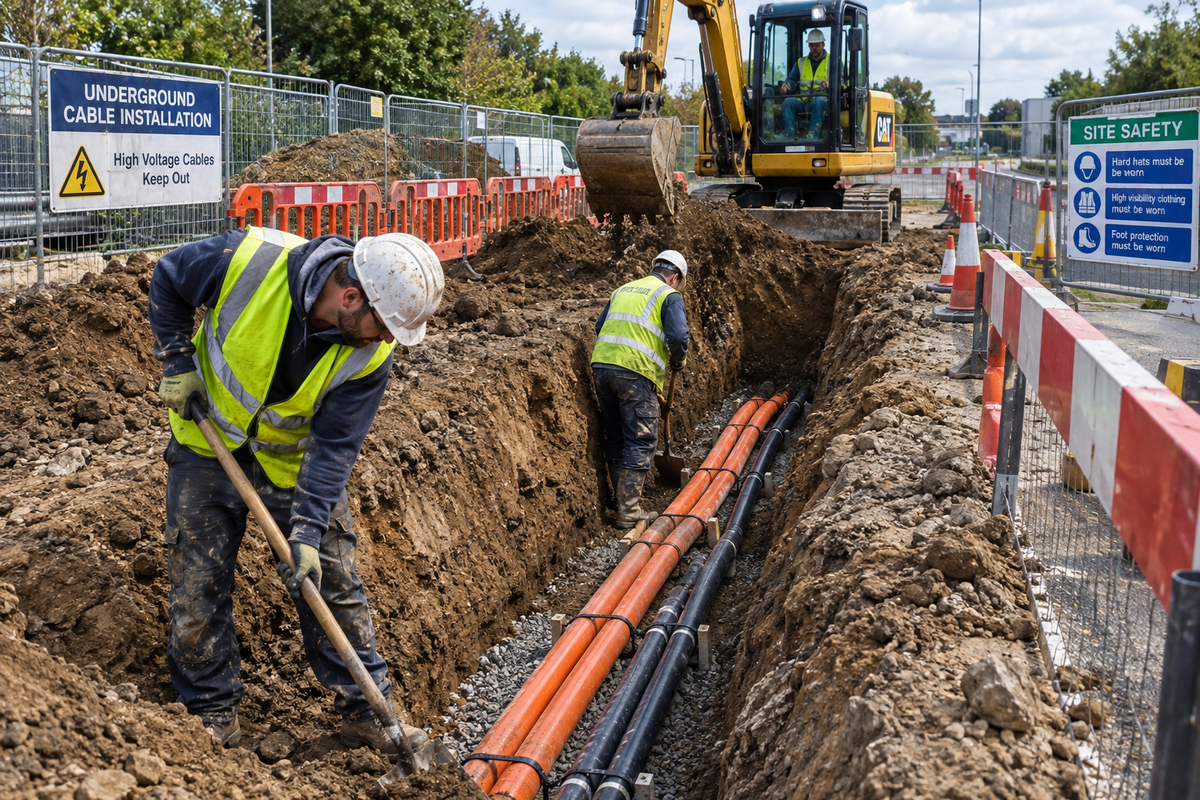
Electrical cables are among the most serious hazards encountered on UK construction sites, particularly when operating machinery, carrying out excavation work or moving tall equipment around a project.
Some electrical hazards are clearly visible, such as overhead power lines. Others may be hidden beneath roads, footpaths, foundations or undeveloped land.
Overhead Cable Warning Signs and Underground Cable Signs help communicate these hazards to workers, contractors, plant operators and site visitors.
But which signs should construction sites display? Where should they be positioned? And what is the difference between warning somebody about an overhead power line and identifying the location of a buried electrical cable?
This practical guide explains the main types of electrical cable signage, suitable locations and important considerations for UK construction projects.
Why Are Electrical Cable Warning Signs Important?
Construction sites are constantly changing environments.
New access routes may be created, excavations opened, machinery introduced and temporary working areas established throughout a project.
Where electrical infrastructure is present, these changes can expose workers to hazards they may not have previously encountered.
Appropriate cable warning signage can help:
-
Alert drivers to overhead electrical lines.
-
Communicate identified underground cable hazards.
-
Reinforce restricted working areas.
-
Warn contractors before entering hazardous locations.
-
Support site-specific electrical safety instructions.
-
Improve awareness around excavation and lifting operations.
However, a warning sign doesn't remove the underlying electrical hazard.
Signage should support appropriate planning, competent supervision, safe working procedures and other necessary risk controls.
Overhead Cable Signs vs Underground Cable Signs
Although both relate to electrical infrastructure, they communicate different hazards.
| Sign type | Main purpose |
|---|---|
| Overhead Electric Cables | Warns about electrical lines above a working area |
| Drivers Beware Overhead Cables | Alerts vehicle and machinery operators |
| High Voltage Cables Over | Communicates a specific overhead electrical hazard |
| Danger Buried Cable | Warns about underground electrical infrastructure |
| Underground Services | Identifies the potential presence of buried services |
| High Voltage Cables Under | Communicates a specific underground electrical hazard |
Choose the wording that accurately reflects the installation and the activities taking place.
A general Danger Electricity sign may not provide enough information where the hazard specifically involves overhead or buried cables.
Part One: Overhead Electric Cable Signs
What Are Overhead Cable Warning Signs?
Overhead Cable Warning Signs communicate the presence of electrical lines above a working area, access route or operational location.
They are particularly relevant where tall vehicles, lifting equipment, scaffolding or other machinery could approach electrical infrastructure.
Common sign messages include:
-
Danger Overhead Electric Cables.
-
Drivers Beware Overhead Cables.
-
High Voltage Cables Over.
-
Danger Live Wires Overhead.
The appropriate wording depends on the actual hazard and the intended audience.
Where Should Overhead Cable Signs Be Displayed?
1. Construction Site Entrances
Where overhead power lines affect access to a construction site, warning signs may be appropriate before vehicles enter the relevant area.
This is particularly important for delivery drivers and contractors who may be unfamiliar with the site layout.
Position notices where they can be recognised in sufficient time for drivers to follow the site's access arrangements.
2. Vehicle Access Routes
Dumpers, excavators, tipper lorries and other construction vehicles may present particular risks around overhead electrical lines.
Where a designated route passes near electrical infrastructure, suitable warning signs can reinforce the hazard.
The message should be visible from the driver's normal approach.
3. Crane & Lifting Areas
Cranes, lifting equipment and long materials can create serious risks when used near overhead power lines.
Appropriate warning signs may help identify relevant restricted areas.
However, signage must support suitable work planning, safe separation and other precautions identified through the risk assessment.
4. Temporary Site Roads
Temporary access roads may change during different phases of construction.
Where overhead electrical infrastructure is relevant to the route, review the signage whenever access arrangements change.
An existing warning may become ineffective if vehicles begin approaching from a different direction.
5. Agricultural & Rural Construction Sites
Rural developments and farm construction projects may involve overhead electrical lines crossing fields, access tracks or working areas.
Consider how contractors, delivery vehicles and agricultural machinery will approach the site.
Suitable warnings can help communicate identified hazards to people unfamiliar with the location.
Can an Overhead Cable Sign Replace a Safety Barrier?
No.
A warning sign communicates the presence of electrical infrastructure, but it doesn't physically prevent a vehicle, crane or item of equipment from approaching a power line.
Where necessary, appropriate controls may include designated routes, exclusion arrangements, physical barriers, suitable goalposts and other precautions determined through site planning.
Construction work near overhead lines should follow relevant HSE guidance and the requirements of the electricity network operator.
Never assume a power line is safe simply because it appears insulated or is positioned above normal head height.
Choosing the Right Overhead Cable Sign Size
Overhead cable notices may need to be read by drivers approaching from a distance.
Consider:
-
Vehicle approach speed.
-
Viewing distance.
-
Mounting height.
-
Sign orientation.
-
Symbol and text size.
-
Lighting.
-
Weather conditions.
-
Potential obstructions.
A small warning that is suitable for an equipment enclosure may not be sufficiently visible on a construction vehicle route.
Part Two: Underground & Buried Cable Signs
What Are Underground Cable Signs?
Underground Cable Signs warn people about electrical infrastructure located beneath the ground.
These signs may be particularly relevant during excavation, trenching, landscaping, groundwork and utility maintenance activities.
Common messages include:
-
Danger Buried Cable.
-
Buried Cable Danger.
-
Underground Electrical Services.
-
High Voltage Cables Under.
The correct sign should accurately reflect the known hazard.
Importantly, a warning notice doesn't establish the exact position, route or depth of an underground cable.
Where Should Buried Cable Signs Be Displayed?
1. Excavation Areas
Where underground electrical services have been identified, suitable warning signs may help communicate the hazard to people entering the excavation area.
Position signs at relevant access points or barriers.
However, the actual cable route must also be identified and marked through appropriate site procedures.
2. Groundwork & Trenching Locations
Groundworkers may encounter buried services when digging foundations, trenches or drainage channels.
Appropriate signs can reinforce the presence of an identified hazard.
The site team should also use current service information, suitable locating equipment and safe excavation practices.
3. Utility Maintenance Areas
Utility works may involve existing underground electrical infrastructure.
Where relevant, warning notices can help identify hazardous working areas and reinforce access restrictions.
Choose signs according to the actual services and the work being undertaken.
4. Industrial & Commercial Developments
Redevelopment projects may contain buried electrical services associated with existing buildings, external lighting, access equipment or previous site installations.
Don't assume that an apparently clear area of ground contains no electrical services.
Suitable investigations are necessary before excavation begins.
5. Temporary Construction Compounds
Site cabins, temporary lighting and construction power supplies may introduce new underground cable routes.
Where these services are installed, ensure their positions are properly recorded and communicated.
Relevant warning notices can support the site's wider service identification arrangements.
Why Underground Cable Signs Aren't Enough on Their Own
Buried electrical cables may not follow an obvious route.
Existing plans can be incomplete, outdated or inaccurate.
A warning sign can communicate that a hazard exists, but it cannot confirm exactly where a cable is located.
The HSE's guidance, Avoiding Danger from Underground Services (HSG47), identifies three key elements of safe excavation:
-
Planning the work.
-
Locating and identifying buried services.
-
Safe excavation.
These measures are essential when planning work around underground electrical infrastructure.
Appropriate signage should support these arrangements, not replace them.
Cable Location Markings vs Warning Signs
A Buried Cable Sign and a cable location marking serve different purposes.
A warning sign alerts people to the presence of an electrical hazard.
A location marking communicates information about the identified route or position of a service.
Both may be relevant to a construction project, but neither should be treated as a substitute for proper service identification and safe digging procedures.
Site teams should ensure that any marking system is clearly understood by the people carrying out the work.
Which Cable Signs Should a Construction Site Display?
The correct selection depends on the hazards identified at the particular site.
Use the following table as a starting point.
| Site condition | Sign to consider |
|---|---|
| Overhead power lines near vehicle access | Drivers Beware Overhead Cables |
| Electrical lines above a working area | Overhead Electric Cables |
| Known high-voltage overhead infrastructure | Appropriate High Voltage / Overhead Cable warning |
| Buried electrical services near planned excavation | Danger Buried Cable |
| Underground services within a working area | Underground Services |
| Known underground high-voltage installation | Appropriate High Voltage Cables Under warning |
| Restricted electrical compound | Danger Electricity and relevant access restriction |
Only display notices that accurately reflect the site conditions.
Avoid using High Voltage wording unless it is technically appropriate.
Are Overhead & Underground Cable Signs a Legal Requirement in the UK?
UK construction employers and contractors have responsibilities under legislation including the Health and Safety at Work etc. Act 1974, the Electricity at Work Regulations 1989 and the Construction (Design and Management) Regulations 2015.
The Health and Safety (Safety Signs and Signals) Regulations 1996 also establish requirements for workplace safety signage.
Appropriate signs are required where significant risks remain after other relevant safety measures have been implemented and a sign can help reduce those remaining risks.
However, there isn't one universal set of cable warning signs that every construction site must display.
The correct signage depends on the electrical infrastructure, work activities, site layout and identified risks.
Relevant HSE Guidance
Two particularly important HSE publications are:
GS6 – Avoiding Danger from Overhead Power Lines
This provides guidance for people planning or controlling work near overhead electrical lines where contact may occur.
HSG47 – Avoiding Danger from Underground Services
This explains the precautions involved in planning excavation work, locating buried services and carrying out safe digging operations.
Site managers should consult the relevant guidance when planning work around electrical infrastructure.
Choosing Materials for Construction Cable Signs
Construction sites can expose signs to rain, wind, mud, dust and physical damage.
Choose a material suitable for the intended location and duration of use.
Depending on the product, options may include:
Self-Adhesive Vinyl: Suitable for appropriate smooth, clean surfaces.
Rigid Plastic: A practical option for many general construction signage applications.
Recycled Plastic: Available across selected signage products.
Aluminium Composite: A durable option for suitable longer-term outdoor installations.
Consider the fixing method and whether the sign will remain secure and visible throughout the relevant phase of work.
Where Should Cable Signs Be Mounted?
The correct mounting position depends on the hazard and the people who need to see the warning.
For example:
-
Vehicle warnings should be visible from the normal driving approach.
-
Excavation warnings should be displayed at relevant access points.
-
Restricted electrical areas should be clearly identified before entry.
-
Temporary warnings should remain relevant as site conditions change.
Avoid placing signs where they may be hidden by machinery, materials, temporary fencing or vegetation.
Common Electrical Cable Signage Mistakes
Avoid these frequent problems:
-
Displaying a generic electrical warning where a more specific cable notice is necessary.
-
Positioning overhead cable warnings after vehicles have entered the hazardous area.
-
Using signs that are too small for the intended viewing distance.
-
Assuming buried cable signs identify the exact cable route.
-
Displaying inaccurate voltage information.
-
Failing to review signage when site access routes change.
-
Missing warnings at secondary entrances.
-
Allowing signs to become damaged or obscured.
-
Leaving outdated temporary warnings in place.
-
Treating signage as a substitute for safe electrical working procedures.
Printable Overhead & Underground Cable Sign Checklist
Use this practical checklist when reviewing your construction site.
Overhead Cable Hazards
-
Have overhead electrical lines been identified?
-
Have relevant network operators been consulted where necessary?
-
Have vehicle routes been reviewed?
-
Are lifting operations appropriately planned?
-
Are suitable warning signs displayed where needed?
-
Are signs visible before vehicles approach the hazard?
-
Are appropriate exclusion arrangements and other controls in place?
Underground Cable Hazards
-
Have available service plans been obtained and reviewed?
-
Have buried services been located by competent people?
-
Are identified cable routes appropriately marked?
-
Are relevant Buried Cable Signs displayed?
-
Have excavation access points been reviewed?
-
Are safe digging procedures established?
-
Are warnings updated as the work progresses?
Sign Selection
-
Does each sign accurately describe the hazard?
-
Is the wording suitable for the intended audience?
-
Is any voltage information correct?
-
Are recognised warning symbols used where appropriate?
-
Are additional access restrictions needed?
Installation & Maintenance
-
Signs are large enough for the viewing distance.
-
Mounting positions are appropriate.
-
Signs aren't obscured by equipment or materials.
-
Outdoor materials are suitable for the environment.
-
Fixings are secure.
-
Damaged or faded signs are replaced.
-
Temporary notices are removed or updated when work arrangements change.
Important: This checklist supports site signage selection. It doesn't replace a suitable electrical risk assessment, service detection, safe excavation procedures or appropriate precautions around overhead power lines.
Shop Overhead & Underground Cable Signs at Safety Sheep
Safety Sheep supplies Overhead Cable Warning Signs, Buried Cable Signs and Electrical Safety Signs for UK construction sites, contractors, industrial premises and commercial developments.
Our range includes:
-
Overhead Electric Cables.
-
Drivers Beware Overhead Cables.
-
High Voltage Cables Over.
-
Danger Buried Cable.
-
Underground Services.
-
High Voltage Cables Under.
Choose from a selection of sizes and durable materials suitable for different working environments.
Made in Britain, with bulk savings available for businesses and trade customers.
Explore our full range of Electrical Safety Signs to find suitable warnings for your project.
Think Safety. Think Sheep.
Share:
High Voltage Warning Signs: Where Should They Be Displayed?
First Aid Signs: A Checklist for UK Workplaces