

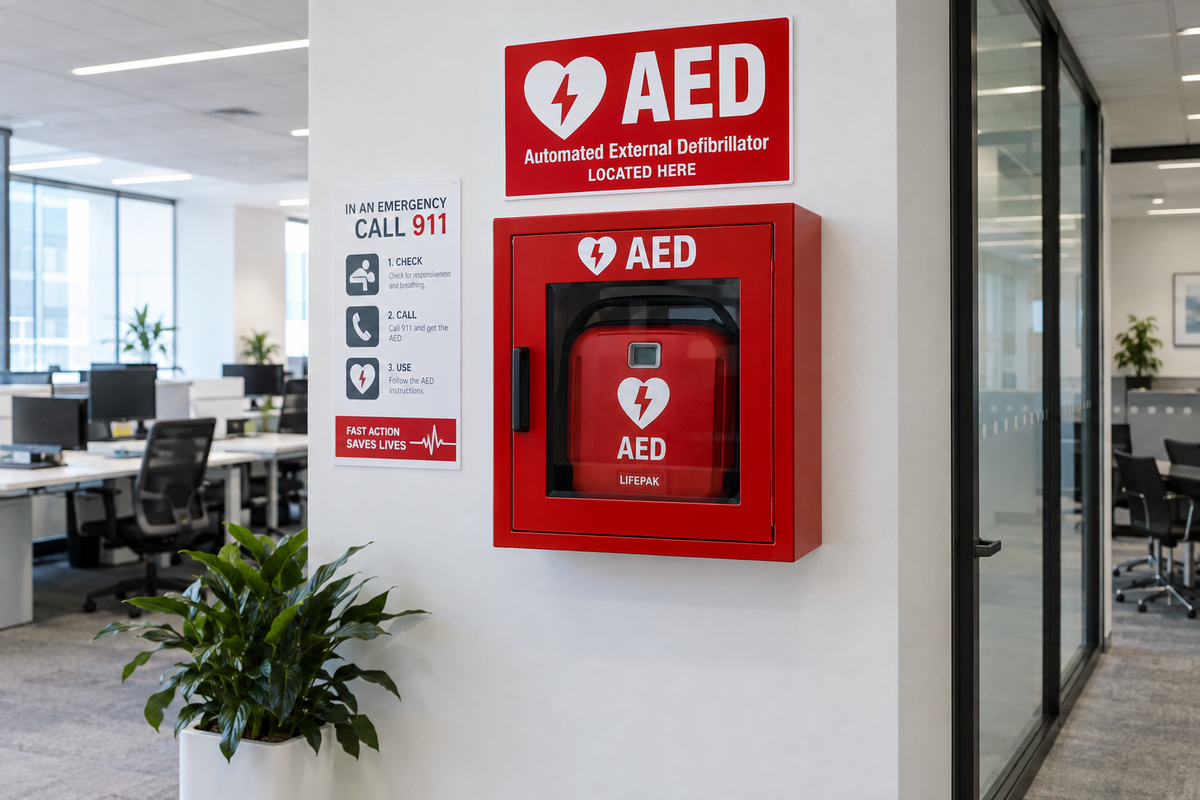
When somebody suffers a sudden cardiac arrest, being able to locate an automated external defibrillator (AED) quickly is extremely important.
A workplace or public building may have a defibrillator installed, but that equipment is far less useful if employees, visitors or members of the public struggle to find it.
Clear AED and Defibrillator Signs help people recognise where the equipment is located and guide them towards it during an emergency.
But where should these signs be displayed? Is a single notice above the AED cabinet sufficient? And should businesses use additional directional signs throughout their premises?
This practical UK guide explains how to position defibrillator signage, choose appropriate notices and make AED equipment easier to locate.
What Is an AED Sign?
An AED Sign identifies the location of an automated external defibrillator.
An AED is a portable device designed to analyse a person's heart rhythm and, when necessary, deliver an electrical shock during a cardiac arrest.
The equipment provides spoken and visual instructions to guide the user.
Recognised AED signage commonly uses a green background and a heart symbol incorporating a lightning bolt.
Depending on the design, the wording may include:
-
AED.
-
Defibrillator.
-
Automated External Defibrillator.
-
Defibrillator – Heart Restarter.
The Resuscitation Council UK and British Heart Foundation have developed recommended signage to help make public access defibrillators easier to recognise.
Why Are Defibrillator Signs Important?
During a cardiac arrest, unnecessary delays in locating an AED can affect how quickly assistance is provided.
Clear signage can help:
-
Identify the AED cabinet.
-
Direct people towards the nearest available defibrillator.
-
Make equipment easier for visitors to locate.
-
Improve awareness of workplace emergency arrangements.
-
Help people unfamiliar with the building navigate towards the AED.
-
Communicate the availability of public access equipment.
A defibrillator should be clearly signposted, but signage is only one part of an effective emergency response arrangement.
Equipment accessibility, routine checks, staff awareness and appropriate emergency procedures are equally important.
Where Should AED & Defibrillator Signs Be Displayed?
The best approach is to identify the equipment at its actual location and provide additional directions wherever people may otherwise struggle to find it.
1. Directly Above or Beside the AED Cabinet
The most important position is the defibrillator's actual storage location.
A prominent Defibrillator Location Sign should make the equipment easy to recognise.
Suitable positions may include:
-
Directly above the cabinet.
-
On an adjacent wall.
-
On the front of an appropriate AED enclosure.
-
Immediately beside the equipment.
The sign should remain visible when people approach from the normal access route.
Avoid placing the cabinet behind furniture, stock, equipment or other obstructions.
2. Building Entrances & Reception Areas
Entrances and reception areas are useful locations for additional AED information.
These are often the first places visitors, contractors and new employees encounter when entering a building.
Where the AED is located elsewhere, a directional notice can help identify the correct route.
For example, a reception sign might direct people towards a defibrillator in the main corridor or nearby welfare area.
Make sure any arrow accurately reflects the route from that particular position.
3. Corridor Junctions
Large buildings can contain multiple corridors and connecting routes.
Where the AED isn't immediately visible, Defibrillator Directional Signs can help people navigate towards it.
Consider positioning notices at:
-
Main corridor junctions.
-
Department entrances.
-
Connecting passageways.
-
Relevant stairwell exits.
-
Other points where somebody must choose a direction.
A sequence of clear signs can be more useful than a single notice located far from the equipment.
4. Stairwells & Multi-Floor Buildings
Offices, schools, hotels and commercial buildings may have several floors.
If the AED is located on a different level, consider whether additional directional information is necessary.
Signs should help users identify the correct floor and route.
Where appropriate, include the location in staff emergency information and building plans.
5. Factory Floors & Warehouses
Industrial premises may have large working areas, storage racks, machinery and separate departments.
These features can make emergency equipment difficult to locate from certain positions.
Review the routes employees normally use and consider whether AED directional signage is required at relevant access points.
Signs should be sufficiently prominent for the environment and remain visible despite changes to storage arrangements.
6. Schools & Educational Buildings
Where an AED is provided, suitable signage can help staff, visitors and other relevant users locate it.
Consider:
-
Main reception.
-
Sports facilities.
-
Assembly areas.
-
Relevant corridors.
-
The actual AED cabinet.
For larger school sites, ensure directional information reflects the building layout and any access restrictions.
7. Gyms, Sports Centres & Leisure Facilities
Sports and leisure premises may contain several separate activity areas.
An AED positioned at reception may not be visible from a sports hall, changing area or fitness studio.
Review whether directional signs are needed along the relevant routes.
Staff should also know where the equipment is located and how it can be accessed quickly.
8. Outdoor Public Access AED Cabinets
Some defibrillators are installed in external cabinets so that they can be accessed by the wider community.
These locations may benefit from particularly prominent signage.
Consider:
-
A clear sign on or immediately above the cabinet.
-
Directional notices at relevant approach points.
-
Suitable visibility during darkness.
-
Weather-resistant materials.
-
Unobstructed access.
For public access defibrillators, follow current Resuscitation Council UK guidance on accessibility and signage.
AED Location Signs vs Directional Signs
These two types of signage serve different purposes.
| Sign type | Purpose | Typical location |
|---|---|---|
| AED Location Sign | Identifies the actual equipment | Above or beside the cabinet |
| Defibrillator Directional Sign | Guides people towards the equipment | Corridors and junctions |
| Public Access AED Sign | Communicates the presence of a publicly accessible AED | External cabinet or building frontage |
| AED Information Notice | Provides additional information about the equipment | Near the AED or relevant information point |
For larger premises, a combination of location and directional signage may be appropriate.
The objective is to make the equipment easy to find from the places where it may be needed.
How Far Away Should Defibrillator Signs Be Visible?
The appropriate visibility depends on the environment and the intended audience.
A notice identifying an indoor cabinet may be viewed from a relatively short distance.
An outdoor directional sign intended for people approaching from across a public space may need to be considerably larger.
Resuscitation Council UK's public access defibrillator guidance recommends prominent locations and directional signs that communicate the direction and distance to the equipment.
Its 2026 community guide also recommends outdoor directional signage that is legible from at least 50 metres and visible within a minimum 200-metre radius of the AED.
These are specialist recommendations for public access defibrillator provision, not universal statutory sign-size rules for every indoor workplace.
For your own premises, review the actual approach routes and ensure signs can be recognised without unnecessary searching.
What Colour Should an AED Sign Be?
AED signs commonly feature green and white graphics.
Recognised defibrillator signage often incorporates a heart symbol and lightning bolt.
Green is associated with safe-condition and first aid information, helping distinguish AED notices from hazard warnings and prohibition signs.
Using a familiar, consistent design can help people recognise the equipment quickly.
Where appropriate, use the signage recommended by Resuscitation Council UK and the British Heart Foundation.
Are AED Signs a Legal Requirement in UK Workplaces?
The Health and Safety (First-Aid) Regulations 1981 require employers to provide adequate and appropriate first aid arrangements.
However, HSE states that health and safety legislation does not automatically require every workplace to provide an AED.
Employers should consider their first aid needs assessment when deciding what equipment to provide.
Where an AED is provided, appropriate signage is a practical way to communicate its location.
HSE also explains that employers who provide AED equipment should supply suitable information and instructions for its use.
Resuscitation Council UK recommends that AED locations are clearly signposted and that staff know where the equipment is kept.
There isn't one identical AED signage layout suitable for every workplace.
The appropriate arrangement depends on the building, equipment location, intended users and accessibility requirements.
Should AED Cabinets Be Locked?
For public access defibrillators, Resuscitation Council UK recommends unlocked cabinets that allow immediate access during an emergency.
Its current guidance also encourages AEDs to be readily accessible 24 hours a day, seven days a week.
Where an AED has restricted availability, the information recorded about that equipment must accurately reflect when it can be accessed.
Avoid displaying signs that suggest a defibrillator is publicly accessible when it is actually locked inside a closed building.
Registering an AED with The Circuit
The Circuit is the UK's national defibrillator network, developed by the British Heart Foundation in partnership with ambulance services and other organisations.
Registering a public access AED helps ambulance services identify its location and availability during an emergency.
If your organisation owns or manages an AED, make sure its registration and availability information are accurate.
Signage should complement this information by making the physical location easy to recognise.
What Size Defibrillator Sign Should I Choose?
Choose the sign size according to its intended purpose.
A small location notice may be appropriate immediately above a cabinet in a clearly visible indoor area.
A larger directional sign may be necessary for long corridors, large industrial buildings or external approach routes.
Consider:
-
Viewing distance.
-
Mounting height.
-
Symbol size.
-
Text legibility.
-
Lighting conditions.
-
Approach direction.
-
Background contrast.
-
Potential obstructions.
The sign should be recognisable without requiring somebody to stand directly in front of it.
Choosing Materials for AED Signs
Different environments require different materials.
Depending on the product, options may include:
Self-Adhesive Vinyl: Suitable for appropriate smooth, clean surfaces.
Rigid Plastic: A practical option for many general indoor workplace applications.
Recycled Plastic: Available across selected signage products.
Aluminium Composite: A durable option for suitable longer-term installations, including outdoor locations.
For external AED cabinets, consider weather exposure, secure mounting and visibility during darkness.
Common AED Signage Mistakes
Avoid these frequent problems:
-
Installing an AED without clearly identifying its location.
-
Relying on a single sign in a large or complex building.
-
Positioning directional arrows incorrectly.
-
Displaying signs that are too small for the viewing distance.
-
Allowing cabinets to become obscured by furniture or stored materials.
-
Failing to review signs when the AED is relocated.
-
Using outdoor materials that aren't suitable for the environment.
-
Suggesting equipment is accessible outside opening hours when it isn't.
-
Failing to tell employees where the AED is located.
-
Treating signage as a substitute for routine equipment checks.
Regularly review AED signage alongside your wider first aid arrangements.
Printable AED & Defibrillator Sign Checklist
Use this practical checklist when installing or reviewing defibrillator signage.
AED Location
-
The AED is installed in an appropriate, accessible location.
-
The cabinet or storage point is clearly identified.
-
A suitable AED Location Sign is displayed.
-
The equipment isn't obscured by furniture or stored materials.
-
Employees know where the AED is located.
Directional Signage
-
Main entrances have been reviewed.
-
Reception areas have been considered.
-
Relevant corridor junctions have directional signs.
-
Multi-floor access routes have been reviewed.
-
Arrows point towards the correct location.
-
Signs remain visible from normal approach routes.
Public Access AEDs
-
The external cabinet is clearly identified.
-
Outdoor signage is suitable for the environment.
-
The cabinet is visible during darkness.
-
Actual access arrangements are accurately communicated.
-
The AED is registered with The Circuit.
-
Registration and availability information is current.
Installation & Maintenance
-
Signs are large enough for their intended viewing distance.
-
Recognisable AED graphics are used.
-
Fixings are secure.
-
Notices are clean and legible.
-
Damaged or faded signs are replaced.
-
Signage is updated if the AED is moved.
-
The AED itself receives appropriate routine checks.
Important: This checklist supports effective AED signage and location awareness. It doesn't replace suitable first aid arrangements, equipment maintenance or appropriate emergency response procedures.
A Simple AED Signage Walkthrough
One of the easiest ways to assess your signage is to ask somebody unfamiliar with the premises to locate the defibrillator.
Start at the main entrance and follow the signs towards the equipment.
Consider:
-
Is the first AED sign easy to recognise?
-
Are directional arrows clear?
-
Can somebody find the correct corridor or floor?
-
Is the actual AED cabinet clearly marked?
-
Is the equipment accessible?
-
Would the signage still be effective during an emergency?
If the route is confusing, review where additional signs or clearer directions may be needed.
Shop AED & Defibrillator Signs at Safety Sheep
Safety Sheep supplies AED Signs, Defibrillator Location Signs and First Aid Signs for UK businesses, schools, factories, warehouses, construction sites and commercial premises.
Our range includes recognisable AED and First Aid notices designed to help identify important workplace emergency equipment.
Choose from a selection of sizes and durable materials suitable for different locations.
Made in Britain, with bulk savings available for businesses and trade customers.
Explore our full range of First Aid Signs and make your workplace's emergency equipment easier to locate.
Think Safety. Think Sheep.
Share:
First Aid Signs: A Checklist for UK Workplaces
First Aid Kit & First Aider Signs: What Should UK Businesses Display?