

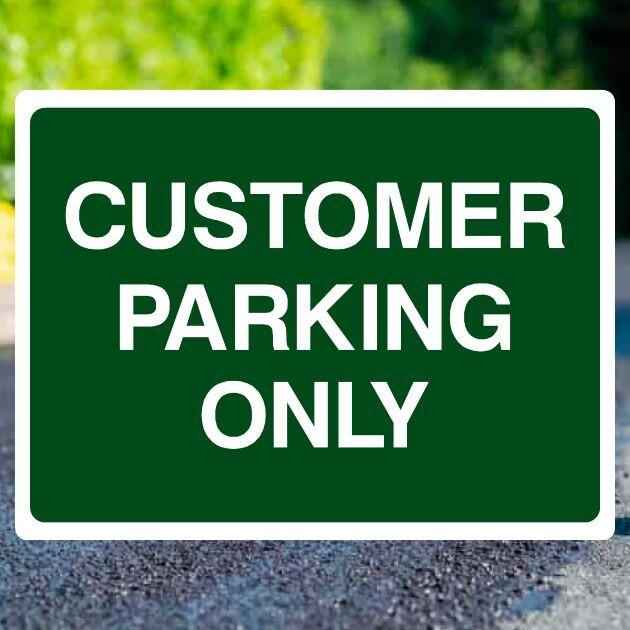
Providing customer parking is one thing. Making it obvious where customers should park is another.
A busy car park can quickly become confusing when spaces are shared by customers, employees, visitors, delivery drivers and other users. Clearly positioned Customer Parking Signs can help drivers identify the right spaces as soon as they arrive.
Whether you run a shop, garage, office, hotel, restaurant or other customer-facing business, this guide explains how to choose customer parking signs, where to position them and what to consider if your car park has specific parking restrictions.
What Are Customer Parking Signs?
Customer parking signs identify parking spaces or areas intended for people using a business as customers.
Typical messages include:
- Customer Parking
- Customer Parking Only
- Parking for Customers Only
- Reserved for Customers
- Customer Parking with directional arrows
Signs can identify individual bays or an entire section of a car park.
The objective is simple: make it immediately clear where customers should park.
Why Use Customer Parking Signs?
Imagine arriving at an unfamiliar business and finding a car park containing 20 apparently identical spaces.
Which spaces are for customers?
Which are for staff?
Are any reserved?
Is there another customer car park around the building?
Customers shouldn't have to guess.
Clear parking signs can make a business easier to visit by identifying the spaces intended for customers and helping drivers navigate the site.
They can be particularly useful where parking is limited or shared between different groups.
Which Businesses Use Customer Parking Signs?
Customer parking signs can be useful for almost any organisation providing designated parking for customers or clients.
Common examples include:
Shops & Retail Premises
Retail businesses can identify spaces intended for people currently visiting the shop.
This can be especially useful where parking is limited or the car park is shared with neighbouring premises.
Garages & MOT Centres
Vehicle-related businesses often have particularly complicated parking arrangements.
A garage might simultaneously have vehicles belonging to customers, employees, mechanics, suppliers and vehicles waiting for an MOT, service or collection.
Clearly marked customer spaces can help arriving drivers avoid parking in operational or workshop areas.
Hotels
Hotels may need to distinguish guest or customer spaces from staff parking, loading areas and other reserved bays.
Directional parking signs can also help where the main car park is not immediately visible from the entrance.
Restaurants, Cafés & Pubs
Hospitality businesses can use customer parking signs to identify spaces intended for people using the premises.
This can be particularly useful where neighbouring businesses or residential properties share nearby parking areas.
Offices & Professional Services
Accountants, solicitors, estate agents, consultants and other offices receiving clients can reserve spaces close to reception or the main entrance.
Healthcare & Veterinary Premises
Dentists, clinics, pharmacies, vets and other customer-facing healthcare businesses can use signs to help patients and visitors identify the appropriate parking area.
Garden Centres & Larger Retail Sites
Large sites may require more than individual bay signs.
Directional Customer Parking signs can guide drivers from the site entrance towards the appropriate parking area.
Customer Parking or Customer Parking Only?
These messages are similar, but they can communicate slightly different intentions.
Customer Parking identifies an area as being provided for customers.
Customer Parking Only makes the restriction more explicit by indicating that the spaces are not intended for other users.
Which one should you choose?
Think about the problem you're trying to solve.
If you simply want customers to recognise their designated parking area, Customer Parking may be sufficient.
If spaces are frequently occupied by people who are not customers, Customer Parking Only may communicate the restriction more clearly.
The wording should accurately reflect how your parking area actually operates.
Customer Parking vs Visitor Parking
Customer Parking and Visitor Parking aren't necessarily the same thing.
A customer is generally someone using the products or services provided by the business.
A visitor could be:
- A contractor
- A supplier
- Someone attending a meeting
- An interview candidate
- A sales representative
- A consultant
- A guest
- Someone visiting an employee
Some businesses may therefore benefit from separate Customer Parking and Visitor Parking spaces.
For example, a large office could provide:
Customer Parking
Visitor Parking
Staff Parking
Disabled Parking
EV Charging
Using specific signs for each area can make the overall car park much easier to understand.
Where Should Customer Parking Signs Be Positioned?
Position signs where drivers can see them before they have to decide where to park.
For individual spaces, this commonly means installing the sign at the head of the parking bay.
Depending on the site, the sign could be attached to:
- A wall
- A fence
- A post
- Another suitable permanent structure
Think about what happens when the car park is full.
A sign positioned too low could disappear behind a parked vehicle.
Likewise, a sign placed at an awkward angle may be clearly visible to pedestrians but difficult for an approaching driver to see.
Think About the Driver's Journey
One of the easiest ways to improve car park signage is to look at the site from the perspective of someone who has never visited before.
Start at the entrance.
Can the driver immediately see where customer parking is located?
If not, what happens at the first junction?
And the next one?
A larger site might need a sequence such as:
Site Entrance → Customer Parking → Directional Arrow → Customer Car Park → Individual Customer Bays
This is usually much more useful than putting several signs around the final parking area but providing no directions on how to reach it.
When Should You Use Directional Customer Parking Signs?
Directional signs are useful when customer parking is not immediately visible from the site entrance.
For example, the customer car park might be:
- Behind the building
- Around the side of the premises
- On another level
- Across a large industrial site
- Separate from staff parking
- Accessed from a different road
A simple Customer Parking → sign at the right decision point can save drivers from taking a wrong turn or entering operational areas.
What Size Customer Parking Sign Do You Need?
There isn't one ideal size for every car park.
The most important consideration is viewing distance.
A sign immediately in front of an individual parking bay does not necessarily need to be as large as a sign drivers must recognise while approaching from across a car park.
Consider:
- How far away drivers will be
- Whether vehicles will be moving
- The amount of text on the sign
- Mounting height
- Lighting
- Other signs nearby
- Whether parked vehicles could obscure it
A concise message displayed clearly will generally be easier for drivers to understand than a large amount of small text.
Should Every Customer Bay Have Its Own Sign?
Not necessarily.
If you have ten adjacent bays in a clearly defined customer parking area, it may be possible to identify the whole area effectively without installing ten identical signs.
However, individual bay signs can be useful where customer spaces are mixed with other parking.
For example:
Staff | Customer | Customer | Disabled | EV | Visitor
In this situation, individual signs make the allocation of each space much clearer.
The right approach depends on the layout of your car park.
Customer Parking Signs & Ground Markings
Upright signs and surface markings can complement each other.
A parking bay marked CUSTOMER provides an immediate indication of its intended use.
However, surface markings can become:
- Worn
- Dirty
- Covered by leaves
- Covered by snow
- Obscured by vehicles
An upright sign can remain visible when the parking surface cannot.
For important designated spaces, using both methods can make the parking arrangement clearer.
Customer Parking Signs for Shared Car Parks
Shared car parks can be particularly confusing.
Imagine a small retail development containing a café, hairdresser, dentist and convenience store.
Each business may have particular spaces allocated to its customers.
Simply displaying Customer Parking Only might not tell a driver whose customers are permitted to park there.
In situations like this, business-specific wording may be more useful.
For example:
Parking for [Business Name] Customers Only
The clearer the message, the less room there is for misunderstanding.
What About Unauthorised Parking?
One of the main reasons businesses buy Customer Parking Only signs is to discourage people who aren't customers from occupying valuable spaces.
A clear sign can make the intended use of the space obvious and may discourage unwanted parking.
However, it is important to distinguish between a simple customer bay identification sign and signage forming part of a formal private parking-management arrangement.
A standard Customer Parking Only sign does not automatically give a business the right to issue parking charges.
If your business operates formal parking terms, time limits, charges or enforcement arrangements, those conditions need to be communicated appropriately.
Are Customer Parking Signs Legally Enforceable?
This question needs a little more explanation than a simple yes or no.
On private land, parking arrangements can involve contractual terms between the driver and the parking operator or landholder.
If a formal private parking scheme operates, signage can play an important role in communicating those terms.
But a simple sign saying:
Customer Parking Only
is primarily communicating the intended use of the space.
It should not automatically be treated as equivalent to a detailed contractual parking notice.
Businesses wanting to introduce parking charges or formal enforcement should make sure their arrangements and signage meet the applicable requirements rather than relying on an ordinary customer parking sign.
Keep Parking Terms Separate from Simple Bay Signs
This is particularly important for clarity.
A customer bay sign needs to be understood quickly.
For example:
CUSTOMER PARKING ONLY
is straightforward.
Trying to add several paragraphs of contractual terms, charges, exemptions and enforcement information to the same small sign can make the basic message harder to read.
Where formal parking conditions apply, businesses may need separate signage explaining those terms.
Think of the signs as performing different jobs:
Bay sign: Who is this space for?
Directional sign: Where should I go?
Parking terms notice: What conditions apply to parking here?
Separating these functions can make a car park much easier to understand.
Can Customer Parking Have a Time Limit?
Businesses sometimes want customer spaces to be available only for a reasonable period.
For example, a shop may want to prevent someone parking all day and walking elsewhere.
If you operate a time restriction, make sure the conditions are communicated clearly.
A simple Customer Parking Only sign does not tell a driver whether they may park for 30 minutes, two hours or all day while using the premises.
Where formal restrictions or parking charges apply, seek appropriate advice about the parking-management arrangements and signage required.
Customer Parking Signs for Garages & MOT Centres
Garages deserve particular attention because their parking areas can become complicated very quickly.
A typical garage may need separate areas for:
- Customer Parking
- MOT Parking
- Vehicles Awaiting Service
- Vehicles Awaiting Collection
- Staff Parking
- Customer Viewing Area
- Delivery Vehicles
- No Parking
- Keep Clear
Customer Parking signs at the entrance can help drivers leave their vehicle in the correct place without entering workshop or vehicle-movement areas.
Directional signs can be especially useful if reception is separate from the workshop entrance.
Customer Parking Signs for Industrial Premises
Factories, warehouses and industrial sites may receive customers while also handling HGVs, forklifts, loading operations and other workplace traffic.
Customer parking should therefore be clearly distinguished from operational vehicle areas.
Depending on the site, useful signs might include:
- Customer Parking
- Visitors Report to Reception
- Staff Parking
- Delivery Vehicles
- Loading Only
- No Parking
- Keep Clear
- Speed Limit signs
Parking signage should form part of the site's wider traffic-management arrangements.
Don't Forget Accessible Parking
Where businesses provide accessible parking, these spaces should be clearly identifiable within the overall parking layout.
Avoid treating a general Customer Parking sign as a substitute for appropriate accessible-parking identification.
Accessible bays may need their own signage and markings so disabled customers can identify them easily.
Don't Forget EV Charging Bays
EV charging is becoming increasingly common in customer car parks.
If your business provides chargers, distinguish charging bays from ordinary customer parking.
For example:
Customer Parking
and:
EV Charging Only
communicate different uses.
If the EV spaces are specifically intended for customers, make sure the combination of signs and parking conditions makes this clear.
Choosing Customer Parking Signs for Outdoor Use
Most customer parking signs spend their working life outside.
When choosing a sign, consider:
- Weather exposure
- Sunlight
- Mounting surface
- Expected lifespan
- Viewing distance
- Potential impact damage
- How the sign will be fixed
A durable rigid sign is generally suitable for longer-term outdoor installation on walls, fences and posts.
Check signs periodically for fading, damage, dirt and loose fixings.
Common Customer Parking Sign Mistakes
1. Putting the Sign Where Drivers Can't See It
A perfectly worded sign is useless if it is hidden behind parked vehicles.
Check visibility when the car park is busy, not just when it is empty.
2. Using Wording That Is Too Vague
If a bay is only for customers, saying Parking doesn't communicate enough.
Use wording that accurately identifies the intended user.
3. Forgetting Directional Signs
Customers may know spaces exist but still be unable to find them.
Consider the route from the site entrance.
4. Mixing Customer and Visitor Parking Without Explanation
If the two groups have different spaces, identify them separately.
5. Putting Too Much Information on the Sign
Drivers should be able to understand the main message quickly.
Keep individual bay signs concise.
6. Assuming a Sign Automatically Creates Enforcement Rights
A standard Customer Parking Only sign communicates an instruction or intended use.
Formal private parking enforcement is a separate matter and may require appropriate terms, notices and parking-management arrangements.
7. Forgetting to Review Old Signs
Parking layouts change.
A Customer Parking sign pointing towards a car park that has been relocated or redesignated creates more confusion than having no directional sign at all.
A Customer Parking Sign Checklist
Before ordering your signs, ask:
- Which spaces are actually reserved for customers?
- Do we also have separate visitor and staff spaces?
- Can drivers identify customer parking from the entrance?
- Do we need directional signs?
- Should individual bays be identified?
- Will signs remain visible when vehicles are parked?
- Are the signs large enough for the viewing distance?
- Are they suitable for outdoor use?
- Do we provide accessible customer parking?
- Do we have EV charging bays?
- Are any parking time limits or conditions clearly communicated?
- Are formal parking terms displayed separately where required?
- Does every sign still reflect the way the car park currently operates?
Answering these questions will make it much easier to choose the right combination of signs.
Creating a Clearer Customer Car Park
Good customer parking signage doesn't need to be complicated.
Start with the driver's journey.
Identify the entrance, the important decision points and the spaces themselves.
Then use the appropriate type of sign at each stage:
Entrance signs tell drivers they have arrived at the correct parking area.
Directional signs guide them towards customer parking.
Customer Parking signs identify the spaces.
Accessible and EV signs identify specialist bays.
Parking terms notices, where applicable, explain additional conditions.
This approach is much clearer than expecting one sign to communicate everything.
Made in Britain Customer Parking Signs
Safety Sheep offers a range of Customer Parking Signs for shops, offices, garages, hotels and other UK businesses.
Our customer parking signs are made in Britain and available in a choice of sizes and durable materials for individual parking bays, car parks, walls, fences and posts.
Whether you need a simple Customer Parking Only sign or directional signage for a larger site, clear parking signs can help customers find the right spaces from the moment they arrive.
Share:
EV Parking & Charging Signs: A UK Guide
Fire Exit Signs: A Complete Guide for UK Businesses