

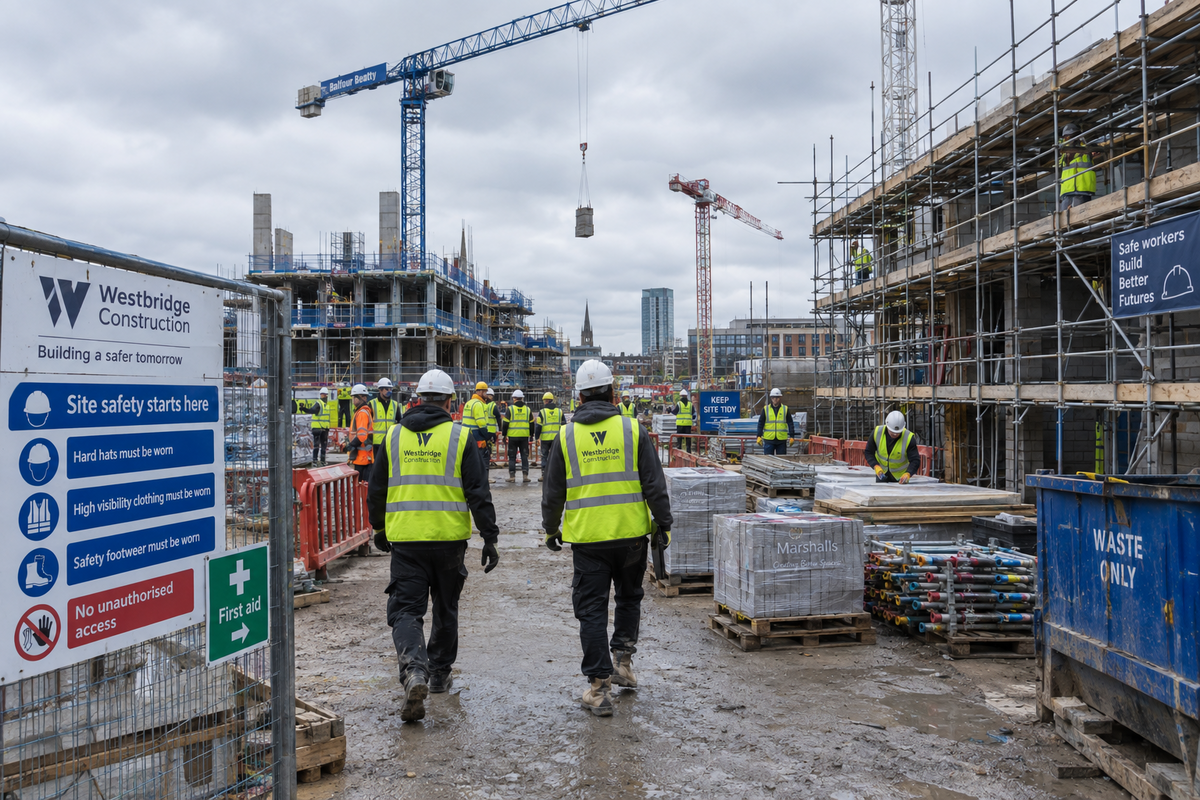
Construction sites can change almost daily. Excavations appear, scaffolding is erected, vehicle routes move, new contractors arrive and different stages of work introduce different hazards.
Clear construction safety signs help workers, subcontractors, visitors, delivery drivers and members of the public understand those hazards and the rules they need to follow.
But which construction signs do you actually need?
There isn't one standard list that applies to every building site.
The signs required depend on the work being carried out, the hazards present, the layout of the site, access arrangements and the people who could be affected.
This guide explains the main types of construction safety signs used on UK sites, where they may be needed and how to choose appropriate signage without covering your site in unnecessary notices.
What Are Construction Safety Signs?
Construction safety signs communicate important information about hazards, mandatory actions, prohibited activities, access restrictions and emergency arrangements.
Typical examples include:
-
Danger Construction Site
-
Construction Site Keep Out
-
No Unauthorised Access
-
Safety Helmets Must Be Worn
-
High Visibility Clothing Must Be Worn
-
Safety Footwear Must Be Worn
-
Danger Deep Excavation
-
Warning Moving Vehicles
-
Visitors Must Report to Site Office
-
Fire Exit
-
First Aid
-
Fire Assembly Point
Some signs communicate one specific message, while multi-message construction boards combine several important site rules.
What Signs Are Required on a Construction Site?
There is no universal shopping list of signs that every construction site must display.
The appropriate signage should reflect the risks and arrangements for the individual project.
In practice, construction sites commonly use a combination of:
-
Warning signs
-
Mandatory PPE signs
-
Prohibition signs
-
Access and security signs
-
Traffic-management signs
-
Fire safety signs
-
First aid signs
-
Emergency and safe-condition signs
-
Hazard-specific signs
-
Site information signs
The starting point should be your risk assessments, site rules, traffic arrangements and emergency procedures.
A small refurbishment project inside an occupied building will have very different requirements from a major construction project involving excavations, tower cranes, demolition work and heavy plant.
Construction Safety Signs & UK Law
Construction safety signage sits within a wider system of health and safety management.
The Health and Safety (Safety Signs and Signals) Regulations 1996 require safety signs where there is a significant risk to health and safety that has not been avoided or adequately controlled by other measures.
This is an important distinction.
A sign should not be used instead of controlling the hazard.
For example:
A Danger Deep Excavation sign does not replace barriers or appropriate edge protection.
A Safety Helmets Must Be Worn sign does not replace providing and managing appropriate PPE.
A Construction Site Keep Out sign does not replace effective site security.
A Warning Moving Vehicles sign does not replace appropriate traffic management and pedestrian segregation.
Signs communicate the remaining risk and the actions people need to take.
Construction Design & Management Regulations 2015
The Construction (Design and Management) Regulations 2015 – usually known as CDM 2015 – provide the principal framework for managing health, safety and welfare on construction projects in Great Britain.
Construction projects need appropriate arrangements for managing risks and providing workers with relevant information and instructions.
Signage can form part of those arrangements.
The important point is that information should be clear, relevant and appropriate to the project.
More signage is not automatically better signage.
Construction Site Entrance Signs
The entrance is one of the most important places for construction signage.
People should understand the key site rules before entering an active work area.
Depending on the project, entrance signage might include:
-
Danger Construction Site
-
Construction Site Keep Out
-
No Unauthorised Access
-
All Visitors Must Report to Site Office
-
Safety Helmets Must Be Worn
-
High Visibility Clothing Must Be Worn
-
Safety Footwear Must Be Worn
-
No Smoking
-
Site speed limit
-
Site contact information
Larger projects often combine several of these messages on a multi-message construction site safety board.
Multi-Message Construction Site Signs
A multi-message board can provide a clear overview of important rules at a site entrance.
For example, one board might communicate:
Warning – Construction Site
No Unauthorised Access
Visitors Must Report to Site Office
Hard Hats Must Be Worn
High Visibility Clothing Must Be Worn
Safety Footwear Must Be Worn
No Smoking
5 mph Speed Limit
This can be easier to understand than surrounding an entrance with numerous unrelated signs.
However, the messages should reflect the actual site rules.
Don't display mandatory instructions simply because they happen to be printed on a generic site board.
Construction Site Keep Out Signs
Construction sites can present serious risks to people who have not been inducted or authorised to enter.
Construction Site Keep Out and No Unauthorised Access signs can reinforce site security at:
-
Site gates
-
Temporary fencing
-
Hoardings
-
Compounds
-
Demolition areas
-
Restricted work zones
They can be particularly important where sites are close to residential areas, schools, public footpaths or other locations where members of the public could approach the boundary.
Signs should complement suitable fencing, hoarding, barriers and other access-control measures.
Protecting Children & Members of the Public
Construction sites can be particularly attractive to children, especially when work has stopped for evenings, weekends or school holidays.
Site managers should consider foreseeable unauthorised access and maintain suitable site security.
Potential measures include:
-
Secure fencing or hoarding
-
Locked gates
-
Covered or protected excavations
-
Secured plant and machinery
-
Secure storage of hazardous substances
-
Appropriate warning and prohibition signs
Signs can warn people about the danger, but they should not be treated as a physical security measure.
Mandatory Construction Signs
Mandatory signs tell people what they must do.
They normally use a blue circular symbol.
On construction sites, many mandatory signs relate to personal protective equipment.
Common examples include:
-
Safety Helmets Must Be Worn
-
High Visibility Clothing Must Be Worn
-
Safety Footwear Must Be Worn
-
Eye Protection Must Be Worn
-
Hearing Protection Must Be Worn
-
Protective Gloves Must Be Worn
-
Respiratory Protection Must Be Worn
-
Safety Harness Must Be Worn
The instruction should correspond with the actual PPE requirement for that area.
Hard Hat Signs
Safety Helmets Must Be Worn signs are among the most familiar construction safety signs.
Where head protection is mandatory throughout the operational site, signs can be displayed at entrances so workers and visitors see the requirement before entering.
Where head protection is required only within a particular work area, position signage at the boundary of that area.
The recognised mandatory head-protection symbol is BS EN ISO 7010 M014.
High Visibility Clothing Signs
High-visibility clothing can be important where workers need to remain conspicuous around moving vehicles, plant and machinery.
Where hi-vis clothing is mandatory, signs can reinforce the requirement at:
-
Site entrances
-
Vehicle yards
-
Loading areas
-
Plant operating zones
-
Other relevant work areas
Again, the sign should support the site's actual PPE arrangements.
Safety Footwear Signs
Construction work can expose feet to falling materials, sharp objects, uneven ground and other hazards.
Where safety footwear is mandatory, appropriate signs can communicate the requirement before people enter the work area.
Combined PPE signs can be useful where hard hats, hi-vis clothing and safety footwear are all required from the same point.
Eye Protection Signs
Certain activities can create risks from:
-
Flying particles
-
Dust
-
Chemicals
-
Cutting
-
Grinding
-
Drilling
-
Other processes
Where eye protection is mandatory, place the appropriate sign where the requirement begins.
Don't automatically make a specialist PPE requirement site-wide if it only applies within one controlled area.
Hearing Protection Signs
Construction machinery and processes can generate harmful noise levels.
Where hearing protection forms part of the required controls, mandatory signs can identify hearing-protection zones.
Signage does not replace controlling noise exposure through appropriate engineering and organisational measures.
Respiratory Protection Signs
Some construction work can expose workers to harmful dusts, fumes and other airborne contaminants.
Where respiratory protective equipment is required, signage can help identify the relevant controlled area.
Correct RPE selection, fit testing where appropriate, training and other exposure controls remain essential.
Warning Signs on Construction Sites
Warning signs alert people to hazards.
They normally use the familiar yellow and black triangular format.
Examples include:
-
Danger Construction Site
-
Deep Excavation
-
Overhead Loads
-
Falling Objects
-
Moving Vehicles
-
Forklift Trucks
-
High Voltage
-
Asbestos
-
Fragile Roof
-
Slippery Surface
-
Hazardous Substances
The warning should correspond with the actual hazard.
Deep Excavation Signs
Excavations and trenches can create serious fall and collapse risks.
Appropriate warning signs can alert workers, visitors and others approaching the area.
However, signs are only supplementary controls.
Excavations still need appropriate physical protection, safe access and management.
Falling Object & Overhead Work Signs
Work at height, scaffolding, lifting operations and overhead activities can expose people below to falling objects.
Where relevant, warning signs can help identify exclusion zones or areas affected by overhead work.
They should support physical controls such as barriers, exclusion zones and safe systems of work.
Demolition Signs
Demolition sites can contain unstable structures, falling materials, dust, hazardous substances and restricted work areas.
Depending on the project, signage may include:
-
Danger Demolition Work
-
Keep Out
-
No Unauthorised Entry
-
Falling Objects
-
PPE requirements
-
Asbestos warnings
-
Vehicle warnings
The signage should change as demolition progresses and hazards change.
Asbestos Signs
Asbestos remains an important consideration during refurbishment and demolition work on older buildings.
Where asbestos-containing materials are known or suspected and access needs to be controlled, appropriate signs can help identify the hazard and restricted areas.
Examples can include:
-
Danger Asbestos
-
Asbestos Keep Out
-
Asbestos Removal in Progress
-
Respiratory Protection Must Be Worn
-
Authorised Personnel Only
Signs are only one part of asbestos management.
They do not replace surveys, risk assessment, competent work practices or the legal requirements applying to asbestos.
Confined Space Signs
Construction projects can contain confined spaces such as:
-
Tanks
-
Pits
-
Chambers
-
Sewers
-
Ducts
-
Shafts
Depending on the risk and controls, signage may communicate:
-
Confined Space
-
No Entry
-
Authorised Personnel Only
-
Permit Required
-
Harness requirements
-
Respiratory protection requirements
A sign does not make entry into a confined space safe.
It supports the control system established for the work.
Electrical Safety Signs
Construction sites often contain temporary electrical systems alongside existing and newly installed electrical equipment.
Potential hazards can include:
-
High voltage
-
Live equipment
-
Overhead cables
-
Underground cables
-
Temporary distribution equipment
Appropriate warning and access signs can help people recognise electrical hazards before approaching or beginning work.
Overhead Cable Signs
Overhead power lines can present serious risks to cranes, excavators, tipper trucks and other tall plant.
Warning signs can form part of the control arrangements around overhead cables.
They should support appropriate planning, exclusion zones, height restrictions and other necessary precautions.
Underground Services Signs
Groundworks can expose workers to buried electricity cables, gas pipes, water services and other utilities.
Signs and markers can help communicate known underground services.
They should never be treated as a substitute for plans, locating equipment, safe digging procedures and other controls.
Construction Traffic Signs
Moving vehicles are one of the major hazards on many construction sites.
Traffic-management signage can communicate:
-
Speed limits
-
One-way routes
-
No Entry
-
No Parking
-
Pedestrian routes
-
Vehicle routes
-
Loading areas
-
Delivery areas
-
Reversing vehicle warnings
The objective should be to create a clear traffic-management system rather than simply installing more signs.
Separate Vehicles & Pedestrians
Where reasonably practicable, pedestrian routes should be separated from vehicle routes.
Signs can identify those routes and reinforce the traffic-management arrangements.
Common signs include:
-
Pedestrian Route
-
Pedestrians This Way
-
No Pedestrian Access
-
Vehicle Route
-
Beware Moving Vehicles
-
Beware Reversing Vehicles
Physical segregation remains more important than signage alone.
Construction Site Speed Limit Signs
Construction sites often establish low vehicle speed limits.
Common examples include:
5 mph
and
10 mph
Signs can communicate the limit at the site entrance and along relevant routes.
The appropriate speed should be determined by the site's traffic-management arrangements rather than chosen simply because a particular sign is available.
Visitors Must Report to Site Office
Visitors, delivery drivers and contractors may not know the site layout or rules.
All Visitors Must Report to Site Office signs can direct them to the appropriate control point before they enter operational areas.
These are particularly useful at:
-
Pedestrian gates
-
Vehicle entrances
-
Reception points
-
Site compounds
Directional Site Office signs can then guide visitors to the correct location.
Construction Site Safety Banners
Large-format banners can communicate safety messages across:
-
Site fencing
-
Hoardings
-
Gates
-
Long boundaries
They can be useful where the message needs to be seen from greater distances.
Common banner messages include:
-
Construction Work
-
Visitors Must Report
-
PPE requirements
-
Heavy Plant
-
Children Keep Out
-
Site speed limits
Mesh banners can be useful for exposed locations where wind loading needs consideration.
Fire Safety Signs on Construction Sites
Fire risks and escape arrangements can change significantly during a construction project.
Depending on the site, fire signage can include:
-
Fire Exit Signs
-
Fire Action Notices
-
Fire Extinguisher Signs
-
Fire Point Signs
-
Fire Alarm Signs
-
Assembly Point Signs
Temporary escape routes may change as buildings develop.
Fire-safety signage should therefore be reviewed as the project progresses.
Fire Exit Signs
Fire Exit Signs help people identify and follow emergency escape routes.
On construction sites, temporary escape routes can change during different phases of the project.
Check that directional signs continue to lead people along the actual route rather than an obsolete route that has subsequently been altered.
Fire Extinguisher Signs
Where firefighting equipment needs additional identification, appropriate fire-equipment signs can make its location easier to identify.
If equipment is moved as the site changes, review the signage at the same time.
Fire Action Notices
Fire Action Notices communicate what people should do if they discover a fire or hear the alarm.
The instructions should correspond with the actual arrangements for the construction site.
Update notices if alarm arrangements, escape routes or assembly points change.
Assembly Point Signs
Where the site's emergency plan includes a designated assembly point, signage can clearly identify the location.
Choose the assembly area based on the site's emergency arrangements rather than simply selecting a convenient location for a sign.
Make sure workers, visitors and contractors understand where they should go.
First Aid Signs
First aid signs can help identify facilities and equipment such as:
-
First Aid
-
First Aid Box
-
First Aid Room
-
Eye Wash
-
Emergency Shower
-
Defibrillator
The signs should correspond with the actual first-aid provision established for the site.
Construction Safety Sign Colours
Recognised colours and shapes help people understand the type of message quickly.
Yellow & Black – Warning Signs
Warn people about hazards.
Blue & White – Mandatory Signs
Tell people what they must do.
Red Prohibition Symbols
Tell people what they must not do.
Green & White – Safe Condition Signs
Identify emergency escape, first aid and other safe-condition information.
Red & White – Fire Equipment Signs
Identify firefighting equipment.
Consistency is particularly valuable on construction sites where workers from different companies may be present.
Construction Signs & BS EN ISO 7010
BS EN ISO 7010 provides standardised graphical safety symbols used across many workplace and construction signs.
Recognised symbols can help provide consistent visual communication.
However, BS EN ISO 7010 is a standard rather than construction legislation.
A site does not become legally compliant simply because its signs use ISO 7010 symbols.
The signs must be appropriate to the actual risks and form part of effective health and safety arrangements.
Do Construction Signs Need Text?
Graphical symbols allow many safety messages to be understood quickly.
Supplementary text can make the meaning even clearer.
For example, a mandatory head-protection symbol might be accompanied by:
Safety Helmets Must Be Worn
This can be particularly useful for site visitors and people unfamiliar with the symbol.
Keep wording concise and easy to understand.
Multilingual Construction Sites
Construction sites can have diverse workforces.
Where language differences could affect people's understanding of important health and safety information, consider how instructions can be communicated effectively.
Recognised graphical symbols can help, but they should not automatically be treated as a substitute for suitable instruction and training.
Additional languages, diagrams or other communication methods may be appropriate.
Where Should Construction Safety Signs Be Positioned?
Position signs where people need the information.
Typical locations include:
-
Site entrances
-
Pedestrian gates
-
Vehicle gates
-
Perimeter fencing
-
Hoardings
-
Site offices
-
Welfare areas
-
Vehicle routes
-
Pedestrian routes
-
Hazardous work areas
-
Excavations
-
Electrical installations
-
Fire points
-
First-aid points
The person should see the warning or instruction before encountering the hazard or entering the controlled area.
Position Signs at Decision Points
Think about where somebody needs to make a decision.
For example:
Site entrance: Am I authorised to enter and what PPE do I need?
Traffic junction: Which direction should vehicles travel?
Work area: What additional PPE is required?
Restricted zone: Am I permitted to enter?
Emergency route: Which direction should I go?
Positioning signage at these decision points makes it considerably more useful.
What Size Construction Safety Sign Do I Need?
Choose the sign size according to:
-
Viewing distance
-
Mounting height
-
Environment
-
Approach speed
-
Lighting
-
Visual clutter
A small sign on a site cabin door may be perfectly adequate.
The same sign could be ineffective on perimeter fencing viewed by an approaching vehicle.
Large entrance boards and banners may be more appropriate where information needs to be recognised from further away.
Choosing Materials for Construction Signs
Construction sites can be demanding environments.
Signs may face:
-
Rain
-
Wind
-
UV exposure
-
Dust
-
Mud
-
Impact
-
Frequent movement
Choose a material appropriate to how long the sign will be needed and where it will be installed.
Temporary signs may benefit from lightweight materials, while longer-term exposed locations may justify more durable rigid signage.
Keep Construction Signs Visible
Construction sites change constantly.
Signs can quickly become obscured by:
-
Scaffolding
-
Materials
-
Pallets
-
Plant
-
Skips
-
Temporary buildings
-
Vehicles
-
New fencing
Include signage within routine site inspections.
If a sign cannot be seen, it cannot communicate its message effectively.
Review Construction Signs as the Project Changes
Signage should evolve with the project.
A site might progress through:
Groundworks → structural work → roofing → external works → internal fit-out → commissioning → handover
The hazards and access arrangements can be very different at each stage.
Remove signs that are no longer relevant and introduce new signs when risks or rules change.
Outdated signage can create confusion and weaken confidence in the site's safety information.
Don't Over-Sign the Site
More safety signs do not necessarily mean better safety communication.
Too many signs can create visual clutter and make important instructions harder to notice.
Use signs that communicate:
-
Genuine hazards
-
Genuine mandatory requirements
-
Genuine prohibitions
-
Current access arrangements
-
Current emergency information
If a sign no longer applies, remove it.
Construction Safety Sign Packs
Pre-selected construction sign packs can make initial site set-up quicker.
They may contain combinations of:
-
Site entrance signs
-
PPE signs
-
Keep Out signs
-
Hazard warnings
-
Fire signs
-
First aid signs
-
Assembly point signs
-
Site office signs
They are particularly useful for contractors operating multiple projects or setting up a new site.
However, no generic pack can guarantee that it contains every sign required for every construction project.
Use the pack as a starting point and add signs for site-specific risks.
When Is a Construction Sign Pack a Good Choice?
A pack can be useful when:
-
Starting a new project
-
Replacing damaged signage
-
Standardising signage across several sites
-
Establishing common entrance and welfare signage
-
Keeping replacement signs available
Compare the contents against the site's risk assessments before ordering.
Construction Site Sign Checklist
Walk around the project and ask:
Site Entrance
-
Is the construction site clearly identified?
-
Are unauthorised people told not to enter?
-
Are visitors told where to report?
-
Are site-wide PPE requirements displayed?
PPE
-
Are mandatory PPE requirements clear?
-
Are specialist PPE signs positioned where additional requirements begin?
Hazards
-
Are significant residual hazards appropriately identified?
-
Do warnings still correspond with current work?
Access
-
Are restricted areas clear?
-
Are gates, fencing and hoardings appropriately signed?
Traffic
-
Are vehicle routes clear?
-
Are pedestrian routes clearly identified?
-
Are speed limits displayed?
-
Are dangerous vehicle areas appropriately controlled?
Fire Safety
-
Are escape routes clearly identified?
-
Can firefighting equipment be located where necessary?
-
Are Fire Action Notices current?
-
Is the assembly point correctly identified where appropriate?
First Aid
-
Can workers and visitors locate first-aid facilities?
Condition
-
Are signs clean and legible?
-
Are they securely fixed?
-
Are they large enough?
-
Are any hidden behind equipment or materials?
Relevance
-
Have obsolete signs been removed?
-
Has signage been reviewed following changes to the site?
Common Construction Sign Mistakes
Buying a Generic Pack and Assuming the Job Is Done
Every site is different.
A sign pack is a useful starting point, not a replacement for assessing the project.
Using Signs Instead of Controlling Hazards
Signs supplement controls; they do not replace them.
Displaying PPE Requirements That Don't Apply
Mandatory signs should correspond with actual site rules.
Putting Signs After the Hazard
People need the information before they encounter the risk.
Using Signs That Are Too Small
Consider the real viewing distance.
Letting Signs Become Obscured
Construction sites change quickly.
Leaving Old Signs in Place
Outdated information can be actively misleading.
Using Too Many Signs
Visual clutter can make important messages less noticeable.
Forgetting Visitors & Delivery Drivers
They may know far less about the site than permanent workers.
Assuming ISO 7010 Means the Whole Site Is Compliant
Recognised symbols support communication. They do not replace the wider legal duties or risk controls.
Are Construction Safety Signs Enough?
No.
Construction safety signage is one part of a much larger safety-management system.
Depending on the project, that system can include:
-
Risk assessment
-
Construction phase planning
-
Site induction
-
Training
-
Supervision
-
Barriers and edge protection
-
Site security
-
Traffic management
-
PPE
-
Safe systems of work
-
Fire precautions
-
First-aid arrangements
-
Emergency planning
-
Inspections
Good signage helps people understand that system.
It doesn't replace it.
Choosing Construction Safety Signs
Before ordering, work through the site logically.
Step 1 – Start at the Boundary
What does a member of the public need to know?
Step 2 – Check the Entrance
What does a worker, visitor or driver need to know before entering?
Step 3 – Review PPE
Which requirements apply site-wide and which apply only in particular zones?
Step 4 – Walk the Traffic Routes
Where do vehicles and pedestrians interact?
Step 5 – Review Work Areas
What residual hazards need warning signs?
Step 6 – Check Emergency Arrangements
Can people find exits, fire equipment, first aid and the assembly point?
Step 7 – Check Visibility
Can every important sign actually be seen from the direction people approach?
Step 8 – Review Regularly
Does the signage still match today's site rather than last month's?
This approach usually produces a clearer and more useful sign system than simply purchasing a large quantity of generic signs.
Made in Britain Construction Safety Signs
Safety Sheep supplies Construction Safety Signs for contractors, builders, site managers and construction companies throughout the UK.
The range includes site entrance signs, PPE signs, hazard and warning signs, Keep Out signs, construction traffic signs, multi-message boards, site safety banners and complete construction sign packs.
Available in a choice of sizes and durable materials, our Made in Britain construction signage can help you equip anything from a small refurbishment project to a large construction site.
Shop Construction Safety Signs →
Think Safety. Think Sheep.
Share:
Fire Door Signs: A Complete Guide for UK Businesses
Construction Sign Packs: Which Pack Do I Need?