

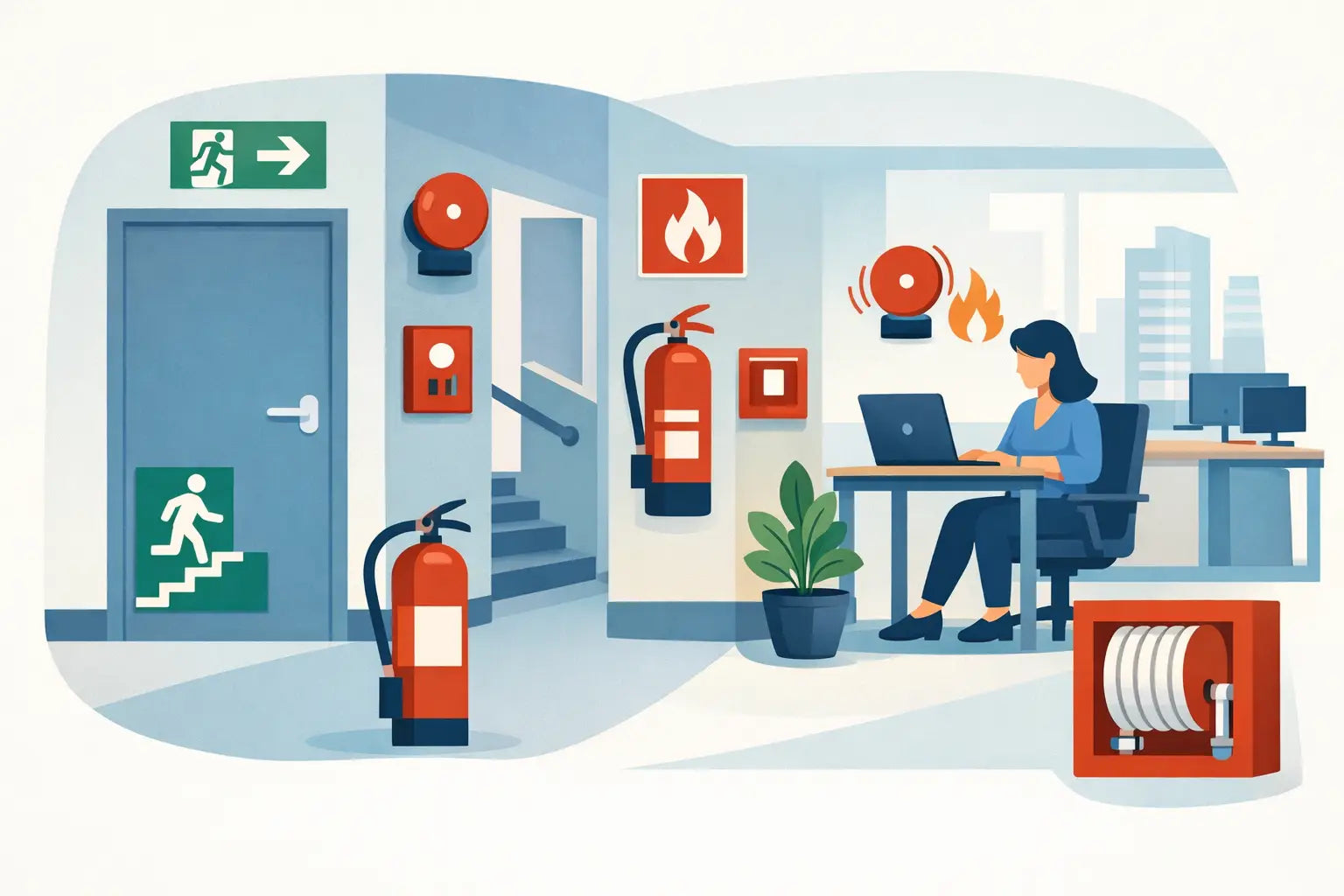
A missing sign beside a final exit, an obscured fire extinguisher or an out-of-date fire action notice can turn a manageable evacuation into confusion. So, which fire safety signs are needed in offices? The answer depends on your fire risk assessment, building layout, occupancy and the equipment provided, but every office needs clear information that helps people raise the alarm, find a safe way out and understand what to do.
For responsible persons, facilities managers and landlords, signage is not decoration or a last-minute compliance task. It is part of the fire safety measures that support staff, visitors, contractors and anyone unfamiliar with the premises.
Start with the office fire risk assessment
Under UK fire safety law, the responsible person must take reasonable steps to reduce fire risks and provide suitable information, instruction and training. In England and Wales, this is principally covered by the Regulatory Reform (Fire Safety) Order 2005. Scotland and Northern Ireland have their own fire safety legislation, but the practical requirement is similar: people must be able to identify escape routes, fire safety equipment and relevant procedures.
There is no universal shopping list that applies to every office. A small, single-storey office with one obvious exit needs fewer signs than a multi-storey building with visitors, meeting rooms, kitchens, shared corridors and several escape routes. Your fire risk assessment should identify where signs are necessary, particularly where the route is not immediately apparent or where people may need direction in an emergency.
Signs should be positioned where they can be seen, understood and followed. Avoid placing them behind open doors, noticeboards, plants or stacked stock. If lighting could fail during an evacuation, photoluminescent signs or emergency lighting may be needed so escape information remains visible.
Fire safety signs needed in offices: the essentials
Fire action notices
A fire action notice tells occupants what to do when they discover a fire or hear the alarm. It normally sets out how to raise the alarm, the evacuation instruction, where to assemble and any local arrangements, such as calling 999 or not using lifts.
Place fire action notices in prominent locations where people are likely to see them, commonly near manual call points, main entrances, kitchens, reception areas and shared noticeboards. The wording must match your actual arrangements. A generic notice stating that staff should call a number that is not monitored, for example, is worse than no notice at all.
Review notices whenever your assembly point, alarm procedure, responsible person or emergency contact process changes.
Fire exit and escape route signs
Green and white safe-condition signs show the direction of travel towards a place of safety. They are usually needed along corridors, at changes of direction, at stairways and above or beside final exits. Their purpose is not simply to label a door. They create a continuous, intelligible route from occupied areas to the outside or another safe area.
Use recognised running-man pictograms and directional arrows, normally in line with BS EN ISO 7010. These symbols are designed to be understood quickly, including by visitors and staff whose first language is not English.
Check the route from every occupied room, including meeting rooms, store rooms and toilets. A sign may be required where a person could reasonably hesitate or take the wrong turn. In a straightforward open-plan office where the only final exit is obvious, additional directional signs may not add value. In a complex layout, they are essential.
Fire door signs
Fire doors only work if they are closed, latched and kept clear. Appropriate signs help prevent common failures such as doors being wedged open, blocked by furniture or mistaken for ordinary internal doors.
Typical messages include “Fire door keep shut”, “Automatic fire door keep clear” and “Fire door keep locked shut” where the door is normally locked but must provide safe escape when needed. The exact sign depends on the door’s function. Do not use a “keep locked” message on a door that occupants may need to use as an escape route unless the locking arrangement permits immediate, safe egress.
Signs are often fitted to both sides of the door, particularly where each side serves a different area. They should be durable and readable, not handwritten labels that peel away after a few weeks.
Fire extinguisher identification signs
Where portable fire extinguishers are provided, each should have a sign showing its location and intended use. The sign should be visible above the extinguisher so it can still be identified if furniture, bags or people obstruct the lower part of the wall.
Office premises commonly use water, foam, CO2 or wet chemical extinguishers depending on the risks present. The sign should make clear the fire classes the extinguisher is suitable for and any dangers. For example, water extinguishers must not be used on live electrical equipment, while CO2 extinguishers are commonly selected for electrical risks but have limitations in open or poorly ventilated spaces.
Signage does not replace staff training. Most occupants should be told to raise the alarm and evacuate. Only trained people should attempt to tackle a small fire, and only where it is safe to do so.
Manual call point signs
Manual call points should be clearly identifiable, particularly if they are not obvious from the normal direction of travel. A red fire alarm call point sign can help people locate the nearest point quickly when they discover a fire.
Avoid cluttering the area with conflicting notices. The call point must remain accessible at all times and should not be hidden by reception displays, cabinets or security barriers.
Assembly point signs
A designated fire assembly point sign is needed at the location chosen for roll calls after evacuation. It should be far enough from the building to avoid danger from smoke, fire appliances and falling debris, while remaining practical for supervising staff and visitors.
The best location depends on the site. A car park may be suitable, but not if it is used by moving vehicles or blocks emergency access. For multi-occupancy offices, coordinate with the landlord or building manager so tenants are not directed to competing or unsafe areas.
Signs that may be required in larger or higher-risk offices
Some signs are only needed where the building design or the fire risk assessment calls for them. In offices with accessible evacuation plans, refuge areas may need refuge point signs, two-way communication instructions and clear “keep clear” messages. These are especially relevant in multi-storey premises where people may need assistance to evacuate.
Where a lift must not be used in a fire, display a clear prohibition sign near the lift. If a lift is specifically designed for evacuation under managed procedures, the arrangements must be clearly documented and communicated instead of relying on a standard “do not use” notice.
Plant rooms, electrical intake rooms, server rooms, kitchens and chemical storage areas may need additional fire safety and hazard signs. A kitchen with deep-fat frying equipment, for example, has different risks from a small office tea point. Server rooms may need equipment-specific suppression instructions and restricted access signage. The point is to sign the real risk, not to apply the same signs across every door.
You may also need “keep clear” signs for fire exits, fire brigade access routes, dry riser inlets, fire hydrants and fire alarm panels. These are particularly useful in shared offices, business parks and sites where deliveries or visitor parking can obstruct safety-critical access.
Choose signs that stay clear when it matters
Sign quality and placement matter as much as selecting the right category. Use suitable materials for the environment: rigid plastic for durable wall mounting, self-adhesive vinyl for smooth internal surfaces and photoluminescent materials where low-light visibility is required. For warehouses attached to offices, external escape routes or busy communal areas, choose products that can withstand knocks, moisture and regular cleaning.
Keep safety sign formats consistent across the premises. Green indicates safe conditions and escape routes, red identifies fire equipment and alarm points, while red circular prohibition signs communicate actions that must not be taken. Familiar colours and symbols reduce the time people spend interpreting a message under pressure.
A quick inspection should be part of routine fire safety checks. Confirm that signs remain legible, are not damaged or faded, match the current evacuation plan and have not been made misleading by alterations to walls, doors or office layouts. Refurbishments are a common source of errors: a sign can continue pointing towards an exit that has been relocated or blocked off.
A practical ordering check before you buy
Walk the premises as a new visitor would. Start at every workstation, meeting room and welfare area, then follow the escape route to the assembly point. You should be able to see where to go, identify any fire doors, locate equipment and understand the basic action to take without asking for help.
For multi-site businesses, create a simple sign schedule by building and floor. Record the sign type, location, material and date checked. This makes replacement ordering faster, supports consistent standards and helps avoid paying for signs that are not needed.
The Safety Sheep Store supplies British-made fire safety signage for offices, facilities and shared commercial premises, with practical options for individual replacements and bulk orders. Think Safety - Think Sheep, but let your fire risk assessment set the specification.
When an office changes, its fire safety signs may need to change with it. Review them after a move, refurbishment, staffing change or revised evacuation procedure, and keep every route clear enough for people to act without hesitation.
Share:
Which Signs Identify First Aid Rooms in the UK?
Workplace Door Identification Signs That Work