

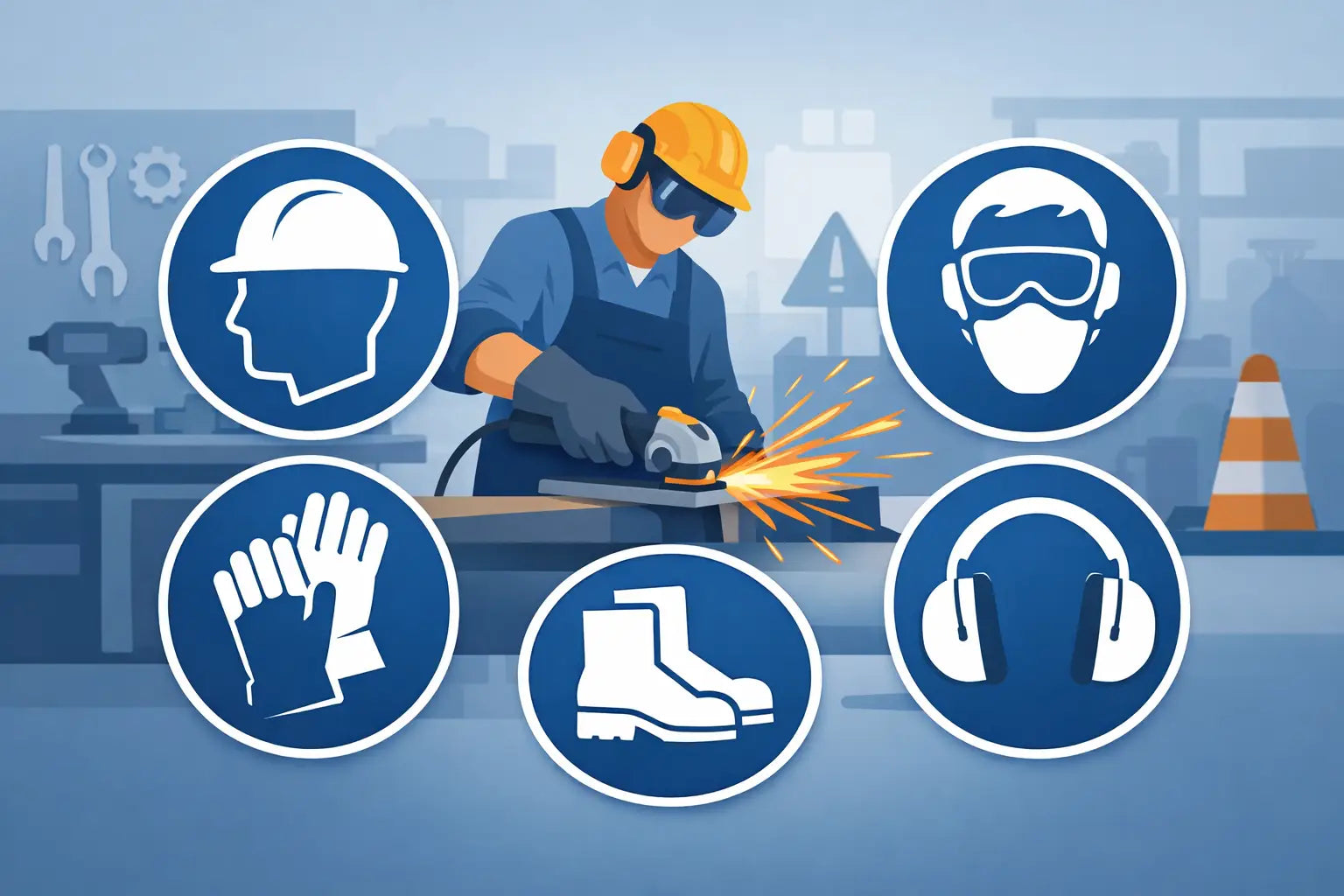
A grinding wheel without an eye-protection sign nearby is an avoidable gap. The same applies to a noisy fabrication bay with no hearing-protection reminder, or a welding area where visitors are not told to wear suitable face protection. So, what PPE signs are used in workshops? The right answer depends on the hazards in each work area, but most workshops need clear mandatory signs for eye, ear, hand, foot, head and respiratory protection.
PPE signage does more than fill a compliance box. It gives employees, contractors and visitors an immediate instruction at the point where a risk exists. In a busy workshop, people may move between tasks, noise levels can make verbal instructions difficult, and a sign can prevent assumptions before someone enters a hazardous area.
The main PPE signs used in workshops
Workshop PPE signs are normally mandatory signs. They use a white pictogram on a blue circular background to show an action that must be followed. This familiar format helps people recognise the instruction quickly, even when they are not familiar with the site.
The most commonly used signs include the following:
- Eye protection must be worn - suitable for grinding, cutting, drilling, turning, chemical handling and any task where chips, dust, sparks or splashes may reach the eyes.
- Hearing protection must be worn - used around noisy machinery, compressors, extraction systems, impact tools and other areas where noise assessment identifies a hearing risk.
- Safety helmets must be worn - often needed in workshops with overhead lifting, racking, crane operations, suspended loads or work taking place above head height.
- Protective gloves must be worn - appropriate for handling rough materials, sharp edges, chemicals or hot items. The glove type must match the task.
- Safety footwear must be worn - common in engineering, maintenance, vehicle, woodworking and fabrication workshops where dropped objects, sharp materials or moving equipment create a foot injury risk.
- Respiratory protective equipment must be worn - required where dust, fumes, vapours or airborne contaminants remain after suitable controls such as extraction and ventilation have been considered.
- Face protection must be worn - used for tasks such as grinding, chemical transfer and certain cutting operations, usually alongside safety spectacles where the risk assessment requires both.
- High-visibility clothing must be worn - useful in shared workshop and vehicle routes, loading areas or yards where pedestrians work near forklift lorries, lorries or other mobile plant.
What PPE signs are used in workshops by activity?
A single sign at the entrance rarely covers every hazard inside. A well-run workshop usually divides PPE requirements by area and activity, so the instruction is relevant when people need it.
Cutting, grinding and drilling areas
Eye protection is the starting point in most machining and grinding areas. A mandatory eye-protection sign should be positioned at the entrance to the zone and close to fixed machinery where there is a foreseeable risk of flying particles. Where grinding creates a higher splash or spark risk, a face-protection sign may also be needed.
Hearing-protection signs are often placed at the boundary of noise-control zones. Do not rely on a general workshop notice if noise exposure is limited to a particular machine bank or process. Put the instruction where the noise begins.
Welding and fabrication bays
Welding can involve intense light, sparks, fumes, hot metal and sharp materials. Signage may specify eye protection, face protection, protective gloves, protective clothing and respiratory protection, depending on the process and controls in place.
There is a practical balance to strike. A sign should state the PPE genuinely required for the area, not every possible item. Over-signing makes instructions less meaningful and can lead to workers treating the display as background noise.
Woodworking workshops
Wood dust, noise and ejected material make eye and hearing protection common requirements around saws, planers, sanders and routers. Respiratory protection may be necessary for certain tasks, particularly during sanding or where local exhaust ventilation does not fully control exposure.
Avoid using a generic glove instruction around rotating equipment without proper assessment. Gloves can create an entanglement risk when used near moving parts. This is why PPE signs must follow the task risk assessment rather than a one-size-fits-all approach.
Vehicle, maintenance and engineering workshops
Safety footwear and eye protection are frequent requirements in these environments. Gloves may be needed for handling oils, chemicals, sharp components or hot parts, while face protection may be necessary for battery work, fluid transfer or cutting operations.
If pedestrians and vehicles share access routes, high-visibility clothing signs can support the site traffic-management plan. They work best alongside clear pedestrian-route, forklift and authorised-personnel signage rather than as a substitute for physical segregation.
Choosing signs from a risk assessment
PPE is the last line of defence. Before specifying signs, consider whether the hazard can be removed, substituted, isolated or controlled through guarding, extraction, safe systems of work and training. A sign does not make an unsafe process safe, and it does not replace suitable PPE provision.
Once PPE is identified as necessary, the sign should match the requirement precisely. For example, “Eye protection must be worn” is appropriate where safety spectacles are sufficient. Where a visor or full face shield is essential, use a face-protection instruction instead. If both are needed, display both symbols clearly.
The Personal Protective Equipment at Work Regulations and wider health and safety duties require employers to assess risks and provide suitable protection where needed. The Health and Safety (Safety Signs and Signals) Regulations also support the use of clear safety signage where a significant risk cannot be avoided or adequately controlled by other means. In practice, using recognised mandatory symbols in line with BS EN ISO 7010 provides a consistent visual language across the workplace.
Where should workshop PPE signs be placed?
Place mandatory PPE signs before the person reaches the hazard. An eye-protection sign mounted behind a grinding machine is too late to influence behaviour. A sign at the entrance to the grinding area, followed by a reminder on or beside the machine, is far more effective.
Signs should be easy to see, well lit and mounted at a sensible viewing height. Do not obscure them with stock, tool cabinets, open doors or temporary notices. In large workshops, repeat signs at access points and wherever a worker can enter the controlled area from another route.
Consider who uses the space. Staff may know the rules, but contractors, delivery drivers, agency workers and visitors may not. PPE instructions at entrances, changing points and reception-to-workshop transitions help set expectations before people step onto the floor.
Combining symbols and supplementary text
A blue mandatory symbol is designed to be understood quickly. Supplementary text can make the instruction more specific, especially where a site has a particular rule such as “Hearing protection must be worn beyond this point” or “Wear safety goggles when using this machine”.
Text should support the symbol, not replace it. Symbols remain clear at a glance and are particularly useful in workplaces with varied literacy levels or staff who speak different first languages. Where several PPE items are required, a combined mandatory sign can keep the instruction tidy and reduce clutter at busy entrances.
Keep signage current and in good condition
Workshop layouts change. A machine is relocated, a new extraction system is installed, a fabrication bay becomes a storage area, or a process is replaced. Each change can alter the PPE requirement and make old signs inaccurate.
Include PPE signage in routine inspections. Check that signs remain legible, secure and relevant, and replace faded, damaged or outdated notices promptly. For multi-site operators, standardising sign designs and wording makes audits simpler and helps workers recognise requirements when moving between premises.
For urgent replacements, durable British-made mandatory signs from The Safety Sheep Store can help keep workshop requirements visible while supporting consistent ordering across sites. Trade buyers can also benefit from buying common PPE signage in quantity for planned maintenance, new fit-outs and replacement stock.
The best workshop PPE signs are not the ones with the most symbols. They are the signs that give the right instruction, in the right place, for the risk people actually face. Review them alongside the risk assessment, keep them visible, and make every route into a hazardous work area clear: Think Safety - Think Sheep.
Share:
Which Signs Are Best for Farmland? A UK Guide
Which Hard Hat Signs Are Required on UK Sites?