

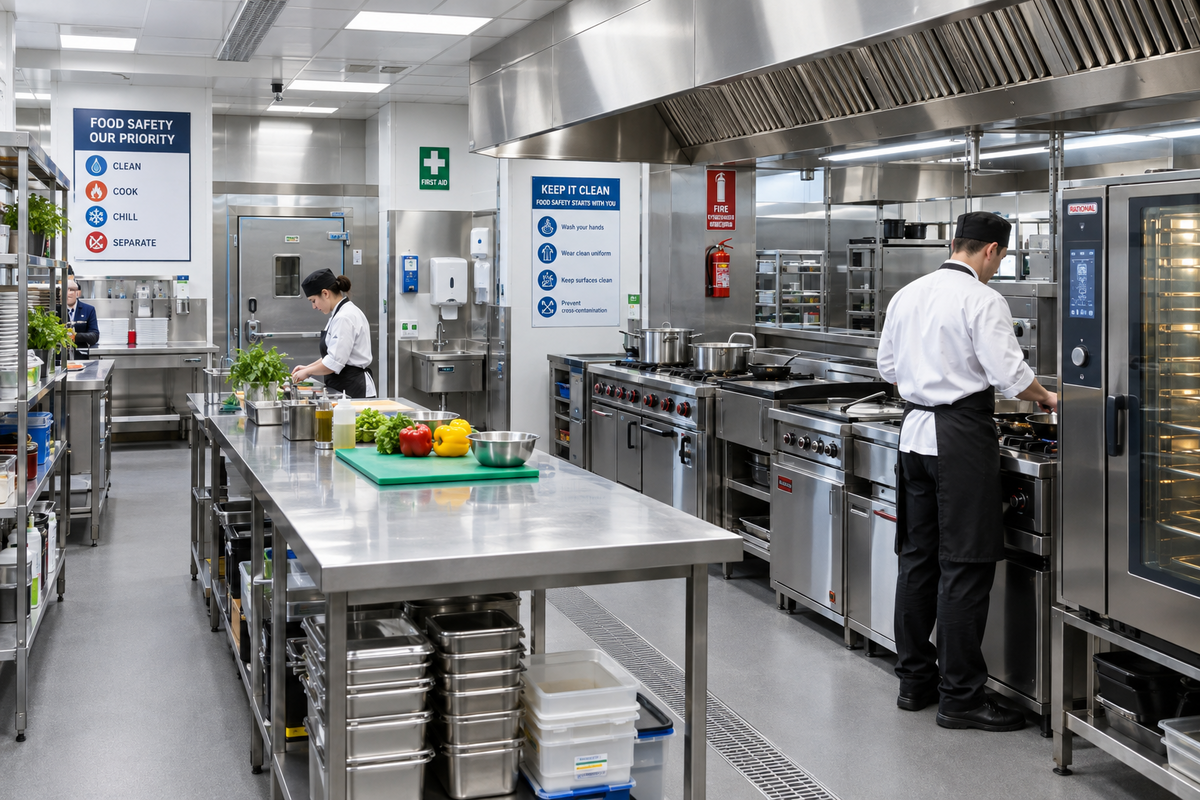
Good hand hygiene is one of the foundations of food safety.
In a busy commercial kitchen, however, knowing that hands should be washed isn't always enough. Staff move quickly between ingredients, equipment, deliveries, cleaning tasks and food preparation areas, creating plenty of opportunities for contamination if good hygiene procedures aren't followed consistently.
That's where hand washing signs can help.
Positioned in the right places, they provide a simple visual reminder at the point where staff need to act.
But where should hand washing signs actually go in a commercial kitchen?
Let's take a look.
Why Is Hand Washing So Important in Commercial Kitchens?
Hands can transfer bacteria, allergens and other contaminants between people, surfaces, equipment and food.
Good hand hygiene therefore forms an important part of the food safety procedures used by restaurants, cafés, takeaways, hotels, canteens and other food businesses.
Staff may need to wash their hands at appropriate times during the working day, including after activities that could contaminate them.
The important point is that hand washing needs to happen when and where it's required.
A well-positioned sign can reinforce that procedure.
Are Hand Washing Signs Required in Commercial Kitchens?
UK food businesses have legal responsibilities relating to food hygiene and the provision of suitable facilities for maintaining personal hygiene.
However, this doesn't mean that every commercial kitchen is legally required to display an identical set of prescribed hand washing signs.
Signage should support the food hygiene procedures established for the individual business.
A hand washing sign can be particularly useful where it provides staff with a clear reminder at the point where hand washing needs to take place.
Think of the sign as part of the wider hygiene system rather than the system itself.
Training, suitable facilities, appropriate procedures, supervision and good working practices remain essential.
Where Should Hand Washing Signs Go?
The simplest answer is:
Put the sign where the person needs to act on it.
A hand washing reminder hidden on a general staff noticeboard is unlikely to be as useful as one positioned immediately beside the hand wash basin.
Here are some of the most useful locations to consider.
1. Beside Designated Hand Wash Basins
This should usually be the first place to consider.
Position a Wash Hands or hand hygiene sign immediately beside or above the designated hand wash basin.
The sign should be clearly visible when somebody approaches or uses the facility.
This can reinforce the purpose of the basin and remind staff to follow the appropriate hand washing procedure.
Avoid placing the sign so far away that its relationship with the basin becomes unclear.
Point of action beats point of information.
2. At Kitchen Entrances
Depending on your food safety procedures, a hand washing reminder can also be useful where staff enter a food preparation area.
This may be particularly relevant where employees move between:
-
Staff facilities and kitchens
-
Storage areas and preparation areas
-
Delivery areas and kitchens
-
Waste areas and food areas
-
Different hygiene zones
The message should match the actual procedure used by your business.
If staff are expected to wash their hands before beginning food preparation, position the reminder where it supports that procedure.
3. Near Raw Food Preparation Areas
Handling raw meat, poultry, fish and other ingredients can create cross-contamination risks.
Where appropriate, a hand washing reminder positioned near the transition from raw-food handling to other tasks can help reinforce established hygiene procedures.
This can be particularly useful alongside other controls such as:
-
Separate preparation areas
-
Colour-coded equipment
-
Cleaning procedures
-
Raw food storage controls
-
Staff training
A sign doesn't prevent cross-contamination by itself, but it can reinforce what staff have been trained to do.
4. Near Food Preparation Areas
Hand washing signs may also be useful near key preparation areas, particularly where staff frequently move between different tasks.
However, don't cover every wall with the same instruction.
Ask whether another sign genuinely adds value.
If staff already pass a clearly identified hand wash station immediately before entering the preparation area, another large hand washing sign a metre away may achieve very little.
Effective safety and hygiene signage is about relevance, not quantity.
5. Near Staff Changing Areas
Where employees change into work clothing before entering a kitchen or food production area, hand hygiene reminders may form part of the transition into the working environment.
This can be particularly useful in larger catering operations, food production facilities and other premises where staff follow defined entry procedures.
Again, the sign should reflect the procedure established for that workplace.
6. At Appropriate Staff Toilet Exits or Hand-Washing Facilities
Good hand hygiene after using toilet facilities is particularly important for food handlers.
Clear hand washing instructions or reminders can reinforce appropriate hygiene practices in staff facilities.
However, toilet signage shouldn't be treated as a substitute for hand washing reminders within the food preparation environment itself where those reminders are also appropriate.
7. At Different Hygiene Zones
Larger food businesses may divide premises into different hygiene or production zones.
Employees moving from one area to another may be required to follow specific hand hygiene procedures.
Where that's the case, signs can be positioned at transition points to remind staff what they need to do before entering the next area.
The message should be specific to the procedure.
A clear:
WASH HANDS BEFORE ENTERING
can be more useful than a generic hygiene notice containing several paragraphs of instructions.
Hand Wash Only Sink Signs
One of the most useful signs in a commercial kitchen is slightly different from a general hand washing reminder:
HAND WASH ONLY
Commercial kitchens can contain several sinks with different purposes.
For example, there may be facilities for:
-
Hand washing
-
Food washing
-
Equipment washing
-
Pot washing
-
Utensil washing
Clearly identifying the purpose of a sink can help prevent confusion.
A Hand Wash Only Sink Sign should be positioned directly beside or above the designated basin so its purpose is immediately obvious.
Should You Display Hand Washing Instructions?
There's a difference between a simple reminder and an instructional sign.
A sign saying:
WASH HANDS
provides a straightforward instruction.
A more detailed hand washing procedure can remind staff about the steps involved.
Which is appropriate depends on the workplace, staff training and procedures.
In some locations, a simple instruction may be enough.
In others, a more detailed illustrated hand washing guide positioned beside the basin may be useful.
The important thing is that staff can read and understand it easily.
Don't Put Hand Washing Signs in the Wrong Place
Poor positioning can make even a well-designed sign ineffective.
Avoid locations where the sign is:
-
Hidden behind equipment
-
Obscured by an open door
-
Too high to read comfortably
-
Too far away from the hand wash basin
-
Surrounded by excessive signage
-
Positioned where staff have already passed the point at which they should act
-
Regularly covered by stored items
Look at the sign from the perspective of somebody actually working in the kitchen.
Can they see it when they need it?
If not, move it.
Avoid Sign Clutter
Commercial kitchens can accumulate signs surprisingly quickly.
Wash Hands.
Clean As You Go.
Raw Food Only.
Protective Clothing Must Be Worn.
Food Allergy Notice.
Danger Hot Surface.
Keep This Door Closed.
Each message may be useful individually, but putting too many together can create a wall of information that staff stop noticing.
Prioritise the most important messages and position them at the relevant points of action.
A Wash Hands sign belongs at the hand wash facility—not lost amongst ten unrelated notices on the other side of the kitchen.
What Size Hand Washing Sign Do You Need?
The right size depends on where the sign will be viewed.
A sign positioned immediately above a hand wash basin doesn't usually need to be enormous because it's being viewed at close range.
Consider:
-
Viewing distance
-
Available wall space
-
Mounting height
-
Lighting
-
Amount of text
-
Other nearby signage
Detailed hand washing instructions may need to be larger than a simple Wash Hands message because they contain more information.
The aim isn't to choose the biggest sign possible.
It's to make the message easy to notice and easy to read.
What Material Is Best for Kitchen Hand Washing Signs?
Commercial kitchens can be demanding environments.
Signs may be exposed to:
-
Moisture
-
Steam
-
Grease
-
Splashes
-
Frequent cleaning
-
Cleaning products
-
Temperature changes
Choose a sign material appropriate for the environment and expected cleaning regime.
A smooth, durable surface that can be wiped clean can be particularly useful around sinks and food preparation areas.
Also consider how the sign will be attached.
The fixing method should be appropriate for the wall or surface and shouldn't create unnecessary hygiene problems.
Hand Washing Signs & Cross-Contamination
Hand washing signage can form part of a wider approach to reducing cross-contamination.
For example, a commercial kitchen might combine:
Wash Hands signs – reminding staff about hand hygiene.
Raw Food Only signs – identifying dedicated preparation or storage areas.
Sink identification signs – preventing facilities from being used for the wrong purpose.
Cleaning signs – reinforcing cleaning procedures.
Food allergy notices – supporting allergen-awareness procedures.
The signs work together to communicate different parts of the food safety system.
But they're still reminders.
Effective cross-contamination control depends on the underlying procedures being suitable and consistently followed.
What About Food Allergens?
Hand hygiene can also be relevant to allergen management.
Food businesses need procedures for managing allergens and reducing the risk of unintended allergen cross-contact.
Hand washing may form part of those procedures, but a generic Wash Hands sign shouldn't be treated as an allergen-control system.
Businesses should have appropriate procedures covering ingredients, equipment, surfaces, utensils, staff practices and the provision of allergen information.
Do Hand Washing Signs Make a Kitchen HACCP Compliant?
No.
A sign can support food safety procedures based on HACCP principles by reminding staff about an established control or hygiene practice.
But displaying a Wash Hands sign doesn't make a kitchen “HACCP compliant”.
The important issue is whether the business has suitable food safety procedures and whether those procedures are being followed.
A more accurate way to think about signage is:
The procedure controls the risk. The sign helps communicate the procedure.
Should Hand Washing Signs Use Symbols?
Recognisable symbols can make instructions quicker to understand and can be useful in workplaces where people have different first languages.
Text can provide additional clarity where necessary.
The best sign is one that communicates the required action quickly and unambiguously to the people who need to follow it.
How Many Hand Washing Signs Does a Commercial Kitchen Need?
There's no useful universal answer such as “one sign per kitchen”.
A small café and a large hotel kitchen have completely different layouts and working practices.
Instead, look at each hand wash location and ask:
-
Is its purpose obvious?
-
Do staff need a reminder here?
-
Can the sign be seen clearly?
-
Are there different kitchen zones?
-
Are staff moving between raw and ready-to-eat food areas?
-
Are there several hand wash basins?
-
Could a sink be confused with another facility?
A business with several separate hand wash stations may benefit from signage at each relevant location.
A Simple Hand Washing Sign Checklist
Walk through your kitchen and check:
-
Are designated hand wash basins easy to identify?
-
Is there a clear hand washing reminder where it's needed?
-
Can staff see the sign while approaching or using the basin?
-
Are signs positioned at relevant hygiene-zone transitions?
-
Are signs clean and easy to read?
-
Are any signs hidden by equipment or doors?
-
Is there too much competing signage nearby?
-
Do the signs reflect your current food safety procedures?
-
Are the sign materials suitable for the kitchen environment?
-
Have damaged or outdated signs been replaced?
If the answer to any of these is no, it may be time to review your kitchen signage.
Review Your Signs When Procedures Change
Commercial kitchens don't stay the same forever.
Equipment is moved, menus change, preparation areas are reorganised and procedures are updated.
Review your hand washing signage whenever these changes affect how staff move through or use the kitchen.
Also check signs periodically for:
-
Damage
-
Fading
-
Grease
-
Dirt
-
Poor adhesion
-
Obstruction
-
Outdated instructions
If nobody can read the sign, it isn't providing much of a reminder.
Shop Hand Washing & Food Hygiene Signs
Well-positioned hand washing signs provide a simple visual reminder of good hygiene procedures at the point where staff need to follow them.
Safety Sheep supplies hand washing, hand wash basin, food hygiene and kitchen safety signs for restaurants, cafés, takeaways, hotels, schools, care homes, canteens and other food businesses.
Explore our complete Food Hygiene & Kitchen Signs range for hand washing, food preparation, cross-contamination, cleaning, allergen, food storage and commercial kitchen safety signage.
Made in Britain. Think Safety. Think Sheep.
Share:
10 Common Workplace Safety Signs & When to Use Them
Food Allergy Signs: What UK Food Businesses Need to Know