

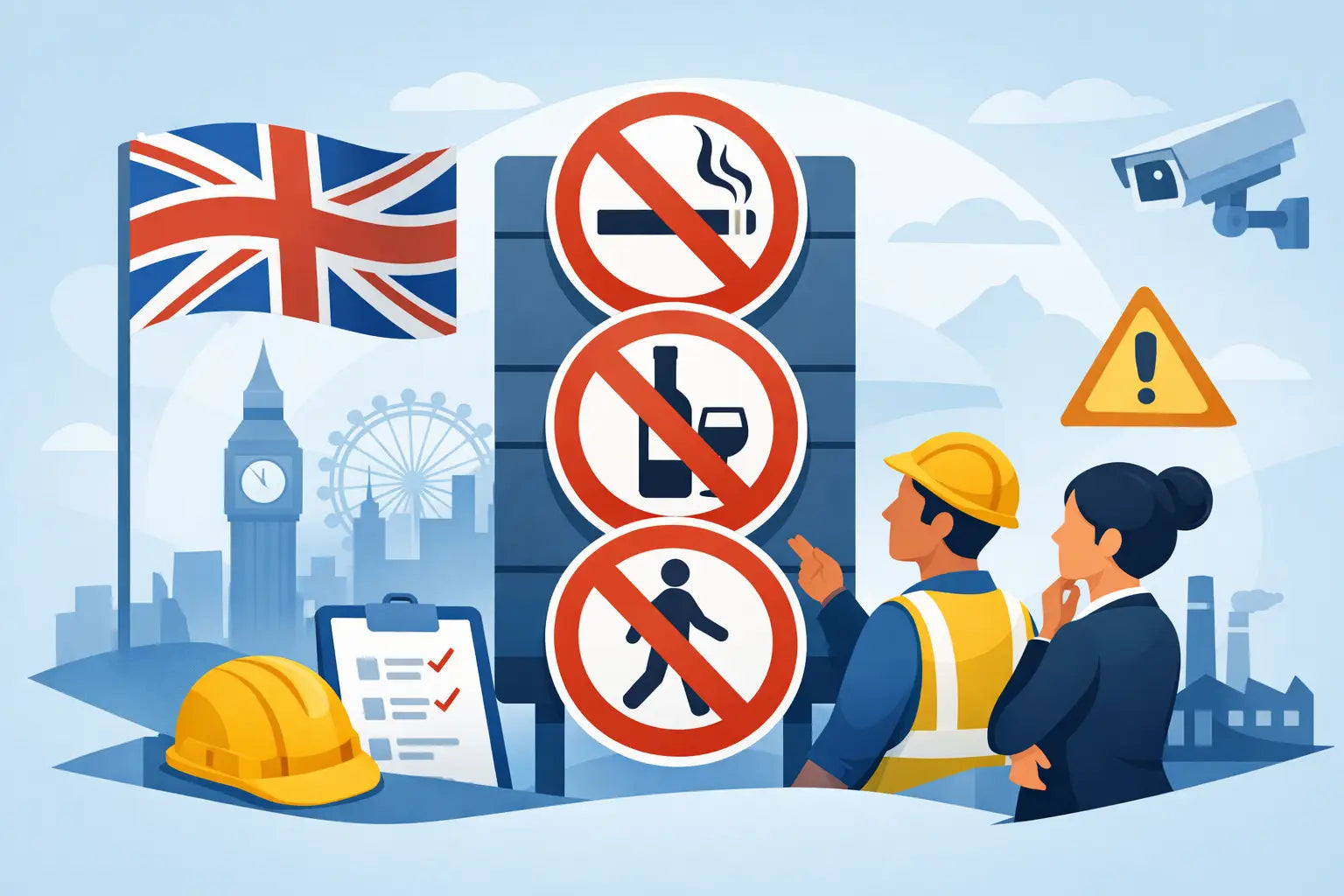
A missing prohibition sign can turn a clear site rule into an assumption. On a busy construction project, farm, warehouse or public-facing premises, assumptions are where unauthorised access, ignition sources and unsafe behaviour slip through. This guide to prohibition signs explains how to choose, position and maintain signs that give people a clear instruction before they enter a risk area.
What prohibition signs mean
Prohibition signs tell people what they must not do. They are used to stop an action that could create danger, compromise site controls or breach operating rules. Familiar examples include No Smoking, No Unauthorised Access, No Pedestrians and No Mobile Phones.
The recognised safety sign design is a black pictogram on a white background, enclosed by a red circular band with a red diagonal bar. The red area should be prominent enough to make the restriction immediately recognisable. Where a standard pictogram exists, it is generally the best option because it can be understood quickly by workers, visitors and contractors regardless of their first language.
In the UK, the Health and Safety (Safety Signs and Signals) Regulations 1996 require safety signs where a significant risk cannot be avoided or adequately controlled by other means. A sign is not a substitute for a physical control, training, supervision or a safe system of work. It supports those measures by making the rule visible at the point where it matters.
For example, a No Entry sign on a live work area does not replace barriers, access control or a permit system. It reinforces them. Used properly, prohibition signage helps remove doubt and gives managers a clear, consistent way to communicate restrictions across the site.
Guide to prohibition signs: choosing the right sign
Start with the hazard and the behaviour you need to prevent, rather than choosing a sign because it appears familiar. A prohibition sign needs to answer a simple question: what must a person not do here?
A No Smoking sign is appropriate where smoking could create a fire or explosion risk, or where smoking is not permitted under site policy. In areas handling flammable materials, smoking controls may need to be supported by restrictions on naked flames, mobile phones and other potential ignition sources. The exact combination depends on the risk assessment and the materials present.
No Unauthorised Access signs are commonly used at plant rooms, electrical cupboards, maintenance areas, chemical stores, private offices and operational parts of a site. They work best when the boundary is obvious. If an area has several entrances, each access route should carry the restriction, rather than relying on one sign placed somewhere nearby.
No Pedestrians signs help separate people from vehicle routes, loading bays, forklift operations and other traffic hazards. They should not be used as a quick fix for a poorly planned route. Where pedestrians need access, provide a safe, clearly marked alternative and use the sign at the point where the restricted route begins.
Other common applications include No Photography signs in sensitive areas, No Food or Drink signs in hygiene-controlled environments, No Dogs signs in designated public spaces, and No Mobile Phones signs where distraction, confidentiality or ignition risk is a concern. Wording can be useful alongside a pictogram when the reason for the restriction is site-specific, but the visual symbol should remain clear at a glance.
Standard symbols or text signs?
For common hazards and behaviours, a recognised pictogram is usually the strongest choice. It is quick to read and supports a consistent safety language across multiple locations. Signs designed in line with BS EN ISO 7010 are widely used for this purpose.
Text can add useful detail when a generic symbol alone does not explain the rule. A sign stating “No unauthorised access - permit holders only” gives a clearer instruction at a controlled work area than a symbol without context. Keep additional wording short. Long notices are often missed, particularly at gates, doors and vehicle routes where people are moving.
Avoid creating homemade symbols or altering standard safety pictograms. A sign that is unclear, badly printed or inconsistent with the usual format can delay recognition. When restrictions affect visitors, delivery drivers or the public, clarity is even more important.
Put signs where decisions are made
A prohibition sign should be placed before someone has the opportunity to carry out the prohibited action. At an access restriction, that usually means on the gate, door or barrier, and at each practical approach to it. In a vehicle area, the sign must be visible before a driver or pedestrian commits to the route.
Height, sightlines and lighting all matter. A sign hidden behind stored materials, fixed too high to read, or positioned around a corner will not do its job. Check the view from the direction people actually travel, not just from the position where the sign is installed.
Sign size should suit the viewing distance. A small self-adhesive sign may be suitable for a cupboard door, machine guard or internal equipment panel. A warehouse entrance, yard gate or loading area may need a larger rigid sign that remains clear from several metres away. If the restriction applies to people arriving by vehicle, consider the reading distance and approach speed as well as the physical size of the entrance.
Where visibility is poor, improve illumination or use an appropriate sign material and location. Do not assume that a reflective finish alone solves every low-light issue. The sign still needs to be positioned where it can be seen without creating a distraction or becoming obscured by glare.
Match the material to the environment
The best sign material depends on where it will be fitted and how much wear it will receive. Self-adhesive vinyl is a practical option for smooth, clean indoor surfaces such as doors, cabinets, machinery and walls. It is quick to apply, but it relies on sound surface preparation and may not suit rough, damp or heavily textured areas.
Rigid plastic signs are a dependable choice for workplaces, yards and general external use. They offer good durability, are easy to clean and can be fixed to walls, fences, gates or posts. For harsher outdoor conditions, exposed agricultural settings or high-traffic industrial locations, choose a material and fixing method that can withstand weather, impact and regular cleaning.
A sign that curls, fades or detaches is more than an untidy detail. It can undermine the authority of the instruction and leave a gap in the control measures identified by your risk assessment. Include safety signs in routine inspections, especially after building works, layout changes, severe weather or a change in site operations.
Avoid common compliance mistakes
The most common mistake is using a prohibition sign where a mandatory sign is needed. Prohibition signs show what people must not do, while mandatory signs tell them what they must do, such as Wear Eye Protection or Keep This Door Closed. Mixing the two can cause confusion at exactly the moment a worker needs a quick instruction.
Another issue is sign overload. A gate covered in competing notices is less effective than a small, well-organised set of signs that identifies the key restrictions. Prioritise the actions that present the greatest risk, group related instructions where appropriate and remove old notices that no longer apply.
It is also worth checking whether the sign reflects the actual rule. A No Entry sign should not be used if authorised staff are expected to enter routinely without a clear alternative message. In that case, No Unauthorised Access or an access-control notice may be more accurate. Precision matters because site rules need to be enforceable as well as visible.
Finally, make sure staff understand why the restriction exists. Toolbox talks, inductions and visitor briefings give signs their context. This is particularly relevant where workers may be tempted to take a shortcut, such as crossing a vehicle route or entering a restricted plant area to save time.
A practical ordering check
Before ordering, confirm the restriction, the number of entrances or approaches, the expected viewing distance and the mounting surface. Then consider whether you need a standard symbol, an additional text message or both. For multi-site estates, standardising the same design, size and wording makes inspections and replacement ordering much simpler.
For urgent replacements or larger site roll-outs, choose a supplier that can provide clear UK-compliant signage, durable material options and dependable dispatch. British-made signs and bulk pricing can be particularly useful when a contractor, facilities team or procurement department needs consistent signage across several locations.
The right prohibition sign is a small, visible part of a much bigger safety system. Put it at the decision point, keep it clear, and make sure the rule behind it is one your team can apply every day. Think Safety - Think Sheep.
Share:
Who Needs Asbestos Warning Signs in the UK?
Aluminium Signs vs Plastic Signs for UK Sites