

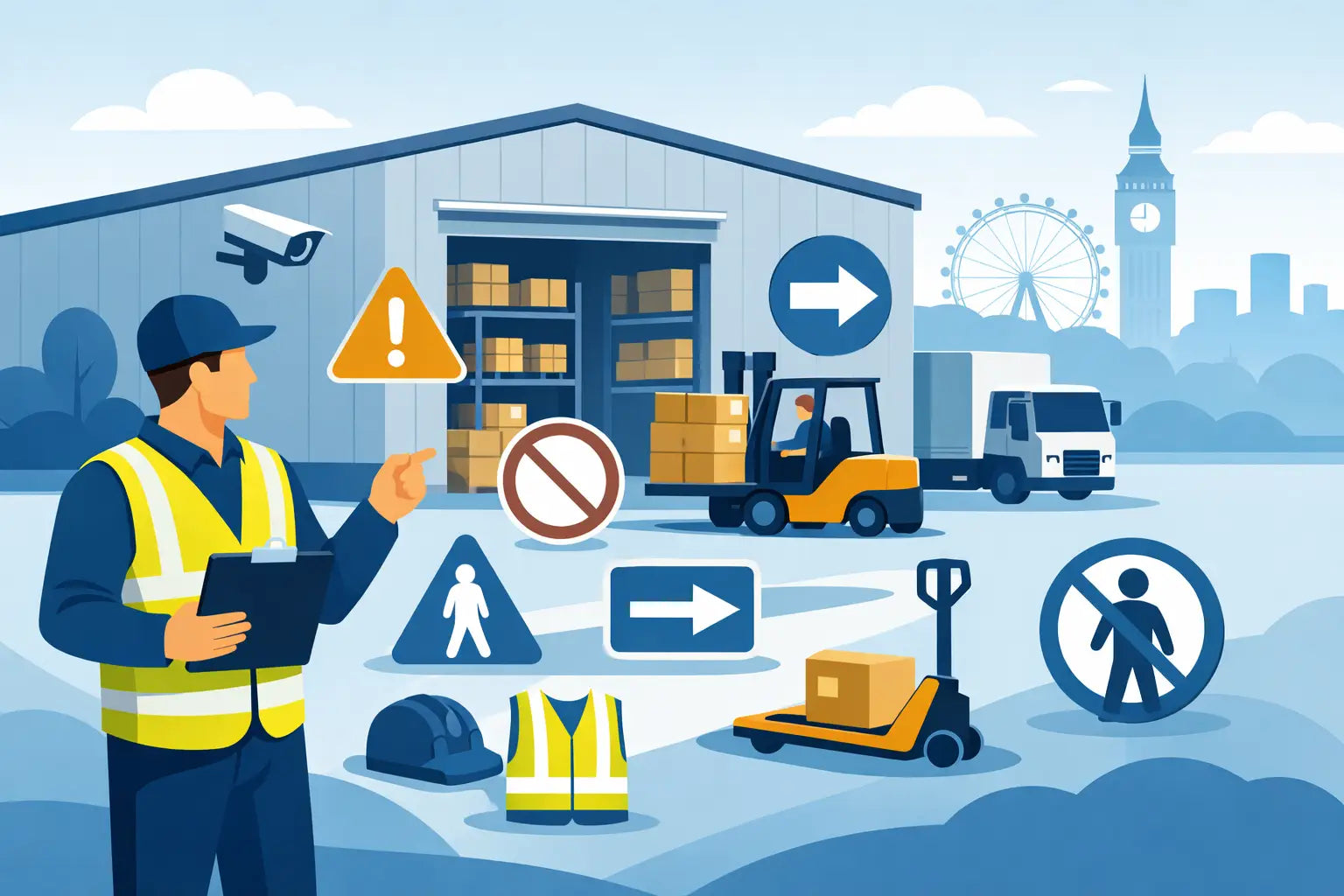
A warehouse can change character quickly. A quiet dispatch area becomes a busy loading zone; a pedestrian route crosses a forklift lane; a spill, fire alarm or blocked exit turns a routine task into a serious risk. So, what signs does a warehouse need? The answer depends on the layout, activities and risk assessment, but every warehouse needs clear, durable signage that tells people where to go, what to do and which hazards to avoid.
For UK operators, signs should support the controls already in place - not replace training, supervision, safe systems of work or physical safeguards. Used properly, they help employees, agency staff, visitors and drivers make the right decision at the point it matters.
What signs does a warehouse need?
A well-signed warehouse normally needs a combination of safety signs, traffic-management signs, fire signs, mandatory PPE notices and facility identification. The precise selection should follow your site risk assessment and be reviewed when racking, processes, stock types or traffic routes change.
Where a safety sign is required, use clear pictograms and familiar colours. Many workplaces use signs designed around BS EN ISO 7010 symbols, helping people recognise warnings and instructions quickly, including visitors or staff whose first language is not English.
Fire safety and emergency escape signs
Fire signage is not something to leave until the final site walk-round. Escape routes, final exits, fire doors and fire-fighting equipment must be easy to identify, particularly in large buildings with high racking, enclosed packing areas or changing shift patterns.
Green safe-condition signs should show the route to emergency exits and assembly points. Position them so the direction of travel remains obvious from aisles, offices, welfare areas and mezzanines. A sign hidden behind stored goods or only visible when standing directly beneath it is unlikely to do its job.
Red fire equipment signs identify items such as extinguishers, hose reels, fire alarm call points and fire action notices. Fire door signs are equally useful. Notices such as “Fire door keep shut” or “Fire exit keep clear” support day-to-day housekeeping and help stop an exit becoming a convenient place for temporary storage.
Forklift, pedestrian and vehicle route signs
The separation of people and workplace transport is one of the most important warehouse safety controls. Forklifts, pallet lorries, reach lorries, delivery lorries and pedestrians all need predictable routes. Floor markings, barriers and mirrors help, but signs make the rules visible at entrances, crossings and junctions.
Use warning signs where forklift lorries operate, particularly at blind corners, loading bays, battery charging areas and access points used by office staff or visitors. Clearly mark pedestrian walkways, crossing points, speed limits, one-way systems and no-pedestrian zones. If drivers need to report to a designated point, display a clear driver instruction sign before they enter the yard or loading area.
Do not assume a painted line alone is enough. Lines wear away, can be obscured by pallets and may be missed by new starters. A combination of floor markings, upright signs and physical segregation usually gives better results.
Mandatory PPE signs
PPE signs tell people which protective equipment must be worn in a particular area. Common examples include safety footwear, high-visibility clothing, head protection, eye protection, hearing protection and gloves. The right requirement varies by task: high-vis may be needed throughout an active warehouse, while eye protection may only be compulsory in a strapping, cutting or maintenance area.
Place mandatory signs before the person enters the relevant zone, not halfway through it. At a goods-in entrance, for example, a combined notice can set out high-vis and safety footwear requirements before a visitor steps onto the operational floor.
Avoid blanket PPE messages that are not supported by the risk assessment. Over-signing can reduce attention and make genuinely critical instructions easier to ignore.
Hazard warning signs
Warning signs alert people to a risk that cannot be eliminated entirely. In a warehouse, this may include slippery surfaces, overhead loads, low headroom, uneven floors, automated doors, battery charging, fragile roofs, hazardous substances or restricted-height areas.
Pay special attention to racking. Aisle-end signs can identify rack rows, while safe working load and bay loading notices help prevent overloading and unsafe storage. Where there is a risk of falling goods, use clear warnings and keep exclusion areas marked. For loading bays, warnings about dock edges, vehicle movement and reversing operations are often necessary.
Chemical and hazardous-substance areas need particular care. Where substances are stored or used, containers should carry the appropriate labels, and the wider area may need warning or access-control signage. A general warning sign should never be used as a substitute for correct chemical labelling, storage and COSHH controls.
Access control and operational signs
Not every useful warehouse sign is a formal safety sign. Clear operational notices prevent errors, reduce interruptions and help visitors follow site rules without needing an escort for every basic instruction.
Consider signage for authorised personnel only areas, staff entrances, visitor reporting points, delivery check-in, smoking restrictions, welfare facilities, first aid points and waste segregation. In temperature-controlled, food-handling or clean areas, hygiene notices can reinforce handwashing, protective clothing and contamination controls.
For larger sites, identification signs are especially valuable. Clearly named zones, aisle markers, dock numbers, pick faces and staging areas make it easier for operatives to locate stock, for emergency teams to orient themselves and for managers to give precise instructions over the radio. These signs should use a simple naming convention that matches warehouse management systems and site plans.
Signs for visitors, contractors and delivery drivers
A warehouse is often safest for the people who know it best. The gap usually appears when a contractor, courier or visiting driver arrives and does not understand the traffic plan, PPE rules or emergency procedure.
A concise site safety board at the entrance can set expectations before access is granted. It may cover speed limits, reversing rules, reporting instructions, mobile phone restrictions, PPE, smoking, emergency arrangements and the need to follow a host or banksman. If your site receives drivers from different countries, simple pictograms and plain language can be more effective than dense paragraphs of text.
Contractors should also be directed to sign in, receive relevant induction information and obtain a permit where the work requires one. A “No unauthorised access” sign is useful, but it is not a security system or a contractor-management process on its own.
Positioning, condition and visibility matter
Buying the correct sign is only half the job. A sign must be placed where it can be seen in time to influence behaviour. Check viewing distance, lighting, approach direction and obstructions such as open roller shutters, stacked pallets and seasonal stock peaks.
Material choice matters too. Internal office notices may suit self-adhesive vinyl, while high-traffic warehouse doors, yard entrances and loading bays often need rigid plastic, aluminium composite or another hard-wearing option. For temporary works, removable signs can be practical, provided they remain secure and legible.
Include signs in routine workplace inspections. Replace damaged, faded or outdated notices promptly. If a route changes, update signs at the same time as barriers and floor markings. An old arrow pointing towards a moved fire exit is worse than no arrow at all because it creates false confidence.
A practical warehouse sign check
Before ordering, walk the site from the perspective of a new employee, a delivery driver and a visitor. Start at the gate, follow the route to reception or goods-in, enter the warehouse, pass through pedestrian crossings, visit welfare areas and trace the emergency escape route. Note every point where someone needs an instruction, warning or direction.
Then check whether each sign is necessary, visible and consistent with the actual site rules. Your core review should cover:
- emergency exits, assembly points, fire equipment and fire doors
- pedestrian routes, forklift traffic, crossings, speed limits and loading bays
- required PPE and restricted-access areas
- warehouse-specific hazards, including racking, low clearance and chemicals
- first aid, welfare, visitor reporting and operational identification
A good warehouse sign should answer a practical question in seconds: where is the safe route, what is the risk, and what must I do now? When the answer is clear at every decision point, the warehouse is easier to run and safer for everyone working in it. Think Safety - Think Sheep.
Share:
Where Should Extinguisher ID Signs Go?
Where Slippery Floor Warning Signs Belong