

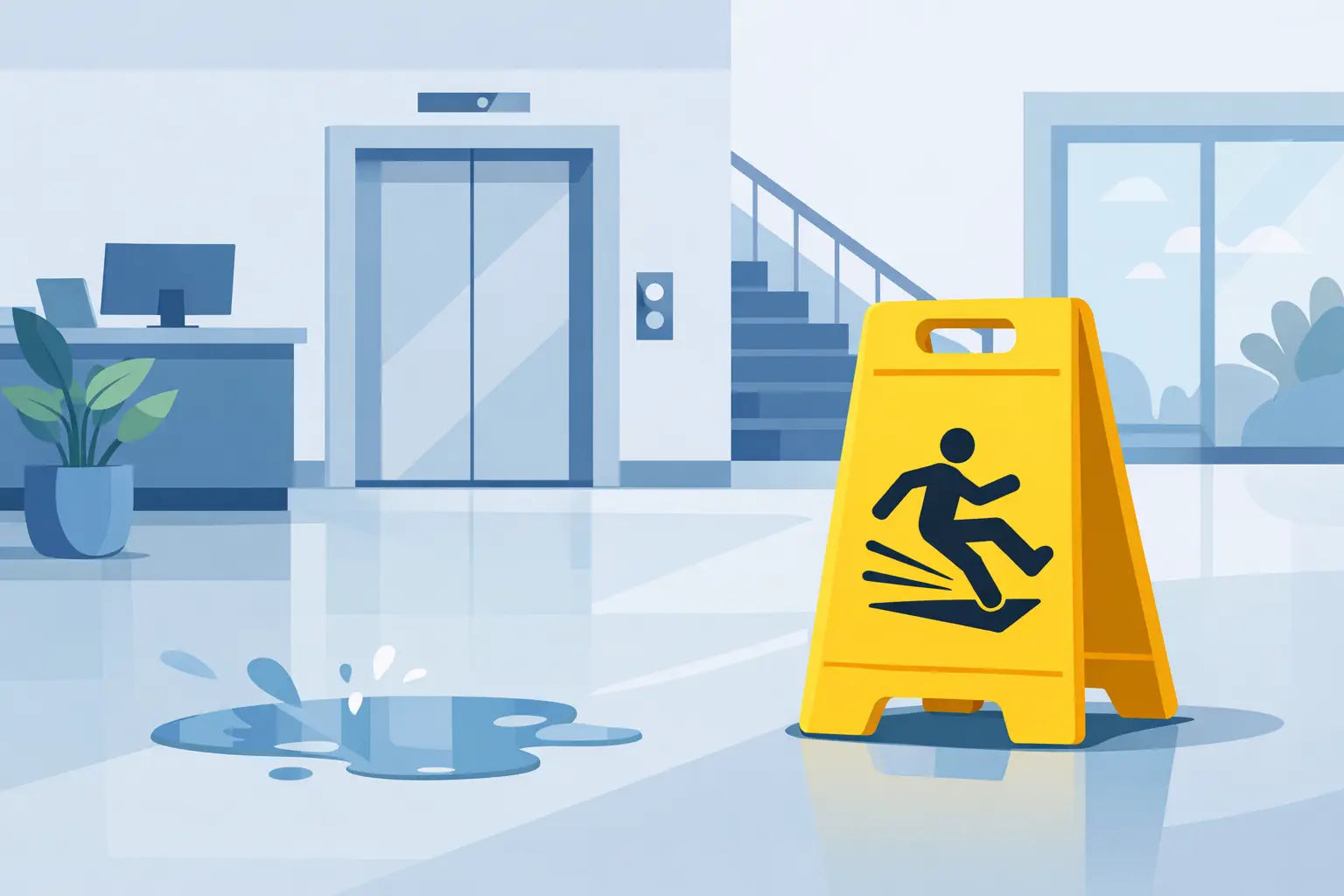
A wet entrance on a rainy morning, a spill beside a drinks machine or freshly mopped tiles can create a slip risk within minutes. Slippery floor warning signs give staff, visitors and contractors a clear prompt to take care while the immediate hazard is dealt with. For busy UK workplaces, they are a simple but valuable part of a wider slip-prevention plan.
The key point is simple: a sign is not a substitute for cleaning, maintenance or safe flooring. It should support those controls by making a remaining or temporary risk obvious at the point where people need to see it.
When are slippery floor warning signs needed?
Slips, trips and falls are among the most common causes of workplace injury. The risk is often highest where people are moving quickly, carrying goods, wearing unsuitable footwear or entering from outdoors. Warning signage is particularly useful when a hazard cannot be removed immediately, or when a temporary condition changes the surface underfoot.
Typical situations include cleaning in progress, leaks, spillages, wet weather at entrances, condensation in cold areas, food or drink contamination, and flooring that has become worn or damaged. In public-facing premises, clear warnings also help visitors who are unfamiliar with the layout and may not expect a change in floor conditions.
Under the Health and Safety (Safety Signs and Signals) Regulations 1996, safety signs may be required where a significant risk cannot be avoided or adequately controlled by other means. The decision should follow a suitable risk assessment. In practice, this means considering who could be affected, how long the hazard will remain, how likely a slip is and whether existing measures are working.
A warning sign is appropriate where it adds useful information. It is not appropriate to use one as a permanent excuse for a known defect. If water regularly collects at a doorway, for example, investigate drainage, matting, canopy coverage and cleaning arrangements rather than leaving a temporary caution board in place all year.
Choosing the right slippery floor warning signs
The most effective sign depends on whether the risk is temporary, recurring or permanent. A bright yellow folding floor sign or cone is usually the practical choice for a freshly mopped corridor, a spillage or a short-term leak. It can be placed quickly, is visible from more than one direction and can be removed as soon as the area is safe.
For known fixed risks, such as a ramp with a surface that can become slippery in wet conditions, a durable wall-mounted warning sign may be more suitable. The familiar warning format uses a yellow triangular symbol with a black border and black slipping-person pictogram. This is widely recognised and provides an immediate visual message, even where people do not read every word on the sign.
Wording should be short and specific. ‘Caution Wet Floor’ works for a temporary wet surface. ‘Warning: Slippery Surface’ may suit a location with an ongoing risk. If the hazard is associated with a particular activity, such as cleaning, a sign that explains this can improve understanding. Avoid vague messages and overcrowded designs that require people to stop and read.
Material matters too. Indoor floor stands need to be stable, easy to clean and resistant to regular handling. Outdoor or semi-exposed signs need weather-resistant materials and secure fixing. In warehouses, loading areas and farms, choose a more durable format that remains legible around dirt, moisture and vehicle traffic.
Match the sign to the environment
A hospital corridor, school kitchen, office reception and distribution depot may all have wet-floor risks, but the practical requirements are different. A lightweight folding sign is convenient for cleaners moving between office floors. In a food preparation area, signs must be easily cleaned and positioned without obstructing operations. On an industrial site, larger signs may be needed where pedestrians approach from a distance or visibility is reduced.
Think about the people using the area. Visitors entering a leisure centre may need a prominent warning immediately after the entrance mat. Warehouse staff may need a sign that is not hidden by pallets, stock cages or forklift routes. For farms and rural sites, mud, washdown areas and changing weather can create regular hazards that need durable, location-specific warnings.
Position signs where people can act on them
A warning sign only works if it is seen before someone steps onto the affected surface. Place it on the approach to the hazard, not directly in the wet patch or behind the person responsible for cleaning. Where people can enter from multiple directions, use more than one sign.
Keep signs clear of doors, fire exits, walkways and routes used by wheelchairs, trolleys or evacuation traffic. A poorly placed A-board can create the very trip hazard it is meant to prevent. It should be stable, easy to spot and positioned so it does not narrow a route unnecessarily.
Check visibility at the times the risk is most likely to occur. Lighting can be different early in the morning, during evening shifts or in poor weather. A sign near a glazed entrance may be lost against glare, while one in a warehouse aisle could be hidden by stored materials. In these cases, reconsider the location or use a larger format.
Signs must sit alongside practical controls
The fastest response to a spill is to make the area safe, not simply put up a sign. Staff should know who is responsible for cleaning, where equipment is kept and how to report leaks or damaged flooring. Warning signs should be available at the point of need, rather than stored in a locked cupboard at the other end of the building.
Good controls commonly include suitable entrance matting, regular inspections, prompt spill response, non-slip flooring where justified, planned maintenance and cleaning methods that leave surfaces as dry as possible. In areas cleaned during operating hours, consider whether work can be timed for quieter periods or whether a section can be temporarily closed off.
Recurring incidents deserve closer attention. If the same corridor becomes wet after every delivery, the cause may be poor drainage or an unsuitable cleaning routine. If staff repeatedly slip near a machine, investigate overspray, leaking pipes, footwear requirements and the floor finish. Records of near misses and cleaning reports can reveal patterns before someone is injured.
Avoid common signage mistakes
The most common failure is leaving temporary warning signs out long after the hazard has gone. People quickly stop noticing a sign that is always present, and its credibility is reduced when it does not reflect an actual risk. Remove temporary signs promptly once the surface is dry and safe.
Another mistake is relying on a single small sign in a large or busy area. A warning needs to be proportionate to the space, sightlines and number of approaches. Equally, avoid filling a workplace with signs for every minor possibility. Too many messages compete for attention and can make genuinely urgent warnings easier to miss.
Finally, inspect signage as part of routine checks. Replace signs that are faded, cracked, dirty, unstable or difficult to read. A clean, well-positioned warning sign shows that the site takes safety seriously and gives people information they can use immediately.
For facilities teams managing several locations, keeping a standard stock of folding wet-floor signs, permanent warning signs and replacement notices can prevent delays when a hazard appears. British-made signage with clear symbols and durable materials also helps maintain a consistent safety standard across sites. Safety Sheep Store supports this practical approach with trade-friendly quantities for teams that need to replenish signage quickly.
A slippery surface may be temporary, but the consequences of overlooking it can last far longer. Put the right warning in the right place, deal with the cause without delay, and give everyone on site a clearer, safer route through the working day. Think Safety - Think Sheep.
Share:
What Signs Does a Warehouse Need in the UK?
Best EV Charging Bay Signs for UK Car Parks