

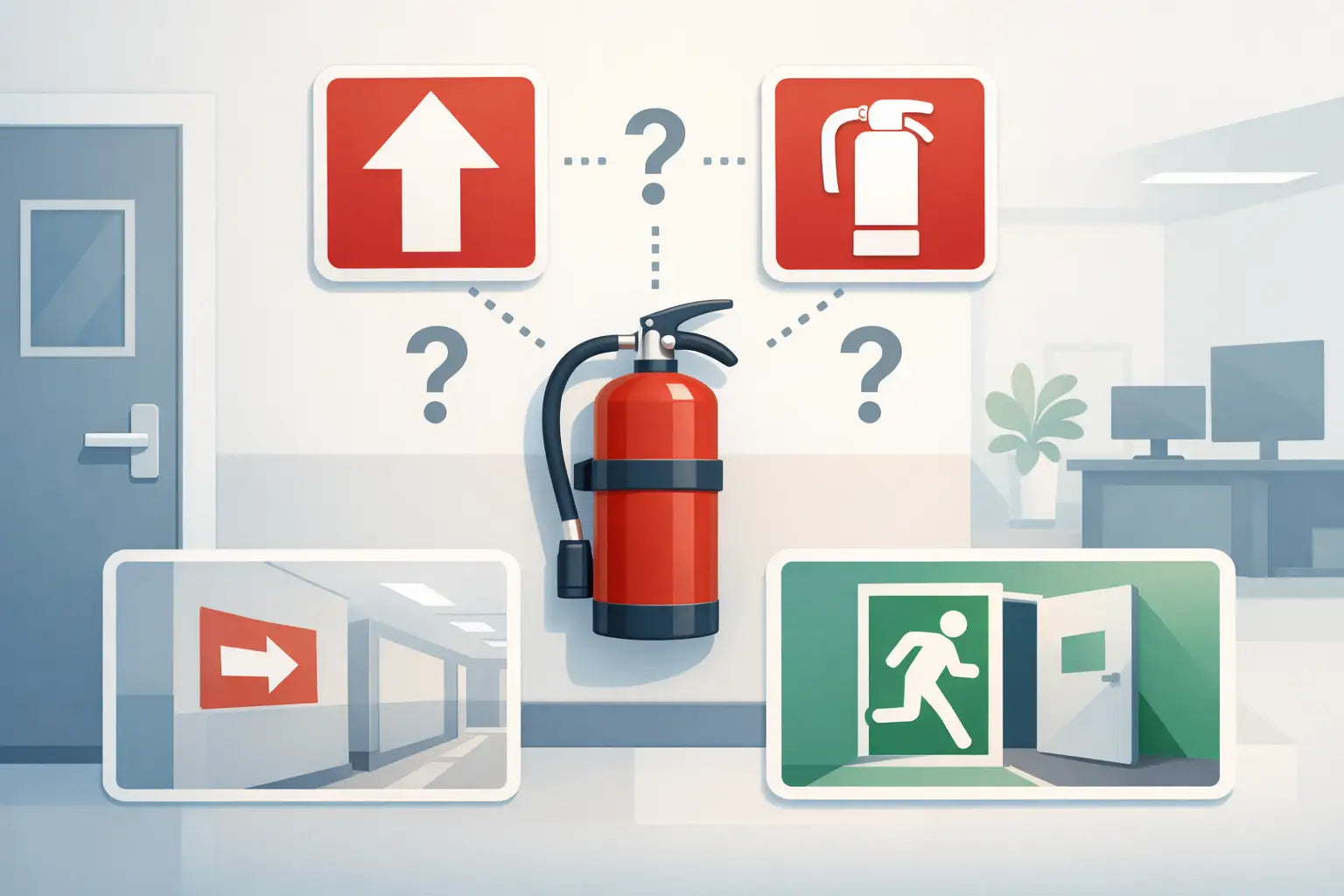
If a fire extinguisher is mounted in the right place but nobody can spot it quickly, you have only done half the job. That is why the question of where should extinguisher ID signs go matters in real workplaces, not just on a compliance checklist. In an office corridor, a warehouse aisle or a farm outbuilding, people need to identify the extinguisher location fast, even when stock, doors or poor sight lines get in the way.
For most premises, extinguisher ID signs should be positioned directly above the extinguisher so the sign remains visible from a distance and still marks the equipment if the area around it becomes partially blocked. That is the standard approach because it is simple, familiar and easy for staff, visitors and contractors to understand at a glance. The sign should not sit so low that the extinguisher itself hides it, and it should not be offset so far away that people are left guessing which unit it refers to.
Where should extinguisher ID signs go in practice?
In practice, the best position is on the wall above the fire extinguisher at a height that can be seen clearly over the unit itself and over nearby fixtures. This helps in two ways. First, it highlights the extinguisher point from a distance. Second, it still identifies the location if the extinguisher is temporarily obscured by people, open doors or stored items.
If extinguishers are mounted in a recessed area, alcove or behind a structural column, the sign may also need to be repeated nearby so the equipment can be located from the normal direction of travel. That is where judgement matters. A technically correct sign placement is not always the most visible one.
In larger buildings, the viewing angle is often the deciding factor. A wall-mounted sign above the extinguisher usually works well in offices, schools, shops and smaller industrial units. In long corridors, open-plan warehouses or plant rooms with multiple visual obstructions, you may need a projecting sign or an additional directional sign so the extinguisher point is visible before someone is standing directly in front of it.
Why the sign normally goes above the extinguisher
Placing the ID sign above the extinguisher is standard because it creates a clear visual relationship between the sign and the equipment. There is no ambiguity. If the sign is fixed to the side, below, or on a nearby surface with no obvious connection, people can lose time deciding whether they are looking at the correct appliance.
This is especially important where more than one extinguisher type is installed together. A fire point may include water, foam, CO2 or powder units, and the sign helps users identify what is there before they take it off the bracket. The sign position should support that quick decision, not complicate it.
There is also a practical maintenance reason. When signage sits above the extinguisher, it tends to stay visible even if the floor area becomes cluttered or if the extinguisher is removed for servicing and temporarily not yet returned. The sign still shows where the unit belongs, which helps with inspections and reinstatement.
The right height matters
There is no one magic measurement that suits every wall, but the sign should be high enough to remain visible and low enough to read clearly. In most workplaces, positioning the sign above head height but not excessively high gives the best result. If it is too low, the extinguisher can hide it. If it is too high, smaller text becomes difficult to read and the sign can be overlooked.
You also need to consider surrounding features such as door frames, noticeboards, racking and service pipes. A good sign in the wrong vertical position is still a poor installation.
Keep the line of sight clear
One of the most common mistakes is placing an extinguisher in a sensible position, then fixing the sign where it is partly blocked by the open door next to it, a beam, a vending machine or stored materials. The sign needs a clear line of sight from the approach route. If a person has to step into the exact fire point position before they can see the sign, the placement is not doing enough.
For that reason, a quick walk-through is often more useful than relying on a drawing. Stand where staff or visitors would normally enter the area and ask a simple question: can you spot the extinguisher point immediately?
What UK workplaces should consider
UK fire safety arrangements vary by building use, occupancy and risk, so there is no single layout that covers every site. Still, the principle stays consistent. Extinguisher ID signs should help users find firefighting equipment quickly and understand what is provided there.
In a small office, one sign above each extinguisher may be enough. In a warehouse, signs may need to be visible down an aisle or above pallet height. On farms and in workshops, dirt, impact risk and changing layouts can all affect where signage will remain visible and legible over time.
Landlords and facilities managers should also think about unfamiliar users. Staff may know where extinguishers are by habit, but visitors, agency workers and contractors do not. Signage is there for the person who does not know the building.
When one sign is not enough
Some sites need more than a single wall sign above the extinguisher. This is common where the extinguisher is installed around a corner, inside a plant space, behind a final exit door or along a route broken up by partitions and machinery.
In these cases, supplementary signs can make the difference between a fire point that is technically marked and one that is actually easy to find. Directional signs are useful where the extinguisher cannot be seen from the main circulation route. Projecting signs can help in wide spaces where people approach from different angles.
There is a balance to strike. Too few signs and equipment is hard to find. Too many signs and the message gets lost in visual clutter. The best approach is targeted visibility, not sign overload.
Areas with multiple extinguishers
If several extinguishers are mounted side by side, each appliance should still be clearly identified. A generic fire point marker may show the location, but individual extinguisher ID signs help users distinguish between types. That matters because different extinguishers are intended for different fire risks.
Where space is tight, combination signage can work well, provided it remains easy to read and clearly matched to the appliances below. The key test is speed. Someone should be able to recognise what is available without stopping to decode the layout.
Common placement mistakes
The biggest mistake is treating extinguisher signs as an afterthought. They are often fitted wherever there is spare wall space, rather than where people will actually see them first. That leads to signs hidden by open doors, mounted too close to adjacent notices, or fixed on surfaces that are not directly associated with the extinguisher.
Another common issue is poor consistency across a site. If one extinguisher has a sign above it, another has a sign beside it, and another has no visible sign until you are next to it, the overall system feels unreliable. Consistent placement helps people scan a building quickly.
Durability matters too. In industrial and agricultural settings, signs need to cope with dust, moisture, knocks and routine cleaning. A faded, curling or damaged sign is nearly as unhelpful as no sign at all.
A practical standard for most sites
If you want a workable rule for most UK premises, put the extinguisher ID sign directly above the extinguisher, make sure it is visible from the normal approach route, and add directional or projecting signage where the extinguisher cannot be seen easily in time. That approach suits the majority of offices, shops, schools, factories, farms and communal buildings.
It also makes inspections easier. Fire points are simpler to check when signage is placed consistently and clearly. For multi-site operators and procurement teams, that consistency saves time and reduces the risk of missed locations during audits or maintenance visits.
For buyers responsible for replacement or rollout, it is worth choosing signage that is clear, durable and suited to the environment from the start. Think Safety - Think Sheep. The right sign in the right place is a small detail, but in an emergency it removes hesitation, and that is exactly what good safety signage is supposed to do.
Share:
Bulk Sign Ordering for Contractors That Works
What Signs Does a Warehouse Need in the UK?