

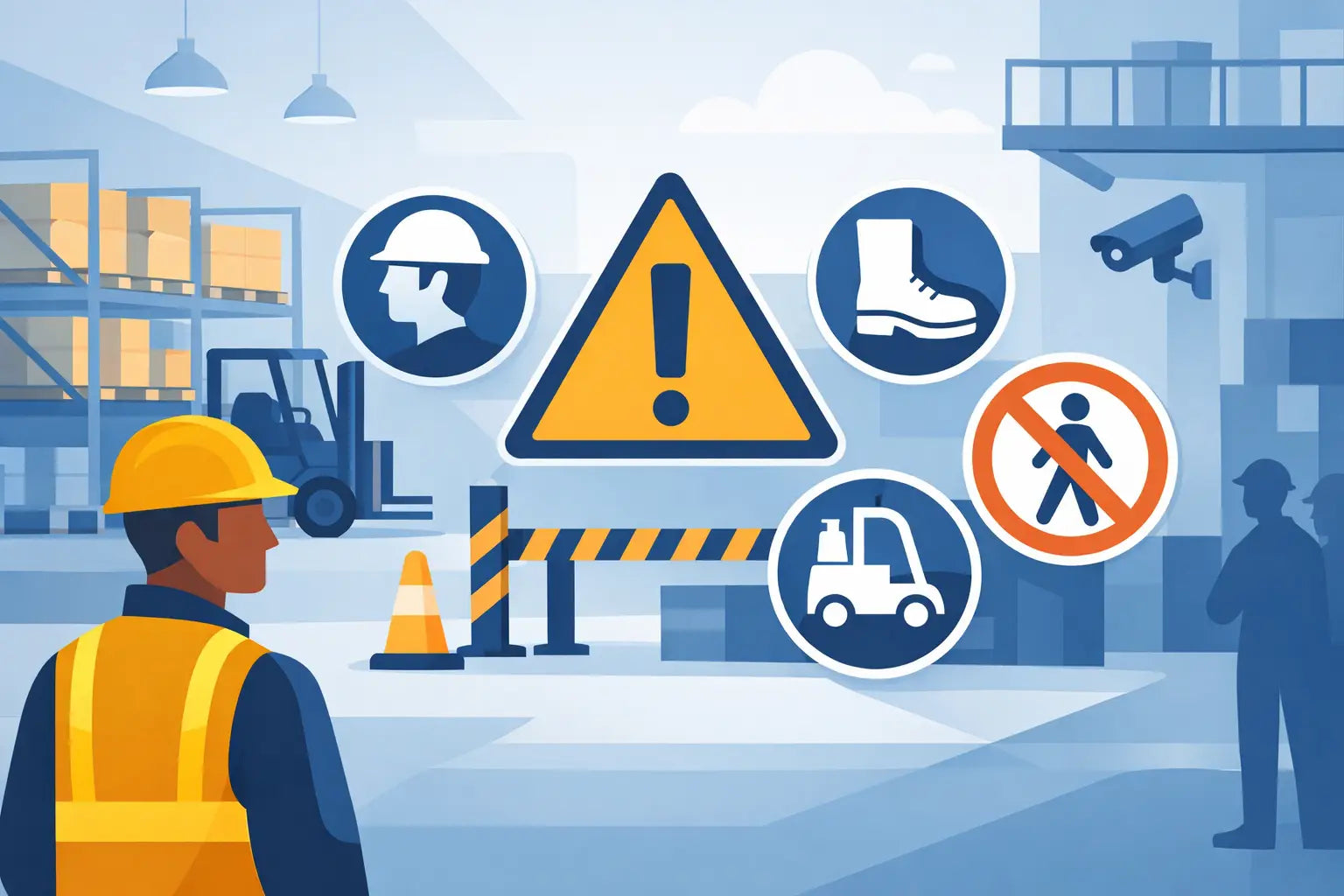
A forklift turning into a blind aisle, a fire exit partly blocked by wrapped pallets, a visitor stepping into a loading zone without high-vis - this is where signage stops being a formality and starts doing real work. A good warehouse safety signage guide is not about filling walls with notices. It is about putting the right message in the right place so staff, drivers, contractors and visitors can act quickly and safely.
In warehousing, signs need to do three jobs at once. They must support legal compliance, reduce day-to-day risk and keep operations moving. If a sign is unclear, poorly positioned or already peeling away after a few months, it fails on all three.
What warehouse signage needs to achieve
Most warehouse environments combine vehicle movement, manual handling, racking, loading activity, restricted areas and emergency routes in one space. That means signage has to work across multiple hazards without becoming visual clutter. Too few signs leave people guessing. Too many signs, especially when they compete for attention, can make people ignore all of them.
The aim is simple. People should be able to understand the hazard or instruction at a glance, from a realistic viewing distance, and in enough time to respond. That applies whether the person is a trained warehouse operative, a delivery driver on site for five minutes or a maintenance contractor visiting an unfamiliar building.
A sensible signage plan also helps standardise behaviour. If one area says "Forklift Lorries Operating" and another uses a homemade printed notice saying "Watch Out For FLTs", the message may be similar, but the site looks inconsistent and the risk communication is weaker. Standard, compliant signage gives clarity and credibility.
Warehouse safety signage guide - the main categories
The core categories in any warehouse safety signage guide are usually prohibition signs, mandatory signs, warning signs, safe condition signs and fire safety signs. Each has a clear purpose, and mixing them up causes confusion.
Prohibition signs tell people what they must not do, such as no smoking, no unauthorised access or no pedestrians beyond a certain point. Mandatory signs set out instructions that must be followed, such as safety helmets must be worn or high-visibility clothing must be worn. Warning signs draw attention to specific hazards like forklift lorries, overhead loads, slippery surfaces or fragile roofs in attached storage structures.
Safe condition signs help people find emergency exits, first aid points, assembly points and emergency escape routes. Fire safety signs identify extinguishers, alarm call points, fire doors and related equipment. In a busy warehouse, these are not secondary details. They are critical during an evacuation, especially where temporary staff or agency workers may not know the layout well.
For many sites, floor marking and warehouse notices also play a major role. Wall signs tell people the rule. Floor graphics often show them exactly where to stand, walk, queue or stop. In vehicle-heavy areas, that combination is often more effective than relying on one format alone.
Placement matters as much as the sign itself
A compliant sign that no one sees in time is still a poor control measure. Placement should reflect movement, approach angles, lighting conditions and likely obstructions. Warehouses change constantly. Pallets stack up, cages move, racking gets altered and temporary stock can block sightlines that were clear six months ago.
Signs should generally be placed at decision points rather than after the hazard has already been entered. For example, PPE instructions belong before someone steps onto the warehouse floor, not halfway down an aisle. Restricted access signs should be fixed where the boundary begins. Warnings about forklift activity should be visible before pedestrians cross into vehicle routes.
Height matters too. A sign mounted too high may be missed by someone walking in from a side entrance. Too low, and it may disappear behind stock or equipment. In loading bays and dispatch areas, larger formats are often needed because people are moving quickly, sometimes in poor weather or variable light, and often while focused on vehicles or paperwork.
Matching signage to real warehouse risks
No two warehouses are exactly alike. A food distribution site, a builders' merchant and a self-storage facility all face different risk patterns. That is why signage should follow the site risk assessment rather than a generic shopping list.
Where forklift and pedestrian routes cross, priority signs, warning notices and floor markings should work together. In picking areas, signs around manual handling, step access and falling objects may be more relevant. In cold stores, you may need notices that remain legible in low temperatures and damp conditions. In chemical or cleaning stores within a warehouse, hazard communication and restricted access signs become more prominent.
This is where buyers often benefit from thinking in zones. Goods-in, storage aisles, mezzanines, charging points, loading bays, waste areas, staff-only rooms and fire exits each call for their own signage mix. Ordering by zone is usually faster and more accurate than trying to build an order around isolated product types.
Compliance is essential, but so is durability
Warehouse managers usually care about compliance first, and rightly so. But durability is not a minor purchasing detail. If a sign fades, cracks or lifts from the surface, it quickly becomes a replacement problem and, in some cases, a safety problem.
Material choice depends on the environment. Indoor warehouse areas may suit standard rigid plastic, aluminium or self-adhesive vinyl depending on the surface and expected wear. Outdoor loading areas may need more weather-resistant materials. Washdown zones, temperature-controlled spaces and dusty industrial environments all place different demands on signage.
There is also a cost judgement to make. The cheapest option can be false economy if it needs replacing repeatedly or fails to stay readable. Trade buyers managing multiple sites usually benefit from standardising durable formats across their estate, especially where there is frequent wear or a need for repeat ordering.
Common mistakes that weaken warehouse signage
One of the biggest mistakes is over-signing. If every pillar, door and racking end carries multiple notices, urgent information loses impact. Staff learn to tune it out. Better signage plans prioritise the hazards and instructions people actually need at each location.
Another common issue is inconsistency. Sites often build up a mix of old signs, temporary labels and printed A4 notices taped to doors. That creates an untidy, unreliable system. It can also suggest that safety communication is reactive rather than controlled.
A third problem is failing to review signage after operational changes. New racking layouts, altered pedestrian routes, EV charging areas, relocated first aid kits and updated fire points all affect what signs are needed and where. Warehouses are live environments. The signage should be reviewed the same way other controls are reviewed.
Language and readability also matter. Short, standard messages usually perform better than site-made text-heavy notices. Where literacy, language differences or visitor traffic are factors, recognised symbols become even more valuable.
How to build a practical warehouse safety signage guide for your site
Start with a walk-through based on how people actually use the space, not how the site looks on a plan. Follow a driver route, a pedestrian route, a visitor route and an emergency escape route. You will often spot gaps quickly when viewing the warehouse from those different perspectives.
Next, group your signage needs by function. Think access control, vehicle movement, PPE, hazard warnings, emergency information and area identification. That makes ordering simpler and helps avoid duplicates. It also suits buyers responsible for more than one premises, because the same framework can be applied site by site.
Then check condition as well as presence. A faded fire exit sign, a cracked mandatory sign or a notice hidden behind shrink-wrapped stock should be treated as a failure, not as a box ticked. Replacement speed matters when signs are damaged, missing or no longer fit the space.
Finally, buy with operations in mind. If you need a one-off replacement, speed may be the priority. If you are updating an entire warehouse or rolling signage out across multiple depots, consistency, trade pricing and bulk savings become more important. British-made products, fast dispatch and reliable stock support can make a real difference when deadlines are tight. Think Safety - Think Sheep.
When custom signage is worth considering
Standard signs cover most core warehouse requirements, but there are times when custom notices make sense. Site-specific speed limits, named loading bays, door identifiers, warehouse zones, traffic flow instructions and operational reminders often need wording or numbering unique to the premises.
That said, custom signage should support standard safety messaging, not replace it. The legal and visual strength of recognised sign formats should remain the foundation. Custom signs work best when they add clarity around local procedures.
For example, a standard warning sign for forklift lorries may sit alongside a custom directional sign showing one-way warehouse traffic. Together, they give both compliance and site-specific instruction.
A final thought on getting signage right
Good warehouse signage should feel almost invisible in use - not because it is unnoticed, but because it makes the right action obvious without slowing the job down. When signs are clear, consistent and built for the environment, they support safer behaviour with less friction. That is usually the difference between a warehouse that is merely signed and one that is properly managed.
Share:
How to Choose Safety Signs for Your Site
Loading Bay Signs That Keep Sites Safe