

A missing sign is rarely noticed until there is a near miss, a delivery driver heads into the wrong area, or a visitor walks straight past a hazard. That is why knowing how to choose safety signs matters. The right sign does more than fill a compliance gap - it helps people act quickly, avoid risk and move through your site with confidence.
For most UK businesses, the challenge is not whether signage is needed. It is choosing signs that are correct for the environment, clear to the reader and durable enough to last. A warehouse, farm, school entrance and construction site may all need safety signs, but not the same kind, not in the same material and not with the same message.
How to choose safety signs without overbuying
The starting point is the risk, not the catalogue. Before you select any sign, look at what people need to know at the point they need to know it. That usually falls into a few practical questions. Is there a hazard to warn about? Is there an action people must take, such as wearing PPE? Is there something they must not do? Or are you directing them towards safety equipment, exits or restricted areas?
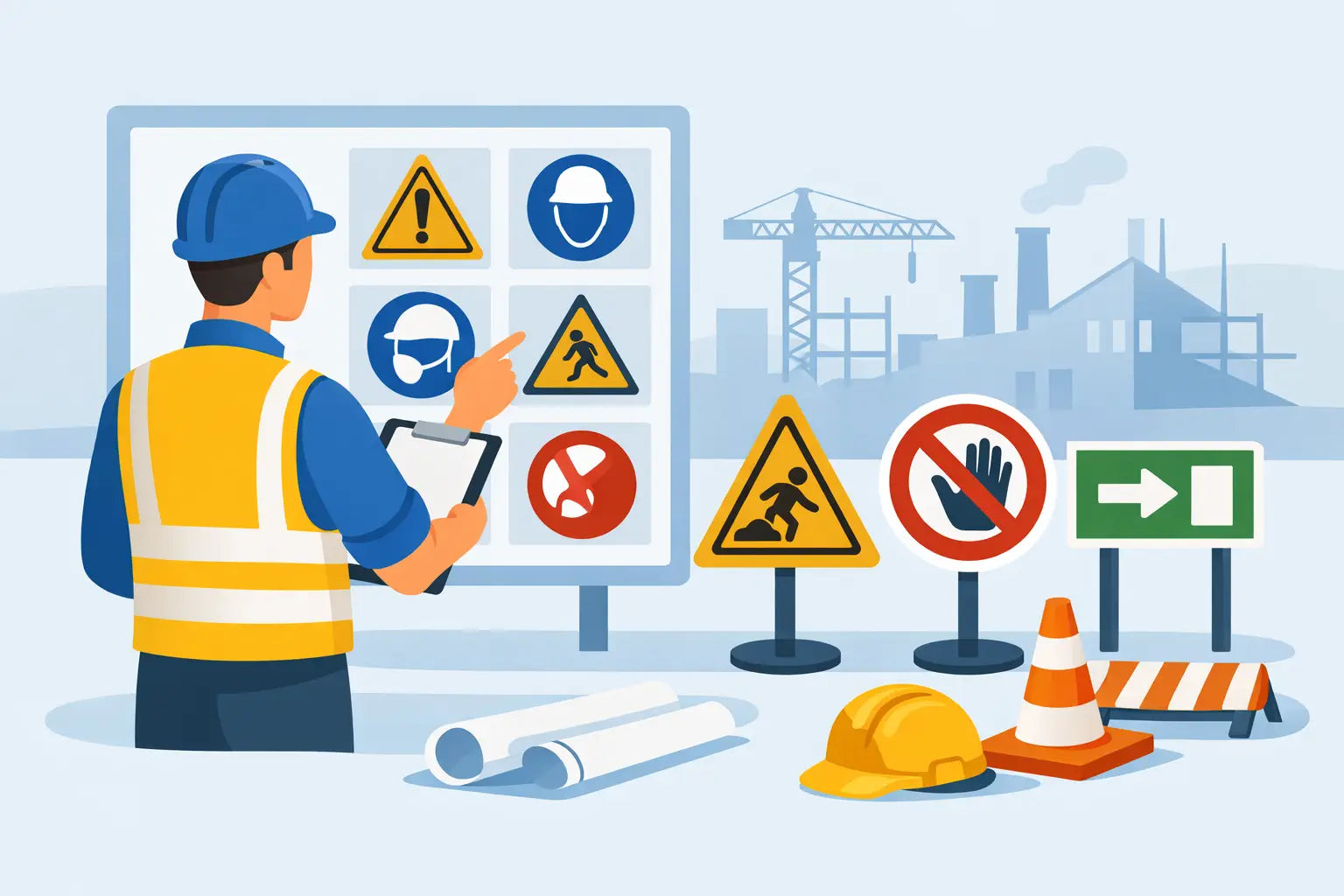
This matters because UK safety signs are designed to communicate different types of instruction. Warning signs alert people to danger. Mandatory signs tell them what they must do. Prohibition signs tell them what they must not do. Safe condition signs identify exits, first aid points and emergency equipment. Fire safety signs identify firefighting equipment and related instructions.
If you choose the wrong sign type, the message becomes weaker even if the wording seems sensible. A site manager may know what you mean, but the sign is there for everyone else too - staff, contractors, visitors and members of the public.
Start with the legal and practical requirement
In the UK, safety signage should support your wider duty to manage risk. Signs are not a substitute for proper controls, training or safe systems of work, but they are often an essential part of communicating those controls. If a hazard cannot be removed entirely, signage helps reduce the chance of confusion or unsafe behaviour.
In practice, that means your first check should be your risk assessment. If the assessment shows a need to warn, instruct or restrict, the sign should reflect that finding clearly. For example, a simple "Caution Fork Lift Lorries Operating" sign may be suitable in one loading bay, while another site may need a fuller combination sign covering pedestrian routes, high-visibility clothing and speed limits because traffic movement is more complex.
There is a trade-off here. Too little information creates risk. Too much information on one board can make the message harder to absorb. On busy sites, shorter messages often work better, especially when people are moving, carrying loads or reading from a distance.
Match the sign to the people using the area
A sign that works for trained engineers may not work as well for visitors or agency staff. Think about who is likely to see it and how familiar they are with the environment. In public-facing spaces, plain wording and strong symbols are especially useful. In controlled work areas, more specific instructions may be appropriate because the audience already understands the setting.
Where literacy, language differences or quick recognition are a concern, symbol-led signage is often the strongest choice. That is one reason standard safety colours and shapes matter. They allow people to identify the type of message before they even read the text.
Choose the right wording and sign format
One of the most common buying mistakes is choosing signage that is broadly relevant rather than precisely useful. "Danger" and "Warning" do not mean the same thing. "Authorised Personnel Only" is different from "No Unauthorised Access". "Wear Face Protection" is not the same instruction as "PPE Must Be Worn" if your risk assessment requires a specific item.
This is where sector-specific buying helps. Construction, agriculture, warehousing, food production and office facilities all have recurring signage needs, but each also has its own operational details. Farms may need clear biosecurity, machinery and livestock warnings. Car parks need traffic flow, EV charging and access control signs that are readable from vehicles. Offices may focus more on fire points, first aid, washroom identification and restricted access.
Combination signs can be a practical option where several related instructions apply in one place. They save wall space and give people one clear reference point. That said, they work best when the messages belong together. If a board becomes crowded with mixed instructions, separate signs may be more effective.
Material matters more than many buyers expect
Once the message is right, the next question is durability. How to choose safety signs properly includes choosing a material that suits the environment. This affects legibility, lifespan and value for money.
For indoor use in clean, low-impact environments, self-adhesive vinyl can be a sensible choice. It is cost-effective and quick to apply to smooth surfaces such as doors, walls and equipment. For tougher settings, rigid plastic often gives a better balance of durability and price. It suits many commercial and industrial applications where signs need to stay flat, visible and intact over time.
For exposed outdoor areas, harsher industrial conditions or places where weathering is likely, aluminium composite or other hard-wearing rigid options may be the better investment. A cheap sign that fades, curls or cracks within months is not good value if it needs replacing repeatedly.
There is also the question of temporary versus permanent use. A short-term construction phase, event setup or maintenance closure may justify a different sign format from a fixed workplace instruction. In those cases, banners, site boards or temporary notices can make more sense than permanent plates.
Consider fixing method and surface
A sign is only useful if it stays where it should. Before ordering, check whether the surface is suitable for adhesive application or whether you need pre-drilled rigid signs for screws, posts or fencing. Uneven brick, mesh fencing, gates and outdoor hoarding often require a different fixing approach from smooth internal walls.
This sounds basic, but it is one of the easiest ways to waste time on a rushed order. The message may be right, yet the sign arrives in a format that does not suit the installation point.
Size and placement decide whether the sign gets seen
Even the correct sign can fail if it is too small or poorly positioned. The sign should be readable at the distance people first need the information, not only when they are standing directly in front of it. A pedestrian entrance, plant room door and vehicle access point all call for different viewing distances.
Placement should reflect behaviour. Put warning signs before the hazard, not after it. Position mandatory PPE signs where the equipment needs to be worn, such as at entry points to the work area. Mount fire exit and emergency information where it can be spotted quickly under pressure.
Clutter is another issue. If a wall already contains ten notices, adding an eleventh may not improve safety. In some locations, fewer, better-chosen signs will perform more effectively than a crowded display. Good signage helps people prioritise what matters immediately.
Think about site consistency, especially across multiple locations
If you manage more than one building, depot, farm unit or retail site, consistency has real value. Standardising signage style, wording and materials makes sites easier to understand and simpler to maintain. It also helps with procurement, because repeat ordering becomes faster and more accurate.
This is where trade buyers often benefit from ordering by category and use case rather than one-off product searching. When you know that every warehouse requires the same pedestrian warning signs, fire action notices and restricted access signage, you can buy more efficiently and often reduce unit cost. Bulk ordering also makes sense when replacing faded or outdated signs across an estate.
For many businesses, speed matters just as much as unit price. If a damaged sign needs replacing before an audit, site opening or contractor visit, fast dispatch becomes part of the value. Think Safety - Think Sheep works as a simple reminder here: the right supplier should help you get compliant signage in place quickly, not turn a straightforward job into a delay.
A practical checklist for how to choose safety signs
If you need to make a decision quickly, work through four points. First, identify the exact risk or instruction from your assessment. Second, choose the sign category and wording that communicates it clearly. Third, select a material and fixing method that suit the environment. Fourth, check the size and position so the sign will be seen in time to influence behaviour.
That process keeps the purchase focused. It also helps avoid two common problems - buying signs that look right but are too generic, and buying low-cost options that are unsuitable for the setting.
The best safety sign is not the one with the most text or the lowest price. It is the one that gives the right instruction, in the right place, for the right people, and keeps doing its job long after installation. If your signage does that, you are not just ticking a box. You are making the site clearer, safer and easier to manage every day.
Share:
How to Order Site Safety Banners
Warehouse Safety Signage Guide for UK Sites