

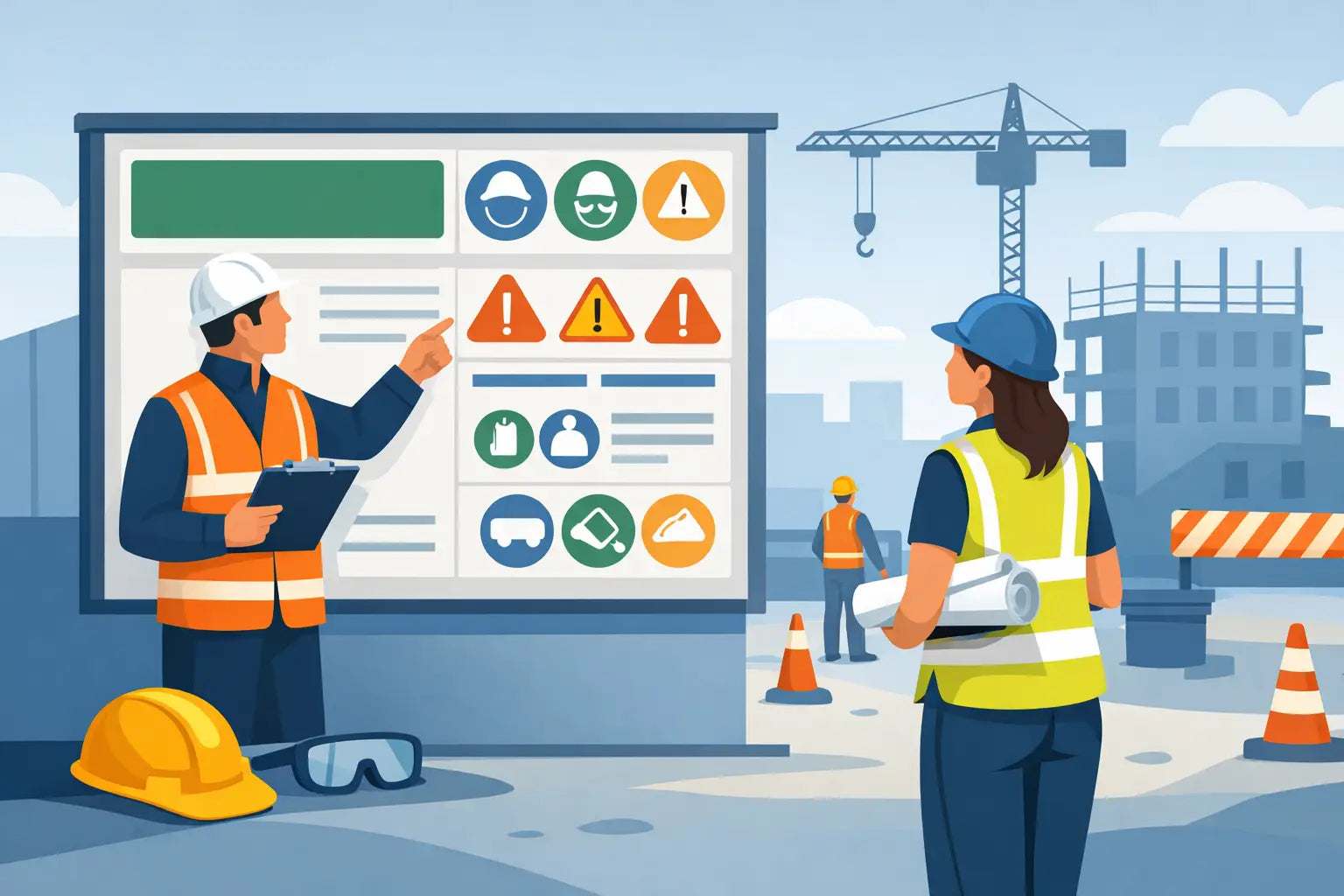
A missing contact number, an out-of-date F10 notice or a weather-damaged panel can turn a simple site entrance into a compliance problem. That is why site safety boards UK contractors and site managers use need to do more than fill a fence panel - they need to communicate clearly, stand up to the elements and reflect the way the site actually operates.
For busy construction teams, facilities managers and principal contractors, the value of a site safety board is straightforward. It brings key information together at the point where workers, visitors and inspectors expect to find it. Done properly, it helps with induction, supports legal duties and reduces the risk of mixed messages across the site.
What site safety boards UK sites typically need
On most UK construction and maintenance sites, the entrance is the natural place for a combined board. This usually includes mandatory safety messaging, site rules, PPE requirements, emergency contact details and selected statutory information. The exact content depends on the project, but the principle is the same - people should be able to understand the rules quickly, before they step into the working area.
A board might include standard messages such as "Construction Site - Keep Out", "All Visitors Must Report to Site Office" and PPE requirements covering hard hats, high-visibility clothing and safety footwear. Many sites also display first aider details, fire assembly point information and emergency numbers. Where relevant, you may also need to show the principal contractor, principal designer and project-specific notices.
The trade-off is space. If you try to place every possible instruction on one board, readability suffers. A cleaner approach is to keep the main board focused on the most important entrance information, then support it with separate signs around the site for speed limits, smoking restrictions, plant movement, fire points and restricted access areas.
Compliance matters, but context matters too
There is no single off-the-shelf layout that suits every project. A housing development, a roadworks compound, a school refurbishment and an agricultural build all have different risks, different audiences and different practical constraints. The right board is the one that matches the site's legal duties and day-to-day operation.
That said, several points come up again and again. Health and safety signage should be clear, visible and easy to interpret. If the board is positioned at the vehicle entrance but pedestrians enter elsewhere, you may need duplicate information in both locations. If a site has frequent deliveries, the board should help visiting drivers understand reporting procedures without blocking access while they stop to read it.
It also pays to think about who is actually using the information. Regular subcontractors may know the basic site rules already, but agency staff, visitors and members of the public will not. On mixed-use sites or public-facing works, the difference between internal rules and public warnings becomes especially important.
What to include on a site safety board
The best boards are practical rather than overloaded. In most cases, the core content falls into a few clear groups.
Essential site identification
At minimum, the board should make it obvious that the area is an active work site and who controls it. Site name, contractor details and reporting instructions are often the first items people look for. Where contracts involve multiple firms, clarity matters. People should not have to guess which cabin or contact applies to them.
Mandatory instructions and PPE requirements
Mandatory signs are there to remove ambiguity. If hard hats, hi-vis and boots are required, say so clearly with familiar symbols and legible text. If eye protection or hearing protection applies only in certain zones, it may be better shown on local signage rather than at the main gate. This is where accuracy matters more than quantity.
Emergency and welfare information
Emergency contacts, first aid arrangements and fire procedures should be easy to spot. If the site uses a single assembly point, place that information prominently. If arrangements vary by phase or area, the board should direct people to where updated information is posted. Out-of-date emergency details are worse than sparse information, so these sections need regular review.
Access and prohibition messages
Many boards also carry prohibition notices such as no unauthorised entry, no smoking, no mobile phones in designated areas or no children. These messages are especially useful at boundaries where workers, visitors and the public may all approach the same entrance.
Size, material and layout make a real difference
A compliant message still fails if nobody can read it. Board size should match viewing distance and the amount of content. For a small gated entrance, a compact board may be enough. For wider access points or larger projects, a bigger panel gives text and symbols room to breathe.
Material choice matters just as much. Temporary short-duration works may suit lighter solutions, but long-running external projects usually benefit from more durable board materials that resist fading, rain and site wear. If the board sits on perimeter fencing exposed to wind and passing traffic, strength and fixing method need careful thought.
Layout is often overlooked. The most important information should sit at eye level and in a sensible reading order. Crowded designs create hesitation, and hesitation is exactly what you do not want at a live entrance. Good boards guide the eye quickly - site rules first, reporting instruction next, emergency details where they can be found fast.
When a standard board is enough and when it is not
For many sites, a standard construction safety board covers the essentials efficiently. This works well when the risks are common, the entrance arrangement is straightforward and the board's purpose is to communicate broadly recognised rules. It is usually the fastest route when a site needs signage in place quickly.
Custom boards make more sense when the site has unusual hazards, branded client requirements or multiple operational messages that need combining in a controlled format. If you are managing a phased development, a rail-adjacent scheme or a public-sector refurbishment with strict visitor protocols, a tailored layout can prevent confusion. The trade-off is lead time and the need to check details carefully before print.
That is why many buyers use a mix. A standard site safety board forms the backbone, while additional signs handle specific hazards and local instructions. It keeps ordering simpler and reduces the chance of having to replace an entire board because one detail changes.
Buying site safety boards UK teams can rely on
When sourcing site safety boards UK-wide, speed matters, but so does consistency. Procurement teams and site managers are usually balancing urgent start dates, replacement needs and budget controls across one site or several. The cheapest option is not always the best value if the print fades quickly or the messaging does not match UK safety expectations.
It helps to buy from a supplier that understands how trade customers actually order signage - by application, by sector and by compliance need rather than by vague design category. Clear product descriptions, durable material options and sensible bulk pricing make repeat purchasing easier, especially for contractors managing multiple compounds or framework jobs.
A dependable supplier should also make it easy to source matching supporting signs. There is little benefit in ordering a main entrance board quickly if you then lose time chasing separate fire point signs, prohibition notices or PPE reminders elsewhere. Practical range structure saves time as much as fast dispatch does.
At The Safety Sheep Store, that is the thinking behind the range - British-made signage, clear sector categories and trade-friendly pricing designed to help buyers get the right products ordered without delay. Think Safety - Think Sheep.
Common mistakes to avoid
One of the most common mistakes is treating the board as a one-time purchase rather than a live source of information. Contact names change, fire arrangements move and project responsibilities shift. If nobody owns the update process, the board becomes background noise.
Another issue is poor positioning. A board hidden behind open gates, stacked materials or parked vans is not doing its job. The same applies to boards mounted too low, too high or at an angle that catches glare. Visibility is part of compliance, not an afterthought.
There is also a tendency to overcomplicate. A site entrance is not the place for every instruction on the job. Clear hierarchy beats volume every time. If people can grasp the key rules in seconds, the board is working.
Getting the right result first time
Before ordering, check three things. First, confirm what information must be displayed for the specific project. Second, think about where people enter and how they will read it. Third, decide what belongs on the main board and what should sit elsewhere around the site.
That small amount of planning usually prevents the costly part - reordering boards because a detail was missed, or adding a patchwork of extra signs to correct a poor layout. For site managers under pressure, the best signage decisions are the ones that keep compliance straightforward from day one.
A good site safety board does not need to be complicated. It needs to be correct, durable and easy to understand when people are arriving on site with a job to do.
Share:
Electrical Hazard Warning Signs Explained
Custom Safety Banners for Sites That Work