

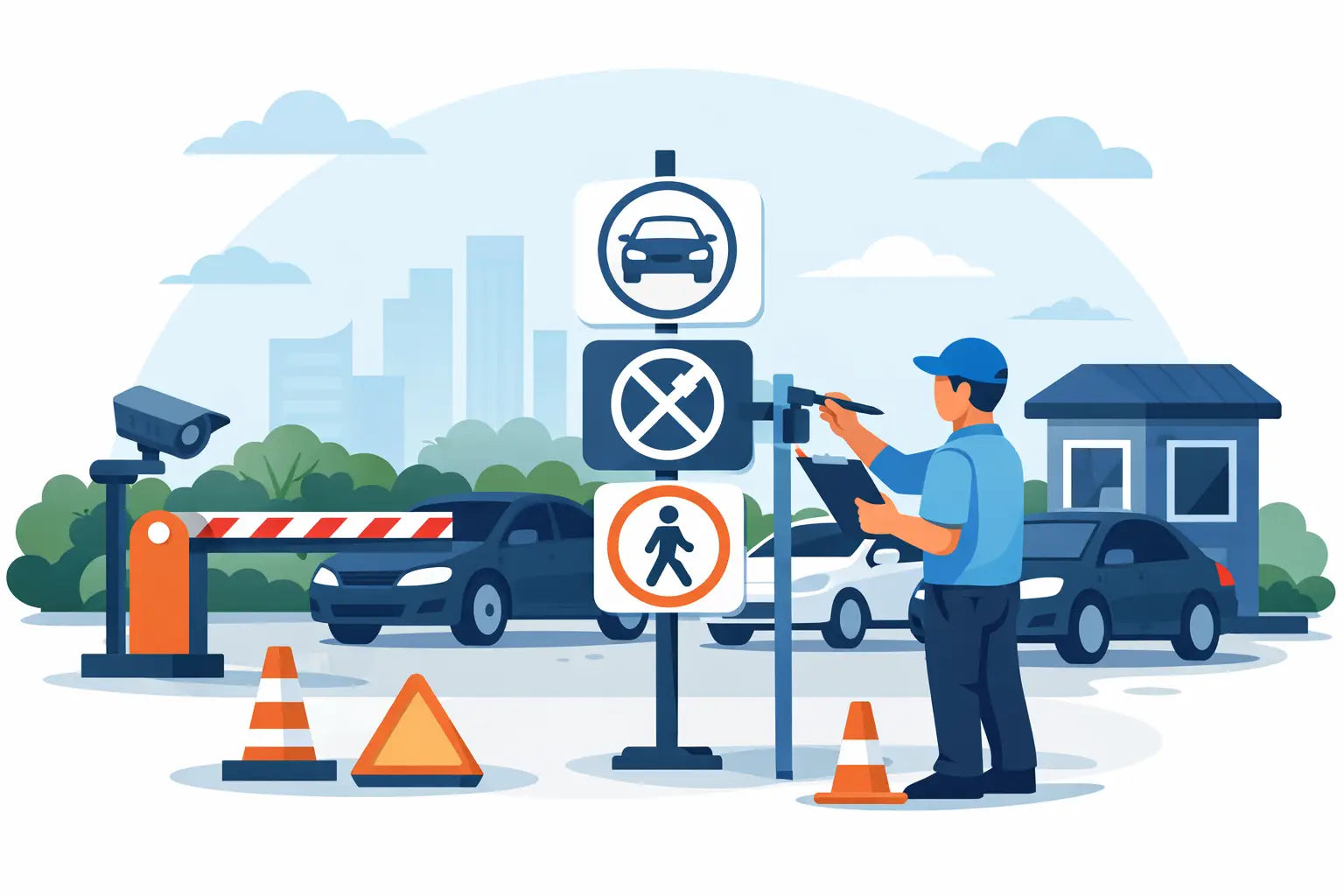
A private car park with poor signage invites the wrong kind of attention - unauthorised parking, driver disputes, blocked access, and complaints you did not need on a Monday morning. If you are working out how to sign private car parks, the aim is not simply to put a few notices on a wall. It is to make the site rules obvious, defensible and easy to follow from the moment a driver arrives.
That matters whether you manage a retail forecourt, office parking area, industrial yard, farm entrance, residential development or staff-only bay behind a unit. Good signage helps control behaviour, supports site safety and reduces the time your team spends explaining rules that should already be clear.
What private car park signage needs to do
Private car park signs have a practical job. They need to tell drivers that the land is private, who can park there, what restrictions apply and what happens if those restrictions are ignored. If the message is vague, hidden or contradictory, enforcement becomes harder and arguments become more likely.
In most cases, signage also needs to do two things at once. It must guide legitimate users quickly, while discouraging misuse without creating confusion for visitors, delivery drivers or contractors. A staff car park, for example, may need entrance signs, bay markers, permit notices and warning signs around access roads. A customer car park may need different wording, clearer time limits and more emphasis on site terms.
The right solution depends on the site. A ten-space private parking area behind a small business does not need the same sign plan as a multi-entrance commercial car park open to the public for part of the day.
How to sign private car parks for clear control
The first rule is simple: sign the car park before the driver has committed to entering or parking. Entrance signage is where most control starts. If the first notice is only visible after someone has parked, you are already on the back foot.
At the entrance, the wording should make the land status and core restriction clear. That could mean "Private Car Park", "Authorised Vehicles Only", "Permit Holders Only" or "Customer Parking Only Whilst On Premises", depending on the use of the site. If parking terms apply, they should be introduced at this point, not buried in a far corner.
Once inside the site, repeat the message where decisions happen. Drivers need to see signs near parking bays, payment points if relevant, pedestrian routes, loading areas and any restricted sections. Repetition is not overkill in car parks. It is what prevents the common excuse of "I did not see the sign".
Height and positioning matter as much as wording. A sign hidden behind a hedge, mounted too high to read from a vehicle, or placed on a gate that stays open all day is doing very little. In practice, signs should sit where a driver naturally looks when entering, slowing, turning or parking.
The wording that works best
The strongest private car park signs are plain, specific and easy to scan. Drivers are not standing still with time to read a paragraph. They are moving through the site, often watching pedestrians, reversing vehicles and bay markings at the same time.
Start with the headline message. "Private Property" or "Private Car Park" establishes control. Under that, state the actual rule - permit holders only, staff only, customers only, no overnight parking, maximum stay, no parking outside marked bays, no unloading without permission, or similar. If there are consequences for non-compliance, include them clearly and in line with the way the site is managed.
Avoid vague phrases that leave too much room for interpretation. "Unauthorised parking prohibited" is stronger when paired with a definition of who is authorised. "Parking restrictions apply" is less useful than setting out the restriction itself. The more precise the wording, the easier it is for users to understand and for site managers to rely on.
There is also a balance to strike. Overloading a sign with text can make it harder to read, even if the content is technically correct. If a site has several rules, it is often better to split them across entrance signs, area-specific notices and directional signs rather than cramming everything onto one board.
Choosing the right types of signs
Most private car parks need more than one sign category. Entrance signs establish ownership and access rules. Parking control signs set conditions for use. Bay identification signs show who can park where. Directional signs keep traffic moving safely. Warning signs cover hazards such as pedestrians, blind corners, low headroom or delivery vehicle movement.
This is where many sites fall short. They may have a large private parking notice but no disabled bay markers, no visitor parking identification and no signposting to loading or turning areas. The result is friction rather than control.
Think in layers. The first layer tells drivers what kind of car park they are entering. The second tells them where they may or may not park. The third supports safe movement around the site. On a busy mixed-use premises, that layered approach is usually far more effective than relying on one all-purpose sign.
Materials, size and visibility
A sign that fades, bends or becomes unreadable after one winter will not help much. Outdoor private car park signs should be durable enough for UK weather and suitable for the environment they are fixed to. For exposed areas, weather-resistant rigid boards are often the sensible option. Stickers and adhesive notices can work well on smooth surfaces, barriers or internal parking areas, but they are not always right for every location.
Size should match viewing distance. A small sign may be acceptable at a pedestrian gate or beside a single bay, but at an entrance used by moving vehicles it may be missed completely. If drivers need to read the sign from inside a vehicle before deciding whether to enter, it must be large enough to do that job.
Reflective finishes can also be worth considering if the car park is used early in the morning, late in the evening or in poorly lit conditions. The trade-off is cost, but in the right setting better visibility is worth it.
Common mistakes when signing private car parks
The most common failure is inconsistency. One sign says customer parking only, another refers to permit holders, and a third makes no mention of any restriction at all. Mixed messages weaken control and frustrate legitimate users.
The second is poor placement. Signs clustered at one end of the site leave too much unsaid elsewhere. Drivers should not have to hunt for the rules after parking.
The third is forgetting operational reality. A car park used by staff during the week and visitors at weekends needs signage that reflects that pattern. A rural site with agricultural traffic may need larger, more rugged signs and clearer separation between car parking and vehicle movements. A residential site may need more emphasis on trespass prevention and allocated bays.
There is also the issue of maintenance. Dirty, damaged or outdated signs can create just as many problems as having no signs at all. If your terms have changed, your signs need to change with them.
Compliance, risk and why details matter
Private car park signage is not only about convenience. It also supports risk control. Clear notices can reduce unsafe parking near fire exits, loading zones, gates, pedestrian routes and emergency access points. They can help keep disabled spaces available, prevent obstruction and make traffic flow more predictable.
If your site is public-facing, poor signage can quickly become a customer service problem. If it is staff-only or trade-focused, it can become an operational one. In either case, being able to show that restrictions were clearly signed is far better than relying on verbal instructions after the event.
That does not mean every car park needs an elaborate sign scheme. It means the signage should reflect the level of risk, traffic type and likelihood of misuse. A simple private office car park may only need clear entrance and bay signs. A busy mixed-use estate may need a more complete package with directional, warning and restriction notices working together.
A practical way to assess your site
Walk the route as a first-time driver would. Start on the approach to the entrance. Ask yourself whether it is obvious that the area is private, who can park there and where they should go next. Then check what happens once a vehicle is inside the site. Are the rules still visible at the point of parking? Are restricted areas clearly marked? Are there any places where a driver could make a genuine mistake?
It is also worth viewing the site in poor weather and lower light. Signs that seem clear on a bright afternoon can disappear in rain, shadow or winter gloom. If your car park handles visitors, contractors or shared use, clarity matters even more because those users will not already know the layout.
For buyers responsible for multiple premises, consistency helps. Using standardised wording and sign types across sites makes management easier and reduces confusion for staff and regular visitors. It can also simplify reordering when signs need replacing. That is where a specialist supplier with clear product categories, fast dispatch and trade-friendly pricing can save time as well as hassle.
Think Safety - Think Sheep. When private car park signs are clear, well placed and fit for the site, they do more than mark boundaries. They help the site run properly, which is usually the result everyone wants.
Share:
Loading Bay Signs That Keep Sites Safe
Disabled Parking Sign Rules for UK Sites