

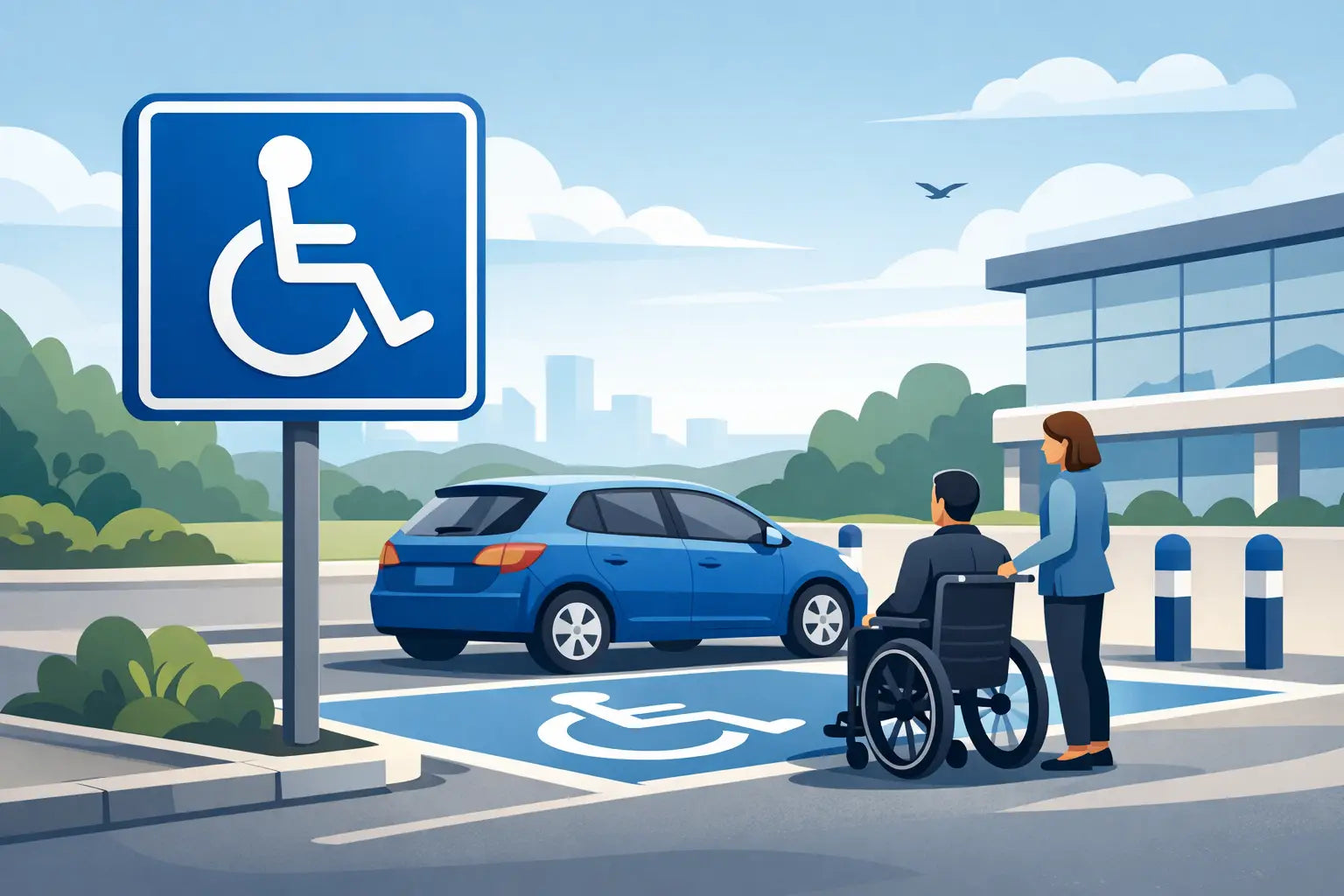
A disabled bay that is badly signed causes more trouble than most site managers expect. It leads to misuse, complaints, frustrated visitors and awkward conversations on site. Getting disabled parking sign rules right is not just about putting a badge symbol on a post. It is about making the bay easy to spot, easy to understand and suitable for the way your car park actually works.
For UK businesses, landlords, schools, farms, depots and public-facing sites, the goal is simple. Drivers need to recognise reserved accessible parking quickly and clearly, especially in busy or unfamiliar car parks. That means looking at signs, bay markings, placement and the wider layout together rather than treating the sign as a standalone item.
What disabled parking sign rules usually involve
In practical terms, disabled parking sign rules are about clear communication and suitable designation of accessible spaces. On private land, there is not one single short rulebook that covers every possible site layout. Instead, you are balancing accessibility, good practice, visibility and consistency with the rest of your parking controls.
At minimum, the sign should make it obvious that the space is reserved for disabled users. In most settings, that means using the recognised wheelchair symbol and plain wording such as Disabled Parking Only or Badge Holders Only, depending on how the site is managed. If misuse is a recurring issue, adding direct wording can help remove ambiguity.
The sign also needs to be positioned where drivers can see it before or as they enter the bay, not hidden behind a hedge, fixed too low, or lost among unrelated notices. A perfectly compliant-looking sign is far less useful if it cannot be read from a vehicle.
Signage alone is rarely enough
One common mistake is relying on a single wall-mounted sign at the far end of a parking area. In reality, accessible parking works best when upright signs and ground markings support each other. Drivers notice markings on approach, then confirm the restriction through the sign.
If you only use surface paint, markings can fade. If you only use a sign, it may be missed in poor weather, low light or a crowded car park. Using both creates a much clearer result and reduces the chances of disputes.
This matters even more on multi-use sites where visitors may not know the layout. Retail units, surgeries, schools, offices and mixed commercial premises all benefit from signage that removes guesswork. Think Safety - Think Sheep is a useful line because that is exactly the point here: clear signs prevent avoidable problems before they start.
Where signs should be placed
The best placement depends on the car park layout, but some principles are consistent. The sign should face approaching traffic or be clearly visible from the parked position. It should not sit so high that the wording becomes difficult to read, and it should not compete with a cluster of other messages on the same post unless that combination is genuinely necessary.
For a single bay, one sign directly associated with that bay is often enough if the marking is also clear on the ground. For a run of bays, you may need repeated signs so there is no doubt where the designated area begins and ends. End-of-row signage on its own can work in a small, tidy layout, but on larger sites repeated posts are usually a safer choice.
If the bay is near an entrance, dropped kerb or pedestrian route, the sign should support that route rather than obstruct it. A post set in the wrong place can become a hazard in itself. This is where off-the-shelf signage still needs site-specific thinking.
Wording matters more than many buyers realise
A symbol-only sign can be enough in some private car parks, but wording often improves compliance. Disabled Parking is clear. Disabled Parking Only is firmer. Blue Badge Holders Only may be appropriate where your site policy relies on badge display, although private land operators should still consider how that policy is applied and enforced.
The right wording depends on what you need the sign to do. If your aim is simple wayfinding, a standard disabled parking sign may be suitable. If your aim is restriction and control, stronger wording helps. If there is time-limited parking, registration requirements or enforcement in place, that information must be displayed clearly and in a way drivers can reasonably read.
Too much text can be as unhelpful as too little. A sign packed with small-print conditions may satisfy an internal policy but fail in real-world use. The clearer and shorter the core message, the better.
Bay markings and layout still matter
Accessible parking is not created by signage alone. The bay itself should be identifiable and practical to use. That usually means clear white or yellow line marking, an appropriate wheelchair symbol on the surface and enough space for vehicle access.
The exact dimensions and layout can vary depending on the site, whether it is a public car park, private business premises or a workplace parking area. What matters most is usability. If the bay is technically marked but too narrow for safe access, poor layout undermines the sign.
Access routes are part of the same picture. A disabled bay placed beside a kerb with no dropped crossing, or at the far end of a rough gravel yard, may tick a box visually without serving users properly. Signs should support access, not mask weak planning.
Temporary and permanent signs
Not every site needs the same solution. A retail park, office block or medical practice will normally need permanent, durable signage fixed to posts or walls. A construction site, agricultural setting or temporary event may need a more flexible arrangement, but the message still has to remain clear.
Temporary signs can work where parking layouts change, though they need enough weight, weather resistance and visibility to stay effective. Flimsy boards that blow over or become unreadable after rain are a false economy. On active sites, durability matters just as much as wording.
Permanent signs are generally the better choice where bays are fixed long term. They create consistency, improve appearance and reduce the need for repeated replacement. For buyers managing multiple locations, standardising sign designs across sites also helps visitors and staff recognise rules quickly.
Common issues that lead to complaints
Most parking disputes around accessible bays come down to poor clarity. The sign may be too far from the bay, the paint may be worn, or the wording may not match the site's enforcement approach. Sometimes the sign is visible only after a driver has parked, which is not much use if you are trying to prevent misuse.
Another issue is inconsistency. If one disabled bay has a post sign, surface symbol and clear border, while another has only a faded stencil, drivers will not treat them the same way. The same applies when reserved bays are mixed with parent and child spaces, permit areas and EV charging bays without clear separation.
There is also the issue of over-signing. Adding too many messages to one area can reduce rather than improve understanding. A clean, legible sign in the right place usually performs better than a cluttered post full of instructions.
Choosing the right sign for your site
For most buyers, the practical decision comes down to material, size and visibility. Outdoor car parks need signs built for weather exposure. Busy commercial sites may need more rigid materials and larger formats than small private premises. If the parking area is used in low light, reflective finishes may be worth considering.
Size should match viewing distance. A small sign near a bay can work well at close range, but if drivers need to identify the restriction while manoeuvring through a larger car park, going bigger is often the better call. It saves confusion and helps enforcement later if the restriction is obvious.
Consistency across your site is also worth considering. Matching parking control signs create a more professional look and make rules easier to follow. That matters for schools, business parks, healthcare settings and any premises where visitors arrive under time pressure.
A practical standard to aim for
If you are reviewing disabled parking sign rules for a private UK site, aim for something straightforward. Mark the bay clearly. Install an upright sign that can be read easily. Use direct wording. Place it where a driver would naturally look. Make sure the bay itself is usable, not just labelled.
That approach will not solve every parking problem, because some misuse is deliberate. But it does remove uncertainty, and that is the first step in better compliance. Clear signs support accessibility, reduce disputes and help your premises present as well-managed from the moment a visitor arrives.
When in doubt, buy signage that is easy to read, built to last and suited to the conditions on site. The cheapest sign is rarely the cheapest option once you factor in fading, repeat orders and avoidable confusion. A well-chosen accessible parking sign does a simple job, but it does it every day, in all weather, for every visitor who needs a fair and usable space.
Share:
How to Sign Private Car Parks Properly
Restricted Area Door Signs That Work