

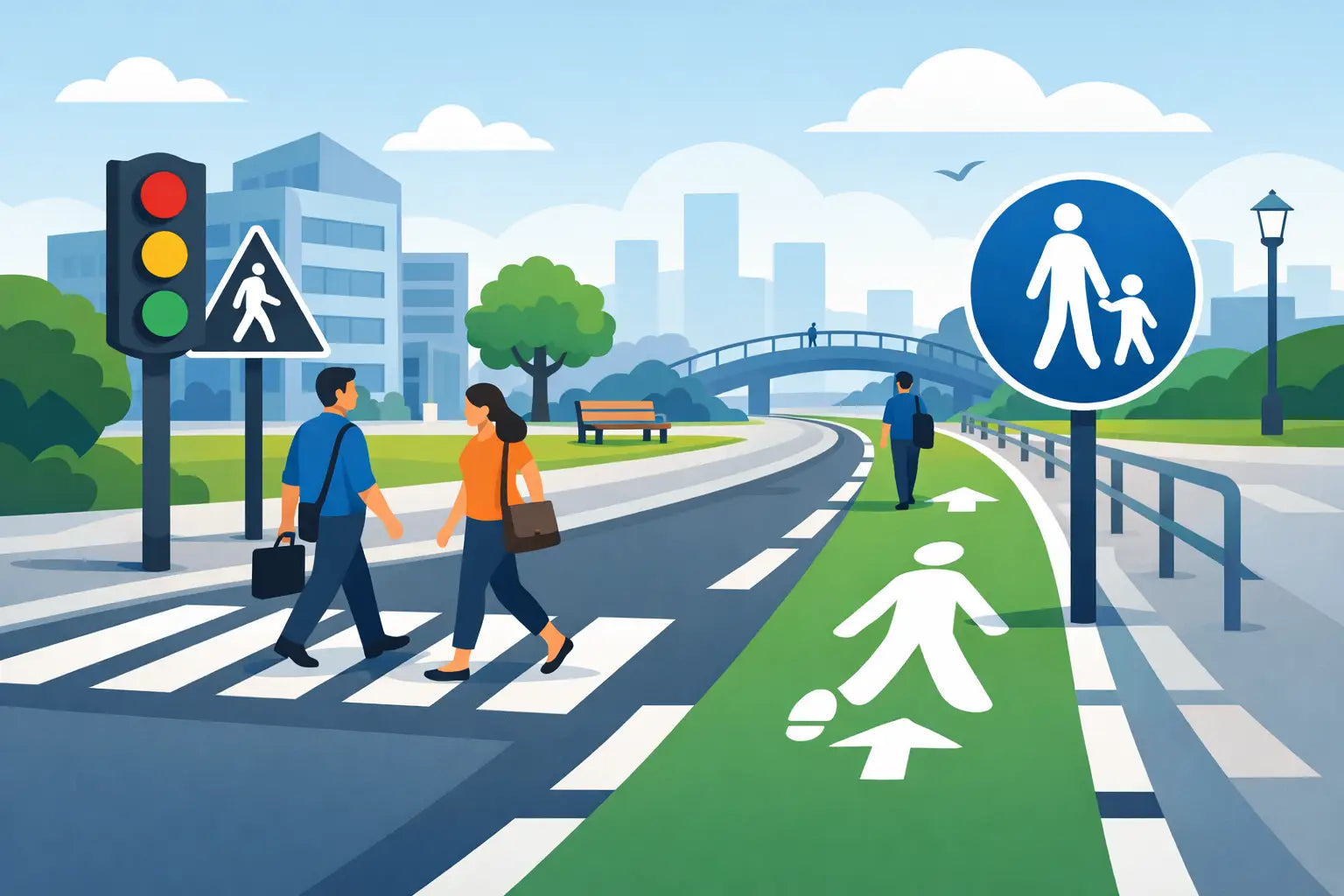
If people on your site have to guess where they should walk, the route is not marked well enough. That is the simplest way to think about how to mark pedestrian routes. Whether you manage a warehouse, construction site, farm, school, factory yard or public-facing facility, the goal is the same - separate people from vehicles, plant, hazards and confusion.
A clearly marked pedestrian route does more than tidy up a space. It helps reduce the risk of collisions, supports safer movement for staff and visitors, and shows that access has been considered properly rather than left to chance. In many workplaces, that matters both for day-to-day safety and for demonstrating a sensible approach to compliance.
Why pedestrian route marking matters
Pedestrian routes are often treated as a paint-and-signs job at the end of a project. In practice, they should be part of the traffic management plan from the start. A route that looks clear on paper can fail on site if it crosses loading areas, disappears at a doorway, or runs too close to reversing vehicles.
The risk is not limited to large industrial sites. Smaller premises can be just as exposed, especially where delivery vehicles, forklifts, customer footfall and uneven ground all meet in the same area. Farms, depots, trade counters and mixed-use yards are common examples.
Good route marking helps people make the right decision quickly. That is particularly useful for visitors, contractors and new starters who do not know the layout. A regular employee may know to avoid a certain corner when the shutter door opens. A visitor will not.
How to mark pedestrian routes in a way that works
The best approach starts with movement, not materials. Before choosing tape, paint or signs, look at how people and vehicles actually travel through the site. Watch where pedestrians naturally walk, where vehicles queue, where doors open, and where visibility is poor. The route should reflect real behaviour while improving safety, not fight against it for the sake of a neat line on the floor.
A pedestrian route should be direct enough that people will use it, but not so close to vehicle activity that it creates avoidable risk. If staff need to cross a vehicle route, make that crossing point obvious and controlled. If there is frequent forklift traffic, a painted line alone may not be enough.
In most settings, effective pedestrian route marking uses more than one control. Floor markings guide movement. Signs reinforce instruction. Barriers provide physical separation where risk is higher. This layered approach is usually more reliable than relying on a single measure.
Start with a site-specific risk assessment
There is no one-size-fits-all layout for pedestrian routes because the risks vary by environment. A retail service yard, a manufacturing line and a school access road all have different traffic patterns and user groups. The right route width, surface marking and level of segregation depend on who is walking there, what vehicles are present and how often movement occurs.
Assess pinch points, blind corners, crossing points, changes in level, poor lighting, wet areas and any places where noise may prevent people hearing approaching vehicles. Also consider whether pedestrians include members of the public, children, elderly visitors or people with reduced mobility. Those details affect what "clear" really means in practice.
Choose the right type of marking
Floor marking is usually the starting point. In internal environments, this may be line marking tape or painted walkways. In external areas, durable road-grade paint is often more suitable. The route needs to be visible in the conditions people actually face, including dust, mud, low light and heavy wear.
Colour choice should be consistent across the site. Many workplaces use green or yellow walkway markings, but consistency matters more than habit. If yellow is used for hazard zones elsewhere, make sure staff are not left decoding mixed meanings. The key is that the pedestrian route is clearly distinguishable from vehicle lanes, storage areas and exclusion zones.
Where routes change direction, cross another path or lead to an entrance, markings should stay continuous. One of the most common mistakes is a well-marked route that simply stops at the point where people most need guidance.
Use signs to remove doubt
Signs support route markings by making the instruction explicit. A painted line may suggest a walkway. A pedestrian walkway sign confirms it. Where drivers operate nearby, signs warning of pedestrian routes or crossing points help both sides of the traffic plan.
This is especially useful in shared environments or on temporary sites where layouts can change. Signs at entry points, junctions and crossing areas help visitors understand the system before they step into it. If access is restricted, prohibition signs and access control notices may also be needed.
For many sites, the practical answer is not floor marking or signage, but both. Think Safety - Think Sheep.
When paint is not enough
Some routes need physical protection. If pedestrians are walking beside forklifts, telehandlers, LGVs or reversing vehicles, a line on the ground may offer very little real-world separation. In those cases, barriers, guard rails, bollards or pedestrian gates can make the route far safer.
This is where commercial judgement matters. Physical segregation costs more upfront and takes planning, but the trade-off is stronger control in higher-risk areas. If your route runs through a busy loading bay or haul road crossing, it is usually money well spent.
Temporary barriers may also be useful during works, peak delivery periods or seasonal changes in site layout. The route should still be obvious when operations are under pressure, not only when the site is quiet and tidy.
How to mark pedestrian routes for different environments
The same principle applies across sectors, but the detail changes.
In warehouses and factories, pedestrian routes often need strong floor markings, crossing points, one-way systems and clear separation from MHE traffic. Durability matters because markings can wear quickly under constant use.
On construction sites, routes may be temporary, uneven and affected by changing work phases. Here, portable signage, temporary barriers and regular review are just as important as the original layout. A safe route on Monday may be blocked by materials by Thursday.
On farms and estates, the challenge is often mixed traffic and outdoor conditions. Mud, weather and mobile plant can reduce visibility fast, so signs and markings need to be suitable for exposed environments.
In schools, healthcare settings and public buildings, clarity for unfamiliar users is crucial. Routes should be intuitive, visible and accessible, with crossings and entrances marked in a way that does not rely on local knowledge.
Common mistakes that weaken pedestrian safety
The biggest problem is usually inconsistency. A route may be clearly marked in one area and then fade out near a loading bay, doorway or car park edge. Once people stop trusting the route, they start making their own choices.
Another common issue is poor maintenance. Worn paint, damaged signs and barriers used as storage points all reduce the effectiveness of the system. Marking a pedestrian route is not a one-off task. It needs inspection and upkeep, especially in high-traffic environments.
There is also the question of realism. If the designated route adds unnecessary distance or cuts through unpleasant ground conditions, people may ignore it. A compliant-looking layout that nobody uses is not a successful one.
Finally, avoid assuming that staff know what markings mean without reinforcement. Briefing, induction and refreshers all help. Route marking works best when the physical layout and the site rules tell the same story.
Practical checks before you sign off a route
Before treating the job as done, walk the route yourself at working pace. Then do it again as a first-time visitor might. Is the path obvious from every approach? Are crossing points clear? Can a driver see pedestrians in time? Does the route remain usable in rain, low light or when deliveries are being unloaded?
It is also worth checking line of sight from cab height where vehicles operate regularly. What seems visible on foot can disappear completely from a forklift or lorry.
If you run multiple sites, standardising colours, sign types and route logic can save time and reduce confusion. Procurement teams and facilities managers often benefit from using consistent products across locations, especially when replacements are needed quickly or bulk buying is more cost-effective.
Keeping routes compliant and usable over time
Once a route is in place, review it whenever traffic patterns, building access, staffing levels or site activities change. New machinery, temporary storage, seasonal demand or contractor activity can all create new conflicts.
Routine inspections should include floor marking condition, sign visibility, barrier integrity and any evidence that pedestrians are bypassing the intended route. If people are stepping outside the system, treat that as useful information rather than simple non-compliance. Often it means the route no longer matches the way the site operates.
Marking pedestrian routes properly is not about adding more signage than necessary. It is about giving people a clear, credible and well-maintained path through the site. When the route is easy to follow and supported by the right signs and separation, safer movement becomes the default rather than something you have to enforce at every turn.
Share:
First Aid Room Signs That Get Noticed
Mandatory Signs vs Prohibition Signs