

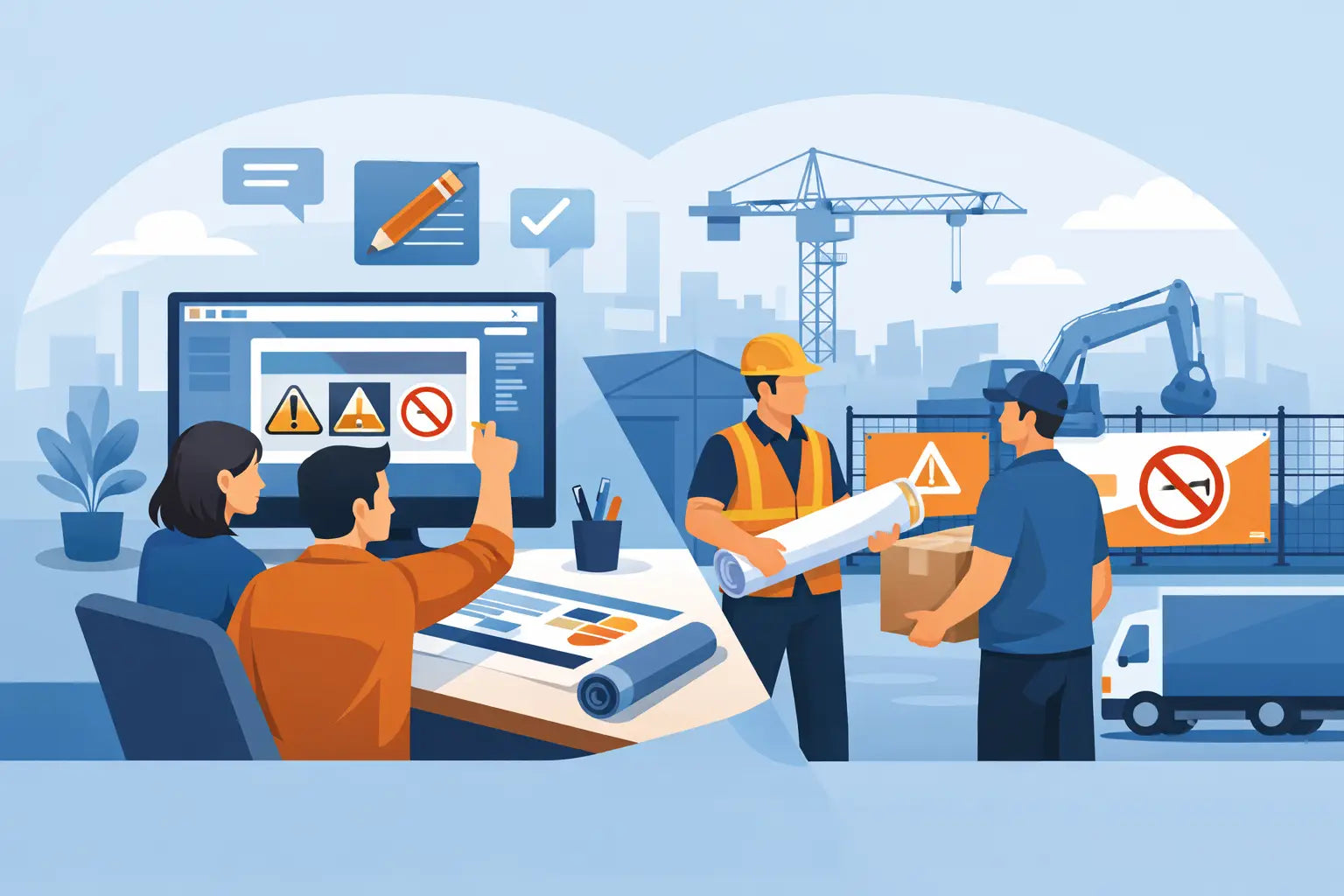
A missing or poorly chosen banner is usually spotted at the worst possible moment - when a principal contractor visits, when the public can see straight onto site, or when your team needs clear rules displayed before work starts. If you are working out how to order site safety banners, the fastest route is to treat it as a compliance and communication job first, and a print job second.
Site safety banners do more than fill fence lines. They set expectations, reinforce key rules and help show that a site is being managed properly. On construction projects, temporary compounds, infrastructure works and public-facing developments, the right banner can cover essential instructions at a glance, from PPE requirements and visitor controls to warning messages and contractor branding.
How to order site safety banners without wasting time
The simplest way to order well is to decide three things before you look at products: what message the banner needs to carry, where it will be fixed, and who needs to read it. Buyers often start with size or price, but that can lead to ordering something that looks right online and works badly on site.
A banner on perimeter fencing facing a public pavement needs different wording from one fixed near the welfare unit or site entrance. Public-facing banners usually need to be short, highly visible and easy to read from a distance. Internal site banners can be more specific because the audience is closer and already expects operational instructions.
It also helps to think about whether you need one banner or a set. Many sites need more than a single all-purpose message. One banner may cover site safety rules, another may direct deliveries, and another may warn against unauthorised entry. Ordering them together is often quicker and more cost-effective, especially if you are buying for multiple compounds or phases.
Start with the message, not the material
Before placing any order, confirm exactly what the banner needs to say. In practice, most site buyers fall into one of three groups. They either need a standard health and safety banner, a branded site banner with safety messaging, or a more specific banner for access control, PPE, hazards or public information.
Standard messages are the quickest option because the wording is already proven, familiar and easy to approve internally. If your requirement is straightforward, such as "Site Safety", "PPE Must Be Worn" or "Construction Site Keep Out", a stock design is normally the fastest route.
Branded banners are useful where presentation matters as much as compliance. Housebuilders, developers, principal contractors and public projects often want site rules displayed alongside company identity. That can improve visibility and make a site look better managed, but it usually means checking artwork, logo quality and proofing before dispatch. If time is tight, that extra step matters.
More detailed banners can be worthwhile where one display needs to do several jobs. For example, a site entrance banner may combine visitor instructions, mandatory PPE symbols, delivery directions and emergency contact details. The trade-off is readability. The more information added, the more care you need over size and viewing distance.
Choosing the right size and layout
Size should be driven by where the banner sits and how far away it will be read from. A compact banner may be enough for a pedestrian gate or internal fenced area. A larger format is usually better for perimeter fencing, vehicle entrances and open compounds where drivers or members of the public need to read it at speed.
If the banner is too small, the wording will be lost. If it is too large for the fixing area, it can crease, sag or become awkward to install. Measure the available fence panel, gate or hoarding section before ordering. That sounds obvious, but it is one of the most common causes of returns and rushed reorders.
Layout matters as much as dimensions. Short, high-contrast wording tends to work best outdoors. A banner packed with text may technically include everything you want, but if nobody can read it from five or ten metres away, it is not doing the job. For most sites, fewer words and clearer symbols are the safer choice.
Think about viewing conditions
Outdoor banners deal with poor weather, uneven light and moving audiences. Drivers approaching a gate, operatives walking in with kit, or passers-by glancing from the pavement all read differently. If a message must be understood quickly, keep it direct and avoid cramming in secondary detail.
Colour contrast is part of that decision. Safety-led designs usually perform best because they use familiar hazard colours and recognisable symbols. That helps with instant recognition, especially on busy sites where visual clutter is already a problem.
Material, durability and fixing points
When buyers ask how to order site safety banners, they often focus on wording and overlook durability. A banner that tears after a short spell of wind and rain is not good value, however sharp the price looked at checkout.
For most UK sites, you need banner material suitable for outdoor use, with proper hems and eyelets for secure fixing. This is particularly important on Heras fencing, scaffold areas and exposed perimeter runs. A banner fixed badly or made from poor material can become damaged quickly, and in some conditions it can create its own hazard.
Check the likely lifespan of the site as well. A short-term project may only need a standard temporary banner. A longer project, or one in a very exposed location, may justify a more durable option. It depends on weather exposure, site traffic and how often the banner may need to be moved or refixed.
Fixing points should never be an afterthought. Make sure the banner you order is prepared for practical installation on the surface you are using. If your team is fitting to mesh fencing, gates or timber hoarding, confirm the fixing method in advance so the banner arrives ready for use rather than needing adaptation on site.
Compliance and site-specific checks before you buy
A banner is not a substitute for a full site induction or detailed safety system, but it does play a visible part in compliance. That means the wording should match actual site rules. Do not order generic PPE messaging if hard hats are not required in that area, and do not display site times, contact numbers or access instructions that may change next week.
This matters even more on multi-contractor sites. If the principal contractor has set standard entrance signage, your banners need to support that approach rather than conflict with it. Procurement teams and site managers should check wording with whoever controls the site rules before ordering in volume.
If you are buying across multiple locations, consistency helps. Standardising banner wording and formats makes roll-out easier, but there can still be local differences around access points, emergency contacts and public interface. That is where a mix of standard banners and selected site-specific versions often works best.
Ordering in bulk for one site or many
If you manage several projects, order planning can save time as well as money. Buyers who order banner-by-banner often end up duplicating freight, repeating approval steps and missing bulk discounts. Grouping requirements by site type, contractor package or region usually produces a smoother process.
Bulk buying is particularly useful when you need repeat messages across multiple compounds, farms, depots or managed properties. It also helps maintain a more professional standard across your estate. The key is to separate what is universal from what is local. Universal messages can be ordered in higher volume, while site-specific banners can be added in smaller quantities.
For trade buyers, service matters here just as much as unit price. Fast dispatch, dependable stock availability and clear support can make more difference than shaving a small amount off each banner. A delayed or unsuitable order can hold up site set-up, and that costs more than the saving.
What to check on the product page
When you are ready to buy, the product page should answer the practical questions quickly. Look for clear dimensions, material details, fixing information, suitability for outdoor use and whether the design is standard or customised. If you are ordering a branded banner, confirm artwork requirements and proofing times before checkout.
It is also worth checking dispatch information properly rather than assuming all banners ship at the same speed. Stock safety banners may be ready quickly, while bespoke designs naturally take longer. If the site opening date is fixed, build in enough time for approval and delivery.
UK-made banners can be especially useful where lead times, quality control and consistency matter. For many commercial buyers, domestic supply is not just a preference. It reduces uncertainty when projects are moving quickly and replacement stock may be needed at short notice.
When a custom banner is the better option
A custom banner is usually the right choice when a standard message cannot cover the real site requirement. That might be because the project has specific client branding, public liaison details, delivery instructions or a combination of mandatory rules that need to appear together.
The mistake is customising for the sake of it. Bespoke banners are most effective when they solve a clear operational problem, not when they simply add more text or visual clutter. If a stock banner communicates the rule cleanly, it may still be the better buy.
For buyers under pressure, simplicity usually wins. A clear, durable, correctly sized banner ordered from a dependable supplier will do more for site presentation and safety than an overcomplicated design approved too late.
If you want the process to stay straightforward, define the message, measure the location, check the fixing method and order with the real site conditions in mind. Think Safety - Think Sheep.
Share:
Site Entrance Safety Signage That Works
How to Choose Safety Signs for Your Site