

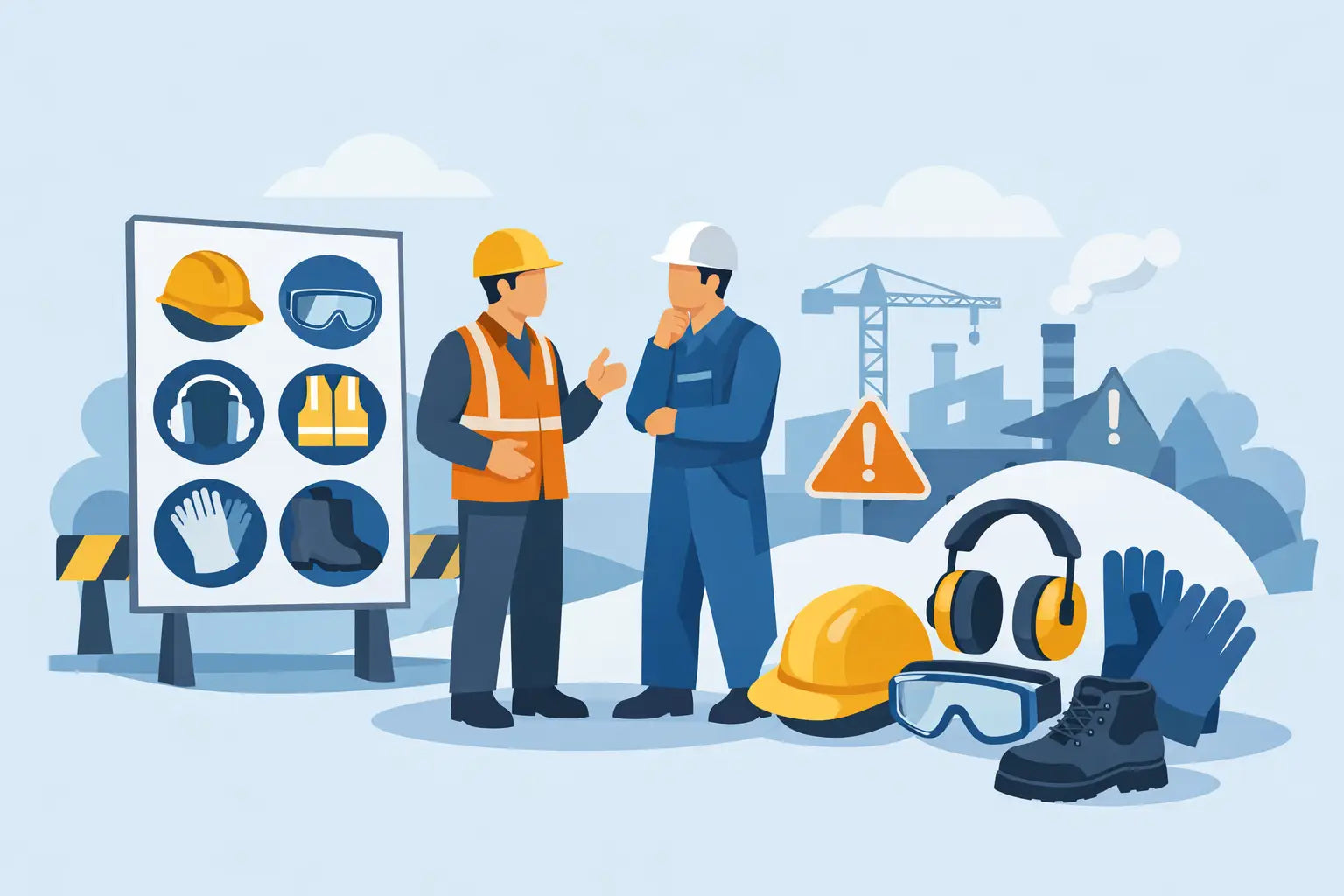
A site entrance with hard hats stacked nearby is not enough. If staff, contractors or visitors need personal protective equipment to enter or carry out a task, the expectation should be made clear before they step into the risk. That is usually where the question comes up: when are PPE signs required, and what does a business actually need to display to stay compliant?
In UK workplaces, PPE signs are required where a risk assessment shows that personal protective equipment must be worn to control a remaining risk, and that requirement needs to be clearly communicated. The sign is not a substitute for the assessment, training or supply of suitable PPE. It is part of the control measure, helping employers make the rule obvious, consistent and enforceable.
When are PPE signs required in the UK?
The short answer is that PPE signs are required when there is a specific need to warn or instruct people to wear protective equipment in a particular area or for a particular activity. In practice, that usually follows a risk assessment under the Health and Safety at Work framework and the Personal Protective Equipment at Work Regulations.
If a hazard cannot be adequately controlled by other means, such as guarding, extraction, isolation or changes to the task, PPE may be necessary. Once that requirement exists, signage becomes an important way to communicate it. A mandatory sign tells people what they must do, not what they might want to consider.
This matters most in workplaces where different people move through the same environment. A regular employee may already know that eye protection is needed in a grinding bay, but a visiting engineer, delivery driver or subcontractor may not. Signs help close that gap quickly.
PPE signage is tied to risk assessment, not guesswork
One of the most common mistakes is treating PPE signage as a general safety extra. It is more specific than that. You do not put up a wear gloves sign simply because gloves are available on site. You put it up because the task or area creates a hazard that requires hand protection.
That means the starting point is always the risk assessment. If the assessment identifies exposure to flying particles, chemical splashes, falling objects, loud noise, respiratory hazards or foot injury risks, PPE may be part of the control. Where that requirement applies to an area, entrance point or task zone, a clear mandatory sign is usually appropriate.
There is also a practical angle. If your site rules depend on PPE, signage helps supervisors enforce them consistently. It is difficult to challenge non-compliance if the requirement is only passed on verbally or buried in induction notes.
What the signs should communicate
PPE signs are mandatory safety signs. In most cases, that means the familiar blue circle with a white symbol showing the equipment that must be worn. The purpose is simple: to give a direct instruction that can be understood at a glance.
The sign should match the actual requirement. If safety helmets, hearing protection and hi-vis clothing are all compulsory in one area, the signage should reflect that. Some sites use combined mandatory signs to show multiple PPE requirements together, while others use separate signs depending on space and layout.
Clarity matters more than volume. Too many signs in one place can reduce impact, especially on busy industrial sites. The better approach is to place the right instruction where someone makes the decision to enter, operate or pass through.
Common workplaces where PPE signs are required
Construction sites are the most obvious example. Hard hats, high-visibility clothing, safety footwear and eye protection are often mandatory either site-wide or in defined zones. Entrance signage is essential, but so is local signage around cutting, lifting, demolition and access areas.
In factories and workshops, PPE signs are often needed near machinery, fabrication bays, welding stations, paint areas, chemical stores and loading points. A blanket sign at reception will not always cover those task-specific risks.
Agricultural sites also need careful thought. Farms combine vehicle movement, chemicals, livestock, machinery and outdoor work, which means PPE requirements can vary sharply from one area to another. A pesticide handling area may need gloves, eye protection and respiratory protection signage, while a workshop may call for hearing and foot protection.
Food production, warehousing, utilities, laboratories and maintenance environments all have similar issues. The exact sign depends on the hazard, but the principle stays the same: where PPE is compulsory, the instruction should be visible and easy to understand.
When a PPE sign on its own is not enough
A sign is a reminder and instruction, not the whole safety system. If a business relies on signage without supplying the correct PPE, training staff, maintaining equipment or reviewing the risks, it is missing the point.
This is especially relevant where the PPE requirement is not obvious. Respiratory protection, face fit considerations, chemical gloves and hearing protection zones all need more than a symbol on a wall. People must know what standard of equipment to use, how to wear it and when to replace it.
There are also situations where a sign may need supporting wording. For example, a simple wear eye protection sign may not be enough if only specific eyewear is suitable for a chemical process. In that case, supplementary text can help make the instruction more precise.
Placement matters as much as the sign itself
Even compliant signage fails if nobody sees it in time. PPE signs should be placed where the instruction becomes relevant, usually before entry into the hazard area or at the point where the task starts.
For site entrances, the sign needs to be visible enough that visitors and contractors can act before proceeding. For internal work areas, it should sit at eye level where practical and not be obscured by doors, stock, equipment or temporary barriers. If traffic routes change regularly, as they often do on building sites and in yards, the signage may need to move with the risk.
Lighting, weather exposure and durability also matter. A faded sign at the gate or a damaged board in a workshop does not communicate much. For outdoor and high-traffic areas, hard-wearing materials are usually the sensible choice.
Are PPE signs legally required in every case?
Not every use of PPE automatically means a sign is legally needed in every corner of a workplace. The test is whether a safety sign is necessary to communicate the precaution clearly and effectively. In many real-world settings, the answer is yes, especially where there are changing personnel, visitors, contractors or multiple hazard zones.
A single operative carrying out a short, controlled task under direct supervision may not need permanent signage in the same way a shared workshop or active construction site does. That is where judgment comes in. The law expects employers to assess the risk and communicate precautions properly. Signage is often the most practical and defensible way to do that.
So the answer to when are PPE signs required is not simply always or never. It depends on the residual risk, the environment, who is exposed and whether the requirement needs to be reinforced visually. On most commercial and industrial sites, that threshold is reached fairly quickly.
Common compliance gaps to avoid
The biggest gap is using outdated or generic signage that no longer reflects the job. If the process changes, the PPE signs should be reviewed too. A workshop that once required only eye protection may now need hearing protection after new machinery is installed.
Another issue is inconsistency. If induction paperwork says one thing, supervisors say another and signage shows something else, compliance becomes hard to manage. Standardising the message across the site saves time and reduces disputes.
It is also worth checking whether signs are positioned for everyone who needs them. A notice aimed at staff may miss delivery drivers entering through a different gate, or contractors using a side access point. Procurement teams and site managers often spot this only after an audit or near miss.
Choosing the right PPE signs for your site
The right sign is the one that matches the actual requirement, fits the location and remains legible in day-to-day conditions. For one site, that may mean a simple mandatory helmet sign at a gate. For another, it may mean a multi-message board covering hard hats, boots, hi-vis and visitor instructions in one place.
If you manage several premises, consistency helps. Using the same sign style, wording and placement approach across locations makes expectations easier to enforce and easier for teams to recognise. It also speeds up replacement orders when signs are damaged or site rules change.
For buyers under time pressure, the simplest route is usually to match signs to the specific hazard zones identified in your risk assessment and then check entrance points, task areas and contractor access routes one by one. Think Safety - Think Sheep, but think placement and relevance first.
If you are unsure whether a PPE sign is necessary, ask a practical question: would someone unfamiliar with this area know what they must wear before they are exposed to the risk? If the answer is no, the sign probably belongs there.
Share:
How to Label Fire Doors Properly
CCTV Warning Signs: What You Need to Know