

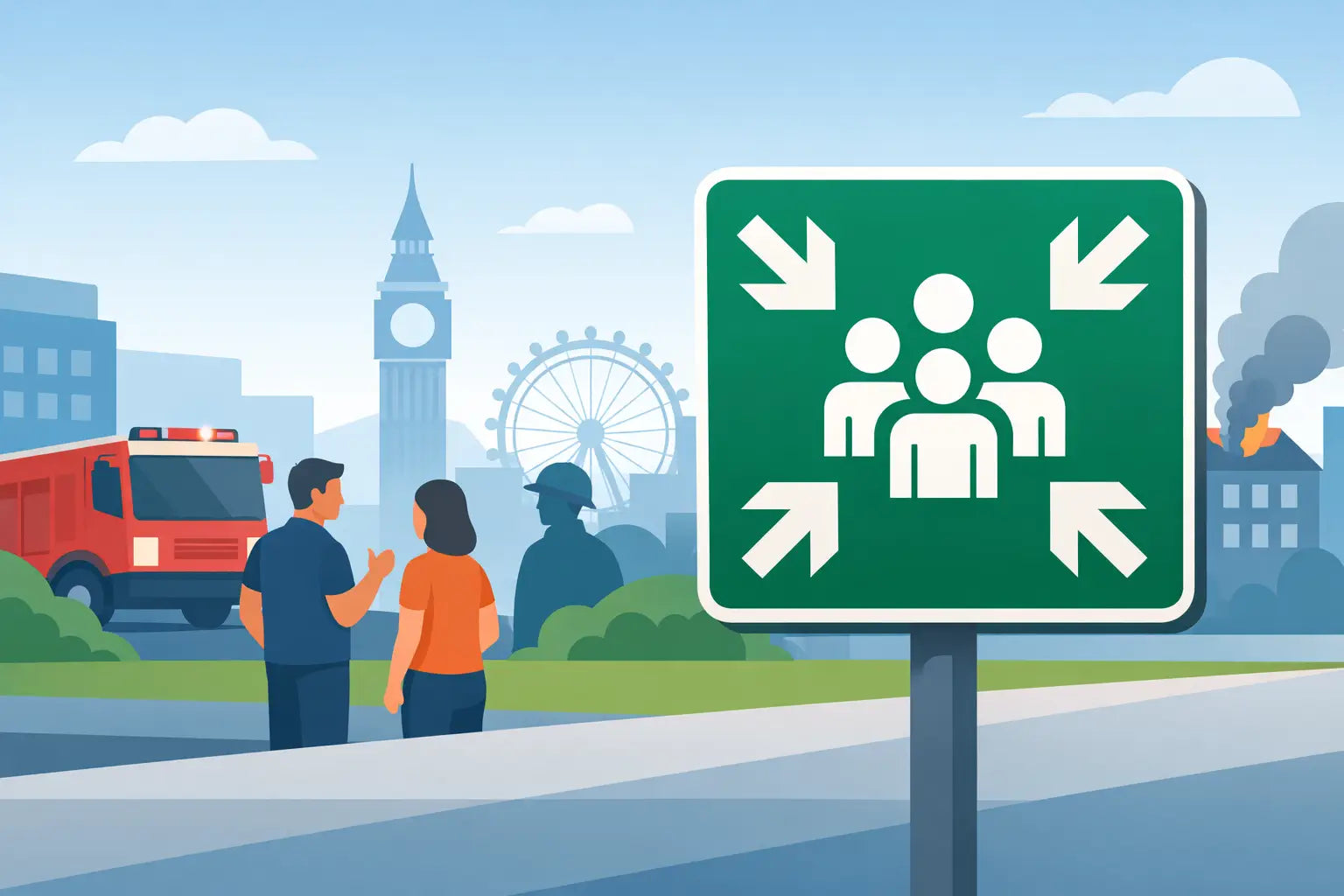
What is a fire assembly point sign? It is a green safe-condition sign used to identify the designated place where people should gather after evacuating a building or work area during a fire alarm or other emergency. It gives staff, visitors and contractors a clear destination once they are safely outside, helping the responsible person confirm that everyone is accounted for.
On a busy construction site, industrial estate, school, farm or office premises, people may leave through different exits and approach from different directions. A properly positioned assembly point sign reduces uncertainty at exactly the moment when instructions need to be quick and easy to follow.
What is a fire assembly point sign used for?
A fire assembly point sign marks the location of the evacuation assembly point, sometimes called a muster point. The recognised symbol usually shows a group of people surrounded by arrows pointing towards the centre. Its green background and white pictogram identify it as a safe-condition sign, rather than a warning, prohibition or mandatory instruction sign.
The sign is not a replacement for a fire evacuation plan, a fire action notice or staff training. It is one part of a wider fire safety arrangement. The evacuation plan explains how people leave the premises; fire exit signs show the route; fire action notices tell occupants what to do; and the assembly point sign tells them where to report once outside.
This distinction matters. A sign placed beside an exit door does not automatically create a suitable assembly point. The chosen location needs to be safe, practical and known to the people responsible for taking a roll call.
Why the assembly point matters during an evacuation
When the alarm sounds, the priority is to get people out safely without delay. Once outside, an unmanaged crowd can create further problems. People may stand close to doors, block appliance access, wander to car parks or return to the building to look for colleagues.
A clear assembly point gives fire marshals or nominated staff a fixed place to check attendance. This helps them identify whether anyone may still be inside and pass relevant information to the fire and rescue service. It also keeps evacuees away from the immediate danger area and from emergency vehicle routes.
For organisations with visitors, agency workers or multiple contractors, visible signage is particularly useful. These people may not know the site layout or have attended a full induction. A familiar, standards-based symbol can be understood more quickly than a written instruction alone.
Is a fire assembly point sign a legal requirement?
Whether a specific assembly point sign is required depends on the premises, the findings of the fire risk assessment and the fire emergency plan. UK fire safety legislation requires responsible persons and employers to take suitable precautions, including providing safety signs where they are needed to protect people.
In practice, where your evacuation procedure directs people to gather at a defined location, marking it with a clear sign is usually a sensible and proportionate measure. It supports the instruction given in fire action notices, inductions and emergency drills.
The sign should not be treated as a compliance tick-box. A poorly chosen assembly area can still be unsafe, even if it has a highly visible sign. Review the whole arrangement: the routes out, the people using the site, vehicle movements, possible fire spread, accessibility and how attendance will be checked.
Different rules and enforcement arrangements apply across England, Wales, Scotland and Northern Ireland. If there is any doubt about what is suitable for your premises, seek competent fire safety advice and keep the decision recorded within the fire risk assessment.
What should a compliant assembly point sign look like?
For workplaces and commercial premises, a recognised graphical symbol is generally the clearest choice. The common evacuation assembly point symbol is set out in BS EN ISO 7010 as symbol E007. It uses a white pictogram on a green square or rectangle, with arrows converging on a group of people.
Using a familiar symbol helps create consistency across sites, particularly for national contractors, facilities teams and organisations that regularly host visitors. It also avoids the ambiguity of improvised wording such as Meeting Area or Gather Here, which may be misunderstood or mistaken for a general meeting location.
Text can be useful as a supplement, especially when there are multiple assembly points. For example, the sign may identify Assembly Point A or Assembly Point B. However, the wording should support the symbol rather than make the sign unnecessarily cluttered.
Choosing the right location for an assembly point
The safest location is not always the nearest open space. It must allow people to gather without placing them in the path of smoke, flames, traffic or emergency responders. It should be far enough from the building to avoid immediate danger, while still being close enough for evacuees to reach without crossing hazardous roads or dispersing across a large site.
Consider wind direction where there is a risk of smoke or airborne contaminants, especially on industrial and agricultural premises. On construction sites, the location may need reviewing as the works progress, access routes change and temporary buildings move. A fixed sign pointing people towards an area that no longer exists can cause real confusion.
A suitable assembly point should also leave access clear for fire appliances. Avoid narrow gateways, delivery yards, lorry turning areas, fuel storage zones and entrances likely to be used by emergency services.
If one location cannot safely accommodate everyone, use more than one assembly point and make the allocation clear. This can work well on large offices, schools, warehouses and multi-occupancy sites, but only if the evacuation plan states who should go where and staff understand the arrangement.
Selecting a sign for your premises
The right sign depends on how and where it will be used. A temporary indoor notice may only need lightweight material, while a permanent external assembly point needs a durable solution that remains legible in changing weather and site conditions.
When ordering, check these practical points:
- Visibility: Choose a size that can be read from a sensible distance, taking account of vehicle movements, fencing, pedestrian routes and obstructions.
- Material: For outdoor areas, use weather-resistant materials suited to rain, sunlight and regular cleaning. Rigid boards are often appropriate for posts, walls and perimeter fencing.
- Fixing method: Ensure the sign can be securely fixed to a stable surface at a height people can easily see. Avoid temporary cable ties where they are likely to fail or create a poor impression.
- Site identification: Where multiple points are used, include simple identifiers that match fire action notices, plans and roll-call records.
Where should the sign be installed?
Install the sign at the actual gathering location, where it can be seen by people approaching from the normal evacuation routes. In many cases, this means mounting it on a post, wall, fence or other fixed feature at the edge of the assembly area rather than directly in the middle of it.
Do not place it where people must stand beneath a potential falling hazard, close to stored materials or in a location obscured by parked vehicles. Check it from the perspective of someone leaving through each fire exit, not just from the viewpoint of the person installing it.
Lighting also matters. If evacuations could occur during dark hours, poor weather or reduced visibility, consider whether the assembly area and sign remain identifiable. The answer may involve improved external lighting, a larger sign or a reviewed location, depending on the risk assessment.
Common mistakes to avoid
One common error is positioning the assembly point too close to the building. Another is using the staff smoking area or a convenient car park corner without considering smoke movement, delivery traffic and emergency access.
Conflicting information causes problems too. If a fire action notice says Assembly Point A but the sign states Assembly Point 1, people may waste time trying to work out whether these are the same location. Keep terminology consistent across notices, site plans, induction materials and drill records.
Finally, do not let the sign become invisible through poor maintenance. Faded graphics, damaged boards, overgrown vegetation and temporary site hoardings can all undermine an otherwise sound evacuation plan. Include fire assembly point signs in routine workplace inspections, particularly after building works, seasonal changes or site reorganisation.
A clearly marked assembly point gives an evacuation plan a practical finish line. Choose the location with care, use a recognised sign that people can spot quickly, and make sure your team knows what happens once they get there. Think Safety - Think Sheep.
Share:
Workplace Door Identification Signs That Work
Battery Charging Area Signs for Safer Sites