

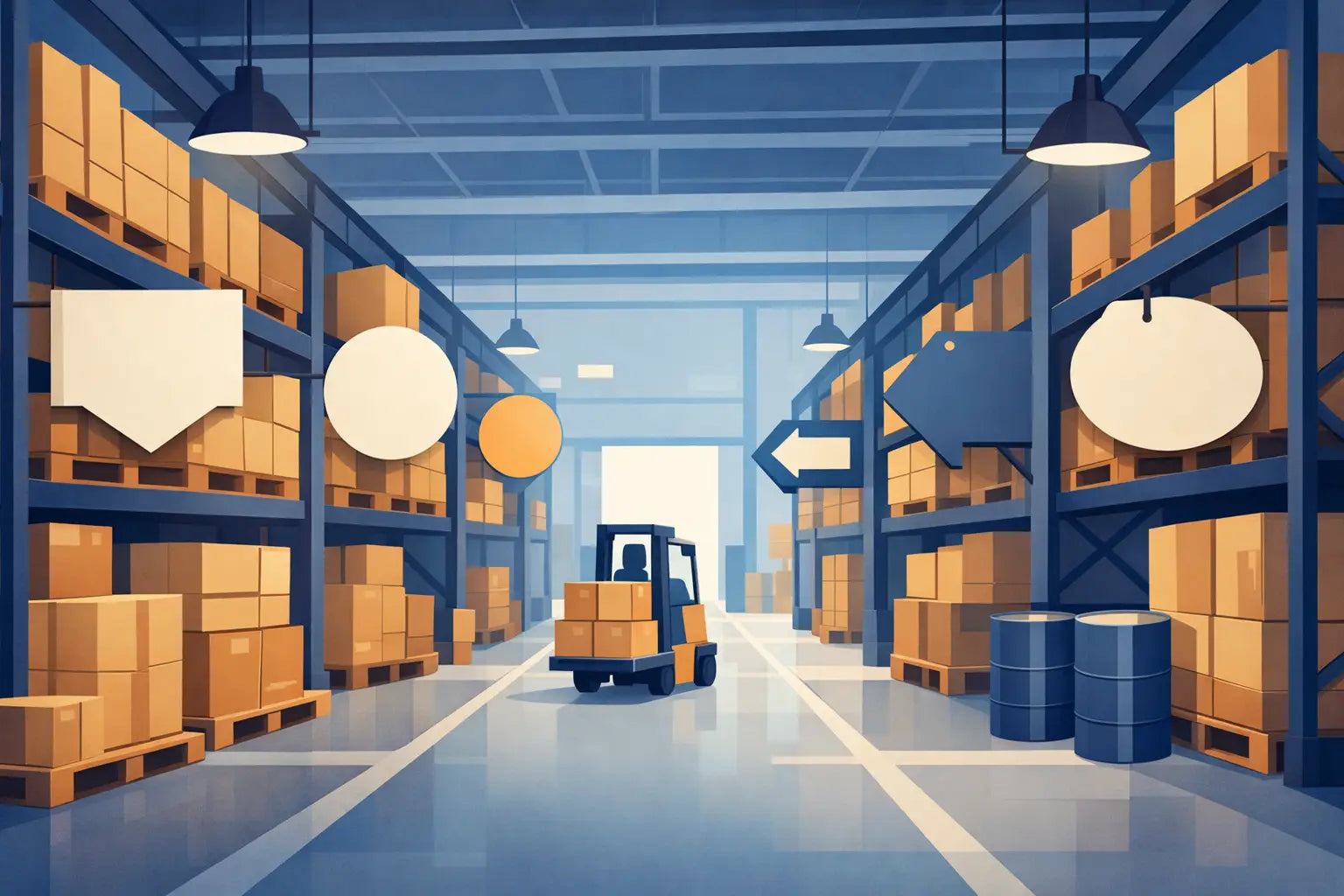
A picker loses two minutes hunting for Aisle 14, a forklift pauses at a junction because bay numbers are hard to read, and a delivery is booked out late. That is usually where warehouse aisle marker signs stop being a nice-to-have and become part of day-to-day operational control. In busy warehouses, stockrooms and distribution spaces, clear aisle identification supports safer movement, faster picking and fewer avoidable mistakes.
The best signs do a simple job well. They tell people exactly where they are, what sits in that zone and how to move through the space without hesitation. That matters whether you run a compact trade warehouse with a few rows of pallet racking or a larger facility handling multiple product lines, returns and outbound loads.
Why warehouse aisle marker signs matter
Aisle markers are often treated as basic wayfinding, but their value runs deeper than that. When staff, agency workers, drivers and visiting contractors can identify aisle locations quickly, the whole site works more smoothly. Picking routes become more efficient, training is easier, and incident risk can be reduced where pedestrian and vehicle movement depend on clear navigation.
There is also a compliance and housekeeping angle. While aisle marker signs are not a substitute for a full site safety system, they support orderly storage areas and help reinforce a workplace that is clearly managed. For facilities managers and health and safety teams, that visual control is useful. It shows that zones, routes and storage areas are defined rather than left open to interpretation.
The commercial benefit is just as practical. Time lost searching for locations adds up quickly across a shift. Poor labelling can also increase picking errors, misdirect replenishment and slow stock checks. Clear aisle markers help remove friction from routine tasks, which is exactly what most warehouse operations need.
Choosing warehouse aisle marker signs for your site
The right signage depends on the environment, the viewing distance and how your team uses the building. A warehouse with narrow aisles and mostly pedestrian picking has different needs from one with high-level racking and constant forklift traffic. In one site, a wall-mounted sign at eye level may be enough. In another, suspended signs or large-format rack-end markers are the better option because they can be seen from a distance.
Size is the first practical decision. If operatives or vehicle drivers need to read the sign from several metres away, smaller labels will not do the job. The lettering and numbering need to be legible under normal working conditions, not only when someone is standing directly in front of the bay. This sounds obvious, but it is a common reason sites replace signs sooner than expected.
Material also matters. In cleaner indoor environments, standard rigid signs may be perfectly suitable. In colder stores, dusty warehouses or more demanding industrial spaces, you may need tougher materials and fixings that can withstand knocks, moisture or regular cleaning. There is no value in buying cheap signage if it curls, cracks or becomes unreadable after a short period.
Then there is layout. Some operations only need aisle letters or numbers. Others benefit from a fuller location system, such as aisle, bay and level identifiers that work together. If your warehouse management process already uses coded locations, your signage should match it exactly. If not, staff end up translating one system into another, which creates avoidable delay and confusion.
What good aisle signage looks like in practice
Effective signage is clear before it is clever. High contrast text, simple numbering and consistent formatting usually outperform anything over-designed. If Aisle B is shown in one style on the rack end and another style on the wall plan, people hesitate. A standard format across the building is easier to follow and easier to maintain.
Positioning is just as important as design. Signs should be visible on approach, not only once someone has entered the aisle. Rack-end signs are useful because they identify the aisle at the decision point. Overhead signs can work well in larger warehouses where sightlines are longer. Floor markings may support traffic flow, but they should not be the only method of location identification because they are more easily obscured by pallets, cages or equipment.
Colour can also help, especially in sites split by product family, temperature zone or dispatch area. That said, colour coding only works when used consistently and backed up by clear text. It should support the message, not carry the whole system on its own.
Common mistakes that cause problems
One of the biggest mistakes is making aisle signs too small for the space. Another is placing them where wrapping, stacked goods or open doors regularly block the view. A third is letting signage drift out of sync with the physical layout after racking changes or site expansion.
Temporary fixes can create trouble as well. Handwritten labels, mismatched replacements and worn stickers may seem good enough in the short term, but they often leave sites with a patchwork system that nobody fully trusts. When staff stop relying on signs, they rely on memory instead. That is not a strong position for safety or efficiency.
Aisle marker signs and warehouse safety
Warehouse aisle marker signs are not only about productivity. They support safer movement by helping pedestrians, pickers and forklift operators identify routes and storage areas quickly. In high-traffic environments, hesitation at aisle entrances or confusion over location can contribute to near misses, congestion and poor decision-making.
Signage becomes more useful when it works alongside the wider visual safety system. That might include pedestrian route markings, speed control notices, one-way instructions, restricted access signs and fire point identification. Aisle markers do not replace those products, but they help create a warehouse where movement feels ordered rather than improvised.
This is especially relevant on multi-user sites or in businesses with seasonal labour. New starters and temporary staff are less likely to know the building by memory, so visible location signs make induction and supervision easier. They also help external visitors, including delivery drivers and maintenance contractors, find the correct areas without unnecessary escorting or guesswork.
When standard signs are enough and when bespoke is better
For many sites, standard alphanumeric aisle markers are the quickest and most cost-effective choice. They are easy to order, simple to install and perfectly suitable where the location system is straightforward. If you need to replace damaged signs fast, standard formats can be the most efficient option.
Bespoke signage becomes more useful when your warehouse has a more complex layout, specific coding requirements or branding and zone distinctions that need to be reflected clearly. Large distribution centres, mixed-use facilities and operations with separate temperature-controlled or hazardous storage areas often benefit from custom numbering, tailored sizes or specific wording.
The trade-off is time and specification. Bespoke signs can solve the right problem, but only if the location plan is settled and consistent. If your racking layout is still changing, it may make sense to finalise the operational structure first rather than ordering custom signage that quickly becomes outdated.
Buying considerations for busy operators
Most buyers are not looking for signage theory. They need products that are compliant, durable, easy to fit and quick to source. That means looking at visibility, material quality, fixing options and turnaround time. If you are ordering for several aisles or multiple sites, consistency across the full order matters just as much as unit price.
Bulk purchasing is often the sensible route where a full warehouse refresh is planned. It helps standardise the site and can reduce the cost per sign, which matters for procurement teams balancing safety requirements with budget controls. Fast dispatch is equally important when damaged or missing signs need replacing without delay.
It is also worth checking whether the supplier understands trade requirements rather than treating every order as a one-off retail purchase. Clear product structure, reliable service and support with larger quantities can save a great deal of admin time. That is one reason buyers across industrial and commercial sectors look for British-made signage from dependable suppliers such as The Safety Sheep Store.
Getting the installation right
Even the best sign can fail if it is installed badly. Before ordering, confirm the viewing distance, mounting surface and likely obstructions. Consider lighting levels too. A sign that reads well in daylight may be far less effective in a dim aisle or under uneven warehouse lighting.
Installation should follow a simple logic across the building. Use the same height, orientation and position wherever practical so staff know where to look. If your warehouse includes cross-aisles, mezzanine levels or split zones, make sure the sign placement reflects real movement patterns rather than just the neatest point on a drawing.
Finally, treat aisle signs as working assets, not one-off purchases. Review them during inspections, replace damaged units promptly and update them when storage layouts change. Signs only support efficient, safe operations when people can trust what they say.
If your warehouse runs on speed, accuracy and clear movement, aisle markers deserve more attention than they usually get. Good signage removes hesitation, supports safer routines and makes the working day easier for everyone on site. Think Safety - Think Sheep.
Share:
School Warning Signs That Keep Sites Safer
How to Signpost Emergency Exits Properly