

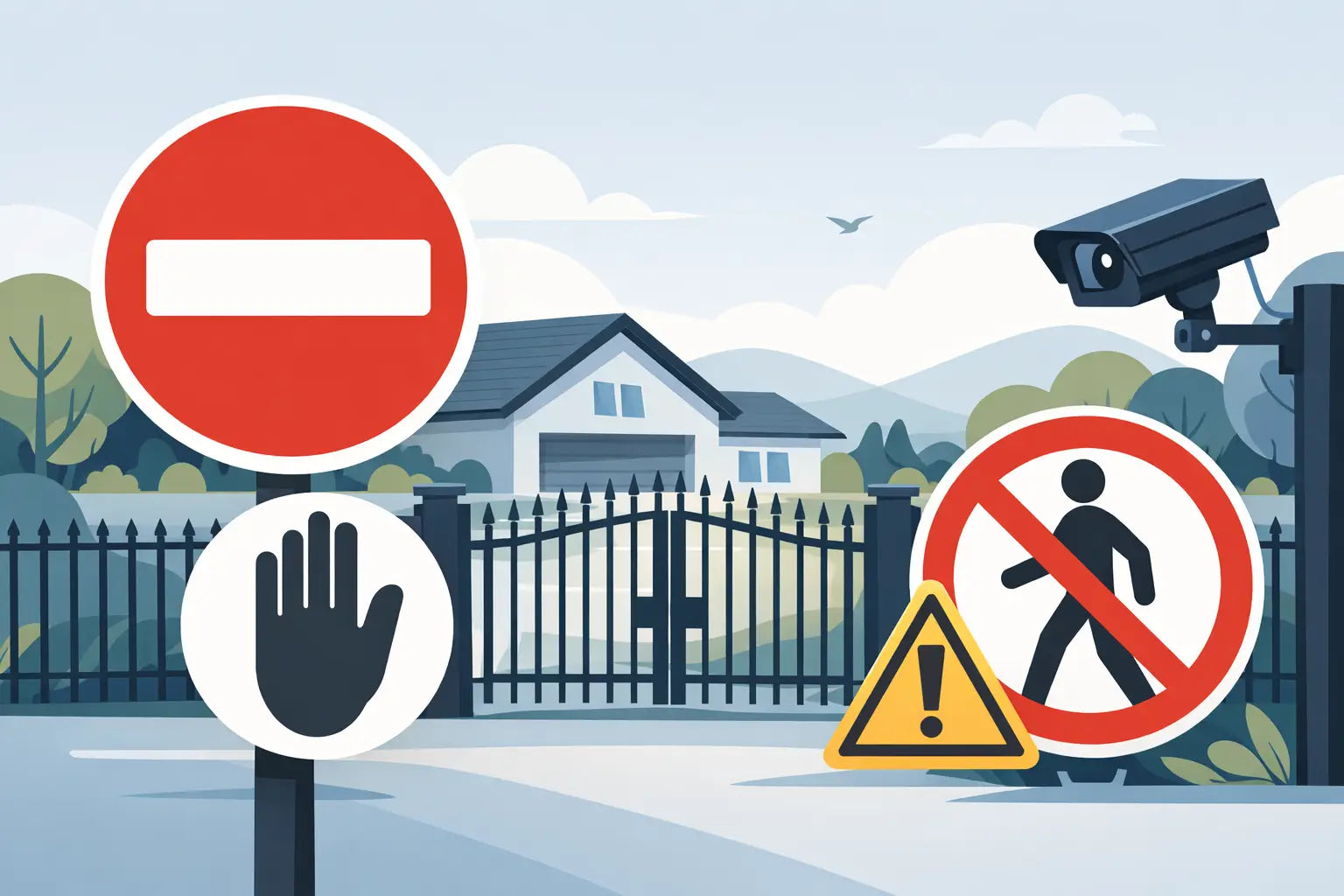
A gate left open, a yard used as a turning point, visitors wandering into staff-only areas - these are small access issues until they become a safety problem, a security breach or a liability question. That is why no entry signs for private property matter. They do a simple job, but in the right place and with the right wording, they help set boundaries clearly and early.
For site managers, landlords, farm operators and facilities teams, the value is practical. A clear sign tells people where they can and cannot go before a member of staff has to step in. It supports safer movement, reduces confusion and helps show that access controls were communicated properly.
What no entry signs for private property actually do
At the most basic level, these signs communicate restriction. They tell drivers, pedestrians, contractors or members of the public that a road, entrance, yard, corridor or open area is not for general access. In many settings, that message is enough to prevent accidental entry.
They also support wider site control. On commercial premises, a no entry sign can separate delivery routes from visitor areas. On industrial sites, it can help keep unauthorised people away from plant, loading zones or hazardous workspaces. On farms and estates, it can discourage casual access to land, tracks or working areas where vehicles, livestock or machinery are present.
A sign is not a substitute for physical security, trained staff or proper site management. But it does form part of a sensible control measure. If a route is restricted, that restriction should be visible.
When no entry signs for private property are needed
Some sites need these signs all the time. Others only need them at particular access points. It depends on who uses the space, what risks are present and how likely it is that someone could enter by mistake.
A warehouse with separate staff and visitor entrances is a straightforward example. If the wrong door is used, people may walk into forklift routes or storage areas. A private car park attached to offices may need signage at the entrance to stop misuse by the public. Residential landlords may use restricted access signs for service yards, bin stores or plant rooms. On farms, a private track may look public unless it is clearly marked.
The common thread is predictable confusion. If an entrance could reasonably be mistaken as open to everyone, signage is worth putting in place.
The wording matters more than many buyers expect
Not every restriction sign says the same thing, and that matters. "No Entry" is direct and widely recognised, but it may not always be enough on its own. In some cases, adding "Private Property", "Authorised Personnel Only" or "No Unauthorised Access" makes the instruction clearer.
The best wording depends on the problem you are trying to solve. If vehicles keep using a private roadway, a sign aimed at drivers is more useful than a general message. If visitors are entering a staff area, access restriction wording aimed at pedestrians may be the better choice. Where the concern is trespass onto private land, adding a clear reference to private property can remove ambiguity.
This is where buyers sometimes overcomplicate things. You do not need a paragraph. You need a message that can be understood at a glance, from the expected viewing distance, by the people most likely to approach the area.
Choosing the right sign format
Material, size and visibility have a direct effect on performance. A small sticker on a side gate may work for a low-traffic internal area. It will not do much at the entrance to a busy yard or roadside access point.
For outdoor use, durability comes first. Rigid aluminium, composite board or weather-resistant plastic are often the better fit where signs face rain, dirt and changing temperatures. In sheltered indoor settings, lighter-duty options may be perfectly adequate. If the sign is going onto glass, doors or smooth internal surfaces, self-adhesive formats can be useful. For fences, gates and perimeter points, rigid signs are usually easier to spot and keep in good condition.
Size should match approach speed and distance. A pedestrian entrance can often use a more compact sign. A vehicle entrance needs something larger and more readable from further away. There is no benefit in choosing the cheapest small sign if no one can read it until they have already entered.
Placement is where many access signs fail
A good sign in the wrong place is still a bad control. If it is mounted behind a hedge, on the inside of a gate, or too far from the decision point, it will not prevent entry. The sign needs to be seen before someone commits to the route.
For gates and vehicle entrances, that usually means placing it at eye level or driver sightline near the point of approach, not several metres beyond it. On larger sites, repeat signage may be necessary where there are multiple entry points or where one sign can be missed due to parked vehicles, fencing or poor angles.
Lighting and background also matter. A sign fixed against a cluttered surface can disappear visually, even if the print is technically clear. In lower-light areas, reflective finishes or stronger contrast may be worth considering. If the route is used early in the morning, late in the evening or during winter working hours, visibility should be judged in real conditions rather than in daylight only.
Compliance, liability and common sense
There is no single sign that solves every legal question around private land or restricted access. Still, clear signage supports a more defensible position when you need to show that boundaries, hazards or restricted zones were properly identified.
For employers and duty holders, that ties into broader responsibilities around health and safety, traffic management and access control. If members of the public, visitors or contractors could enter an area where they are not meant to be, warning and restriction signs are part of good site practice. They are especially relevant where unauthorised access could expose someone to moving vehicles, hazardous substances, live operations or other foreseeable risks.
It is also worth being realistic. If an area is genuinely high risk, signage alone is not enough. You may need barriers, locked gates, one-way systems, marked walkways or staff controls alongside the sign. The sign works best as part of a system, not as a standalone fix.
Matching the sign to the setting
Different sectors use no entry signage in different ways. On construction sites, it is often about separating active work zones from public or unauthorised access. In commercial premises, it may be more about staff-only areas, service corridors or delivery yards. In agriculture, the issue is often open land, private roads, machinery movement and livestock areas where members of the public may underestimate the risk.
That is why a sector-specific approach helps. The right sign for a retail service yard may not be the right sign for a farm gate or a school maintenance access. Buyers save time when signage is organised around the actual environment rather than treated as a one-size-fits-all purchase.
If you are ordering across multiple sites, consistency is worth thinking about too. Standard wording and sign styles make it easier for staff, contractors and visitors to understand restrictions quickly across your estate. It also simplifies procurement when replacements are needed at short notice.
What buyers should look for when ordering
The practical questions are usually the most useful ones. Will the sign be seen from the right distance? Is the material suitable for the environment? Does the wording match the access issue? Will it be fixed securely to the intended surface? And if you need ten, twenty or fifty signs across a portfolio, can you source them quickly without mixing formats that create inconsistency?
For many trade buyers, speed matters almost as much as specification. Damaged or missing access signs often need replacing quickly, especially after site changes, vandalism or handover works. That is where a supplier with a strong range, clear categorisation and trade-friendly pricing becomes valuable. At The Safety Sheep Store, the focus is on helping buyers find the right sign fast, with British-made products, bulk savings and straightforward online ordering.
No entry signage is simple by design, but choosing well still makes a difference. The right sign in the right place helps stop avoidable access issues before they start, keeps site rules visible and supports a safer, better-managed property. Think Safety - Think Sheep.
Share:
Choosing PPE Signs for Workplace Safety
Disabled Parking Signs UK: What to Buy