

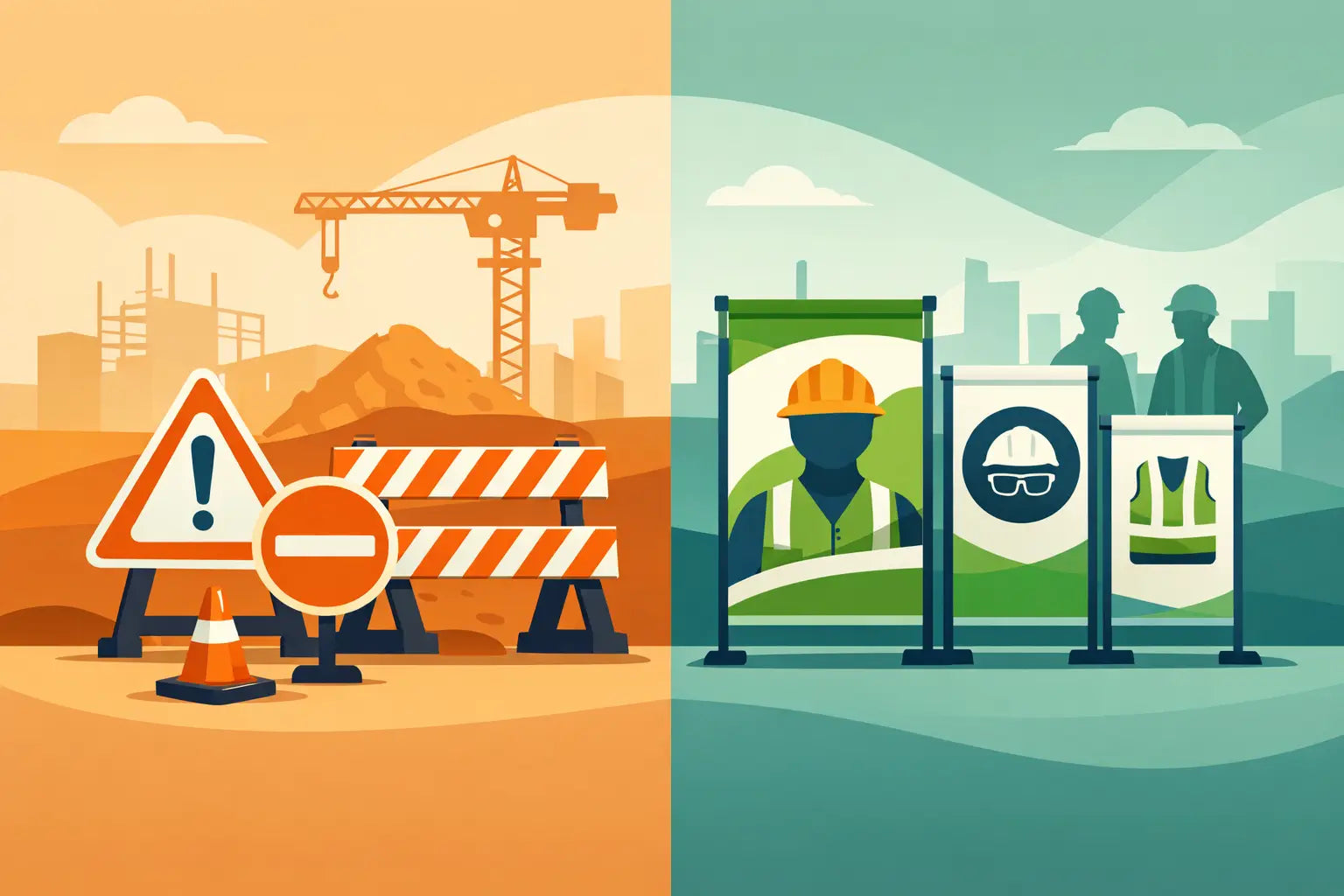
If you are weighing up construction signs vs safety banners, the real question is not which is better overall. It is which one suits the location, message, duration and risk level on your site. On a busy UK construction project, the wrong format can mean poor visibility, wasted spend or a message that does not stand up to weather, wear or compliance checks.
Some buyers default to rigid signs because they feel more permanent. Others go straight to banners because they cover more space and are easy to spot. Both have a place. The best choice depends on what you need people to notice, how quickly they need to understand it and how long the message needs to stay in place.
Construction signs vs safety banners: the core difference
Construction signs are usually rigid boards made from materials such as correx, aluminium composite or rigid plastic. They are designed for fixed display and tend to carry standard safety messaging, legal notices, site rules and hazard warnings. They work well where a clear, durable and formal sign is needed.
Safety banners are flexible printed displays, typically produced in PVC, mesh or similar banner-grade material. They are often larger than standard signs and are commonly used on fencing, scaffolding, hoarding and temporary barriers. Their strength is visibility across a wider area, especially where you need to communicate with workers, visitors or the public approaching from a distance.
That is the practical split. Signs are generally better for targeted, fixed-point communication. Banners are often better for broad, high-visibility messaging across larger perimeters.
When construction signs are the better choice
Rigid construction signs suit locations where the message needs to look formal, remain legible for longer periods and resist movement. Think access points, welfare units, first aid stations, fire points, mandatory PPE zones and plant movement areas. In these settings, a sign gives a clear and dependable visual reference.
They are also often the stronger option where compliance wording matters. Site safety boards, warning notices and prohibition signs usually need consistent presentation and easy reading at close to medium range. A rigid sign keeps its shape, is less likely to sag or flap in high winds and tends to feel more appropriate for fixed instructions.
There is also a maintenance advantage. Once mounted securely to a wall, gate, post or fence panel, a rigid sign usually needs very little attention. On long-running jobs or permanent operational areas, that matters. Fewer replacements mean less disruption and lower lifetime cost.
Where buyers sometimes go wrong is using small rigid signs to cover a large site perimeter. A sign may be compliant and durable, but if people cannot see it until they are almost at the gate, it may not do the job well enough on its own.
When safety banners make more sense
Safety banners come into their own when the message needs impact. If you want to mark a site boundary, reinforce site rules at scale or warn the public and contractors before they reach the entrance, a banner can do that far more effectively than a small sign.
This is especially useful on temporary fencing and hoarding. A banner can stretch across a wider section and carry bold text that is visible from a greater distance. Messages such as "Construction Site Keep Out", "All Visitors Must Report to Site Office" or PPE reminders are often easier to spot when presented on a larger format.
Banners also make sense for short to medium-term projects. They are quick to install with eyelets and ties, easy to move if site access changes and practical where layouts are evolving. If your perimeter shifts, or if one phase of a project gives way to another, replacing or repositioning a banner is often simpler than removing fixed boards and starting again.
That flexibility is useful, but it comes with trade-offs. Banners are more exposed to weather movement, and if they are not tensioned correctly they can become harder to read. They may also wear faster than rigid signs in rough, high-contact areas.
Visibility, distance and reading time
One of the biggest deciding factors in construction signs vs safety banners is how the message will be read. A person standing at a pedestrian entrance can take in a rigid sign with more detailed wording. A driver approaching a site boundary, or a member of the public walking past hoarding, usually needs a larger and simpler message.
That is why banners are often stronger for awareness, while signs are stronger for instruction. A banner can say "Danger Construction Site" in a way that catches attention early. A nearby sign can then provide the specific instructions - PPE requirements, site contact details, delivery procedures or emergency information.
In practice, many well-managed sites need both. The banner gets noticed first. The sign handles the finer detail.
Durability and site conditions
No site buyer wants to reorder because a product was wrong for the environment. Material choice matters as much as message design.
Rigid signs are generally better where there is repeated exposure to impact, rubbing, machinery movement or close-up handling. They suit gate areas, internal compounds and mounted positions where a flatter, harder-wearing display is an advantage. Depending on the material, they can offer good resistance to weather and a long service life.
Safety banners are often better where wind loading, fence coverage and temporary use are part of the brief. Mesh banners can help in more exposed spots by allowing airflow, while PVC can provide bold print quality in more sheltered locations. The right format depends on where the banner sits and how long it is expected to last.
A common mistake is choosing based on price alone. A cheaper option that fails early, fades quickly or becomes unreadable in poor conditions is rarely good value. For trade buyers, the better measure is cost across the job, including replacement time and the risk of poor communication.
Compliance and message type
Not every message belongs on every format. Standard health and safety symbols, prohibition notices, mandatory actions and hazard warnings often sit naturally on rigid signs because they follow familiar visual conventions and are frequently needed at specific points.
Banners are excellent for repeating high-level safety messages across a perimeter or site frontage, but they are not always the best place for dense content. If the wording is too long, people will not read it. If the text is too small, they will miss it altogether.
For that reason, banners work best when the message is brief, direct and bold. Signs work best where a site needs precision. If you need to display detailed instructions, multiple symbols or fixed legal notices, a sign is usually the safer choice.
Cost, quantity and buying efficiency
Commercial buyers also need to think about ordering efficiency. If you manage multiple sites, you may not want a one-format solution. Standard rigid signs can be easier to repeat across welfare areas, entrances and controlled zones, while banners can be reserved for external fencing and public-facing boundaries.
This mixed approach often gives better value than trying to force one product into every use case. It also helps when ordering in volume. Standard site messaging can be bought consistently across locations, while project-specific banners can be added where visibility needs are higher. For procurement teams, that means fewer compromises and clearer category purchasing.
At The Safety Sheep Store, this is where a practical product structure matters. Buyers need to find the right format quickly, compare options clearly and order with confidence, especially when same day dispatch and bulk save up to 35% can make a real difference on urgent or multi-site requirements.
So, which should you choose?
If the message is fixed, detailed, compliance-led and needs to stay put for the long term, choose a construction sign. If the message needs to be seen from further away, cover a wider area or adapt to a changing site layout, choose a safety banner.
If you need both visibility and detail, use both together. A banner on the perimeter and signs at the point of entry is often the most effective setup. It is not about choosing a winner in every case. It is about matching the format to the job.
The safest buying decision is usually the one that considers the site as people actually experience it - driving in, walking past, approaching gates, entering welfare areas and moving around hazards. Think about where attention starts, where instructions need to land and what the environment will do to the product over time.
Get that right, and your signage does more than fill a compliance gap. It helps the site run clearly, safely and with less avoidable friction. Think Safety - Think Sheep.
Share:
How to Choose Workplace Safety Signs
What Signs Are Required on a Building Site?