

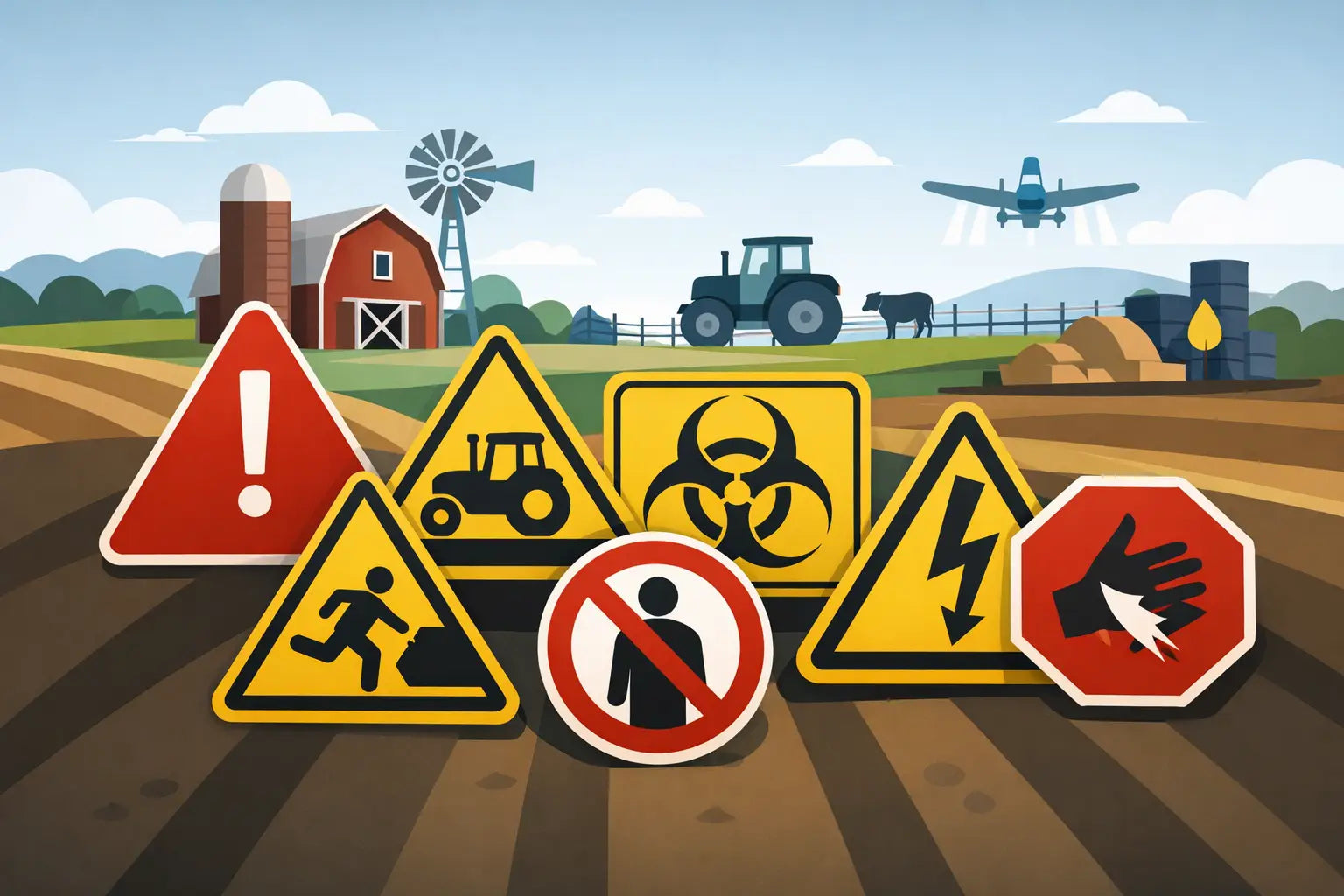
A farm can look calm from the gate, but the risks change fast once people move beyond it. Moving vehicles, livestock, chemicals, slurry, machinery and uneven ground all make the best farm safety warning signs a practical necessity, not a box-ticking exercise. Good signage helps protect workers, contractors, delivery drivers and members of the public while supporting a clearer approach to site safety across the whole holding.
On agricultural sites, one sign rarely solves the problem. Most farms need a mix of mandatory, warning and prohibition signage placed where decisions are actually made - at entrances, yards, workshops, chemical stores, livestock areas and private routes. The right approach is less about buying the biggest sign and more about choosing clear messages that match the hazard, the audience and the location.
What makes the best farm safety warning signs?
The best farm safety warning signs do three jobs well. First, they identify a real hazard without vague wording. Secondly, they are easy to read quickly, often from a vehicle or at a distance. Thirdly, they stand up to farm conditions, which means rain, mud, UV exposure and the general wear that comes with outdoor use.
For UK farms, compliance matters as much as clarity. Signs should follow recognised health and safety conventions so workers and visitors understand them at a glance. Symbols, colours and straightforward wording all help, especially on mixed-use sites where not everyone is familiar with agricultural hazards.
Material choice also matters. A sign fixed to an exposed gate on a windy yard has different demands from one used inside a feed store or workshop. If the sign will face weather, washdowns or heavy handling, durability is not an upgrade - it is part of the buying decision.
1. Warning: Agricultural Machinery Sign
Few farm hazards are as constant as vehicle and machinery movement. Tractors, telehandlers, combines and loaders create visibility issues, reversing risks and blind spots. A machinery warning sign is one of the most useful choices for entrances to yards, work zones and access routes shared with staff, visitors or contractors.
This type of sign works best when placed before people enter the hazard area, not after. If a driver has already turned into a busy yard before seeing the warning, the sign has done its job too late. On larger sites, repeating the message at key junctions can make sense.
2. Warning: Beware of Livestock Sign
Livestock areas need clear signage because risk levels can change by season, species and handling activity. Cattle, particularly cows with calves, can pose a serious risk to walkers, visitors and contractors unfamiliar with animal behaviour. Signs warning of livestock are especially important on farms with public footpaths, shared access or regular third-party visits.
The wording should be direct. In some cases, a more specific message such as warnings for bulls or aggressive livestock may be better than a generic notice. That depends on what is actually on site. Over-general signage can lose impact if every gate says the same thing regardless of the hazard beyond it.
3. Warning: Deep Water or Slurry Lagoon Sign
Slurry stores, lagoons, pits and tanks present one of the most severe hazards on a farm. The danger is not only drowning. Toxic gases, unstable edges and restricted rescue options make these areas particularly high risk. A clear warning sign is essential anywhere access is possible, including around fenced compounds and service routes.
These signs should be highly visible and combined with physical controls where needed. Signage is not a substitute for barriers, but it is a critical part of warning anyone approaching the area. Where there is contractor access, additional instructions may be necessary depending on the task.
4. Warning: Hazardous Chemicals Sign
From pesticides and fertilisers to fuels and cleaning products, farms often store substances that require more than informal labelling. A hazardous chemicals warning sign helps identify storage rooms, bunded areas, spray sheds and other controlled spaces where only authorised or properly equipped persons should enter.
The key trade-off here is between broad and specific messaging. A general hazardous substances sign is useful at the entrance to a store, but individual containers and certain areas may also need more precise hazard communication. If your operation includes several chemical classes, layered signage is often the better option.
5. Warning: Restricted Access Sign
Not every farm risk is tied to one obvious hazard. Sometimes the safer message is simply that access is controlled. Restricted access signs are useful for workshops, machinery sheds, grain stores, chemical areas and back-of-yard spaces where visitors should not wander.
This is particularly valuable on working farms that also receive customers, couriers, school visits or seasonal staff. Clear access control reduces confusion and supports your wider traffic and visitor management plan. It also helps avoid the common problem of people entering the wrong area because no sign told them otherwise.
6. Warning: Uneven Surface Sign
Farmyards and tracks are full of slip, trip and fall risks, especially during wet weather or busy periods. Broken concrete, drainage channels, loose stone, ramps and muddy surfaces all justify warning signage in the right setting. This matters not just for staff but for delivery drivers, service engineers and anyone arriving on site for the first time.
An uneven surface sign is most effective when it supports a known risk that cannot be eliminated immediately. If a route is permanently unsuitable for pedestrian traffic, it may be better to redirect people entirely rather than simply warn them. Signage should support site control, not replace maintenance.
7. Warning: High Voltage or Electrical Hazard Sign
Electrical risks on farms are often overlooked because they sit alongside more visible hazards such as vehicles and livestock. Yet generator rooms, plant areas, electric fences, switchgear and temporary systems all require clear marking. Electrical hazard signs are particularly important where contractors may attend site without full familiarity with the layout.
Placement matters here. Signs should appear at the point of access to the hazard, not buried among general notices on a distant board. If every message is concentrated in one place, urgent warnings lose visibility.
8. Mandatory PPE Signs for Farm Work Areas
Strictly speaking, PPE notices are not warning signs, but they are often part of the same buying decision because they sit alongside hazard signage in workshops, spray areas, handling zones and maintenance spaces. Eye protection, hearing protection, gloves, respiratory protection and safety footwear notices all play a role where specific tasks demand them.
The best results come from matching PPE signage to the real job. A generic "Wear PPE" message is less useful than a sign that tells people exactly what is required. That is especially true on farms where one building may be used for several purposes across the year.
9. No Unauthorised Entry Sign
Farms are workplaces, but many also attract casual visitors, walkers, trespassers or delivery traffic. A no unauthorised entry sign helps establish boundaries around operational areas and supports duty of care. It is especially useful at secondary gates, workshop doors, service yards and private tracks where people may otherwise assume access is acceptable.
This type of sign is also commercially sensible. When access rules are clearly displayed, staff spend less time redirecting visitors and the chance of accidental entry falls. On busier sites, that saves time as well as reducing risk.
10. Biosecurity and Hygiene Signs
For livestock units, dairies and poultry sites, biosecurity signage can be just as important as machinery warnings. Signs instructing visitors to report to reception, disinfect footwear, clean vehicles or keep gates closed help protect animal health and support operational control.
These signs need to be specific to the site. A broad hygiene message may be enough at the farm entrance, while individual buildings often need tighter instructions. If contractors and vets use the area regularly, clear biosecurity notices can prevent expensive misunderstandings.
How to choose the right farm warning signs for your site
The quickest way to buy the wrong signs is to think in categories alone. Start with the actual movement of people around the farm. Where do staff walk, where do visitors arrive, where do vehicles reverse, and where could someone unfamiliar with the site make a poor decision? Those are usually the points where signage has the most value.
It also helps to think in layers. Entrance signs manage first impressions and basic controls. Area signs warn about local hazards. Door and gate signs control access. Mandatory signs support safe behaviour once someone is already in the work area. A farm with livestock, machinery and chemical handling will usually need all four layers in some form.
You should also consider whether the sign is temporary or permanent. Seasonal lambing, harvest traffic or short-term maintenance works may justify temporary signage, while slurry storage, workshops and chemical areas usually need durable permanent signs. Choosing the wrong material can lead to premature fading, damage and replacement costs.
Placement matters as much as the sign itself
Even the best-made sign is ineffective if nobody sees it in time. On farms, signs are often fixed where there is spare space rather than where they are needed. The better approach is to place them at natural decision points - gates, forks in tracks, building entrances, loading areas and pedestrian routes.
Avoid clutter where possible. A gate covered in six notices can be harder to understand than one with two clear messages. If a location carries multiple hazards, prioritise the warnings that affect immediate behaviour. Additional information can sit nearby, but not at the expense of legibility.
For trade buyers ordering across multiple sites, consistency is worth paying attention to. Standardised wording and design make signs easier to recognise and simpler to replace. That helps staff who move between sites and streamlines future purchasing too.
Farm safety signage works best when it reflects the real risks of the job, not a generic checklist. If you choose clear, durable signs and place them where people need them most, you create a site that is easier to manage, safer to work in and simpler for visitors to understand. Think Safety - Think Sheep.
Share:
How to Signpost Emergency Exits Properly
Site Notice Board Guide for UK Workplaces