

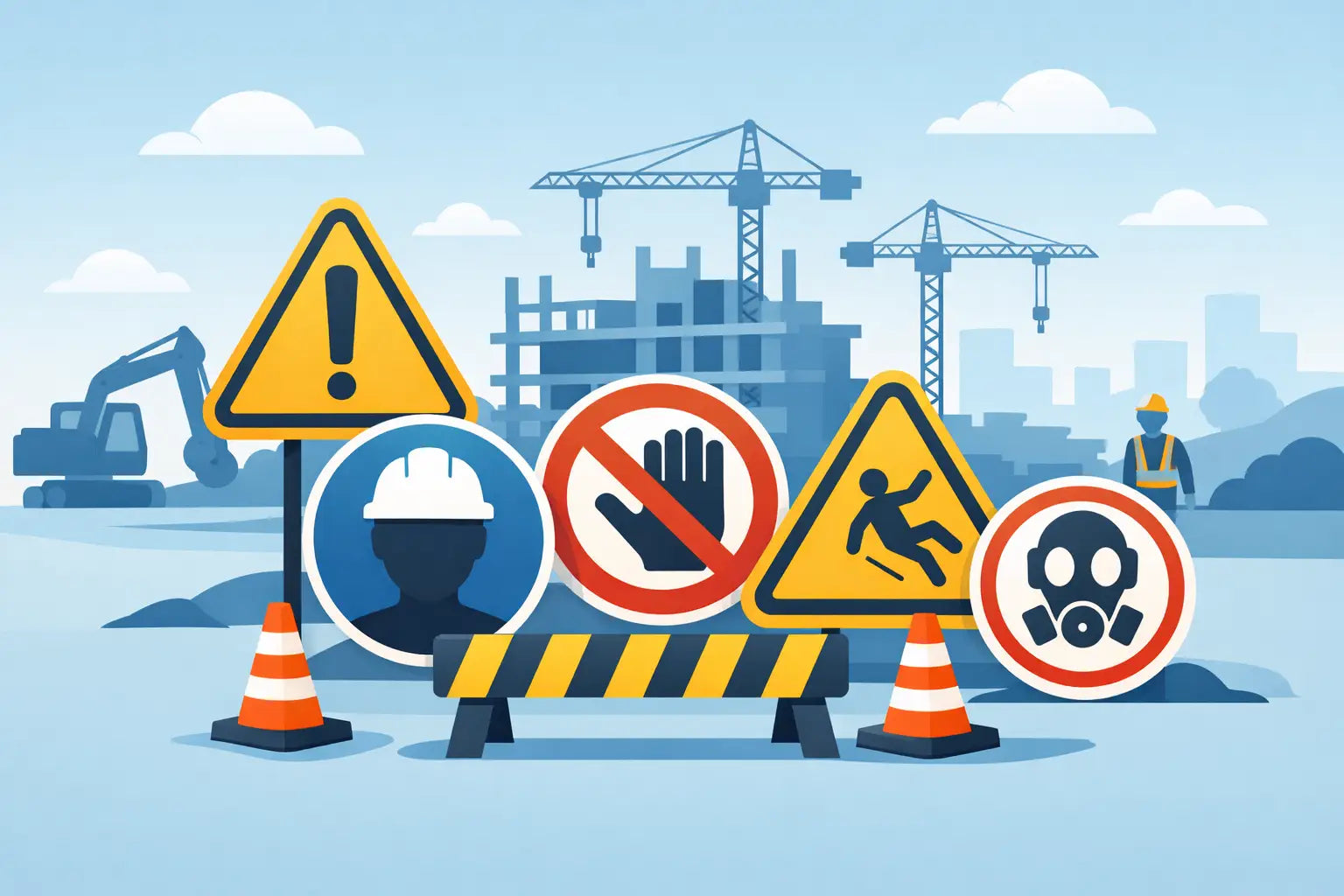
If a delivery driver can walk onto your site without seeing a single clear warning, prohibition or PPE instruction, your signage is already falling short. When people ask what signs are required on a construction site, the honest answer is not one fixed shopping list for every project. It depends on the hazards present, the layout, the stage of works and who needs to be protected - workers, visitors, contractors and members of the public.
That said, there are core sign types that appear on most UK construction sites because they support legal duties under health and safety law. Good signage does two jobs at once. It helps you communicate site rules quickly, and it shows that access, risk and emergency arrangements have been properly considered.
What signs are required on a construction site in the UK?
On most sites, you will need a combination of prohibition signs, mandatory signs, warning signs, safe condition signs and fire safety signs. You may also need traffic management signs, site information boards, access restriction notices and hazard-specific signs depending on the work being carried out.
The key point is that signage should reflect actual risk. A small refurbishment in a controlled internal area will not need the same sign package as a groundworks project beside a public footpath. Buying every sign available is not the aim. Choosing the right signs, placing them well and keeping them visible is what matters.
The core construction sign categories
Prohibition signs
Prohibition signs tell people what they must not do. On construction sites, the most common examples include no unauthorised entry, no smoking, no naked flames and no pedestrian access. These are especially useful at entrances, compound gates, welfare areas, fuel storage points and restricted work zones.
They are often the first line of control where public access is possible. If your site borders a road, school route or commercial premises, clear prohibition signage helps reduce the chance of someone wandering into danger and supports your perimeter control arrangements.
Mandatory signs
Mandatory signs tell people what they must do. This is where PPE signage usually sits. You will commonly see wear hard hats, wear high visibility clothing, wear safety footwear, wear eye protection and hearing protection must be worn.
These signs need to match the actual rules for that area. A generic PPE board at the gate can be useful, but it should not replace local signage where extra protection is required. If one section of the site needs respiratory protection or face protection, that instruction should be posted where the risk begins, not left to assumption.
Warning signs
Warning signs alert people to hazards they need to recognise before entering or passing through an area. Common examples on site include danger construction site, warning overhead work, deep excavations, hazardous substances, moving vehicles and high voltage.
These signs are particularly important where the hazard may not be obvious to a visitor or occasional contractor. A banksman may understand the traffic route from a briefing, but a visiting engineer arriving mid-morning may not. Good warning signage fills that gap quickly.
Safe condition signs
Safe condition signs point people towards emergency and welfare arrangements. These include first aid, emergency exit, assembly point, pedestrian route and eyewash station signs.
On a busy site, especially one with changing access routes, these signs are easy to overlook but hard to manage without. They become more important as site complexity increases, particularly where multiple trades, temporary cabins and segregated walkways are involved.
Fire safety signs
Fire action notices, fire exit signs, extinguisher ID signs and signs marking alarm points all have a place on many construction sites. Where hot works, temporary electrics, fuel, petrol cylinders or combustible materials are present, fire signage should be treated as essential rather than optional.
The exact mix depends on the fire risk assessment and the site set-up. A compact site cabin area needs a different approach from a multi-level project with temporary stair towers and designated escape routes.
Entrance signage is usually non-negotiable
For most projects, the main site entrance needs more than a single warning triangle. This is normally where you set out the site rules clearly for workers, visitors and delivery drivers before they enter.
A well-structured entrance sign or multi-message board often includes no unauthorised persons allowed, mandatory PPE requirements, site office directions, visitor reporting instructions and emergency contact details. Many sites also include speed limits, delivery instructions and a reminder that all accidents must be reported.
This is one of the simplest ways to improve control and reduce confusion from the start. It also gives inspectors, clients and principal contractors visible evidence that site access is being managed properly.
Hazard-specific signs depend on the work
This is where the answer to what signs are required on a construction site becomes more site-specific. Different trades and activities create different signage needs.
If excavation work is underway, barriers and signs warning of deep excavations or hidden services may be needed. If demolition is taking place, you may need notices warning of falling debris, dust hazards and exclusion zones. Where plant movements are frequent, signs for reversing vehicles, forklift routes, blind spots and pedestrian segregation become more important.
Electrical works may call for danger 110 volts, high voltage warnings or restricted access signage at temporary distribution points. Chemical use may require COSHH-related warnings, especially where substances are stored or mixed on site. Even simple temporary hazards such as wet floors, uneven surfaces or scaffolding alterations may justify short-term signage if the risk is not otherwise obvious.
Public-facing sites need stronger perimeter communication
Sites in town centres, near housing, schools, farms or public rights of way usually need more external signage than enclosed commercial projects. The public has not had your site induction. They do not know the traffic routes, lifting times or restricted zones.
In these cases, signs such as construction site keep out, danger overhead work, footpath diversion, beware of moving vehicles and children must not play on this site can all be relevant. The wording should be direct and easy to read at a distance.
You may also need site safety banners or larger-format boards where fencing lines are long or visibility is poor. If the message cannot be seen, it cannot do its job.
Temporary traffic and vehicle signs are often overlooked
A construction site with vans, lorries, telehandlers and pedestrians sharing space needs clear traffic management signs. These are not just for large civil engineering projects. Even smaller sites can become high-risk when visibility is limited and deliveries are frequent.
Signs for one-way systems, site speed limits, pedestrian walkways, loading bays, no parking areas and reversing vehicle warnings can help reduce avoidable incidents. Where a route changes as the project progresses, signs should be updated promptly. Out-of-date traffic signage can be as unhelpful as no signage at all.
Placement matters as much as the wording
A legally correct sign hidden behind stored materials is no use to anyone. Construction signage works best when it is placed at decision points - entrance gates, access routes, stair towers, welfare areas, compounds, plant zones and the edge of hazardous work areas.
It should also be durable enough for the environment. Outdoor boards may need rigid materials and weather-resistant printing. Internal temporary notices may only need short-term adhesive or lightweight display formats. The practical question is simple: will the sign still be readable after wind, mud, dust and a week of site activity?
Keep signage under review as the job changes
Construction sites are not static, and the signage should not be either. A sign package that was suitable at groundworks stage may be incomplete once scaffolding, hot works, internal fit-out or phased handovers begin.
Regular inspections should include signage checks. Look for damaged boards, missing notices, faded text, blocked views and messages that no longer match the actual risk. If the site rules have changed, the signs need to change too.
For procurement teams and site managers, this is where buying from a supplier with a broad, clearly organised range can save time. Instead of treating signage as a last-minute add-on, it is often more efficient to review likely site phases early and order accordingly. Think Safety - Think Sheep.
So, what signs are required on a construction site?
The practical answer is this: you will usually need entrance signs, prohibition signs, mandatory PPE signs, hazard warnings, safe condition signs and fire safety signs, with extra notices based on your site-specific risks. There is no one-size-fits-all pack that suits every project, but there is a clear expectation that hazards, rules, emergency arrangements and restricted areas are communicated properly.
If you are unsure where to start, begin with your risk assessment, traffic routes, fire arrangements and access controls. The right signs should make the site easier to understand at a glance, not cluttered for the sake of it. Clear, durable and relevant signage saves time, supports compliance and helps everyone on site make better decisions before a problem starts.
Share:
School Safety Sign Checklist
Fire Exit Sign Requirements UK Explained