

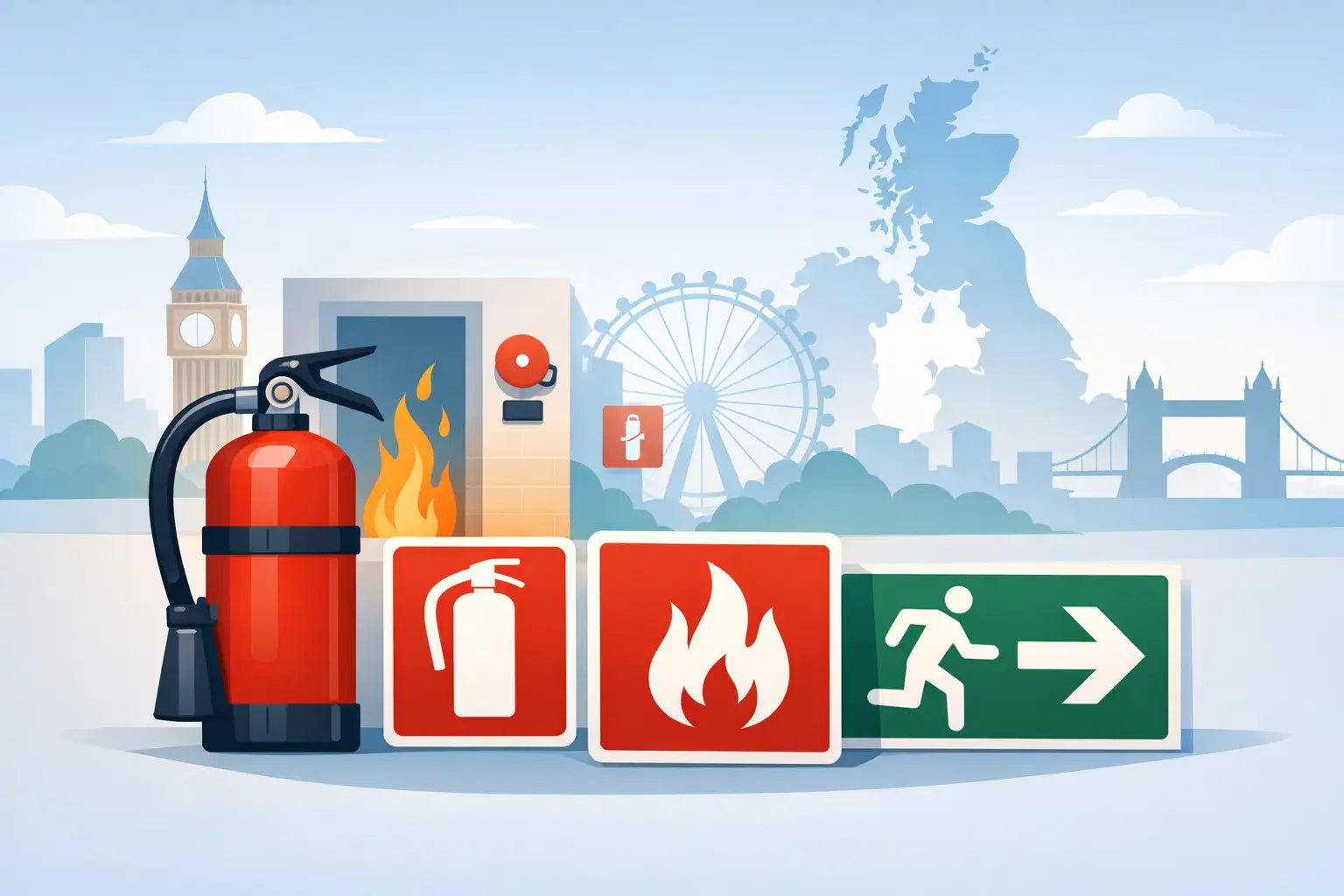
A fire extinguisher hidden behind a door, racking or office furniture is of little use in the first moments of a fire. If you are asking, what fire extinguisher signs do I need?, the practical answer is usually a clear sign that identifies the extinguisher, shows its intended use and makes its location obvious from a distance. The exact requirement depends on your fire risk assessment, your premises and how visible the equipment already is.
For UK workplaces, rental properties with communal areas, farms, retail units and construction sites, good extinguisher signage supports the responsible person’s wider fire-safety arrangements. It helps staff, visitors and contractors find the right equipment quickly, without guessing what is safe to use.
Start with an extinguisher identification sign
In most commercial settings, fit an extinguisher identification sign directly above, or immediately beside, each fire extinguisher. It should remain visible when the extinguisher is in its normal position. This is particularly important where appliances sit in corridors, store rooms, plant areas, warehouses, workshops or other locations where they can be obscured.
A suitable sign normally identifies the extinguisher type and explains which classes of fire it is designed for. It should also show any important limitations, such as a symbol indicating that a water extinguisher must not be used on live electrical equipment. The operating instructions on the extinguisher itself are still essential, but a wall-mounted identification sign is easier to see before someone reaches the appliance.
For a consistent, recognisable approach, use fire equipment location signs with the standard red background, white pictogram and clear extinguisher symbol. UK sites commonly use signs based on recognised safety-sign conventions, including BS EN ISO 7010 symbols. This gives employees and visitors familiar visual information, even where English is not their first language.
What fire extinguisher signs do I need for each type?
The sign must match the extinguisher actually installed. Never use a generic fire extinguisher notice above an appliance if it could cause somebody to select the wrong type during an emergency. Check the label and coloured band on every extinguisher, then order matching identification signs.
The most common requirements are:
- Water extinguisher signs for Class A combustible materials such as wood, paper and textiles. They should clearly show that water is not for flammable liquid or electrical fires.
- Foam extinguisher signs for suitable Class A and Class B risks, including some flammable liquids. Their limitations need to be clear where electrical hazards are present.
- CO2 extinguisher signs for electrical equipment and flammable liquid risks. These are common near server rooms, electrical cupboards, kitchens and machinery.
- Dry powder extinguisher signs for relevant Class A, B and C risks, depending on the extinguisher rating. Powder can reduce visibility and affect breathing, so it is not always the best choice for enclosed indoor areas.
- Wet chemical extinguisher signs for commercial cooking areas with cooking oils and fats. These are normally positioned alongside the correct kitchen fire-fighting arrangements, rather than used as a general-purpose extinguisher.
Do the coloured bands remove the need for a sign?
No. The coloured band identifies the extinguisher type once a person is standing beside it. A sign identifies the equipment and its purpose from farther away. It also provides a fixed reference point if the extinguisher is temporarily removed for servicing or has been placed in a cabinet.
Add directional signs where equipment is not obvious
An identification sign above the extinguisher is not always enough. If the equipment cannot be seen from the normal approach route, use a directional fire extinguisher sign with an arrow. This is useful in larger warehouses, long corridors, multi-storey offices, holiday parks, agricultural buildings, schools and public venues.
Directional signs are also sensible where extinguishers are kept inside cabinets, recessed cupboards or behind a door. The sign should guide a person towards the equipment before they reach the final location. Do not place an arrow sign where it could send someone through a smoke-filled or restricted area to retrieve an extinguisher.
Photoluminescent signs can be a worthwhile choice in areas where lighting may fail or visibility may be reduced. They are not a substitute for emergency lighting, and they must be charged by suitable ambient light to perform properly. However, they can give an additional visual cue during evacuation or a power failure.
Position signs for fast recognition
Mount extinguisher signs high enough to be seen over the appliance and nearby obstructions, but not so high that the text and symbols become difficult to read. Above the extinguisher is usually the clearest position. In high-traffic areas, make sure shelving, stacked stock, parked equipment or open doors cannot hide either the sign or the appliance.
Visibility matters more than simply ticking off a sign at every location. A red extinguisher against a red wall, for example, may be harder to notice. In that situation, a clear, contrasting sign and a sensible location improve the chance of rapid use. For open industrial sites, consider the line of sight from usual workstations, access routes and machinery operating areas.
Keep the sign, extinguisher and escape route information separate and easy to understand. A fire action notice tells people what to do if they discover a fire. Fire exit signs direct evacuation. Extinguisher signs identify fire-fighting equipment. All three may be needed in the same area, but they should not compete for attention or create clutter.
Check your fire risk assessment before ordering
There is no one-size-fits-all quantity of extinguisher signs for every building. The responsible person should use the fire risk assessment to determine the necessary fire-fighting equipment, its locations, the people who may use it and the information they need. Requirements can differ between a small office, a fabrication workshop, a farm shop and a large shared industrial unit.
As a practical rule, review your signage whenever you move equipment, alter a layout, change the work being carried out or introduce a new fire risk. A refurbishment can leave perfectly good signs pointing to empty brackets or outdated extinguisher types. That is confusing in an emergency and can undermine otherwise sound fire precautions.
Your fire extinguisher service visits are a useful prompt for this check. Confirm that each appliance remains in place, accessible, correctly labelled and paired with the right sign. Replace faded, damaged or obsolete notices promptly, especially in outdoor, damp, dusty or high-use environments.
Common mistakes to avoid
The most frequent mistake is treating every extinguisher as interchangeable. A CO2 unit by electrical equipment, a wet chemical unit in a commercial kitchen and a water unit in an office each need information that reflects their actual use. Generic notices can be better than no information, but matching signs are safer and clearer.
Another mistake is installing signs only at eye level beside the extinguisher. This can work in a small, uncluttered room, but it is less effective in a warehouse aisle or busy corridor. A higher location sign, combined with a directional sign where needed, gives better visibility.
Finally, signage does not make an unsuitable extinguisher suitable. Your fire risk assessment, extinguisher selection, maintenance regime, staff instruction and evacuation plan must work together. Fire extinguisher signs are one visible part of that system.
Quick questions from UK premises managers
Are extinguisher signs legally required above every extinguisher?
It depends on the premises and your assessment of visibility and risk. UK safety-sign duties require signs where they are needed to warn or inform people about a risk that cannot be adequately controlled in another way. In practice, clear identification signs above or beside extinguishers are widely used and are strongly advisable for most workplaces because they support quick recognition and correct selection.
Should temporary sites use fire extinguisher signs?
Yes, where extinguishers are provided. Construction sites, temporary events, mobile welfare units and seasonal agricultural operations can change quickly, so equipment locations need to be especially clear. Use durable signs suitable for the conditions and update them when cabins, access routes or work areas move.
Can I place several extinguisher signs on one board?
A fire point board can work well where several appliances are kept together in one clear location. Each extinguisher should still be identifiable, and the board must not imply that an extinguisher is present if it has been removed. Where appliances are spread around a site, individual signs and directional markers are normally the better choice.
Clear, correctly matched signage is a small purchase with a direct safety benefit. Review your fire points before the next inspection, replace anything unclear and keep your site easy to read under pressure. Think Safety - Think Sheep.
Share:
Do I Need Fire Door Signs? UK Rules Explained
Which Fire Safety Signs Are Required by Law?