

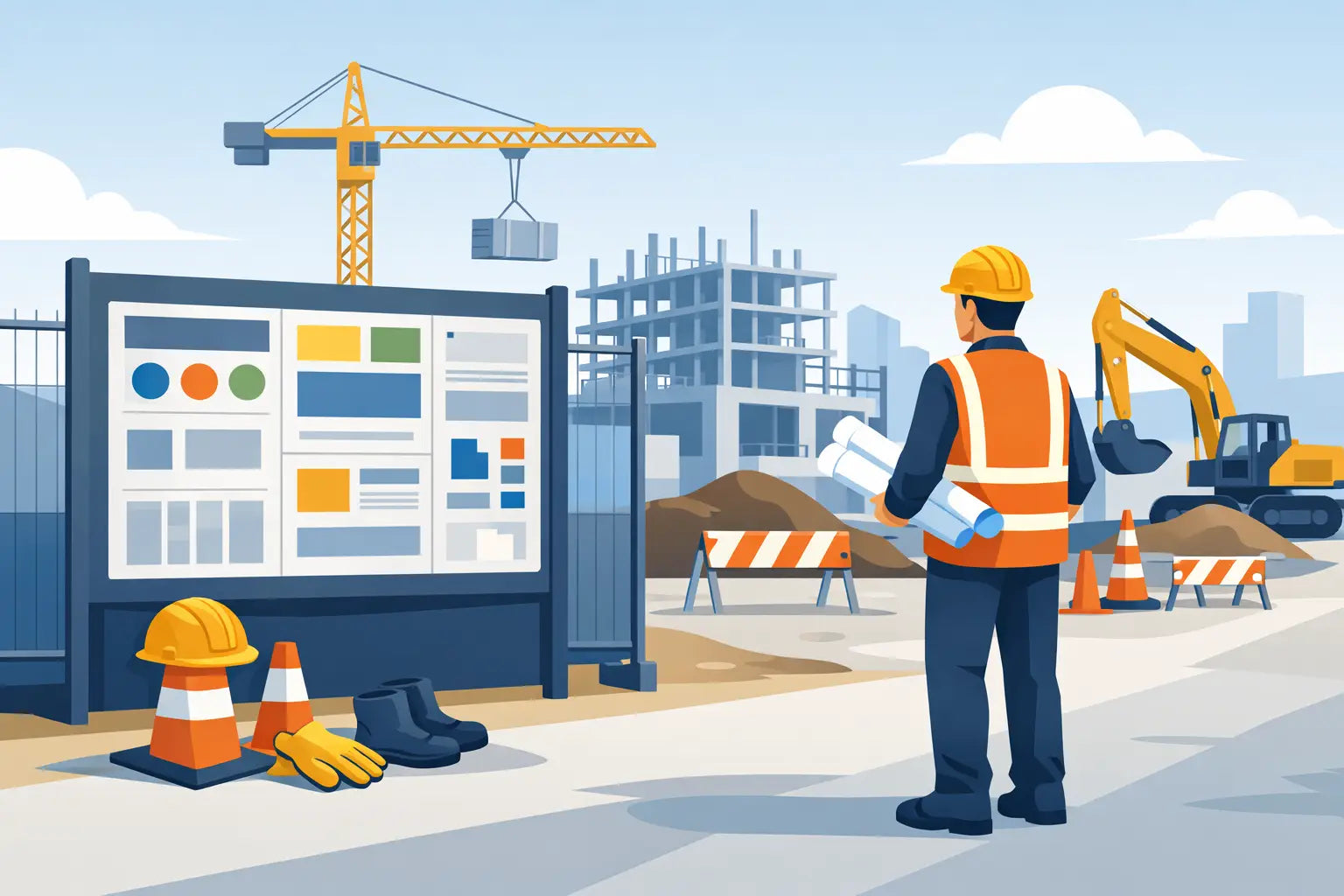
A missing site board is easy to overlook until a visitor walks onto the wrong access route, a delivery driver cannot find the office, or an inspector asks why key information is not clearly displayed. A good construction site board guide helps avoid that kind of scramble. On a busy UK site, boards do more than fill space on a fence line - they set expectations, support compliance and keep work moving.
For site managers, contractors and buyers, the real question is not whether you need a board. It is which board you need, what it should include and where it should go so it actually does the job.
What a construction site board is really for
A construction site board is usually a larger-format sign or grouped display panel used to communicate essential site information. That may include safety instructions, site rules, PPE requirements, contact details, directional information, public warnings or project identification. Some sites use one main board near the entrance. Others split information across several boards depending on layout, access points and public exposure.
The purpose is practical. Workers need clear instructions from the moment they arrive. Visitors need to know where to report. Members of the public need warning of hazards and restricted access. Emergency services may also rely on visible site information when time matters.
That means a site board is not just a branding panel with a company name and a logo. On many jobs, the branded hoarding board is separate from the operational safety board. Combining both can work, but only if the safety message remains clear and easy to read.
Construction site board guide: what to display
The right content depends on the type of project, who uses the site and how much public interface there is. A small private development will not need the same board setup as a city-centre commercial project with multiple contractors and daily deliveries.
In most cases, the main board should cover the basics first. Site rules, mandatory PPE, prohibition messages, emergency contacts and visitor instructions are usually the core. If there is a designated site office, welfare area, first aid point or fire point, directional signs may be just as important as the main information board.
You may also need to display principal contractor details, client information, working hours and out-of-hours contact information. On some projects, especially those with strong public visibility, complaint contact details and project references are included to help manage enquiries from neighbours or passers-by.
The mistake many buyers make is trying to put everything onto one board. If the text becomes crowded, smaller details get missed. A cleaner approach is often better: one primary site safety board, supported by separate hazard, direction and access restriction signs where needed.
The core sign types most sites rely on
The standard mix usually includes mandatory signs such as eye protection, hard hats, high-visibility clothing or safety footwear required. It often includes prohibition signs such as no unauthorised entry, no smoking or no pedestrians beyond a certain point. Warning signs may cover deep excavations, overhead loads, plant movement, asbestos, electricity or uneven ground.
There is also the information side. Think site office, visitors report to reception, first aider names, emergency assembly point and fire action instructions. On larger sites, directional boards become essential because a compliant sign at the gate is only useful if people can still find where they need to go.
Legal compliance and the "it depends" factor
There is no single board format that covers every legal obligation on every construction site. UK requirements depend on risk, layout, activities and who may be exposed to hazards. Health and safety law expects employers and duty holders to provide clear information, instruction and warning where required. Safety signs should support that duty, not replace supervision, induction or control measures.
That is why context matters. If your site has significant vehicle movement near public footpaths, external warning and direction signs carry more weight. If it is a closed site with controlled access, internal safety boards may do more of the heavy lifting. If several trades are on site, clear rule boards help maintain consistency across contractors.
A board should reflect actual site conditions. Generic wording that does not match the risks can create problems rather than solve them. If there is no crane on site, there is no point displaying crane warnings. If there is a live excavation zone, that risk should be visible. Inspectors and auditors notice when signage looks copied rather than thought through.
Choosing the right board size and material
A construction site board guide should always deal with durability, because the right message is no good if the board curls, fades or cracks after two weeks of weather. Board material should match the site environment and expected lifespan.
For shorter-term works, lighter rigid boards may be perfectly suitable, especially when fixed to temporary fencing or hoarding. For longer projects or exposed sites, stronger materials are often the better buy because replacement costs and downtime soon cancel out any upfront saving.
Printed banners can work well for perimeter messaging or branded hoarding where large coverage is needed. Rigid signs are generally better for rule boards and instruction panels where legibility matters. Lamination, UV resistance and weather tolerance are worth considering if the board will face direct sun, rain and site dirt for months at a time.
Size is just as important. A small board by a vehicle entrance may technically contain the right message while failing in practice because nobody can read it from the cab. The viewing distance, mounting height and likely audience all affect the right format.
Readability matters more than squeezing in extras
The best-performing site boards are usually simple. Strong symbol recognition, clear headings and enough white space make a bigger difference than clever design touches. Too much branding, too many colours or tiny blocks of text reduce impact.
If members of the public will see the board from a pavement or roadside, clarity becomes even more important. They are not standing still to study it. They are walking or driving past. The message needs to land quickly.
Where to position your site boards
Placement is where many otherwise good boards fall down. The front gate is the obvious starting point, but it is rarely enough on its own. Think about how people actually move through the site.
The main entrance should normally carry the principal safety information, visitor instructions and access restrictions. Delivery points may need separate driver guidance. Pedestrian entrances should have PPE and reporting instructions where relevant. Internal compound areas, scaffold access points, welfare units and plant routes may all need their own sign support.
Boards should be mounted at a height that suits the audience and not hidden behind open gates, stacked materials or parked plant. If a board is fixed to fencing likely to be moved, inspect it regularly. Temporary sites change quickly, and yesterday's clear location can become today's blind spot.
Night visibility can also matter. If workers arrive early or security teams attend out of hours, poor lighting can make a compliant board effectively useless. In those cases, reflective or well-lit positioning may be worth the extra thought.
Buying for one site versus buying at scale
A single-site order is usually about speed and getting the basics right first time. Multi-site or repeat buyers tend to need consistency, stock availability and sensible pricing across a wider sign package. The choice of supplier matters more when you are managing several live projects and cannot afford delays or mixed signage quality.
Standardisation helps. If every site uses the same layout for rule boards, emergency contacts and visitor reporting signs, workers and subcontractors spend less time figuring things out. Procurement teams also benefit because reordering becomes quicker and clearer.
This is where practical trade support counts. British-made signage, fast dispatch and bulk savings are not just sales points - they directly affect how quickly a site can stay compliant or recover from damaged and missing signs. For buyers under pressure, that matters. Think Safety - Think Sheep.
Common mistakes to avoid
The most common problem is treating the construction site board as a one-off purchase instead of a live safety control. Sites evolve. Access changes. New hazards appear. Contact names and numbers change. If the board is not reviewed, it goes out of date.
Another mistake is buying a board that looks substantial but lacks the right information hierarchy. A large branded panel can be useful, but it should not replace clear instruction and warning signage. Finally, there is the temptation to go too cheap on material. That can work for very short jobs, but on longer programmes it often means faded graphics, broken fixings and avoidable reorders.
A good board should be easy to read, relevant to the site, durable enough for the conditions and simple to update when details change. That is the standard worth aiming for.
When you are choosing site signage, think less about filling a fence panel and more about what people need to know the moment they arrive. The right board makes the site safer, easier to manage and easier to trust.
Share:
Where to Place CCTV Warning Signs
How to Place Fire Exit Signs Correctly