

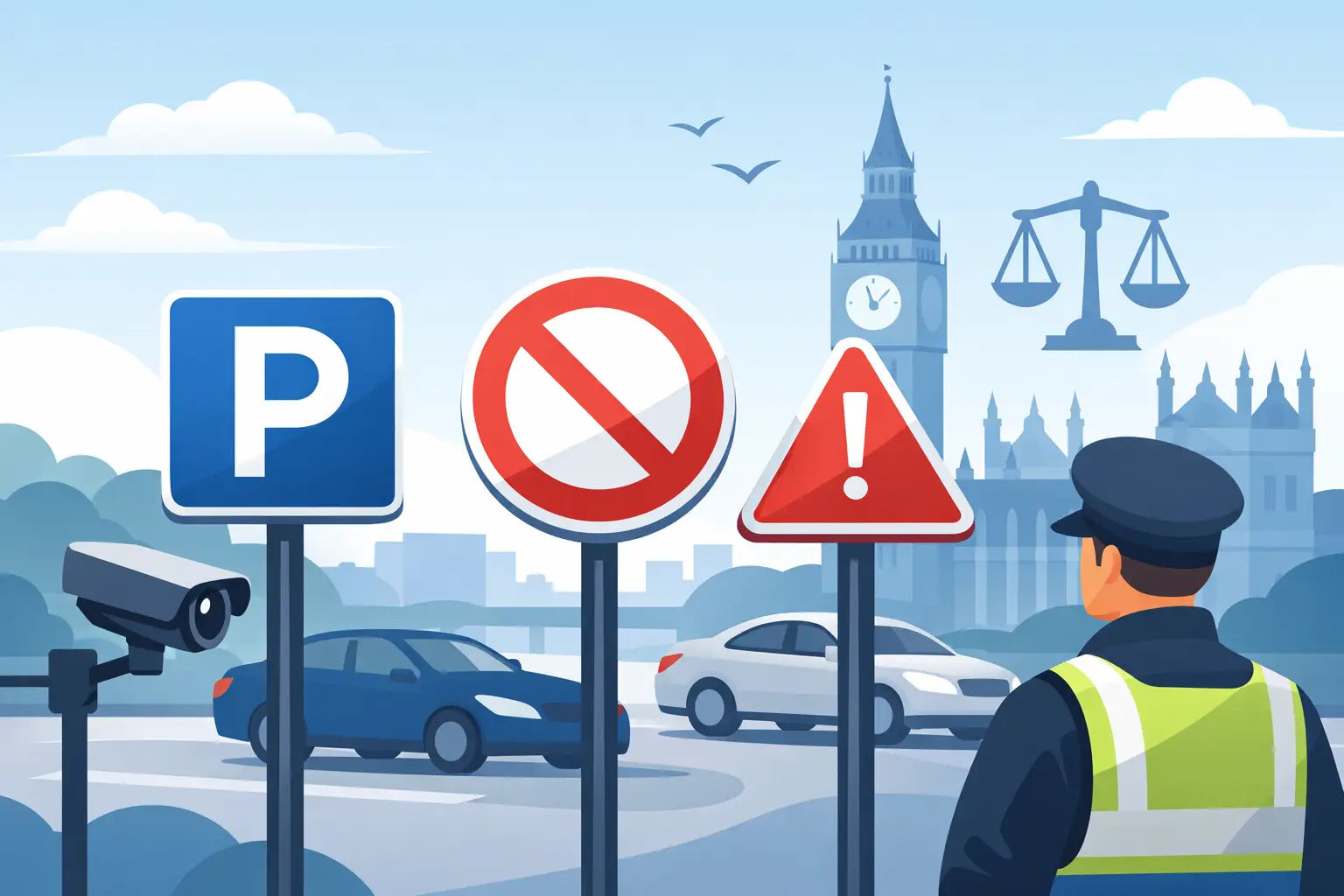
A faded "No Parking" board cable-tied to a fence might look the part, but appearance alone does not make it enforceable. If you are responsible for a private car park, service yard, farm entrance, staff bay or customer parking area, knowing which parking signs are enforceable matters because unclear signage leads straight to disputes, complaints and avoidable risk.
For most UK businesses and landowners, the real question is not just whether a sign exists. It is whether the wording, placement and legal basis behind it are strong enough to support the restriction you are trying to impose. That depends on where the sign is used, who is enforcing it, and whether drivers had a fair chance to understand the terms before parking.
Which parking signs are enforceable on private land?
On private land, parking signs are generally enforceable when they clearly set out the terms and conditions for using that land. In practice, this usually means the sign forms part of a contractual arrangement between the landowner or operator and the driver. If a driver enters and parks after seeing prominent terms, those terms may be relied on.
That sounds simple, but enforceability often falls apart on the basics. A sign hidden behind a hedge, mounted too high, printed in tiny text or positioned only after the vehicle has already entered is much harder to rely on. If a driver could not reasonably see the restriction before parking, enforcement becomes far less certain.
The wording matters as well. A sign that says "Permit holders only" or "No unauthorised parking" is clearer than vague wording such as "Parking control in operation" with no explanation of what that actually means. If there is a charge for breach, that charge should be stated plainly. If parking is limited to certain users, times or bays, those details should be easy to read at the point of decision.
Private parking signs are strongest when they are consistent across the site. Entry signs, repeater signs and bay-specific notices should all support the same message. Contradictions create room for challenge.
Public road signs are a different matter
A lot of confusion comes from mixing up private parking signs with official road traffic signs. On public roads, parking restrictions are normally enforced by local authorities or other authorised bodies under traffic regulation law, not by ordinary landowner signage.
Those signs and road markings must follow formal rules and approved designs. If you manage a private site, you cannot simply copy a council-style sign and assume it carries the same authority. A sign that looks official but has no legal basis may weaken your position rather than strengthen it.
This is why context matters. A "No waiting" sign beside a public highway sits in a very different enforcement framework from a "Customer parking only" sign in a retail forecourt. One relies on statutory controls. The other usually relies on private land terms.
What makes a parking sign more likely to hold up?
Enforceable parking signage is usually built on clarity, visibility and fairness. Those are the practical tests that matter most.
Clarity means the driver can understand what is allowed, what is prohibited and what happens if they ignore the restriction. If your site has reserved bays, disabled bays, loading areas, EV charging bays or staff-only spaces, each restriction should be stated in plain language. Overcomplicated legal wording rarely helps on site.
Visibility means signs are placed where drivers naturally look - at the entrance, near bays, beside access points and in any area where misuse is likely. It also means suitable size, readable font and enough contrast for the sign to be seen in real conditions, not just in a product photo. A dimly lit yard or winter afternoon changes what is readable.
Fairness is where many weak setups fail. If a driver has no realistic opportunity to read the terms before parking, enforcement is harder to justify. The same applies if the sign is misleading, contradictory or unreasonably punitive.
Which parking signs are enforceable when warning against trespass?
Some parking signs are intended less as a contract and more as a warning not to enter or stop at all. This often applies to gated compounds, farm tracks, emergency access routes, delivery yards and areas where unauthorised vehicles create a genuine safety issue.
Here, wording such as "Private land - no unauthorised parking" or "Keep clear - access required at all times" can still be useful and enforceable in a practical sense, especially when backed by physical controls, staff procedures or additional notices. But these signs do not all operate in exactly the same legal way as a pay-and-display car park sign offering parking on terms.
That distinction matters. A prohibitive sign may help show that a motorist had no permission to park, but enforcement options can differ depending on how the site is managed. If you need a parking regime that relies on charges or formal parking control, your signage and operating model need to reflect that from the outset.
Common reasons parking signs fail
Most enforcement problems do not start with a courtroom argument. They start with poor site setup. The sign may be accurate in theory, but weak in practice.
One common issue is poor placement. If the only terms sign is inside the car park rather than at the entrance, the driver may argue they parked before seeing any conditions. Another is inconsistent wording - for example, an entrance sign says "Visitors welcome" while bay signs say "Staff only". That kind of mixed message causes immediate problems.
Condition matters too. Damaged, dirty or faded signs are harder to rely on. So are temporary-looking notices fixed with tape or cable ties in a location that clearly needs a permanent solution. For active commercial sites, professional presentation supports credibility as much as compliance.
There is also the issue of scale. A large mixed-use site with multiple user groups often needs more than one sign type. A single generic parking notice cannot properly control service vehicles, disabled users, permit holders, customers and delivery access all at once.
Practical signage for landowners and site managers
If your goal is to reduce misuse and support enforcement, start with the site plan rather than the sign catalogue. Look at how vehicles enter, where decisions are made, and which bays or routes cause the most friction.
An entrance sign should establish the headline rule immediately. After that, use clear supporting signs for specific restrictions such as authorised vehicles only, no parking in front of roller shutters, loading bay limits, ambulance access, fire exit clearance or electric vehicle charging only. The closer the sign is to the actual restriction, the stronger the practical case that the driver was informed.
For workplaces, housing developments, farms and commercial yards, durability matters as much as wording. Outdoor signs need to stay legible through weather, mud, cleaning and day-to-day knocks. If signage degrades quickly, your enforcement position tends to degrade with it.
This is also where consistency helps procurement teams. Ordering matching UK-made parking signs in the right materials and sizes saves time later, especially across multi-site estates where mixed signage can create inconsistent enforcement standards. Think Safety - Think Sheep works as a simple principle here: buy once, install properly, and avoid preventable disputes.
Do you need more than signs?
Often, yes. Signs are essential, but they work best as part of a wider control system.
On some sites, line marking, bay numbering, permit systems, gates, bollards, ANPR monitoring or staff procedures are what turn a sign from a request into a workable rule. A sign alone may deter casual misuse, but if the area is under constant pressure - such as retail parking, residential overflow, contractor compounds or shared access roads - additional measures may be needed.
There is a trade-off here. More control can improve compliance, but it also increases management effort and may affect the user experience. A customer car park should not feel hostile. A hazardous yard, on the other hand, may need firm and highly visible restrictions. The right balance depends on the risks attached to the space.
A sensible standard to work to
If you are asking which parking signs are enforceable, the safest answer is this: the signs most likely to hold up are the ones that are clear, visible, site-specific and supported by a lawful enforcement approach. They should tell drivers exactly what applies on that land, in language they can read before they park.
That is the practical standard worth aiming for. Not signage that merely looks official, but signage that gives people fair notice, supports site safety and stands up to scrutiny when challenged. If your parking rules matter, the signs should do more than fill a fence panel. They should make your position obvious from the moment a vehicle arrives.
Share:
Parking Signs UK Buyers Actually Need
Chemical Hazard Warning Labels Explained