

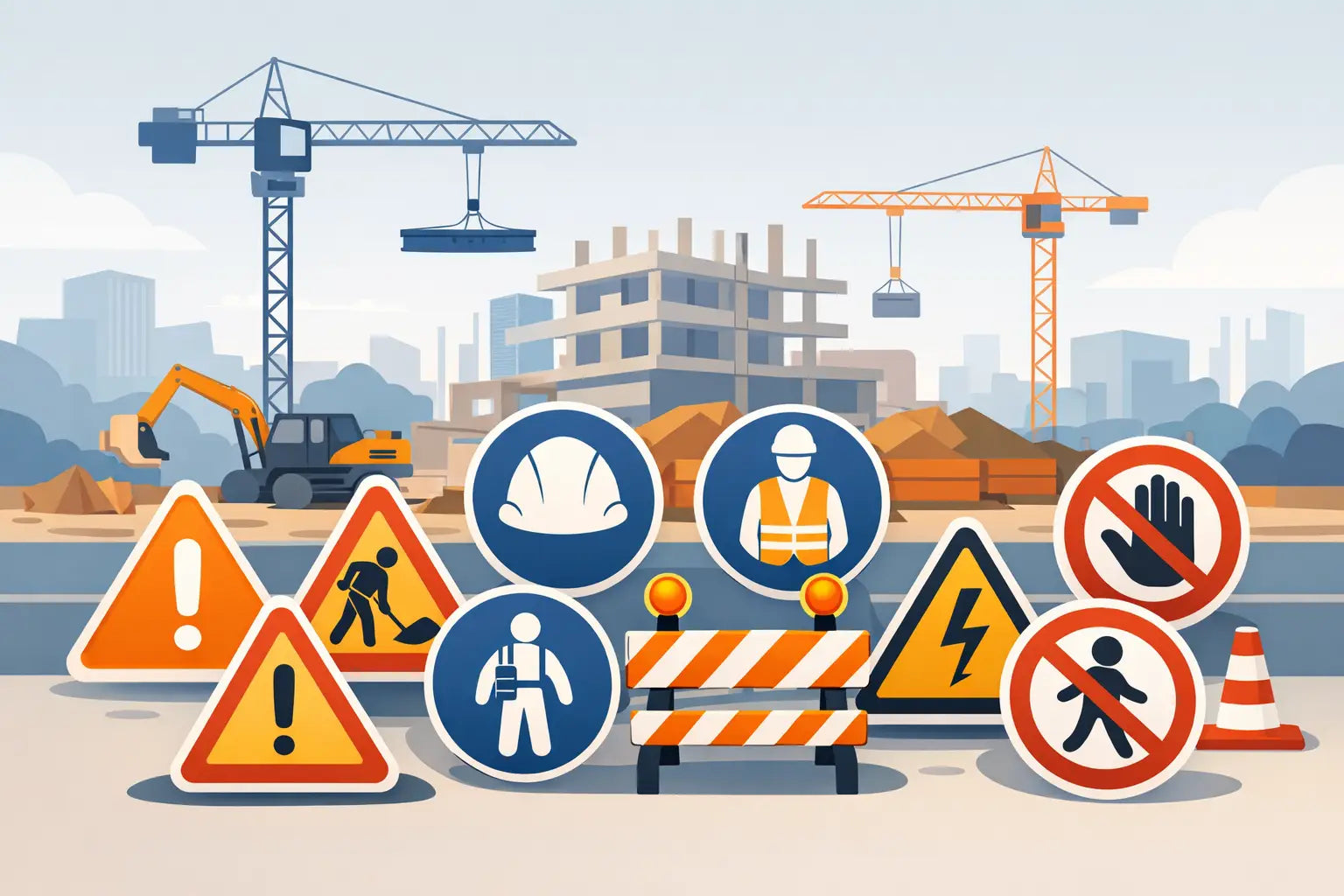
A building site can change by the hour. Deliveries arrive, access routes move, excavations open up, and new trades come onto site with very different risks. That is exactly why the best signs for building sites are the ones that do more than fill a fence panel - they give clear instruction, warn about live hazards and help you meet your duties without slowing the job down.
Good site signage is not just about having plenty of boards on display. It is about choosing the right messages, putting them where people will actually see them, and using durable materials that can cope with British weather, dust and hard use. For site managers, contractors and buyers, that usually means selecting a core set of signs that cover access control, PPE, hazards, traffic and welfare, then adding task-specific notices as the site develops.
What makes the best signs for building sites?
The best signage for a construction site is clear, compliant and suited to the environment. A cheap sign that fades after a fortnight or a notice hidden behind stacked materials does very little for safety. On a working site, visibility matters just as much as wording.
In practice, the best signs for building sites tend to share a few qualities. They use recognised safety symbols, straightforward language and strong contrast so workers, visitors and delivery drivers can understand the message quickly. They are made from materials suitable for outdoor use, and they are available in sizes that suit hoardings, gates, welfare areas and internal work zones.
There is also a commercial point here. Ordering the wrong mix of signs often leads to repeat purchases, patchwork compliance and delays when a principal contractor or visitor flags missing information. A well-planned signage pack is usually more efficient and better value than buying ad hoc.
1. Construction site entrance signs
If there is one sign category every site needs from day one, it is the entrance board. This is often the first point of contact for workers, subcontractors, inspectors and the public. It sets the tone for the whole site.
A strong entrance sign usually combines several messages in one place. It may identify the area as a construction site, restrict unauthorised access, list mandatory PPE requirements and provide instructions for visitors or deliveries. On many sites, this single board helps reduce confusion before anyone even passes the gate.
The trade-off is size and detail. A crowded sign with too much text can be ignored, especially by drivers arriving under time pressure. For that reason, larger entrance signs with a clear visual hierarchy often work better than trying to fit every site rule onto one small panel.
2. PPE mandatory signs
PPE signs are among the most important notices on any active building site. Hard hats, high-visibility clothing, safety footwear, eye protection and hearing protection requirements need to be obvious at the point of entry and wherever conditions change.
These signs matter because PPE rules are rarely uniform across the entire project. General access areas may require hard hats and boots as standard, while cutting zones, demolition areas or temporary workshops may need additional eye or ear protection. Posting the instruction where the risk actually exists gives workers a better chance of complying straight away.
For buyers, the practical decision is whether to use individual signs or combined PPE boards. Combined boards can save time and reduce clutter, but separate signs are often more flexible on larger sites where requirements vary by zone.
3. No unauthorised access signs
Building sites attract all sorts of unwanted access, from curious pedestrians to opportunistic thieves. Clear prohibition signage is essential for legal protection, site control and public safety.
Signs such as No Unauthorised Persons, Keep Out and Authorised Personnel Only are not decorative extras. They help define the site boundary and support your wider control measures, especially where fencing, gates and security patrols are already in place. If a site borders a public footpath, school route or retail area, these messages become even more important.
They are most effective when positioned consistently around the perimeter rather than only at the main entrance. A warning no one sees is not much of a warning.
4. Danger and hazard warning signs
Hazard warning signs do the day-to-day heavy lifting on a construction site. They alert people to specific risks such as deep excavations, overhead work, falling objects, electrical hazards and plant movement.
This is where site managers need to think carefully about relevance. Generic danger signs have their place, but targeted warnings usually perform better because they tell people exactly what to look out for. A sign warning of deep excavation near an open trench is more useful than a vague hazard notice several metres away.
The best approach is to review these signs regularly. Site risks move, and signage should move with them. Old warning boards left in areas where the hazard no longer exists can cause people to stop paying attention.
5. Site traffic and vehicle movement signs
Few risks on a building site are as serious as poor traffic management. Reversing vehicles, delivery wagons, dumpers and telehandlers all need space to move safely, and signage plays a central role in that control.
Vehicle movement signs can include speed limits, one-way systems, pedestrian routes, delivery directions and warnings for reversing plant. On larger projects, these are essential for separating foot traffic from moving vehicles. On tighter sites, they can help reduce confusion where space is limited and timings are compressed.
What works best depends on the layout. A compact urban site may need highly visible directional signs and gate instructions for drivers. A larger development may need repeated route markers across multiple access points. Either way, traffic signs should support the traffic plan, not try to replace it.
6. Fire safety signs
Temporary environments still need clear fire safety information. Fire assembly point signs, fire extinguisher identification, call point notices and emergency action instructions all help a site respond quickly if something goes wrong.
Fire risks can be high on building sites because of hot works, temporary electrics, fuel storage and changing internal layouts. Signage helps workers and visitors locate equipment fast, especially when they are unfamiliar with the site.
This is one area where consistency matters. If welfare cabins, temporary offices and partially completed structures all use different formats or poorly placed notices, people lose time when they most need clarity.
7. First aid and emergency signs
On a noisy, fast-moving site, nobody wants to waste time searching for the first aid point. Signs for first aid rooms, first aid kits, eyewash stations and emergency contact information are basic but essential.
These signs are especially useful for visitors and new starters who may not yet know the welfare layout. They also support compliance by making emergency arrangements more visible and easier to follow.
Where sites are spread across multiple compounds or floors, repeat these signs rather than assuming one notice in the cabin block is enough. Distance and line of sight make a real difference.
8. Welfare and hygiene signs
Building site safety is not only about immediate physical hazards. Welfare signage helps direct people to toilets, washing facilities, canteens, drying rooms and drinking water, while hygiene notices remind teams about hand washing and housekeeping standards.
These signs are easy to overlook when budgets are tight, but they improve site organisation and support a more professional working environment. They are particularly relevant on longer-duration projects, multi-trade sites and any location where client visitors may be present.
They also reduce interruptions. If drivers, subcontractors and agency workers can find facilities without asking, the site runs more smoothly.
9. Scaffold and ladder safety signs
Working at height remains one of the most closely watched construction risks in the UK. Scaffold inspection tags, ladder safety notices and access restriction signs are among the best signs for building sites where elevated work is routine.
These notices help confirm whether equipment is safe to use, who may use it and what precautions apply. They are not a substitute for inspection or supervision, but they do reinforce control measures in a way people can see immediately.
This is another area where timing matters. A scaffold that has been altered needs signage reviewed straight away. Out-of-date notices can create a false sense of security.
10. Multi-message site safety boards
Sometimes the best answer is not another single sign but a combined board that covers the main site rules in one place. Multi-message construction signs can include site safety requirements, PPE rules, access restrictions and warning text together.
For buyers managing multiple sites or urgent setups, these boards are often a practical choice. They simplify ordering, create a more consistent standard across projects and can be cost-effective when buying in volume.
The only caution is not to rely on them alone. They work well at entrances and shared areas, but local hazards still need local signage.
Choosing the right building site signs for your project
Not every site needs the same signage package. A housebuilding development, a city-centre refurbishment and a farm outbuilding project will all have different risks, access patterns and public exposure. The right mix depends on the work, the people on site and how often conditions change.
It also depends on speed. If you need signs quickly for a live project, reliable stock availability and fast dispatch matter just as much as the printed message. For buyers handling multiple locations, bulk pricing and consistent product quality can make procurement much easier. That is one reason many trade customers prefer a specialist supplier with UK-made signage and clear category structure rather than wasting time hunting across generalist sellers. Think Safety - Think Sheep.
The simplest way to get this right is to start with the non-negotiables: entrance signage, PPE instructions, access control, hazard warnings, traffic management and emergency information. After that, add site-specific notices for fire points, scaffolding, welfare and any higher-risk tasks. When signs are clear, durable and properly placed, they do their job quietly in the background - helping the site stay safer, more compliant and easier to run.
Share:
Health and Safety Signs Explained
Top 10 CCTV Signs for UK Business